

Free trading education
MCP University FREE
Crypto trading lessons in the order they make sense.
A free crypto trading course in technical analysis. The ParadiseTeam writes every lesson from its own trading since 2016, then sets them in tracks from a first chart to advanced methods. Education only, free to read.
- 143 free lessons
- 10 learning tracks
- Latest class 25 Sep 2026
Last opened on this device: a lesson
TrackReading market data
An AI summary of our own lessons
Reading market data
In short
Reading market data means seeing the live evidence of what traders are actually doing: price, news, sentiment, funding, open interest and large orders. It matters because it shows the market's mood and positioning, not just the story. Read each metric as one input in a wider picture, never a signal on its own, and confirm with price before you act.
If market data is new to you, I would start with why crypto falls, then how to read news without being played, then the Fear and Greed Index, before moving to futures, funding and open interest.
The learning path6 steps
- Why is crypto down?
Sets the base: dips usually have several causes at once, so you manage risk instead of panicking.
- Reading market news
Teaches you to use news for context and framing, never as an entry signal.
- Crypto Fear and Greed Index
Shows how to treat crowd sentiment as one input, not a buy or sell trigger.
- Perpetuals versus dated futures
Explains how perpetuals differ from dated futures, the ground for reading funding.
- Funding rates explained
Reads funding to see which way the leveraged crowd is leaning.
- Open interest
Pairs open interest with price to see whether fresh money fuels a move.
Education only, not financial advice.
10 learning tracks
Pick a track
Each track runs from its first lesson to its most advanced one, in the order the ParadiseTeam teaches it.
- Foundations of chart reading8 lessons1 h 37 min of readingBeginner to intermediate1How to read crypto charts2Support levels3Resistance levels
- Candlestick patterns13 lessons2 h 29 min of readingBeginner to intermediate1Doji2Shooting star3Hanging man
- Chart patterns23 lessons4 h 34 min of readingBeginner to advanced1What chart patterns predict2Rectangle3Ascending channel
- Indicators and divergences12 lessons1 h 58 min of readingBeginner to advanced1Which indicators matter2Momentum indicators3MACD
- Elliott Wave18 lessons3 h 51 min of readingBeginner to advanced1Elliott Wave basics2Five waves and the ABC correction3Impulse wave
- Fibonacci and harmonic patterns2 lessons23 min of readingIntermediate to advanced1Harmonic patterns2Gartley pattern
- Wyckoff and market cycles8 lessons1 h 15 min of readingBeginner to advanced1The Wyckoff method2The Wyckoff market cycle3Wyckoff schematics
- Risk management and trading psychology16 lessons2 h 5 min of readingBeginner to intermediate1Five risk mistakes2Position sizing math3Sizing under volatility
- Reading market data20 lessons2 h 17 min of readingBeginner to advanced1Why is crypto down?2Reading market news3Crypto Fear and Greed Index
- Signals literacy23 lessons3 h 4 min of readingBeginner to advanced1What crypto signals are2Reading entry, stop and target3Signals versus manual trading
The curriculum
Every lesson, in order
Pick a track, then read top to bottom. Reading times are rounded up, so most lessons take less.
A tick marks a lesson opened on this device. It is saved on this device only.
Foundations of chart reading8 lessons
Foundations of chart reading
8 lessonsRead any crypto chart calmly: candles, trend, support and resistance, and the habit of treating every read as a probability.
Start here
- 01How to read crypto chartsBeginnerGuide6 min
Levels
- 02Support levelsBeginnerClass14 min
- 03Resistance levelsBeginnerClass27 min
- 04Round numbers as levelsNewIntermediateGuide6 min
Strategy basics
- 05Beginner Bitcoin strategiesBeginnerExplainer8 min
- 06Trading styles overviewIntermediateGuide17 min
Trend
- 07Trendlines and the fan principleIntermediateClass11 min
Applied analysis
- 08Worked example: reading XRPIntermediateGuide8 min
Candlestick patterns13 lessons
Candlestick patterns
13 lessonsRecognise the candles that matter, understand the buying and selling behind them, and learn why every candle needs confirmation.
Single candles
- 01DojiBeginnerClass16 min
- 02Shooting starBeginnerClass14 min
- 03Hanging manBeginnerClass13 min
Two candle patterns
- 04Bullish engulfingBeginnerClass13 min
- 05Bearish engulfingBeginnerClass14 min
- 06Piercing lineIntermediateClass10 min
- 07Bullish counterattackIntermediateClass7 min
- 08Bearish counterattackIntermediateClass7 min
Three candle patterns
- 09Morning starIntermediateClass10 min
- 10Evening starIntermediateClass10 min
Continuation candles
- 11On neck patternIntermediateClass8 min
- 12Rising three methodsIntermediateClass13 min
- 13Falling three methodsIntermediateClass14 min
Chart patterns23 lessons
Chart patterns
23 lessonsLearn the shapes crowds repeat on the chart, how each one is confirmed, and exactly where the idea is proven wrong.
Start here
- 01What chart patterns predictBeginnerGuide7 min
Ranges and channels
- 02RectangleBeginnerClass14 min
- 03Ascending channelBeginnerClass14 min
- 04Descending channelBeginnerClass11 min
Triangles
- 05Symmetrical triangleBeginnerClass14 min
- 06Ascending triangleBeginnerClass12 min
- 07Descending triangleBeginnerClass13 min
Flags and pennants
- 08Bull flagBeginnerClass12 min
- 09Bearish flagBeginnerClass9 min
- 10PennantIntermediateClass13 min
Tops and bottoms
- 11Double topBeginnerClass9 min
- 12Double bottomBeginnerClass10 min
- 13Head and shouldersIntermediateClass11 min
- 14Inverse head and shouldersIntermediateClass13 min
- 15Triple topIntermediateClass13 min
- 16Triple bottomIntermediateClass14 min
Wedges and rounded patterns
- 17Rising wedgeIntermediateClass11 min
- 18Falling wedgeIntermediateClass12 min
- 19Cup and handleIntermediateClass14 min
- 20Inverse cup and handleIntermediateClass11 min
Advanced patterns
- 21Broadening triangle (megaphone)Also: Megaphone patternAdvancedClass10 min
- 22Diamond patternAdvancedClass14 min
- 23When patterns failAdvancedClass13 min
Indicators and divergences12 lessons
Indicators and divergences
12 lessonsUse indicators as filters, not triggers: momentum, MACD, RSI and divergences read alongside structure to judge whether a move has fuel.
Start here
- 01Which indicators matterBeginnerExplainer7 min
Momentum
- 02Momentum indicatorsAlso: Momentum indicators, a second guideBeginnerClass19 min
- 03MACDBeginnerClass10 min
- 04RSI and confluenceIntermediateClass9 min
Divergences
- 05Bullish divergenceIntermediateClass9 min
- 06Bearish divergenceIntermediateClass9 min
- 07MACD bullish divergenceIntermediateClass10 min
- 08MACD bearish divergenceIntermediateClass10 min
- 09Exaggerated divergenceAdvancedClass7 min
- 10Hidden divergenceAdvancedClass10 min
Confluence
- 11Moving averages confirm a bullish engulfingIntermediateClass9 min
- 12MACD confirms a bearish engulfingIntermediateClass9 min
Elliott Wave18 lessons
Elliott Wave
18 lessonsCount waves step by step, from the five wave impulse to complex corrections, and learn exactly when a count is invalid.
Foundations
- 01Elliott Wave basicsBeginnerClass18 min
- 02Five waves and the ABC correctionBeginnerGuide6 min
Motive waves
- 03Impulse waveBeginnerClass16 min
- 04Leading diagonalIntermediateClass14 min
- 05Ending diagonalIntermediateClass14 min
Simple corrections
- 06Zigzag correctionIntermediateClass13 min
- 07Flat correctionIntermediateClass14 min
Triangle corrections
- 08Contracting triangleIntermediateClass13 min
- 09Expanding triangleAdvancedClass12 min
- 10Skewed triangleAdvancedClass10 min
Complex corrections
- 11Double zigzagAdvancedClass12 min
- 12Triple zigzagAdvancedClass13 min
- 13Double threeAdvancedClass12 min
- 14Triple threeAdvancedClass10 min
Applying the count
- 15Common Elliott Wave mistakesIntermediateClass10 min
- 16Elliott Wave indicatorsIntermediateClass12 min
- 17Elliott Wave trading strategyAdvancedClass20 min
- 18Spotting reversals with Elliott WaveAdvancedClass12 min
Fibonacci and harmonic patterns2 lessons
Fibonacci and harmonic patterns
2 lessonsUnderstand the ratios traders watch and the harmonic shapes built from them, and treat every ratio zone as an area, never a promise.
Harmonics
- 01Harmonic patternsIntermediateClass13 min
- 02Gartley patternAdvancedClass10 min
Wyckoff and market cycles8 lessons
Wyckoff and market cycles
8 lessonsRead the supply and demand story inside trading ranges and market cycles, and wait for price to confirm it before acting.
Wyckoff foundations
- 01The Wyckoff methodBeginnerClass7 min
- 02The Wyckoff market cycleBeginnerClass8 min
Reading the range
- 03Wyckoff schematicsNewIntermediateClass10 min
- 04Wyckoff accumulationNewIntermediateClass7 min
- 05Wyckoff distributionNewIntermediateClass7 min
- 06Spring and upthrustNewAdvancedClass7 min
Cycles
- 07Distribution near market highsIntermediateClass13 min
- 08The altcoin market cycleIntermediateClass16 min
Risk management and trading psychology16 lessons
Risk management and trading psychology
16 lessonsSize every position so one loss stays small and survivable, and build the habits that keep decisions calm when the market is not.
Risk math
- 01Five risk mistakesBeginnerExplainer8 min
- 02Position sizing mathBeginnerGuide10 min
- 03Sizing under volatilityIntermediateExplainer7 min
- 04Planning leverageNewIntermediateExplainer7 min
- 05Lessons from liquidation cascadesIntermediateExplainer8 min
- 06Why averaging down hurtsIntermediateExplainer7 min
- 07The drawdown budgetIntermediateExplainer7 min
Stops and execution
- 08Choosing the right order typeBeginnerExplainer7 min
- 09SlippageNewBeginnerExplainer7 min
- 10Why stops keep getting hitIntermediateExplainer7 min
Process and psychology
- 11Keeping a trade journalBeginnerExplainer7 min
- 12The rule of exclusionIntermediateGuide7 min
- 13The focus market methodIntermediateGuide6 min
- 14The no trade dayNewIntermediateExplainer6 min
- 15Psychology over strategy (podcast)IntermediateExplainer11 min
- 16Think like the casino owner (podcast)IntermediateExplainer13 min
Reading market data20 lessons
Reading market data
20 lessonsLearn what funding, open interest, liquidations, sentiment, whales and headlines actually measure, so data informs your plan instead of driving it.
News and sentiment
- 01Why is crypto down?BeginnerExplainer7 min
- 02Reading market newsBeginnerGuide7 min
- 03Crypto Fear and Greed IndexBeginnerGuide7 min
- 04CNN Fear and Greed IndexBeginnerGuide5 min
- 05Did the headline move the price?NewIntermediateGuide6 min
- 06Buy the rumor, sell the newsNewIntermediateGuide6 min
Derivatives basics
- 07Perpetuals versus dated futuresBeginnerExplainer7 min
Funding rates
- 08Funding rates explainedBeginnerGuide8 min
- 09Funding rate regimesNewIntermediateExplainer6 min
- 10Funding rate flipsIntermediateExplainer6 min
- 11Funding and short squeezesIntermediateGuide7 min
- 12How professionals use fundingAdvancedClass6 min
- 13Funding case study: August 2026AdvancedGuide6 min
Positioning and liquidations
- 14Open interestIntermediateExplainer7 min
- 15Reading a liquidation mapIntermediateExplainer7 min
On chain and whales
- 16Reading whale alertsIntermediateGuide12 min
- 17Signals plus on chain dataNewIntermediateGuide6 min
- 18Reading DexScreener safelyIntermediateGuide8 min
Probability and prediction markets
- 19Odds are not a forecastNewIntermediateGuide7 min
- 20When prediction markets disagreeNewIntermediateGuide6 min
Signals literacy23 lessons
Signals literacy
23 lessonsKnow what a complete signal contains, how to follow one with sized risk, and how to vet any provider or bot before you trust it.
What a signal is
- 01What crypto signals areBeginnerGuide13 min
- 02Reading entry, stop and targetBeginnerExplainer8 min
- 03Signals versus manual tradingBeginnerGuide19 min
- 04Signals versus trading botsBeginnerExplainer8 min
- 05Anatomy of a complete alertIntermediateGuide9 min
- 06Squeezes and the four part entryIntermediateExplainer6 min
Using signals safely
- 07Signals with a small accountBeginnerGuide7 min
- 08Signals need money managementIntermediateGuide7 min
- 09Risk discipline for signal followersIntermediateGuide9 min
- 10Swing trading signalsIntermediateGuide7 min
- 11Altcoin signalsIntermediateGuide7 min
- 12Futures scalp signalsAdvancedGuide6 min
Vetting a provider
- 13Seven red flags of a signals scamBeginnerExplainer7 min
- 14Choosing a Telegram channelBeginnerGuide8 min
- 15Free versus paid signalsBeginnerExplainer7 min
- 16Verifying signal resultsIntermediateGuide6 min
- 17Which providers are legitIntermediateGuide8 min
- 18Judging a service by its risk managementIntermediateGuide7 min
- 19Fit and proper tests for providersNewAdvancedExplainer8 min
- 20Regulatory capital and provider riskNewAdvancedGuide7 min
Automation and AI
- 21What ChatGPT can and cannot doNewBeginnerGuide6 min
- 22Evaluating a trading botIntermediateGuide7 min
- 23AI crypto signalsNewIntermediateGuide7 min
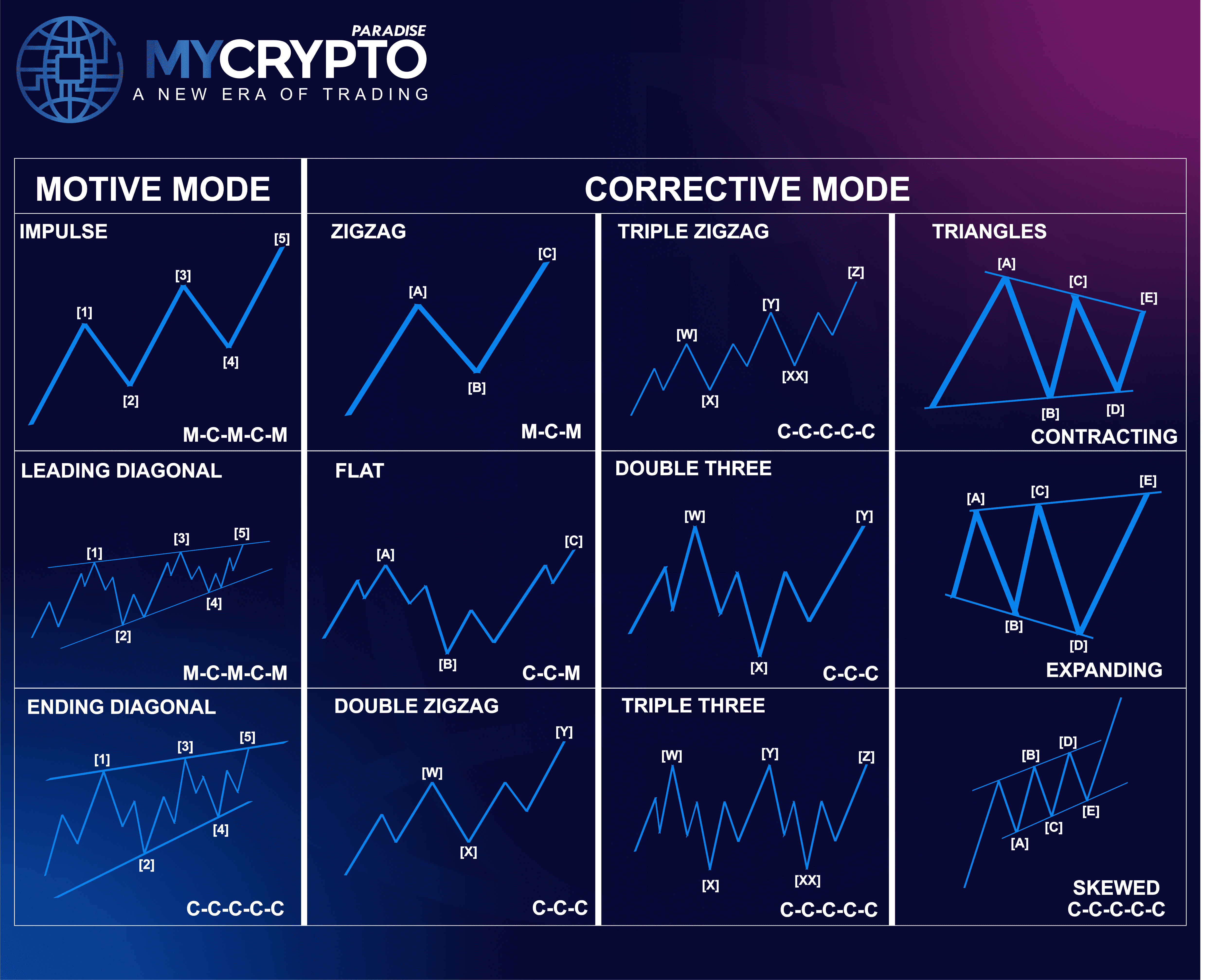
Cheat sheet
Every Elliott Wave structure on one chart
The motive mode on the left, the corrective mode on the right. Each structure shows its internal count, so a pattern on a live chart can be checked against the map.
- Impulse and both diagonals
- Zigzags, flats and their doubles and triples
- Contracting, expanding and skewed triangles
Fresh from the ParadiseTeam
Latest classes
 Wyckoff and market cyclesWyckoff schematics25 Sep 202610 min read
 Wyckoff and market cyclesSpring and upthrust22 Sep 20267 min read
 Wyckoff and market cyclesWyckoff distribution19 Sep 20267 min read
 Wyckoff and market cyclesWyckoff accumulation19 Sep 20267 min read
 Wyckoff and market cyclesThe Wyckoff method4 Sep 20267 min read
 Wyckoff and market cyclesThe Wyckoff market cycle4 Sep 20268 min read
Live market readings
Put the lessons to work
Live tools that show the market as it is right now. Each one is context for a plan, never a signal on its own.
- FreeMCP InsightsWhich live market-data reading answers my question right now?Open
- FreeCrypto Fear and Greed IndexIs the crowd fearful or greedy right now, and is it at an extreme?Open
- FreeFunding Rates and Squeeze ProbabilityWhich side of the market is paying to hold its position right now, and how likely is a squeeze?Open
- FreeCrypto Whale Alert and TrackerIs large money leaning one way right now, and how much weight does that deserve?Open
- FreeBitcoin Order Book WallsWhere are the large buy and sell walls that price may stall at or be drawn toward?Open
- PRO ParadiserAI Indicators by MCPReady made TradingView indicators by the ParadiseTeam. The first one comes with PRO Paradiser.Open
Who teaches here
Written from the ParadiseTeam’s own trading
- Since 2016
MyCryptoParadise has operated since 2016 and was incorporated as MyCryptoParadise s.r.o. in Prague in 2025. The lessons come from that trading.
The story, from founder Simon Mach - One standard
Every lesson follows the same published editorial standard, from sourcing to the risk line at the end.
Read the editorial standards - A public record
The ParadiseTeam publishes its own signal record, verified trade by trade with the losing trades left in.
See the verified record
Questions
About MCP University FREE
What is MCP University FREE?
MCP University FREE is the free trading education library of MyCryptoParadise: a free crypto trading course in technical analysis with 143 lessons in 10 tracks, from reading a first chart to Elliott Wave, Wyckoff, market data and risk management. The ParadiseTeam writes the lessons from its own trading, and each track is ordered so one lesson prepares the next.
Is MCP University FREE really free?
Yes. Every lesson and track in MCP University FREE is free to read, with no account and no payment. Most tools linked from the answers are free, and any paid one is labelled PRO Paradiser or ParadiseFamilyVIP. Paid memberships exist for traders who want more, but no lesson in this library is locked behind them.
Where should a beginner start?
Start with the Start here path: how to read a crypto chart, support and resistance, the first candlestick patterns, what chart patterns really predict, and how to size a position so one loss stays small. After that, pick the track that matches the question on your mind and follow its lessons in order.
How does the Ask box work?
Type a topic or a question, for example Elliott Wave or RSI divergence. The answer is an AI summary of our own lessons, written in advance from those lessons and checked by automated rules before it is published. It lists the lessons to read in order, plus tools that help to apply the idea, each labelled Free or paid. It never predicts prices.
Who writes the lessons?
The ParadiseTeam, the analysts behind MyCryptoParadise, which has operated since 2016 and was incorporated as MyCryptoParadise s.r.o. in Prague in 2025. Every lesson follows one editorial standard: plain language, a clear risk frame, sources where a claim rests on outside facts, and updates when the market or the method changes.
Is this financial advice?
No. MCP University FREE is education only and never personal financial advice. Crypto trading involves substantial risk of loss, and every lesson treats a chart read as a probability, not a certainty. Learn the method, practise it on small size or on paper, and decide for yourself what fits your own situation.
Free, on Telegram
Keep learning, one class at a time.
New classes also land in the MCP University FREE channel on Telegram.
When the timing is right, seats in ParadiseFamilyVIP open by application.