



In short: Market structure reads price through meaningful swing highs and lows. A Break of Structure signals continuation with the trend. A Change of Character warns of a possible shift against it. Neither confirms a reversal, so context and invalidation still matter.
Here is the core idea first. A Break of Structure (BOS) usually means the trend continues. A Change of Character (CHoCH) warns that it may be turning. Both read price through swing highs and swing lows, and neither guarantees the next move.
This lesson sits in the technical analysis track at MCP University FREE. MyCryptoParadise has run a professional crypto signals and trading-education service since 2016. We keep risk and uncertainty central to every interpretation.
Swing highs and swing lows: the building blocks
Market structure is the sequence of meaningful swing highs and swing lows on a chart. These turning points describe whether price advances, declines, or moves sideways. They observe behaviour. They do not predict.
A swing high is a local peak where an advance pauses and price turns lower. A swing low is a local trough where a decline pauses and price turns higher. The exact candle pattern can vary by method and timeframe.
The most useful swings are clear and relevant to the move you study. Marking every tiny fluctuation clutters the chart. Start with the pivots that visibly shape the current sequence.
Swing points also create reference areas for support and resistance. When a prior high or low aligns with a broader level, that area may deserve attention. For plain-English definitions of these basics, Investopedia is a useful external reference.
Uptrend, downtrend and range: HH/HL vs LH/LL
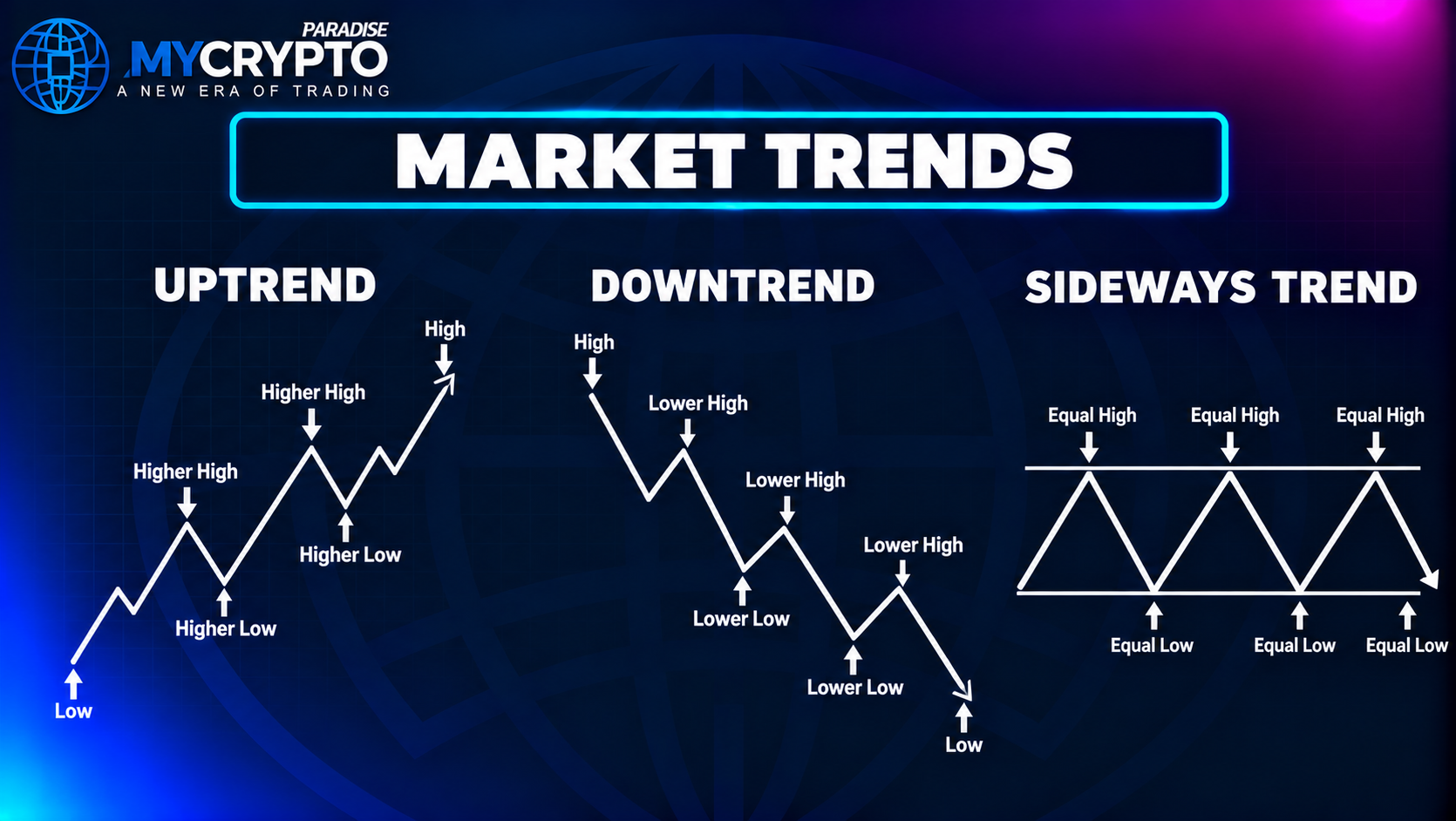
An uptrend commonly forms higher highs (HH) and higher lows (HL). A downtrend commonly forms lower highs (LH) and lower lows (LL). A range lacks a consistent sequence and drifts between fairly stable boundaries.
How an uptrend develops
In an uptrend, buyers push price beyond a previous swing high. Price then pulls back and forms a higher low. If price breaks the prior high again, the sequence supports bullish structure. A pullback does not automatically end the trend.
How a downtrend develops
In a downtrend, price falls below a previous swing low, rebounds to a lower high, then declines again. The sequence suggests sellers hold pressure. A rally can stay corrective while lower highs and lower lows keep forming.
When the market is ranging
In a range, price repeatedly crosses minor highs and lows without a durable direction. A break of one small pivot may not change the larger picture. Compare the move with the range boundaries and timeframe first.
Market mood can sharpen this read. A crowded, one-sided tape often shows in sentiment data, so a quick look at the market fear and greed gauge adds context. No single reading decides structure.
Break of structure (BOS): the trend continues
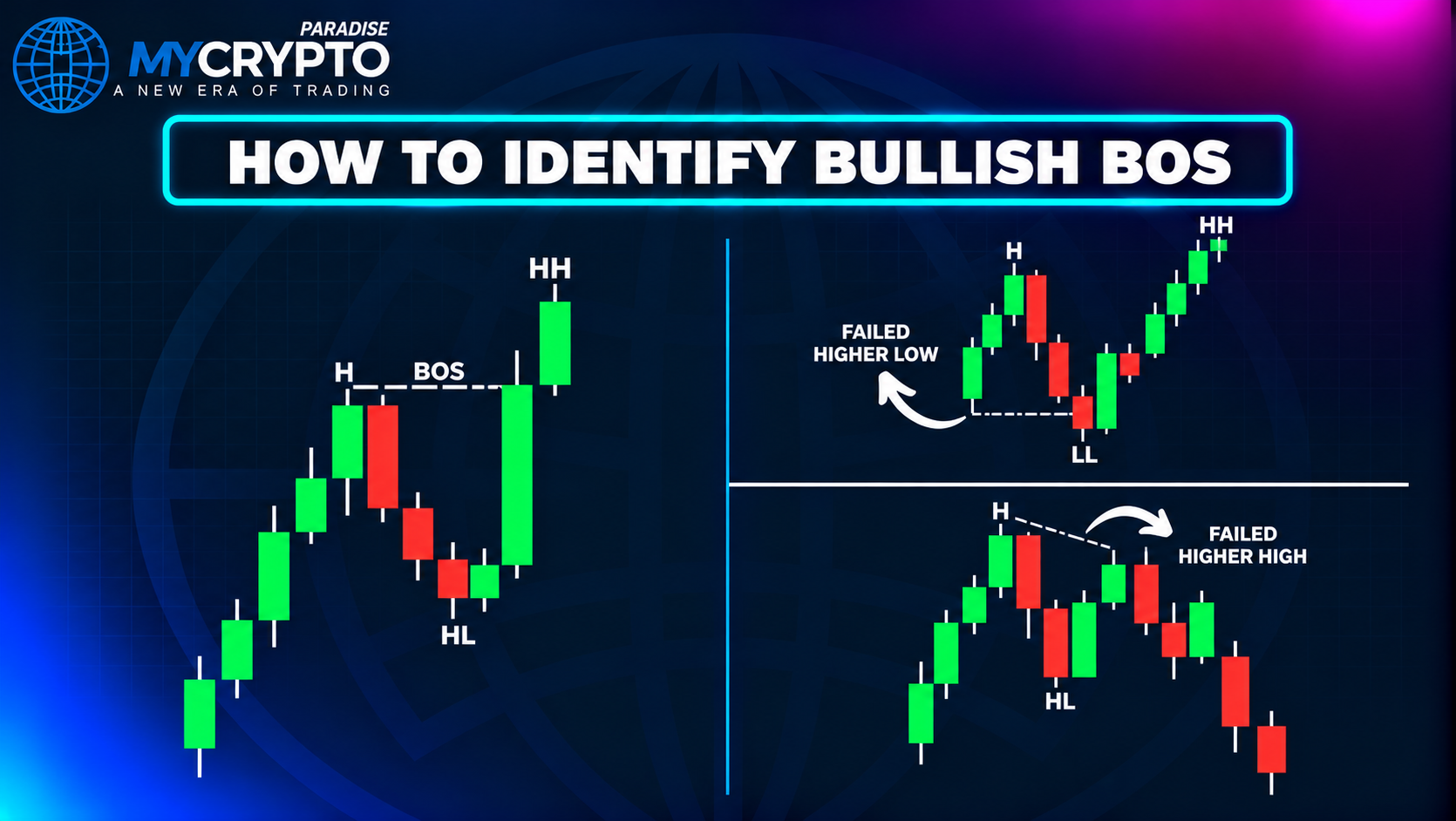
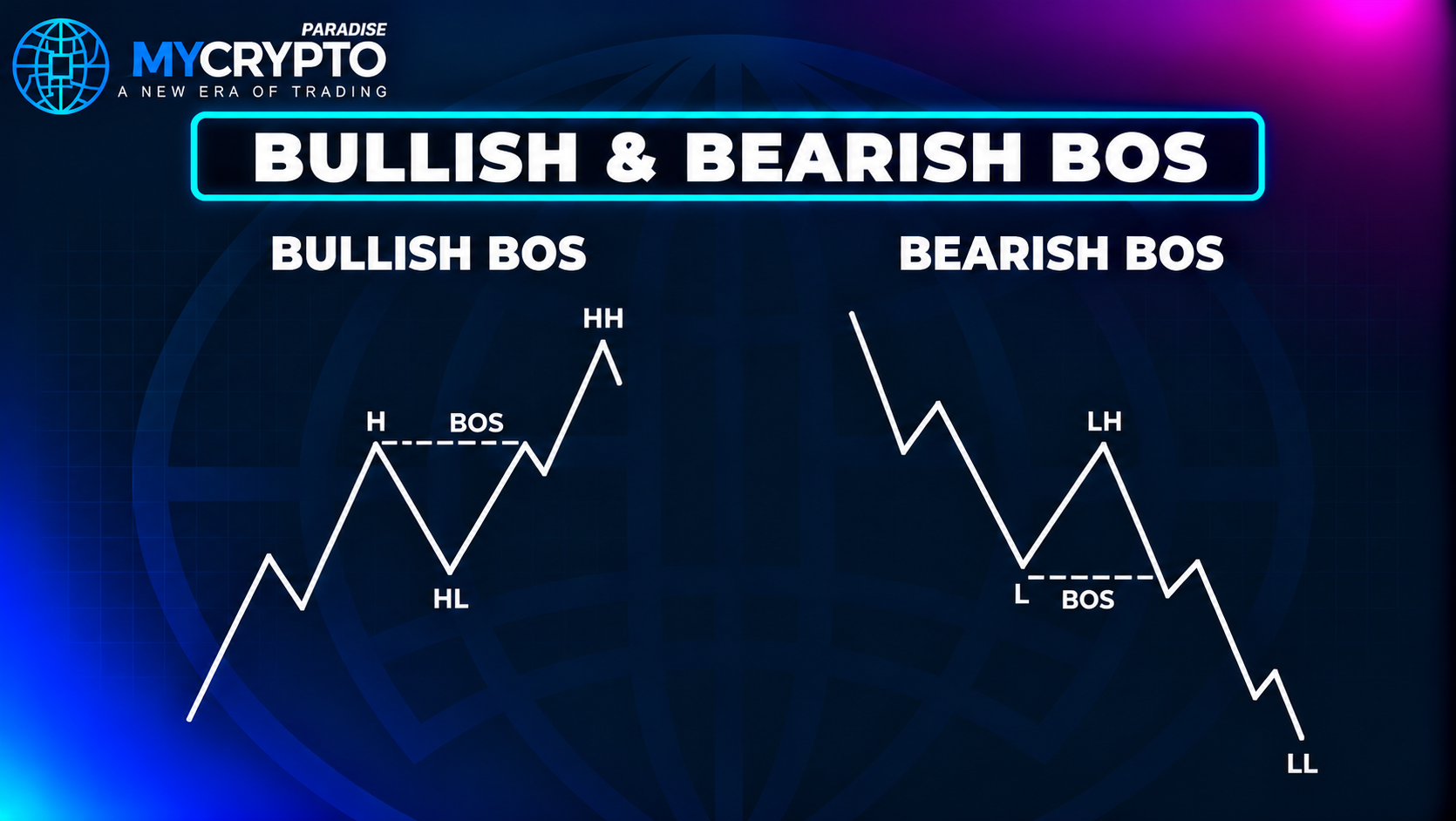
A Break of Structure describes price breaking a meaningful swing in the direction of the established trend. In bullish structure, that means a break above a relevant swing high. In bearish structure, a break below a relevant swing low.
Bullish BOS
Suppose price forms a higher low, then closes above a previous swing high. Traders may label this a bullish BOS, because price extended the upward sequence. Follow-through or a clean retest adds context, though a break can still fail.
Bearish BOS
Suppose price forms a lower high, then closes below a previous swing low. This may be a bearish BOS, since price extended the downward sequence. A quick move back above the broken level weakens the continuation read.
The word meaningful matters. A break of a minor internal swing may show local continuation without changing the larger trend. Decide which swing defines the setup before the break, not afterwards.
Change of character (CHoCH): the first sign of a turn
A Change of Character describes a break of a meaningful swing against the prevailing structure. Traders watch it as an early sign that buying and selling pressure may be shifting. It is a warning, not proof.
Bearish CHoCH after an uptrend
If price has made higher highs and higher lows, a break below a meaningful higher low disrupts the bullish sequence. Traders may call this a bearish CHoCH. They then watch for lower highs, or a reclaim of the broken area.
Bullish CHoCH after a downtrend
If price has made lower highs and lower lows, a break above a meaningful lower high disrupts the bearish sequence. This may be a bullish CHoCH. Further higher lows and highs can support a transition, but one break is not enough.
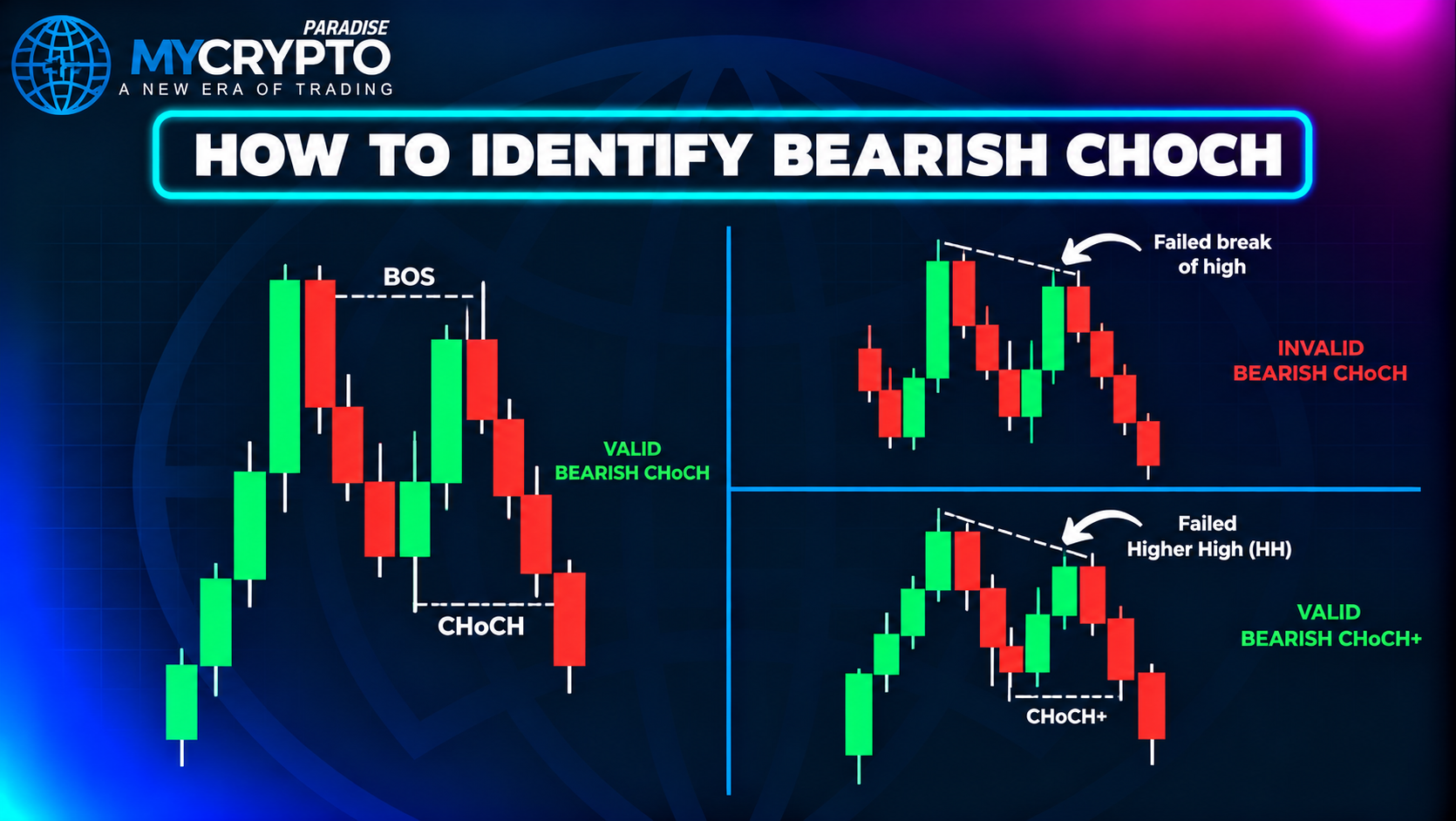
A CHoCH can lead to a larger change, a deeper correction, or a failed break. For related turning points, study Elliott Wave reversals alongside this concept.
Internal vs external structure, and why timeframe matters
External structure refers to the larger swings that define the broad sequence. Internal structure describes smaller swings inside that movement. A lower timeframe can show many local breaks while the higher timeframe holds its trend.
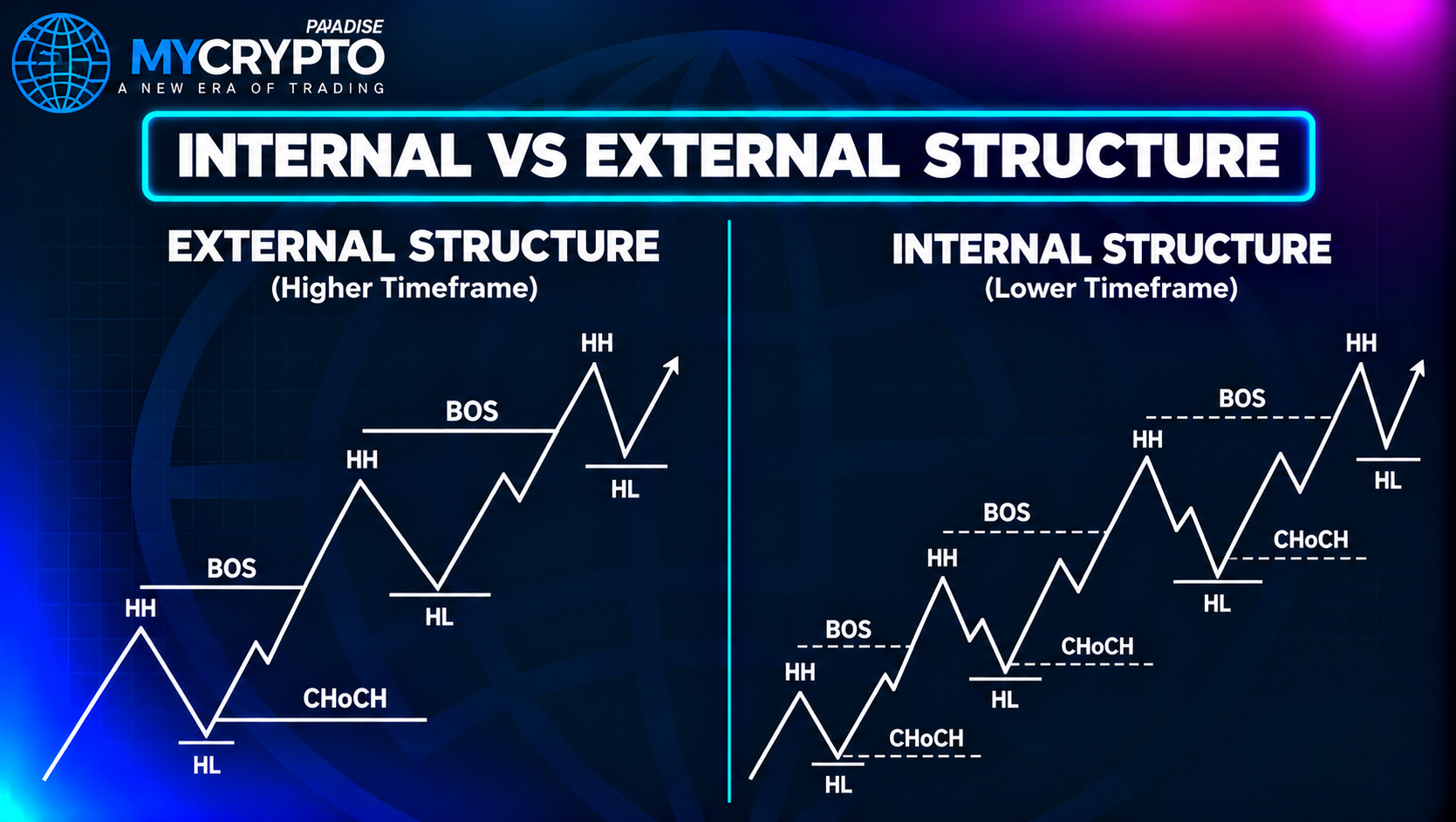
A bullish CHoCH on a 15-minute chart may be a short rally inside a daily downtrend. It can matter to an intraday trader. It does not automatically reverse the daily structure.
Mark major swings on a higher timeframe first, then inspect lower-timeframe detail. Avoid mixing a daily external swing with a tiny five-minute pivot as though they carry equal weight.
Structure is one part of our six-layer confluence framework. MCP University FREE presents it beside other tools, but no single layer guarantees a result. The purpose is to organise evidence, not to predict with certainty.
Fake breaks: wick vs close, and the liquidity sweep
A level can be crossed briefly without a sustained break. A wick beyond a swing shows price traded past it during the candle. A close beyond the level shows the candle finished on the other side, a stricter rule.
Neither guarantees follow-through. A candle can close beyond a level and then reverse. Pick a consistent rule, weigh volatility, and watch what price does next. Confirmation candles like a bullish engulfing pattern or a piercing line pattern can add weight.
A liquidity sweep is when price moves beyond a visible high or low, then reverses back through it. The move may trigger resting orders. A liquidation heatmap can show where that pressure clusters, but confirm from behaviour, not a wick alone.
Using structure to place stops and define invalidation
Every structure-based trade needs a point where the idea no longer makes sense. That is the invalidation level. It may sit beyond a relevant swing, or beyond the level whose recovery or failure supports the setup.
For a bullish continuation after a BOS, watch whether price holds the broken swing area and keeps its latest higher low. For a bearish idea, watch the broken low and latest lower high. These are planning examples, not fixed rules.
Position size should reflect the distance from entry to invalidation and the amount you can afford to lose. A wider stop usually means a smaller position. In perpetual markets, check crypto funding rates, because leverage magnifies losses as well as gains.
Common mistakes
- Marking every tiny pivot, then relabelling structure after price moves.
- Treating a single wick as proof of a BOS or CHoCH.
- Mixing a daily external swing with a five-minute internal one.
- Moving a stop farther away to avoid admitting a setup failed.
- Calling a CHoCH a confirmed reversal before a new sequence forms.
Practice this
- Open a higher timeframe and mark the clear swing highs and lows.
- Label the sequence as HH/HL, LH/LL, or a range.
- Find one recent BOS and one CHoCH, and note which swing defined each.
- Write the invalidation level before you imagine any entry.
- Drop to a lower timeframe and check whether internal breaks fit the higher trend.
Market structure can organise a trade plan, but it cannot remove market risk. This lesson is education, not financial advice. Crypto is volatile, and any interpretation can fail.
FAQs
What is market structure in crypto trading?
Market structure is the sequence of meaningful swing highs and swing lows. Traders use it to describe whether price is trending upward, trending downward, or moving within a range.
What is a Break of Structure (BOS)?
BOS commonly describes a break of a meaningful swing in the direction of the established trend. A bullish BOS breaks a relevant high, while a bearish BOS breaks a relevant low.
What is a Change of Character (CHoCH)?
CHoCH commonly describes a break against the prevailing structure. It can signal a change in behaviour, but it does not guarantee a reversal. Traders then watch whether a new sequence develops.
Is a wick break enough to confirm BOS or CHoCH?
Methods differ. Some traders accept a wick beyond a swing, while others require a candle close or further confirmation. Apply one rule consistently, and remember that neither approach guarantees follow-through.
How should I use structure for risk management?
Define invalidation before entry, place risk controls around the actual setup, and size the position according to the planned loss. A BOS or CHoCH label alone is not a complete trade plan.
Risk disclaimer: Crypto trading involves substantial risk of loss. This class is education only, not financial advice. Never trade with money you cannot afford to lose. Past results do not guarantee future results.











Join the discussion 4
The "liquidity sweep" part still feels a bit too much like reading tea leaves for me. Feels like you can always find a reason after the fact, no? 😅
Anna's right, keeping a log is the only way to see what works. I still use the same system my dad set up for my allowance.
Yeah, the BOS vs. ChoCH is where folks usually get tripped up, thinking every flip is a big move 🙄. My brother's transfers showed me that real "liquidity" is when the fees drop 👇💸.
it's really satisfying seeing the focus on honest risk management and logging everything. it's the only way to avoid past mistakes. 👍