

In short
Mark a trading range by drawing a floor at the lowest obvious swing low and a ceiling at the highest swing high. Price spends most of its time inside this band, not trending. Trade the edges, not the middle: near the floor, risk is cheap; near the ceiling, it is expensive. Always plan for the fakeout, because edges fail and ranges break. A range gives you two reference points and a clear line where your idea is wrong. That line, not a hoped-for bounce, is what makes the trade.
What makes a range a range?
A range is a band where price moves sideways between a stable floor and ceiling. It forms when buyers and sellers agree, roughly, on fair value. Neither side wins. The floor is where buying absorbs selling; the ceiling is where selling caps buying. Most of the time, markets range rather than trend.
Think of it like a room. Price walks from the floor to the ceiling and back. These are the levels traders call support and resistance basics. Until price breaks through one of them, that walk is the whole game.
What is different here
The ParadiseTeam marks the same range across all major exchanges before trusting an edge. A level that holds on one book can be noise on another.
How do you mark the edges without curve fitting?
Mark the edges from obvious swing points your eye finds in seconds, not levels you hunt for to fit a story. Use the clearest high and low that price respected more than once. If you need to zoom and squint, the level is not real. Two touches minimum, three is better.
Curve fitting is drawing the line that makes you feel right, then calling it analysis. Avoid it by keeping your criteria mechanical.
- At least two clear touches, ideally three.
- Wicks and bodies clustering at a similar price.
- A level visible without zooming or redrawing.
- The same band showing on a higher chart.
Before you trust an edge, line up three timeframes so the band is not an artefact of one chart. It also helps to measure the band against a coin’s normal range, so you know whether the edges are wide or tight for that asset.
Why is the middle of a range the worst place to act?
The middle is where risk is highest and reward is lowest. From the centre, both edges are far, so your stop and target are both vague. You are paying full price for a coin flip. At the edges, one side is close, which means your invalidation is tight and defined.
Chasing the middle is how traders manage to be wrong and expensive at the same time. Patience at the edge is cheaper than conviction in the centre.
Reading the edge: reaction versus clean break
At an edge, two things can happen. Price reacts and turns back into the range, or it breaks clean and leaves. Your job is to wait for evidence, not to guess. A reaction shows rejection wicks and a quick retreat. A clean break holds beyond the edge and retests it from the other side.
Many edge trades fail as a false move first. Learn to spot a fakeout before a breakout, because the first poke through an edge is often a trap, not a trend.
When is a range no longer a range?
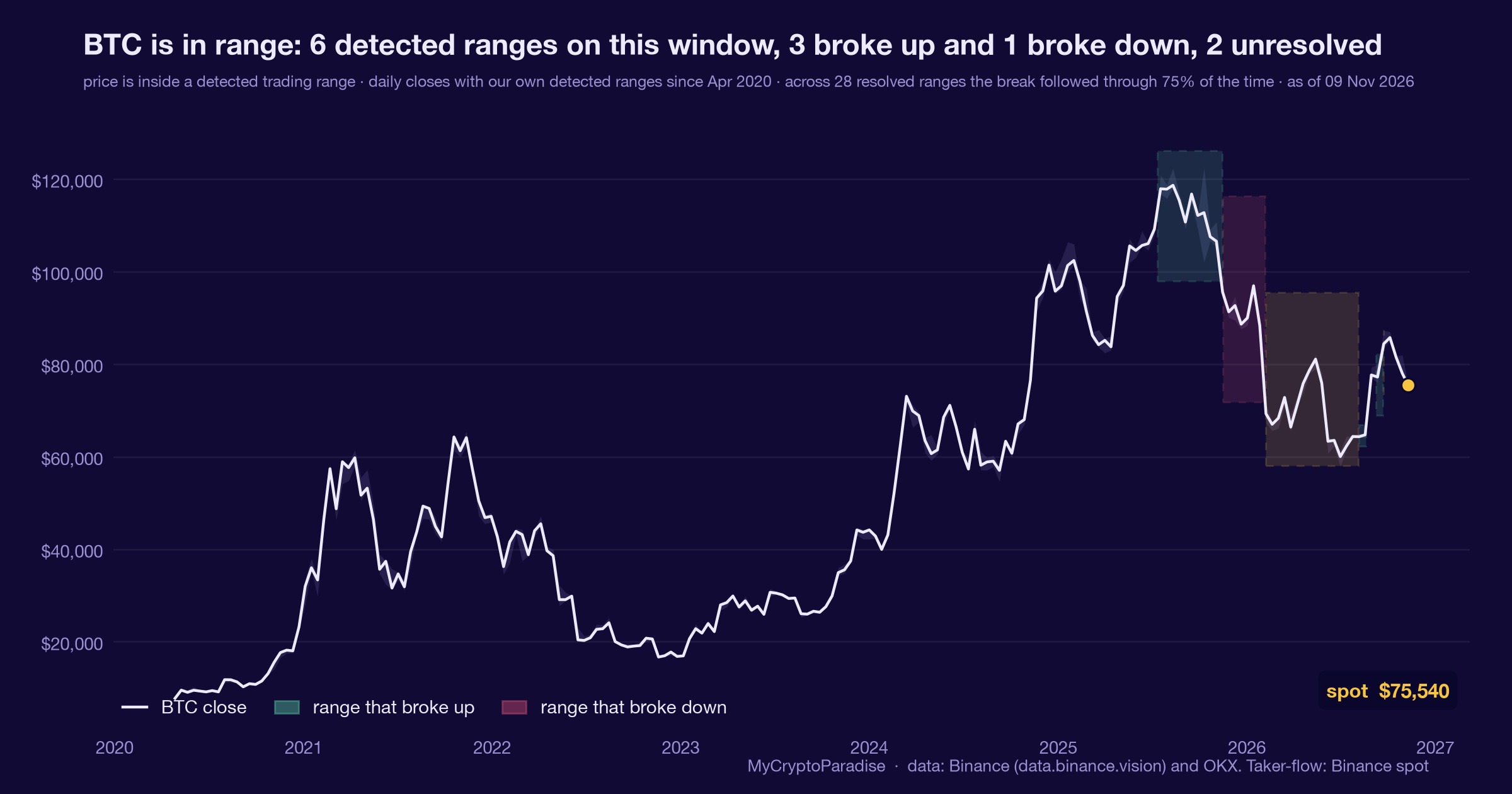
A range dies when price closes decisively beyond an edge and holds there, usually on rising volume. One wick through is not a break; it is often a fakeout. You need a close, a hold, and ideally a retest that respects the old edge as new support or resistance. Until then, assume the range still rules.
This is where most range traders lose money. They call the break too early, then get chopped when price snaps back inside. Wait for the close, then the retest. The market rarely leaves without saying goodbye twice.
Volume and order flow at the edges
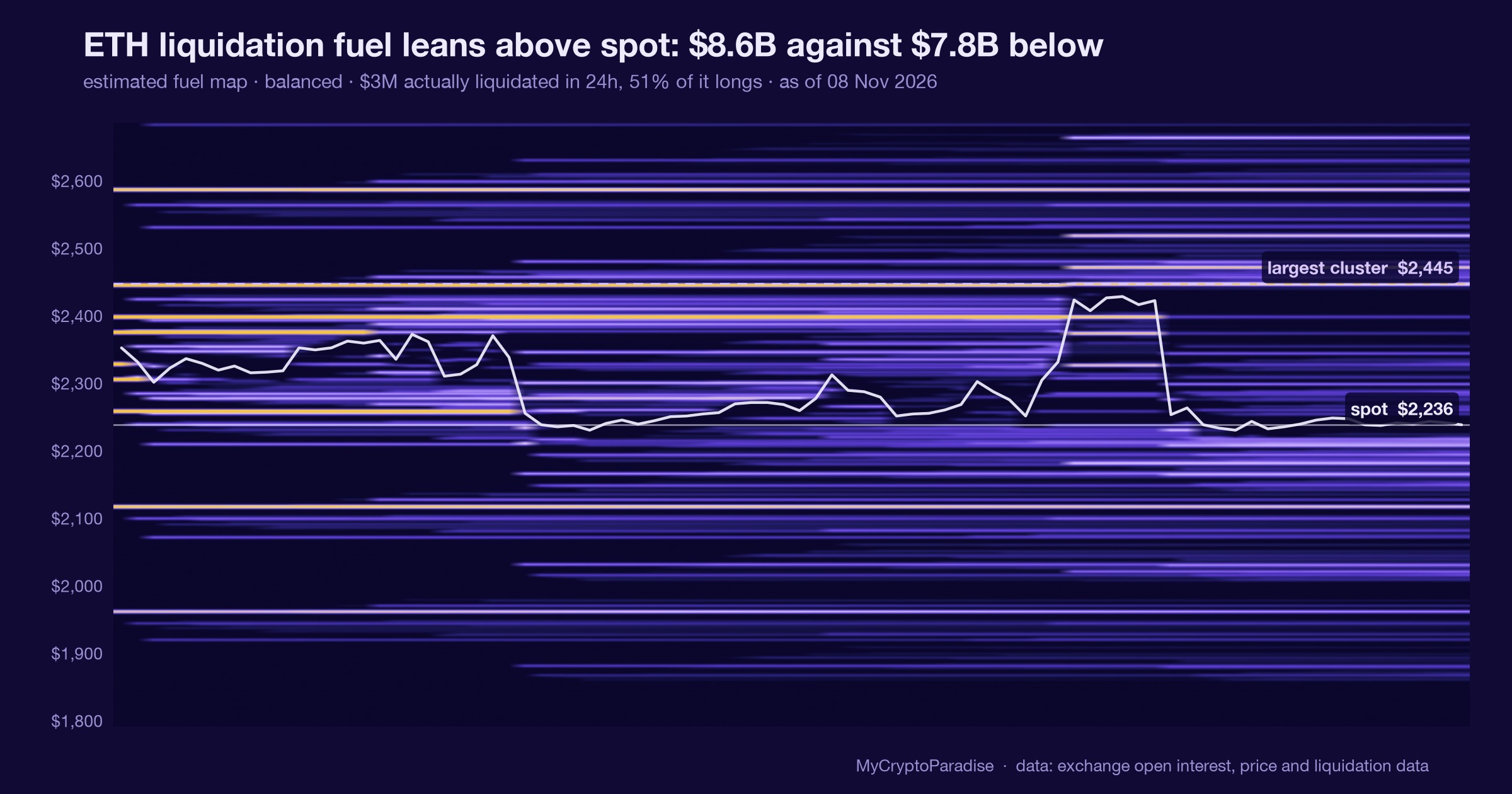
Volume tells you whether an edge is being defended or abandoned. A bounce on heavy volume means buyers showed up at the floor. A break on thin volume often fails. Order flow at the edge shows the resting bids and offers that hold a level, so reading that book turns a guess into evidence.
You can see this directly if you know how to read the order book. A thick wall of bids at the floor says defenders are present. When that wall vanishes just before price arrives, the edge is probably about to give.
Risks and limits: ranges end and edges are zones
Ranges are not permanent, and edges are zones, not single prices. Treat a floor or ceiling as a band a few percent wide, because price overshoots and wicks. Size your risk so a fakeout through the zone does not end your account. Every range eventually breaks; the question is only when and which way.
So mark the band honestly. Respect the edges as zones not single prices, and keep your stop just beyond the zone, not on the line. The range gives you structure. It does not give you certainty, and any read here is a probability read, not a forecast.
Frequently asked questions
How many touches make a valid range?
Two clear touches of a level is the minimum, and three is stronger. Each touch where price respects the floor or ceiling adds confidence that the band is real. If you can only find one touch, you are guessing, not marking a range that other traders also see.
Should I trade the range or wait for the breakout?
It depends on what the edge shows. Inside a confirmed range, fading the edges back toward the middle is the base case. Once price closes and holds beyond an edge on volume, the breakout becomes the trade. Let evidence decide, and do not marry one idea before price commits.
Where do I put my stop when trading an edge?
Put your stop just beyond the edge zone, not on the exact line. Because edges are bands, a single wick can trip a tight stop before the level holds. Give it a little room past the zone, then size the position so that your defined risk stays small.
What timeframe is best for marking a range?
Mark the range on a higher timeframe first, such as the daily or four hour, then refine on a lower one. The higher chart shows the edges that matter; the lower chart times your entry. Lining up several timeframes stops you trading a level that only one chart sees.
Crypto trading involves substantial risk and is not suitable for everyone. Nothing here is financial advice; it is education only. Never risk more than you can afford to lose.










Join the discussion 23
Honestly, the "plan for the fakeout" bit still feels a bit... off to me 🤔. Like predicting which way the wind blows *after* it's already blown, ya know? 😅📉
For fakeouts, I usually wait for a clean break and retest of the range before committing. Otherwise, it’s just noise and quick exits for me! 🧘♂️
i dont always wait for a retest Rahul, sometimes the candle close above or below the level is all you need. what's your one level that matters
My biggest problem is not getting sucked into the fakeouts... my wife just rolls her eyes when I'm glued to the charts 🤦♂️ How many do you usually see in a range?
Oh, this is super helpful for me! I always try to set my alerts a little inside the range edges, just in case... maybe I should trust my lines more. 🤔
yea, trust your lines! 💯 i only do it inside if im scared the momentum is too high for a good retest. 🚀 but mostly it hits. 🎯
I see the range edges differently. I aim for the fakeout, not the bounce, so I look for a breach rather than staying inside.
Ah, I see... so you are actually trying to catch the invalidation of the range? That seems a bit risky for a beginner like me. I prefer to wait for clear confirmation of support or resistance before I do anything. 😬
Yes, you are right that my approach seeks an invalidation, and it certainly carries more risk for a beginner. Your method of waiting for confirmation is safer. For me, the thesis matters more than the price, so I am willing to take that risk.
I also like looking at the weekly chart for ranges, it helps me see the bigger picture more clearly 🔍📈. I always wait for confirmation before entry, especially after a fakeout! 🤞😅
I've been trying to set my alerts a bit wider than the edges... just to avoid the fakeouts. It's still new for me.
Yeah, I always keep an eye on the 15m for range confirmations 👀 but the fakeouts are definitely the hardest part to catch 😅 like Noah said. Just have to be sharp ⚡.
aisha you got a point about the volume most times but you ever notice how the depth of market can show a tell before the big move
My biggest problem with ranges is when the price just keeps going after the fakeout, like it's saying "HAHAHA!" to my face 🤡📉 It's like my meme-coin days all over again! 😩
With all the talk of fakeouts... for those using tighter ranges, how do you manage the higher volume of alerts? Gets noisy sometimes... 🔔
I always prefer to zoom out a lot and look at the weekly for ranges, less noise there. My main concern is when you think you've found the ceiling, but it just keeps going up! 😬
Zooming out to the weekly means you miss the intraday moves. We're here to trade the range, not watch it disappear over three months.
yes, weekly is good for ranges. also consider the monthly for macro confirmation of your boundaries.
Missing intraday moves is fine if it means not getting chopped up! 🤷♂️ I’d rather trade the edges of a clearer, wider range than get faked out by noise every few hours. What's the downside to trading less often, exactly?!
hey ricardo, i get that about zooming out. my problem is usually the opposite, when im trying to find a floor and it just keeps dropping... 📉
Defining the range is critical, though sometimes the perp premium can signal a potential break early, suggesting a basis trade might be less stable.
I watch for the fakeouts before I even think about an entry. It's about protecting what I have from being eaten away.
protecting your capital is key Diego! 🛡️ but thinking about those slippage fees on the way in and out of a position... 💸 that's another thing that eats away at you. 😅