



In short: Elliott Wave rules decide whether a wave count is valid; guidelines only help judge its quality. Three rules govern a standard impulse, and every count needs an invalidation level before you act.
Here is the core takeaway: Elliott Wave rules decide whether a wave count is valid, while guidelines only help you judge its quality. Check the rules first, then weigh the supporting evidence.
Crypto markets move through directional advances, corrections, and periods of consolidation. Elliott Wave Theory offers a framework for organising these movements into recurring structures.
Understanding the rules helps you separate a valid count from an attractive interpretation that quietly breaks the pattern. MyCryptoParadise is a professional crypto signals and trading-education service, operating since 2016, and this lesson sits in our advanced technical tools track.
The Elliott Wave principle separates impulsive movements from corrective structures. Not every chart forms a clean textbook pattern, so several readings can stay possible at once. For the wider map, start with our guide to impulsive to corrective waves.
The three rules that can never be broken
A standard Elliott Wave impulse contains five waves labelled 1, 2, 3, 4, and 5. Waves 1, 3, and 5 move with the larger trend, while Waves 2 and 4 correct part of that move.
Three mandatory rules decide whether this proposed impulse stays valid. Each one is a hard pass-or-fail test, not a preference.
Rule 1: Wave 2 cannot retrace beyond the start of Wave 1
In an upward impulse, Wave 2 cannot fall below the low where Wave 1 began. In a downward impulse, it cannot rise above that starting high. Crossing that boundary invalidates the standard count.
Rule 2: Wave 3 cannot be the shortest motive wave
Wave 3 is often extended, but it does not have to be the longest. Compare all three motive waves when you judge a completed structure. If Wave 3 is the shortest, the standard impulse is invalid.
Rule 3: Wave 4 cannot overlap Wave 1 in a standard impulse
In an upward impulse, Wave 4 cannot enter Wave 1’s price territory, and the reverse applies downward. Diagonals are the important exception, because their structure permits overlap under their own rules.
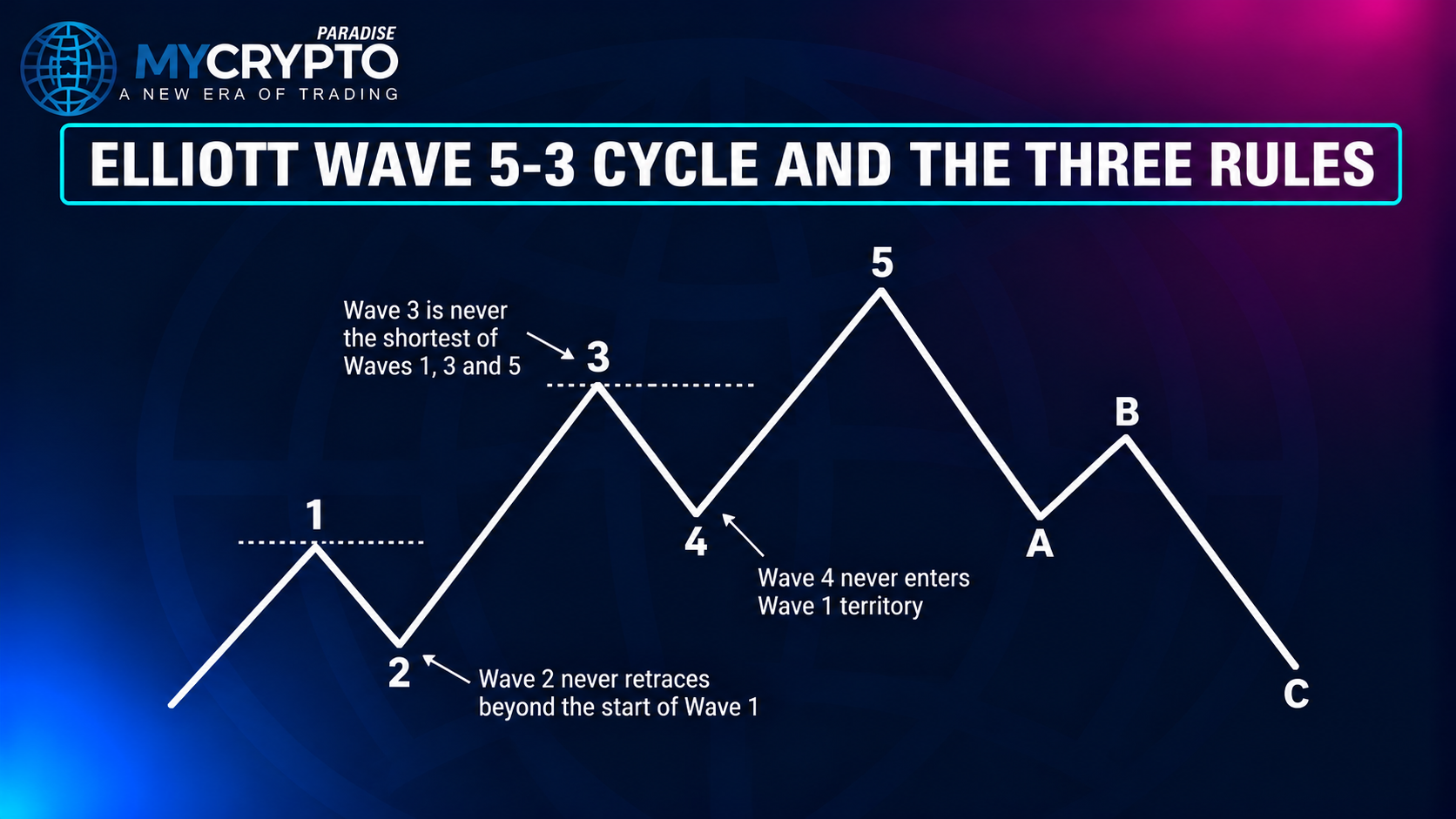
Check these rules before you lean on Fibonacci relationships, channels, or other supporting evidence. A convincing-looking chart never rescues a count that breaks a mandatory rule.
Structure rules for diagonals, zigzags, flats and triangles
Different Elliott Wave patterns have different internal structures. Applying impulse rules to every formation produces wrong conclusions, especially when a corrective pattern contains overlapping moves. Identify the proposed structure first, then apply its rules.
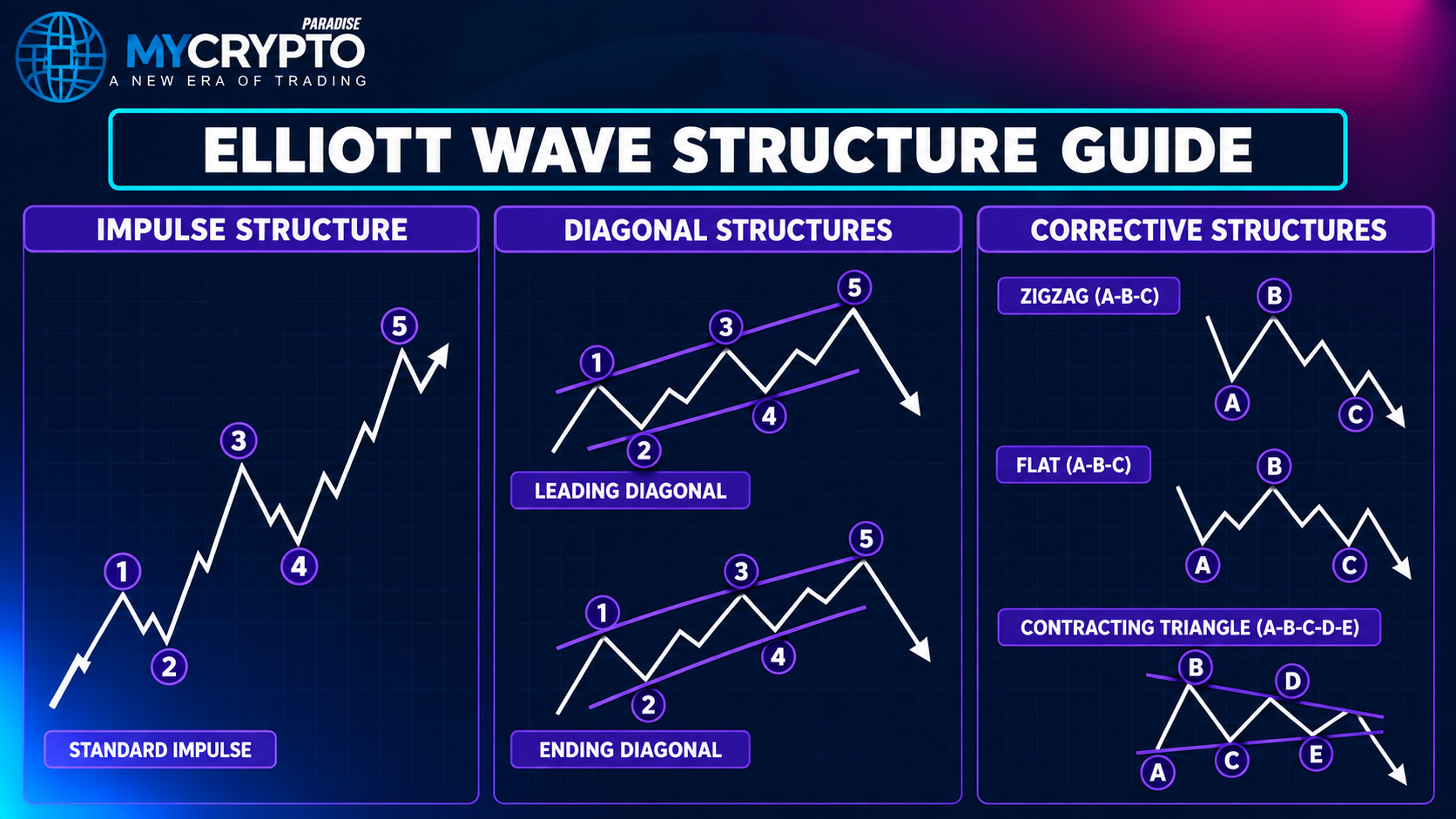
These are the common patterns and what defines each one:
- Impulse: five waves. Wave 2 holds above the Wave 1 start, Wave 3 is not the shortest, and Wave 4 does not overlap Wave 1.
- Leading and ending diagonals: often 5-3-5-3-5 or 3-3-3-3-3. Wave 4 overlaps Wave 1, and converging trendlines help confirm the shape.
- Zigzag: a 5-3-5 correction. Waves A and C subdivide as motive patterns, while Wave B stays corrective.
- Flat: a 3-3-5 correction. Waves A and B are corrective, while Wave C usually develops as a motive structure.
- Triangle: a 3-3-3-3-3 correction. Five segments labelled A to E develop with overlapping price action.
Because corrections overlap so freely, traders who force an impulse reading onto a triangle often mislabel the whole sequence.
The guideline of alternation: sharp Wave 2, sideways Wave 4
The guideline of alternation suggests Waves 2 and 4 often differ in form. When Wave 2 is a sharp zigzag, Wave 4 may develop as a sideways correction such as a flat or triangle.
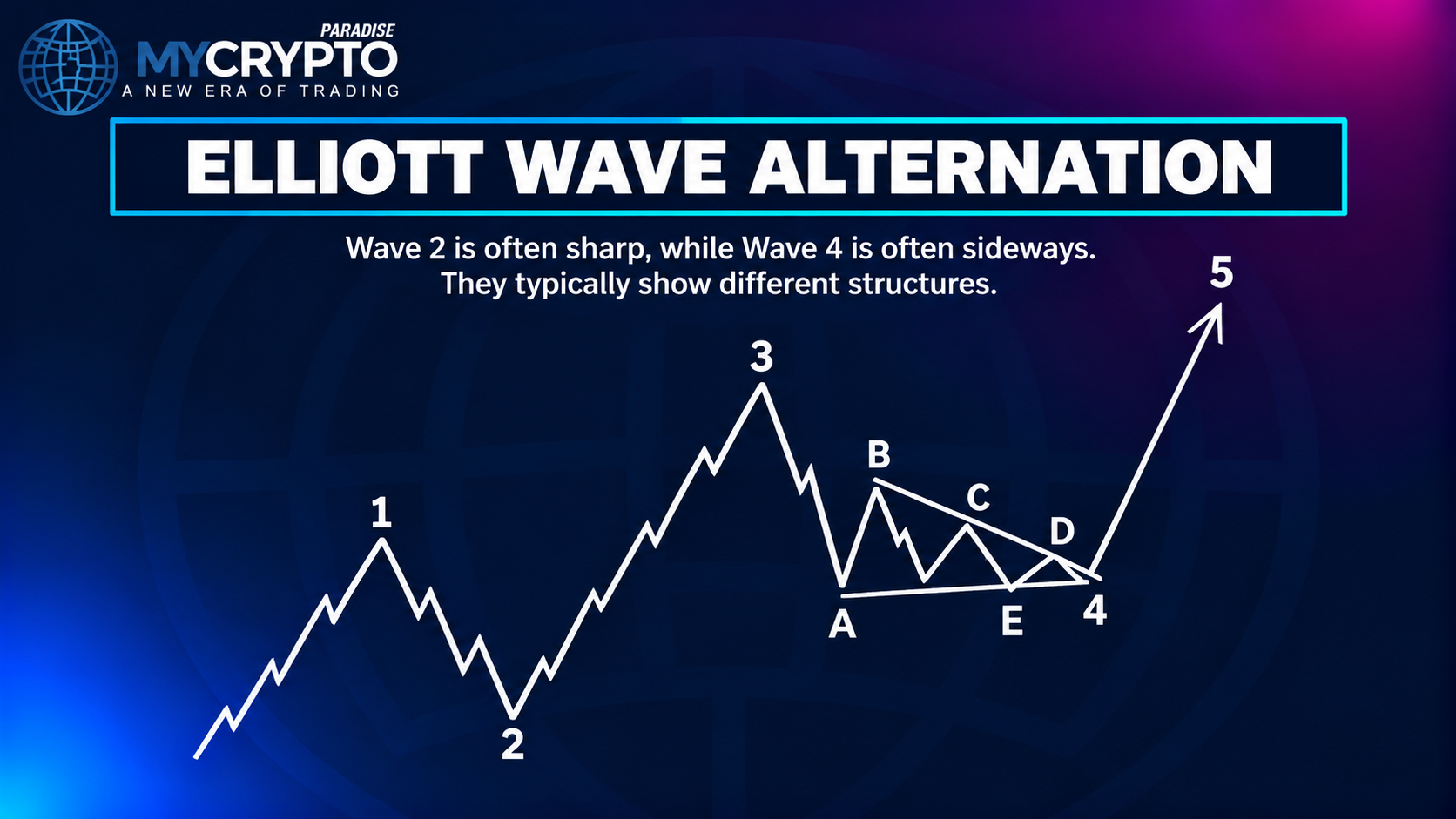
Alternation is a guideline, not a rule. Both corrections can take similar forms, and a valid count does not fail just because alternation is absent. Verify the three mandatory rules first.
In crypto, a sharp Wave 2 may retrace quickly and deeply, while a sideways Wave 4 consumes more time without travelling as far. These are possible behaviours, not guaranteed outcomes. Shifts in fear and greed can shape how each correction feels.
The guideline of equality: Waves 1 and 5 when Wave 3 extends
The guideline of equality helps you estimate the link between Waves 1 and 5. When Wave 3 is extended, Wave 5 may resemble Wave 1 in price length.
Equality does not mean the two are identical. Market conditions, the larger structure, and the degree of extension can produce different proportions. Let the guideline support the analysis rather than become a target price must reach.
Compare the measured lengths of Waves 1 and 3, then watch whether Wave 5 develops in proportion. Fibonacci extensions add context, but they cannot guarantee the final length of Wave 5.
Channeling: the 2-to-4 line and the throw-over
Elliott Wave channeling helps you picture the boundaries of an impulse. After Wave 3 develops, draw a line from the end of Wave 2 to the end of Wave 4. A parallel line through the end of Wave 3 gives the opposite boundary.
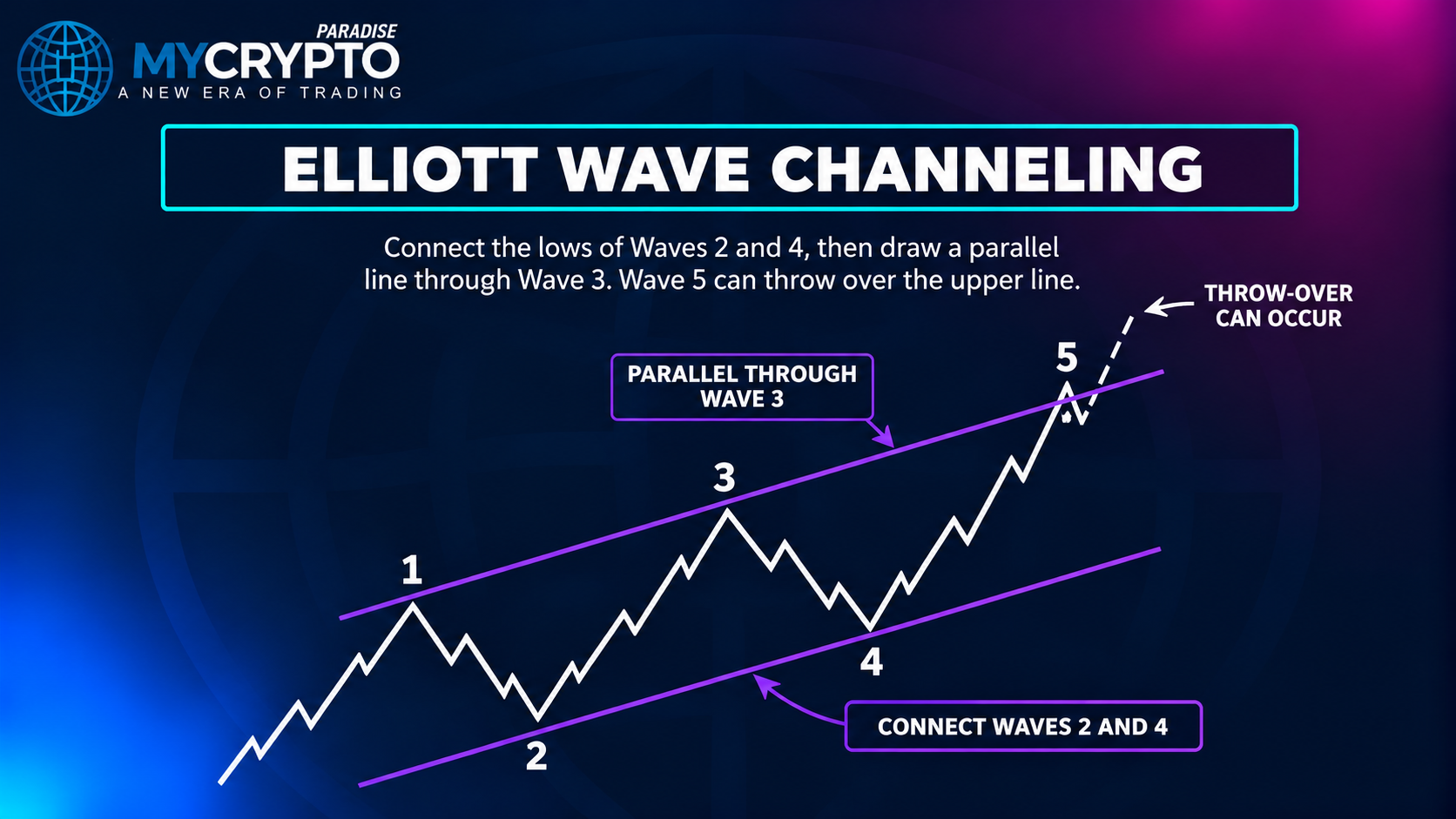
This channel is a visual reference for Wave 5. In some impulses, Wave 5 reaches the boundary or briefly pushes past it in a throw-over. A channel touch or break does not confirm completion on its own.
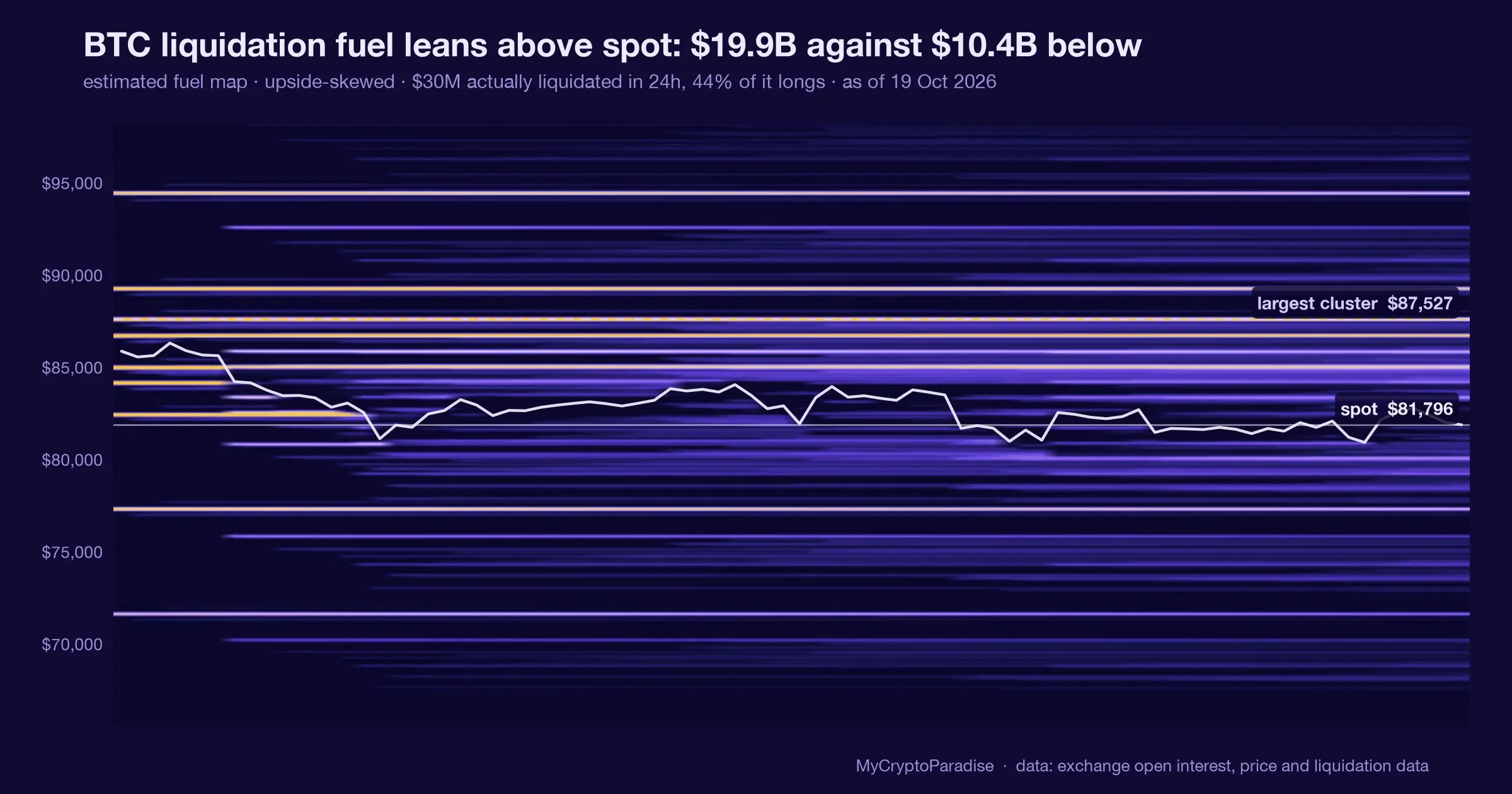
Channeling is a guideline, not a rule. Crypto volatility can produce brief moves outside a channel, and some valid impulses ignore the expected geometry. Pair the channel with structure, price behaviour, and crowding clues from a crypto liquidation heatmap.
Depth of corrections and where Wave 4 usually ends
Wave 4 often retraces part of Wave 3 while preserving the larger impulse. In many upward impulses it stays above Wave 1’s price territory, and the relationship reverses downward.
A common guideline points Wave 4 toward the previous fourth wave of a lower degree. That area is a reference, not a guaranteed destination. Fibonacci retracement levels add context when they align with visible structure.
Treat deep corrections with care, because price may be building a more complex pattern than you expected. If Wave 4 enters Wave 1’s territory, reconsider a diagonal, or accept that the standard impulse is invalid.
Extensions, truncation, and wave degrees
An extension appears when one motive wave develops with more length and subdivision than the others. Wave 3 extends most often, though Waves 1 or 5 can too. An extension reshapes the proportions of the whole impulse.
A truncation occurs when Wave 5 fails to pass the end of Wave 3. It can follow a powerful prior move, but do not assume it just because momentum slowed. Neither event is a standalone entry signal.
Structures also repeat across degrees, or scales. A small five-wave move can sit inside a larger wave. Motive waves usually take numbers, corrective waves take letters, and consistent labelling keeps timeframes from blurring together.
Common mistakes
- Trusting the picture over the rules: a neat chart that breaks a mandatory rule is still invalid.
- Applying impulse rules to a triangle or flat, where overlap is normal and expected.
- Treating alternation, equality, or channeling as requirements instead of guidelines.
- Changing the wave degree to rescue a broken count, which hides invalidation rather than fixing it.
- Entering before you mark the price that would prove the count wrong.
Reversal context helps too. A bullish engulfing pattern near a completed Wave 2 can support, but never replace, a valid count.
Practice this
- Open a daily crypto chart and label a suspected five-wave impulse.
- Run the three rules in order and discard the count the moment one fails.
- Check alternation between Waves 2 and 4, then draw the 2-to-4 channel.
- Mark the exact invalidation price before you consider any entry.
- Cross-check sentiment with crypto funding rates to see whether positioning agrees with your read.
Every wave count is a probability map, not a forecast. Define your invalidation level, manage risk, and let the structure, not hope, decide the trade.
FAQs
What are the three main Elliott Wave rules?
Wave 2 cannot retrace beyond the start of Wave 1. Wave 3 cannot be the shortest of Waves 1, 3, and 5. Wave 4 cannot overlap Wave 1 in a standard impulse, though diagonals permit overlap under their own rules.
What is the guideline of alternation?
Alternation suggests Waves 2 and 4 often differ in form. A sharp zigzag in Wave 2 may be followed by a sideways Wave 4, or the reverse. It is a tendency, not a requirement.
Can Wave 4 overlap Wave 1?
Not in a standard impulse. Diagonals are the key exception, because their structure allows overlap. Identify the pattern before you apply the rule, since the wrong label produces the wrong conclusion.
What is Elliott Wave channeling?
Channeling uses parallel trendlines to outline a possible impulse. Draw a line through the ends of Waves 2 and 4, then copy it through the end of Wave 3. It may help assess Wave 5, but it does not confirm completion.
Is Elliott Wave analysis financial advice?
No. This lesson is education, not financial advice. Crypto markets carry substantial risk, and Elliott Wave analysis cannot guarantee any outcome. Every count can fail, so define your invalidation level and manage risk before acting.
Risk disclaimer: Crypto trading involves substantial risk of loss. This class is education only, not financial advice. Never trade with money you cannot afford to lose. Past results do not guarantee future results.











Join the discussion
No comments yet. Members, share how you are reading this.