



Chart Patterns Explained
In short
A descending channel is a bearish chart pattern that indicates a controlled downtrend, formed by price moving between two downward-sloping parallel trendlines, creating lower highs and lower lows. A breakdown below the support line with strong volume confirms continued downside, while a breakout above the resistance line with strong volume can signal a potential trend reversal.
- The descending channel pattern is a bearish structure that shows a steady, controlled downtrend. It forms when price moves between two downward-sloping parallel lines, creating a series of lower highs and lower lows, which reflects consistent selling pressure.
- It’s important to wait for a clear break before entering a trade. If the price breaks below the support line with strong volume, it usually confirms that sellers are in control. On the other hand, a breakout above resistance with strong volume can signal a possible trend reversal.
- Stop-loss placement depends on your strategy, but it’s typically placed just above the upper trendline on short trades or below support on a bullish breakout. The target is typically estimated by measuring the height of the channel and projecting that distance from the breakout point.
The descending channel is mainly a continuation pattern, as it forms during a downtrend and reflects ongoing selling pressure through lower highs and lower lows. A breakdown below support usually confirms further downside. However, a strong breakout above resistance can signal a potential reversal.
At MCP University FREE, this guide is part of our strategic trading series developed for disciplined, structure-focused crypto traders. After reading the full article, you will be able to identify, confirm, and trade the descending channel pattern with accuracy and confidence.
Introducing the Descending Channel Pattern
Channel patterns are a fundamental concept in technical analysis that help traders understand how prices move within a defined range over time. A channel forms when price respects two parallel trendlines, creating a support-and-resistance structure that guides market direction. These patterns reflect the balance between buyers and sellers, showing whether the market is trending upward, downward, or moving sideways.
The three main types of channel patterns are the ascending channel, where price forms higher highs and higher lows indicating a bullish trend; the descending channel, where price forms lower highs and lower lows reflecting a bearish trend; and the horizontal (sideways) channel, where price moves between flat support and resistance levels, signaling consolidation.
Understanding these channel types allows traders to align with market structure and identify high-probability trading opportunities.
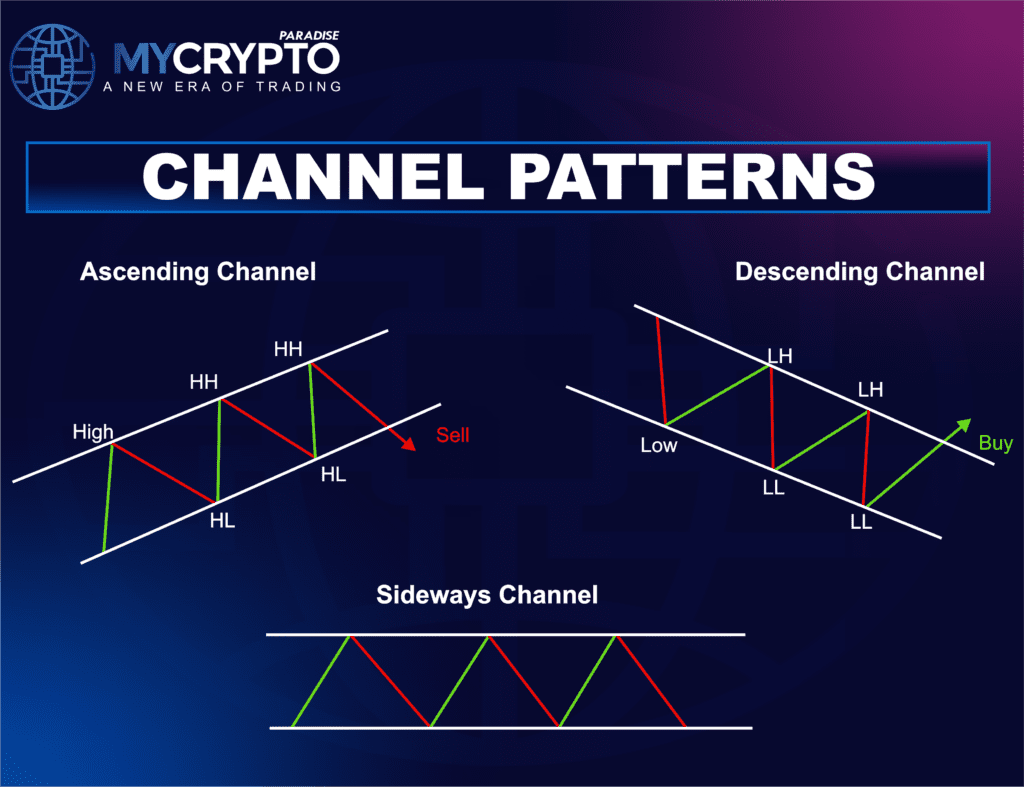
The descending channel pattern is a powerful and structured formation that helps traders identify controlled downtrends in the market. In simple terms, it reflects a situation in which sellers gradually take control while the price remains within a defined range.
Specifically, the pattern forms when price creates lower highs and lower lows within two parallel, downward-sloping trendlines. As a result, this repeated rejection at resistance shows that buying strength is weakening over time.
Finally, the pattern becomes actionable when the price breaks out of the channel, either continuing the bearish trend or reversing with strength.
Learn more about the Ascending channel. Trading the Ascending Channel Pattern: A Guide for Crypto Traders
Structure of a Descending Channel
Parallel Trendlines: On the price chart, two trendlines are drawn in an ongoing downtrend.
Upper trendline: The upper trendline slopes downward, connecting a series of lower highs.
Lower trendline: The lower trendline slopes downward, connecting a series of lower lows.
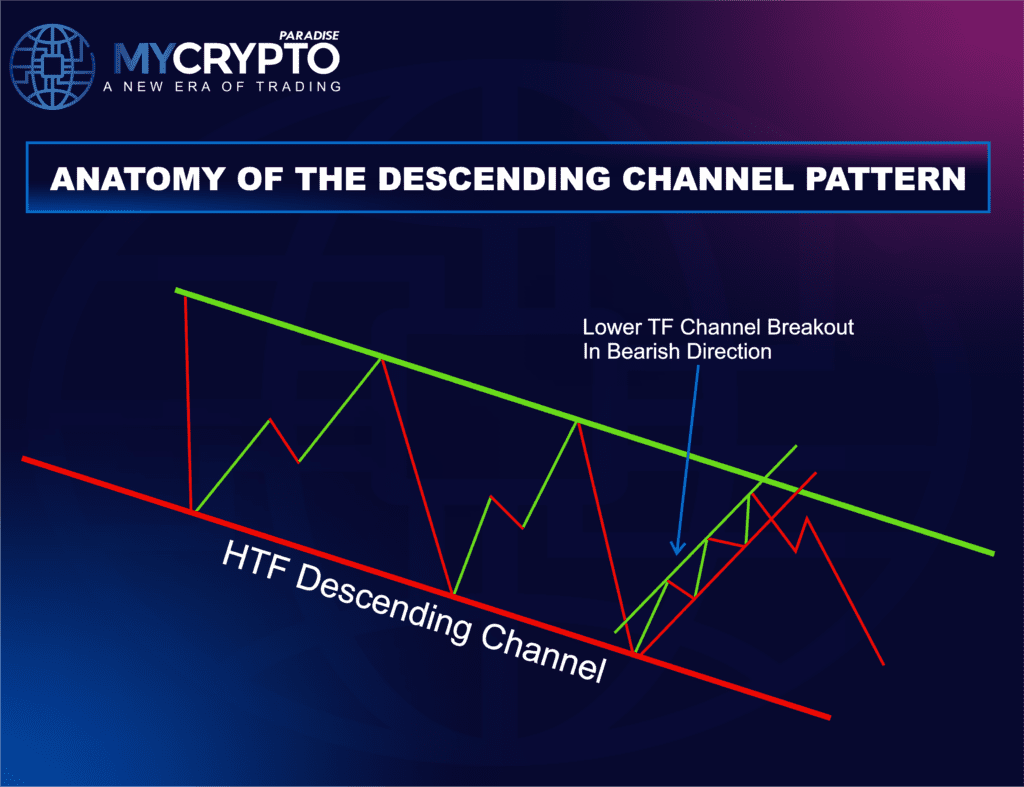
For a valid pattern, the price should touch each trendline at least two times.
How to Identify the Descending Channel Pattern?
Spotting a reliable descending channel requires patience and attention to detail. These are the steps you should follow:
First, confirm that the market is already in a downtrend. Without a clear bearish context, the pattern loses its significance.
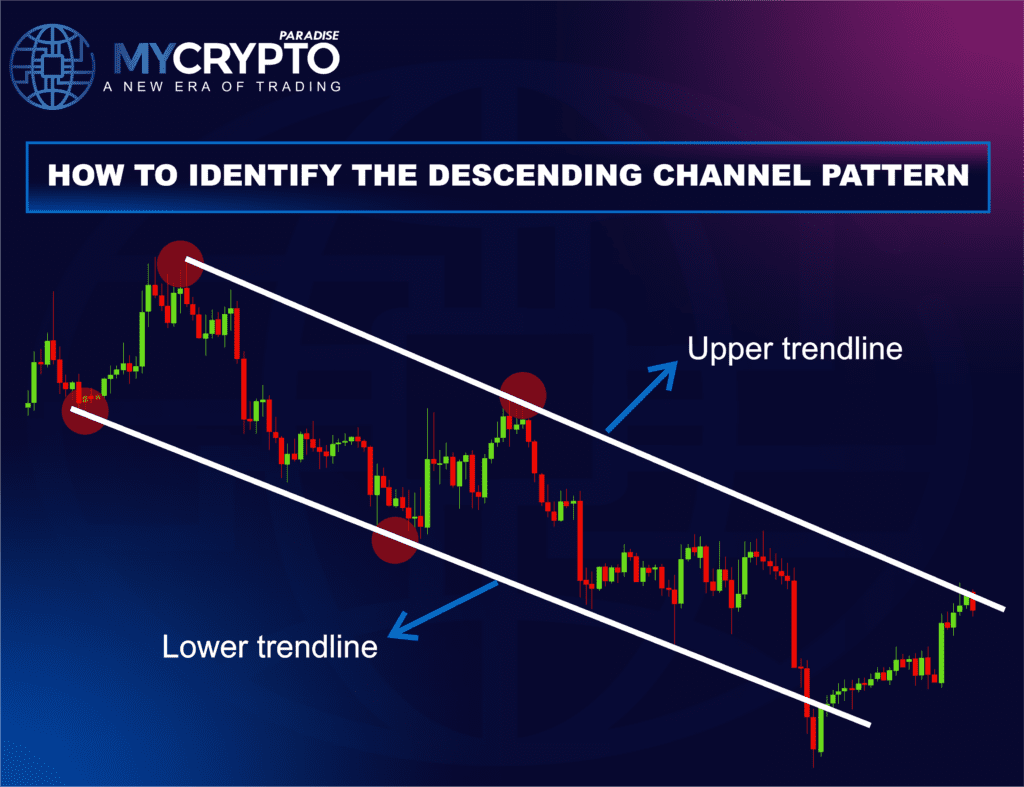
Next, identify at least two lower highs and two lower lows. These points should align to form clean, parallel trendlines.
Then, draw the channel by connecting these highs and lows. The lines should be parallel and respected by price multiple times.
Finally, observe how the price behaves near these levels. Strong reactions at both boundaries confirm that the structure is valid and tradable.
Anatomy of the Descending Channel Pattern
A descending channel typically forms in a structured sequence:
Initial Move: Price begins to trend downward, establishing the first lower low.
Pullback: Buyers attempt a rally, but the price gets rejected at resistance, forming a lower high.
Continuation: Price moves back toward support, respecting the channel structure.
Repetition: This process repeats, creating a consistent pattern of lower highs and lower lows.
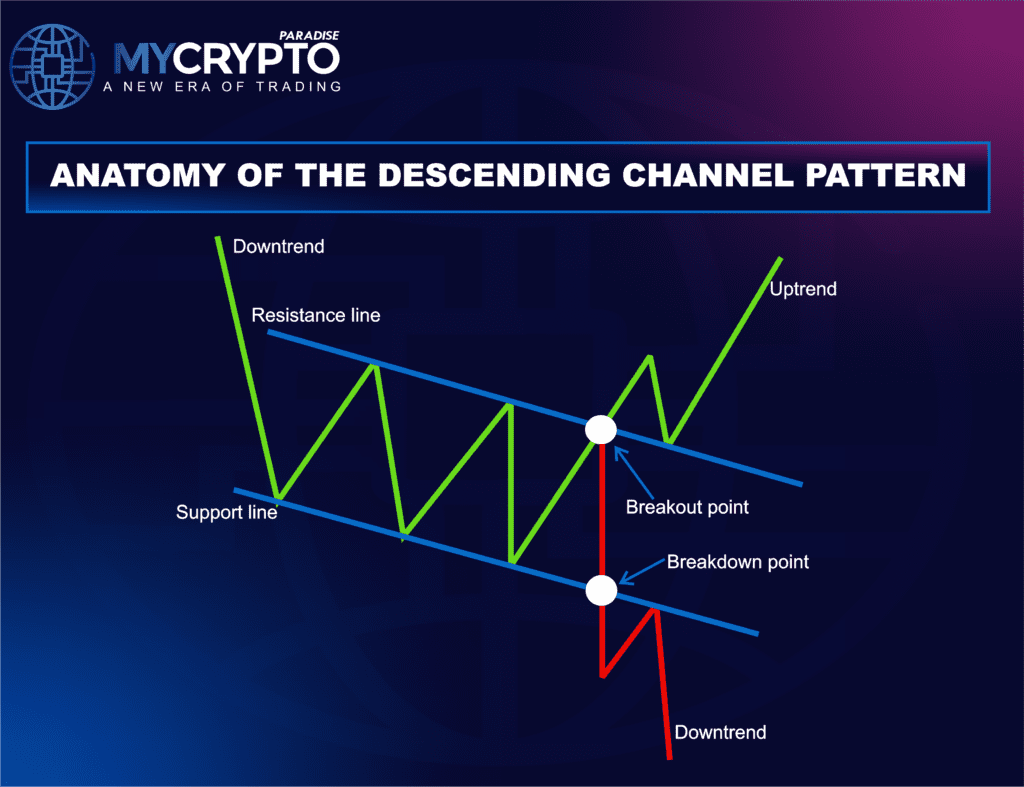
Breakout or Breakdown: Eventually, the price exits the channel, confirming the next directional move.
Each rejection at resistance reinforces seller dominance, while each bounce from support shows temporary buyer activity.
Market Psychology Behind the Descending Channel
Understanding the psychology behind a pattern is what separates average traders from consistent ones. Price movements are not random, they reflect the behavior, emotions, and decisions of market participants.
The descending channel shows a slow shift in control from buyers to sellers. At first, buyers still try to push the price higher, expecting the market to reverse. But each time the price moves up, it gets rejected at resistance, showing that buying strength is fading.
As this keeps happening, sellers become more confident and start entering earlier on every bounce. This leads to lower highs, while buyers become more cautious and less willing to push the price up.
Over time, the market loses upward momentum and continues drifting lower in a controlled way. Eventually, this pressure results in either a breakdown below support or, in some cases, a reversal if buyers manage to break above resistance with strength.
How to Trade the Descending Channel Pattern?
Trading a descending channel requires patience, structure, and confirmation.
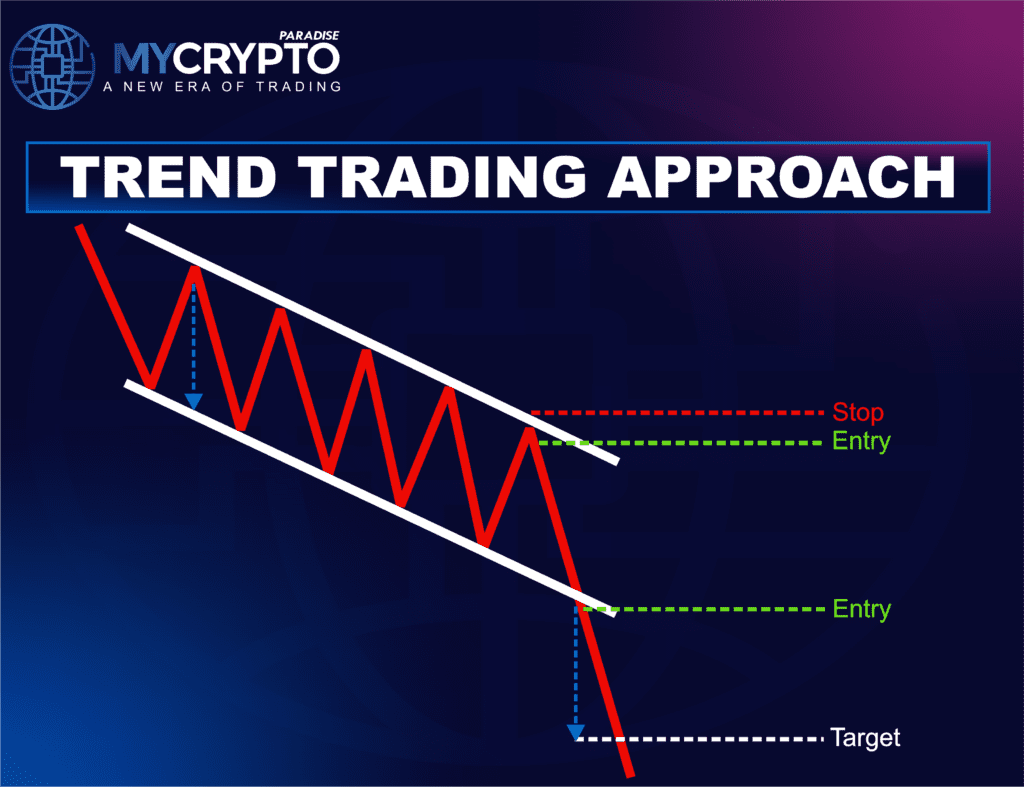
Trend Trading Approach:
Traders can take short positions near the upper boundary of the channel, where the price is more likely to face rejection. Targets are typically set near the lower boundary, and if it breaks down, then we can expect a new range to the downside, similar to the range of the channel as a target.
Breakout Trading Approach:
A breakout above resistance in a descending channel can signal a potential shift in market control from sellers to buyers. However, this is not a widely preferred approach among experienced traders. The reason is structural, as descending channels often have a wide range, which reduces risk-to-reward efficiency and increases exposure.
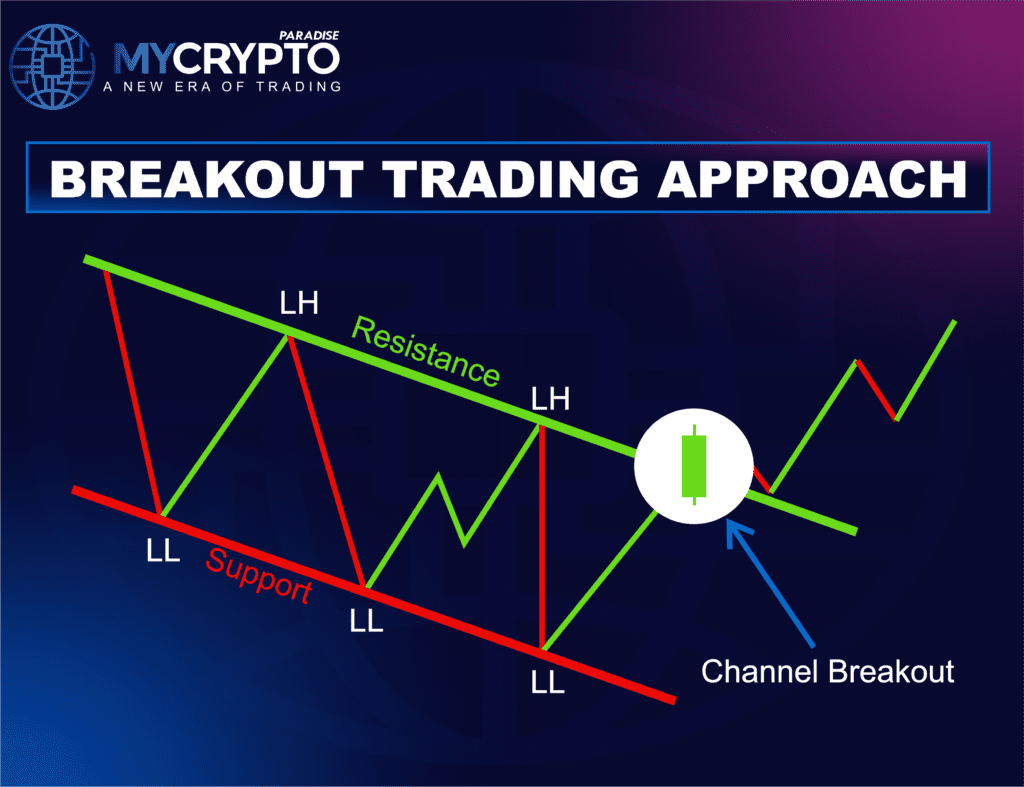
Additionally, since the broader market context is usually bearish, upside breakouts tend to have a higher failure rate. Many of these moves lack follow-through, especially if they are not supported by strong volume and higher timeframe confirmation.
For this reason, traders should treat bullish breakouts from descending channels with caution. Confirmation through a strong close, volume expansion, and ideally a successful retest is essential before considering entries. Even then, trade management must remain conservative, as the underlying trend still favors sellers.
Volume & Confirmation Guide
Understanding volume behavior is crucial when trading this pattern. In both cases, waiting for confirmation is essential to avoid false signals and poor entries. During the formation of the channel, volume often decreases, indicating weakening momentum. However, when the breakout occurs, volume should increase significantly
A strong increase in volume confirms that the move is supported by market participation. Without this confirmation, the breakout may be unreliable.
How to Set Trading Parameters For Descending Channel?
Executing trades correctly is just as important as identifying the pattern.
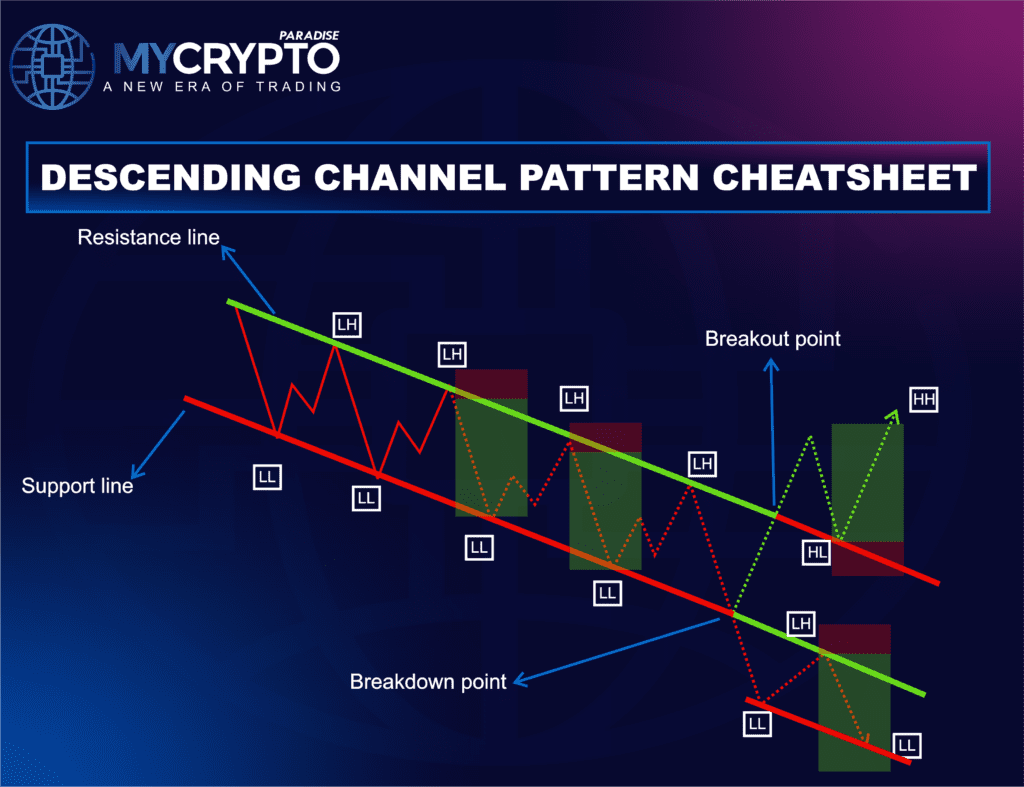
The descending channel offers three main trading setups, two based on trend continuation and one based on potential reversal, depending on how the price reacts within the structure.
Entry Level:
It is important to wait for confirmation. Trades can be taken after a clear breakout above resistance, a breakdown below support, or near the upper trendline in advanced setups. Entering too early, before confirmation, often leads to false signals and poor execution.
Stop-Loss:
Stop-loss placement should always be based on structure rather than guesswork. It is typically placed above or below the most recent swing high or low, or just outside the channel boundary, depending on the direction of the trade and market conditions.
Profit Target:
Profit targets are calculated by measuring the height of the channel and projecting that distance from the breakout or breakdown point. This gives a structured target for expansion moves. In range-based trades within the channel, the opposite boundary, usually the support line, acts as a logical target.
Descending Channel vs Other Patterns
Understanding how this pattern differs from others helps avoid confusion.
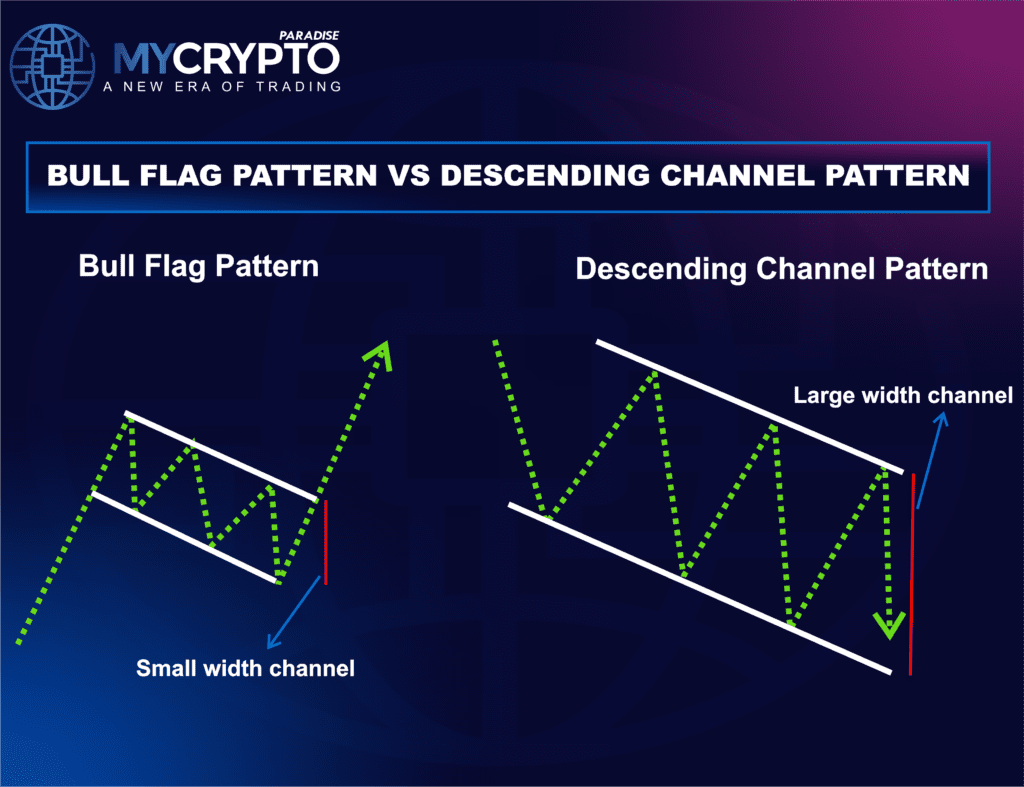
Descending Channel vs. Bull Flag:
A bull flag is typically shorter and steeper, while a descending channel develops over a longer period with a more structured, wide range.
Learn more about bull flag: Bull Flag Pattern in Crypto Trading: How Pros Trade Continuations
Descending Channel vs Falling Wedge:
A falling wedge features converging trendlines, whereas a descending channel maintains parallel boundaries.
Learn more about the Falling wedge: Falling Wedge Pattern: Master the Hidden Crypto Reversal Setup
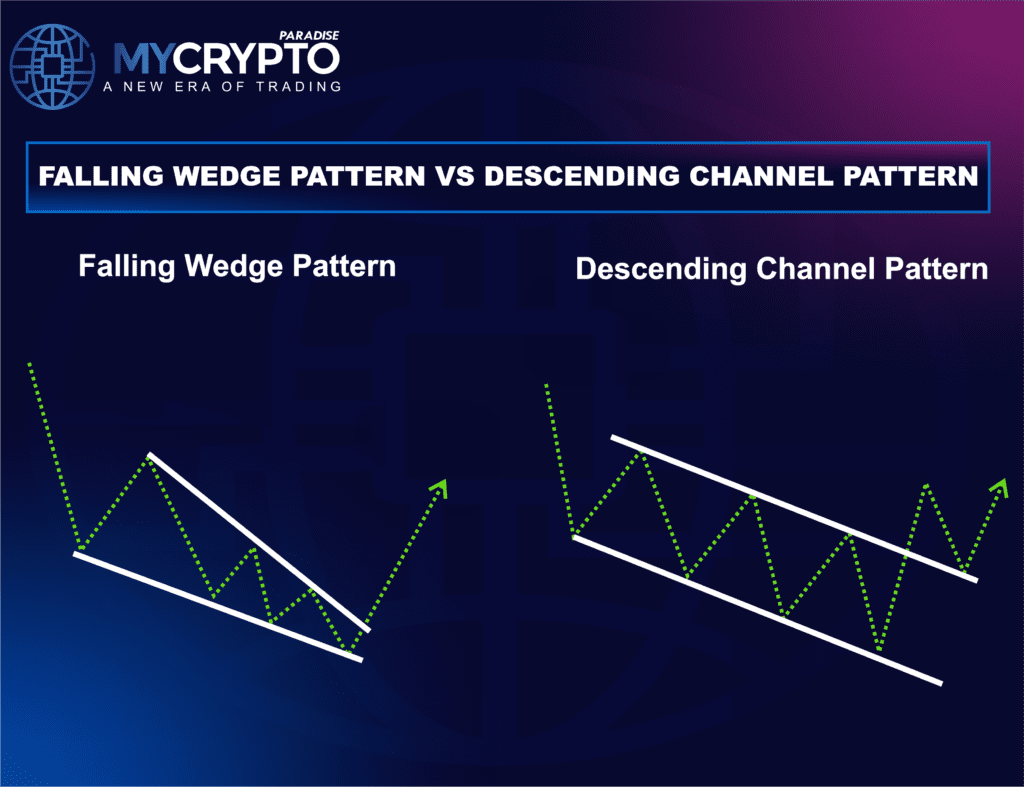
Recognizing these differences ensures accurate pattern identification and better trading decisions.
Common Mistakes When Trading the Descending Channel Pattern
One of the most common mistakes is entering trades without proper confirmation. Traders often anticipate the move instead of waiting for a clear breakdown or rejection, which leads to false entries and unnecessary losses.
Another critical mistake is ignoring volume and overall market context. Without volume confirmation or alignment with the broader trend, the pattern becomes less reliable and more prone to failure.
Keeping stop-loss inadequate is also a major issue. Placing stops too tight can lead to premature exits as stop-loss hunting happens to grab the liquidity, while overly wide stops reduce risk-to-reward efficiency. A well-placed stop-loss should always be based on structure, such as above resistance or beyond key invalidation levels.
Conclusion
The descending channel pattern offers a clear and structured way to understand price movement in a downtrend. It provides well-defined levels for entries, stop-loss placement, and profit targets, making it a valuable tool for disciplined traders.
However, its effectiveness depends on proper execution. Waiting for confirmation, respecting volume behavior, and aligning with the overall market trend are essential for consistent results. Ultimately, traders who focus on structure rather than hype and manage risk effectively can use the descending channel pattern to identify high-probability opportunities with greater confidence.
At ParadiseFamilyVIP🎖️, crypto traders dive deep into setups like the Bull Flag, learning exact entry rules, how to spot momentum, and how to handle risk like a pro.
👉 Join ParadiseFamilyVIP🎖️ to trade with confidence, structure, and precision. Limited slots are available, so secure your place or join the waiting list to stay ahead of high-momentum market moves.
Descending channel FAQ
Is a descending channel bullish or bearish?
A descending channel is bearish. It forms during a downtrend through a series of lower highs and lower lows, reflecting ongoing selling pressure. It mainly acts as a continuation pattern, though a strong break above resistance can occasionally signal a reversal.
How do you identify a descending channel?
First confirm the market is already in a downtrend, then mark at least two lower highs and two lower lows. Connect the highs and lows with two parallel, downward-sloping trendlines. The pattern is valid when price touches each trendline at least twice and reacts clearly at both boundaries.
How do you set a profit target on a descending channel?
Measure the height of the channel and project that distance from the breakout or breakdown point. For range trades inside the channel, the opposite boundary, usually the support line, acts as a logical target.
Why is volume important when trading a descending channel?
Volume often falls while the channel forms, showing weakening momentum. A breakout or breakdown should come with a clear rise in volume to confirm that market participants support the move. Without that volume expansion, the break may be a false signal.
Crypto trading involves substantial risk of loss. This article is educational and is not financial advice. Past performance does not guarantee future results. Always do your own research.
What is different here
Most guides stop at the theory. The MyCryptoParadise team shares the live trades, and the reasoning behind each one, inside ParadiseFamilyVIP. Everything here is education, not financial advice.
Crypto trading involves substantial risk and is not suitable for everyone. Nothing here is financial advice; it is education only. Never risk more than you can afford to lose.












Join the discussion
No comments yet. Members, share how you are reading this.