



Chart Patterns Explained
In short
A megaphone pattern in crypto is a broadening chart formation where price creates higher highs and lower lows, causing price swings to expand over time between two diverging trendlines. It signals rising volatility and market indecision, with no inherent bullish or bearish bias, requiring a confirmed breakout for trade entry.
- The Megaphone Pattern is a high-volatility chart formation. It reflects growing uncertainty in the market. Price creates higher highs and lower lows, causing price swings to expand over time.
- Crypto traders should wait for a confirmed breakout before entering a trade. Volume, support, and resistance, and proper risk management can help improve accuracy and reduce false signals.
- The Megaphone Pattern can provide valuable insights into market sentiment and potential price direction. However, its reliability depends on technical indicators, overall market conditions, liquidity behavior, and external news events
The Megaphone Pattern in crypto trading is one of the market’s most volatile yet powerful chart formations. Spotting this pattern early gives crypto traders a significant advantage. It reveals growing market uncertainty and expanding volatility, where timing can make the difference between capturing major opportunities and getting trapped by false moves.
At MCP University FREE, this guide is part of our free series designed to help you trade with precision, confidence, and control. By the end, you’ll know exactly how to spot, confirm, and trade Megaphone Patterns like a pro.
Introducing the Megaphone Pattern
The Megaphone Pattern, also known as the Broadening Formation or Broadening Triangle, is a chart pattern that reflects increasing volatility and growing market uncertainty. Unlike wedges, pennants, and symmetrical triangles that form through price contraction, the Megaphone Pattern develops through expansion. Instead of narrowing over time, price swings become progressively larger as the structure develops.
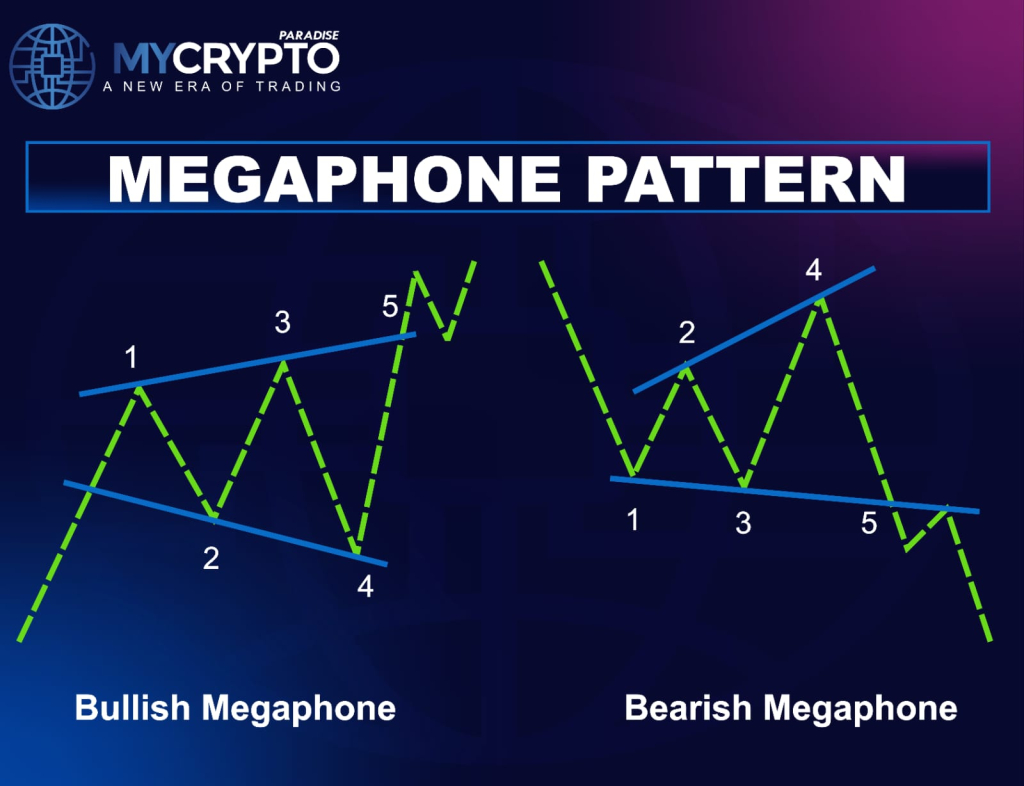
The pattern forms when price consistently creates higher highs and lower lows. Each new swing extends beyond the previous one, showing increasing aggression from both buyers and sellers. As a result, crypto traders can draw two diverging trendlines. The upper trendline connects the swing highs, while the lower trendline connects the swing lows. Together, they create a widening structure that resembles the shape of a megaphone.
This expansion reflects growing conflict between buyers and sellers. Buyers continue pushing prices to new highs, while sellers drive prices below previous lows. As this battle intensifies, volatility increases, and price action becomes more unpredictable. The Megaphone Pattern often appears during periods of market transition, signaling that the existing balance is breaking down. Eventually, one side gains control, leading to a decisive breakout and the start of a significant directional move
Key Characteristics of the Megaphone Pattern
- Expanding Price Action
Each price swing becomes larger than the previous one. Higher highs and lower lows continue to form as the pattern develops. This expanding structure reflects increasing market uncertainty and growing participation from both buyers and sellers.
- Diverging Trendlines
The pattern is defined by two trendlines that move away from each other over time. The upper trendline connects the swing highs, while the lower trendline connects the swing lows. Together, they create the distinctive megaphone shape that signals expanding volatility.
- Increasing Volatility
Price action becomes progressively more aggressive as the pattern matures. Larger candles, longer wicks, and sharper reversals become more common. This increase in volatility often reflects growing emotional behavior among market participants.
- Repeated Liquidity Sweeps
Price frequently breaks above previous highs and below previous lows before reversing direction. These moves often trigger stop-loss orders and trap traders on both sides of the market. As a result, liquidity builds throughout the formation.
- Neutral Directional Bias
The Megaphone Pattern does not have an inherent bullish or bearish bias. It simply reflects increasing conflict between buyers and sellers. The future direction is only confirmed when the price breaks out of the structure with strong momentum and volume.
How to Identify the Megaphone Pattern?
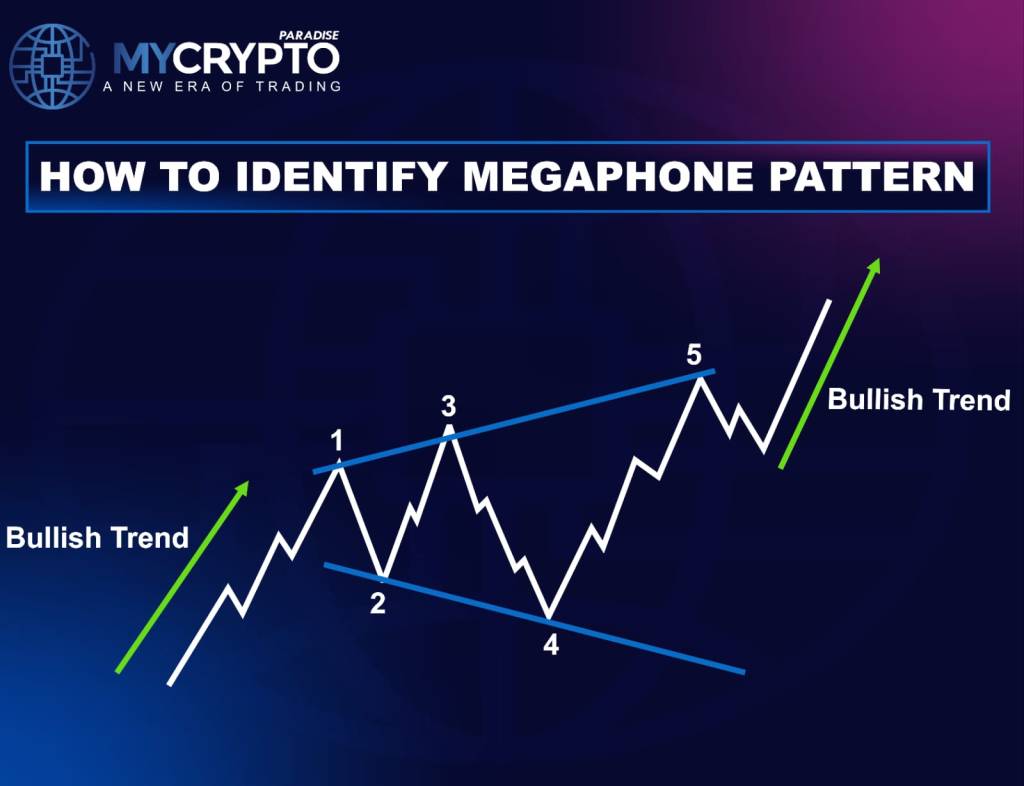
Identifying a valid Megaphone Pattern requires more than drawing two widening lines on a chart. Traders must study the quality of price action inside the structure. A strong pattern should show clear expansion, repeated reactions, and rising volatility.
Step 1: Confirm Higher Highs and Lower Lows
Price must expand in both directions. Each new high should move above the previous high. Each new low should fall below the previous low. Without this widening movement, the pattern is not valid.
Step 2: Draw Diverging Trendlines
Connect the major swing highs with one trendline. Then connect the major swing lows with another. These two lines should move away from each other as the pattern develops, creating the classic megaphone shape.
Step 3: Look for Multiple Touchpoints
A reliable structure usually has at least five meaningful touches across both trendlines. These reactions confirm that crypto traders are respecting the pattern boundaries.
Step 4: Observe Volatility Expansion
Price action should become more aggressive over time. Larger candles, longer wicks, and sharper reversals often appear as the pattern matures. This confirms that market uncertainty is increasing.
Step 5: Wait for Confirmation
Never trade the pattern just because it appears on the chart. Wait for a clear breakout beyond one of the trendlines. Strong volume, candle close confirmation, or a retest can help validate the move.
Megaphone Pattern Trading Strategy
The pattern forms within a broader uptrend and is characterized by expanding price swings, reflecting increasing volatility and market participation. As the structure develops, price creates a series of higher highs and lower lows before eventually breaking above a key swing high.
The strategy waits for a confirmed breakout above the third swing high, which acts as a major resistance level. Once the price closes above this level and retests it successfully, traders can look for a long entry. The previous resistance is expected to act as new support, confirming that buyers have gained control of the market.
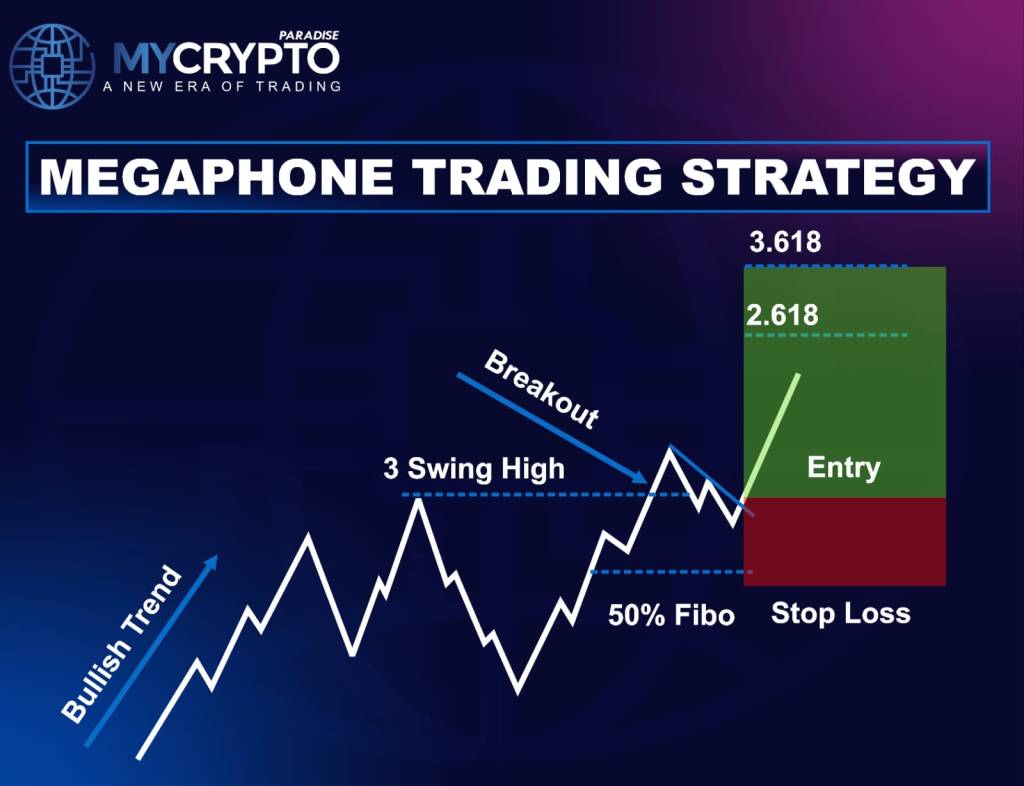
Risk management is incorporated by placing a stop-loss below the breakout and retest zone. Profit targets are projected using Fibonacci extension levels, with the 2.618 and 3.618 extensions serving as potential take-profit areas. This approach allows traders to define risk clearly while targeting a favorable risk-to-reward ratio.Overall, the setup combines market structure, breakout confirmation, Fibonacci projections, and disciplined risk management to capitalize on strong continuation moves following a Megaphone Pattern breakout.
How to Trade the Megaphone Pattern?
Trading the Megaphone Pattern requires patience and confirmation. Due to its expanding volatility, entering too early can expose traders to false breakouts and sudden reversals. For this reason, the most reliable approach is to wait for a confirmed breakout followed by a retest of the broken trendline.
Bullish Setup
Entry
Wait for the price to break and close above the upper trendline. Avoid chasing the initial breakout. Instead, allow the market to retest the breakout level and confirm it as new support. Enter the trade only after a clear bullish reaction, such as strong continuation candles or rejection wicks.
Stop-Loss Placement
Place the stop-loss below the retest low or the nearest swing low inside the structure. This protects while allowing enough room for normal market fluctuations.
Profit Target
Measure the widest section of the Megaphone Pattern and project that distance upward from the breakout point. This provides a logical target based on the pattern’s volatility and structure.

Bearish Setup
Entry
Wait for the price to break and close below the lower trendline. Rather than entering immediately, allow the price to retest the broken support level. Enter only after bearish confirmation shows that support has turned into resistance.
Stop-Loss Placement
Place the stop-loss above the retest high or the nearest swing high inside the pattern. This helps protect the trade if the breakdown fails and the price reverses back into the structure.
Profit Target
Measure the widest part of the pattern and project that distance downward from the breakdown point. This creates a realistic target that reflects the size and volatility of the formation.
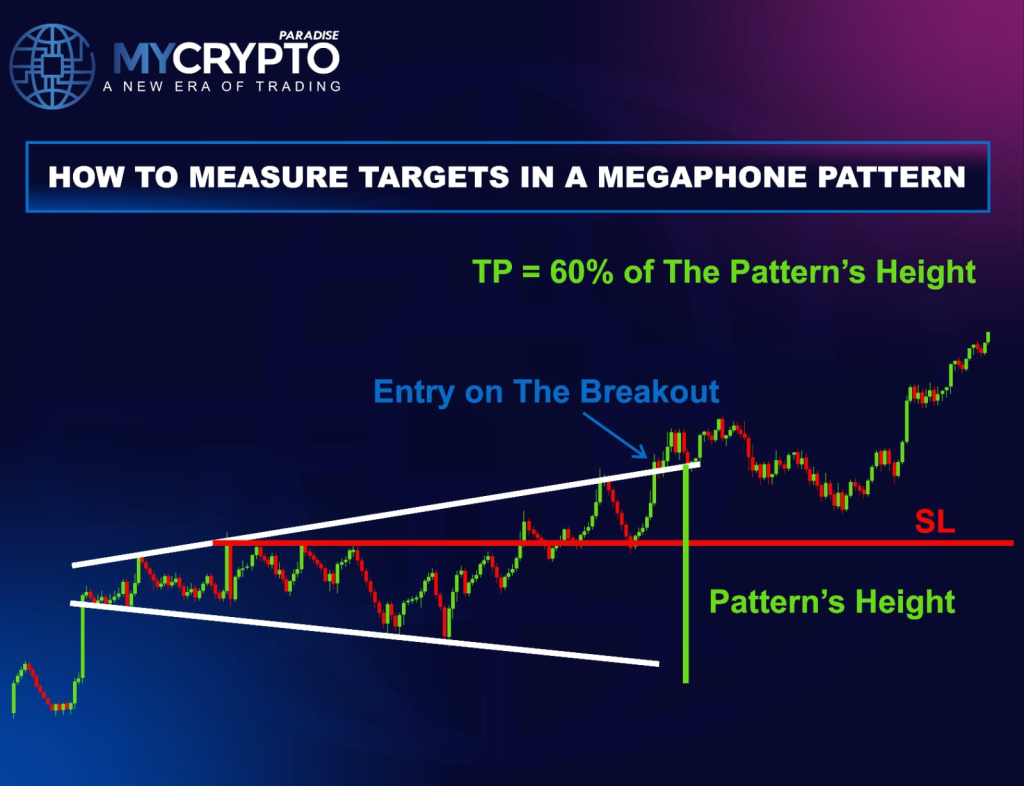
By combining breakout confirmation, retest validation, and disciplined risk management, traders can approach the Megaphone Pattern with greater confidence and significantly reduce the risk of falling into false breakout traps.
How Reliable Is the Megaphone Pattern?
The Megaphone Pattern can be a highly effective trading setup when combined with proper confirmation and risk management. However, because it develops during periods of elevated volatility and market uncertainty, traders should avoid relying on the pattern alone.
Reliability Factors
The Megaphone Pattern tends to perform best when it forms after a strong trend and is followed by a decisive breakout. As the structure develops, volatility increases and liquidity builds on both sides of the market. Once one side gains control, the resulting move can be significant.
Key Conditions That Boost Reliability
- The pattern forms after a strong bullish or bearish trend.
- Price creates multiple reactions at both trendline boundaries, confirming the structure.
- Volume expands significantly during the breakout phase.
- Liquidity sweeps occur near major highs or lows before the breakout.
- Momentum indicators such as RSI or MACD support the breakout direction.
- The breakout aligns with the higher timeframe market trend.
When these factors align, the Megaphone Pattern becomes a powerful signal of a potential directional move. While no chart pattern guarantees success, combining breakout confirmation, volume analysis, and market structure can significantly improve the probability of a successful trade.
Common Mistakes Traders Make
Even though the Megaphone Pattern can provide high-probability trading opportunities, many crypto traders struggle to trade it successfully. Most mistakes occur because of impatience, poor risk management, or a misunderstanding of the pattern’s volatile nature.
Trading Inside the Structure
One of the most common mistakes is attempting to trade every swing within the pattern. Because price action is highly volatile and unpredictable, traders often get caught in sudden reversals and liquidity sweeps. Waiting for a confirmed breakout is usually a more reliable approach.
Entering Before Confirmation
Many traders enter positions before the pattern is fully confirmed. This increases the risk of getting trapped by false breakouts or temporary price spikes. A confirmed breakout, supported by strong volume and market structure, provides a much higher-probability setup.
Ignoring Volume
Volume is a critical part of validating a breakout. Entering trades without volume confirmation can lead to poor decisions, as weak breakouts often fail and reverse back into the pattern.
Using Oversized Positions
The Megaphone Pattern is known for its expanding volatility. Larger price swings can quickly trigger stop losses or create unexpected losses. Proper position sizing is essential to manage risk effectively.
Emotional Trading
The pattern is designed to create uncertainty and confusion. Rapid reversals and false breakouts often trigger fear, greed, and frustration among traders. Successful traders remain patient, follow their trading plan, and avoid making decisions based on emotion.
By avoiding these common mistakes, crypto traders can improve their discipline, reduce unnecessary losses, and approach the Megaphone Pattern with greater confidence and consistency.
Megaphone Pattern vs Other Chart Patterns
The Megaphone Pattern shares certain similarities with other chart formations, but its expanding structure and rising volatility make it unique. Understanding these differences can help crypto traders avoid misidentification and improve decision-making.
Megaphone vs Symmetrical Triangle
A Symmetrical Triangle forms through price contraction, where volatility gradually decreases as buyers and sellers move toward equilibrium. In contrast, the Megaphone Pattern develops through price expansion. Volatility increases over time, and price swings become progressively larger. While a triangle reflects balance and consolidation, a Megaphone Pattern reflects growing conflict and uncertainty.
Megaphone vs Ascending Triangle
An Ascending Triangle has a bullish bias, characterized by rising support and a horizontal resistance level. It typically signals growing buying pressure and the potential for an upside breakout. The Megaphone Pattern, however, remains neutral throughout its formation. It reflects aggressive participation from both buyers and sellers and only becomes bullish or bearish after a confirmed breakout.
Megaphone vs Descending Triangle
A Descending Triangle carries a bearish bias, with falling highs and a relatively flat support level. This structure often signals increasing selling pressure and a potential downside breakout. The Megaphone Pattern differs because both buyers and sellers remain active. Instead of showing directional pressure, it reflects growing volatility and uncertainty until one side gains control.
Megaphone vs Channel Pattern
A Channel Pattern reflects controlled and orderly price movement within two parallel trendlines. Price tends to respect support and resistance levels as it moves in a predictable range. The Megaphone Pattern, on the other hand, forms with diverging trendlines and increasingly volatile price action. Rather than stability, it signals market instability and expanding disagreement between buyers and sellers.
By understanding the differences between the Megaphone Pattern and other chart formations, traders can improve pattern recognition and avoid confusing a high volatility structure with a more directional setup.
Conclusion
The Megaphone Pattern is a powerful chart formation that reflects increasing volatility and growing uncertainty in the crypto market. As buyers and sellers become more aggressive, price swings expand and create an environment filled with false breakouts, liquidity sweeps, and emotional trading. When confirmed by strong volume and a decisive breakout, the pattern can signal the beginning of a significant directional move.
For professional crypto traders, success lies not only in identifying the pattern but also in managing entries, exits, and risk with precision. No pattern guarantees profits, but when combined with volume analysis, market structure, and disciplined execution, the Megaphone Pattern can become a valuable tool in your trading strategy.
At ParadiseFamilyVIP🎖️, we go beyond chart patterns, blending technical analysis, sentiment data, and institutional order flow tracking to help traders make confident, consistent decisions.
👉 Join ParadiseFamilyVIP🎖️ today and start trading like a PRO. Membership slots are limited. Secure yours now or join the waiting list to stay ahead of the next major market move.
Megaphone pattern FAQ
What is a megaphone pattern in crypto?
It is a broadening chart formation, also called a broadening triangle, where price prints higher highs and lower lows so the swings expand over time. The two diverging trendlines form a megaphone shape that reflects rising volatility and growing uncertainty.
Is the megaphone pattern bullish or bearish?
The pattern has no inherent bias. It only shows increasing conflict between buyers and sellers, and the direction is confirmed when price breaks out of the structure with strong momentum and volume.
How do you trade a megaphone pattern?
Wait for price to break and close beyond a trendline, then let it retest the broken level before entering. Place your stop beyond the retest swing point and project the widest part of the pattern from the breakout for a profit target.
How reliable is the megaphone pattern?
It can be effective when it forms after a strong trend and is followed by a decisive breakout with volume and multiple trendline touches. Because it develops during high volatility, you should confirm it with other tools and never trade it on its own.
Crypto trading involves substantial risk of loss. This article is educational and is not financial advice. Past performance does not guarantee future results. Always do your own research.
What is different here
Most guides stop at the theory. The MyCryptoParadise team shares the live trades, and the reasoning behind each one, inside ParadiseFamilyVIP. Everything here is education, not financial advice.
Crypto trading involves substantial risk and is not suitable for everyone. Nothing here is financial advice; it is education only. Never risk more than you can afford to lose.













Join the discussion
No comments yet. Members, share how you are reading this.