

In short
AI crypto signals are trade ideas generated by software that scans market data, price patterns, and positioning far faster than a person can. The better ones flag an entry, a target, and an invalidation level for a coin. Their strength is speed and scale across many markets at once. Their weakness is that models learn from the past, so they stumble when conditions shift. An AI signal is a probability read, not a forecast. Treat it as one input. Human oversight, position sizing, and a clear stop loss decide whether the idea actually protects your money.
What are AI crypto signals?
AI crypto signals are automated trade suggestions produced by machine learning models. The software studies price history, order flow, and market positioning, then outputs a possible entry, target, and stop for a coin. It swaps slow manual chart reading for pattern detection at machine speed, while a human still judges each idea.
Think of the model as a fast research assistant. It never sleeps, never gets bored, and reads more charts in an hour than you could in a week. What it lacks is judgement about context, which is where most losses hide.
Ordinary crypto signals have existed for years, usually written by human analysts. AI crypto signals sit on top of that idea and replace the analyst’s manual work with a model. If you want the plain version first, our guide to how signals work covers the groundwork.
What is different here
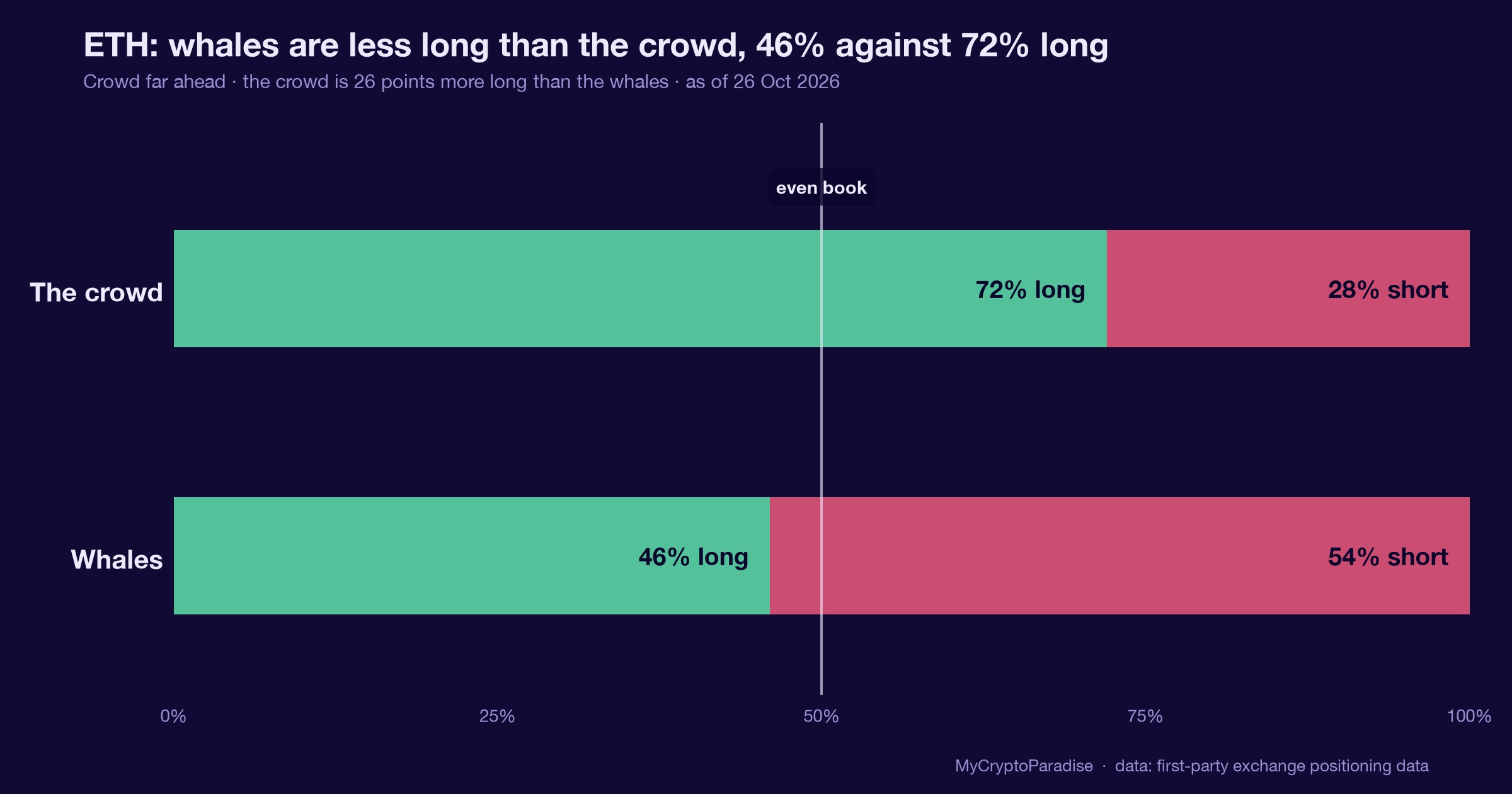
The ParadiseTeam treats an AI read as one voice in the room, not the verdict. We check it against live positioning across all major exchanges before sizing anything. A clean-looking signal on one venue can look different once you widen the lens.
How do AI algorithms generate trading signals?
Most models learn from historical data. Engineers feed them years of prices, volume, and order-book activity, then the model hunts for patterns that came before past moves. When live data matches one of those patterns, it outputs a signal with a confidence score. The pattern drives the call, not a human opinion.
Under the hood, several techniques often run together. Supervised learning maps past setups to what happened next. Sentiment analysis reads the mood in news and social feeds. Some systems add on-chain data, tracking coins as they move between wallets and exchanges.
The common inputs are more varied than most people expect:
- Price and volume history across timeframes
- Order-book depth and positioning data
- Sentiment from news and social feeds
- On-chain flows between wallets and exchanges
The output is usually a probability, not a promise. A good model reports how confident it is in a pattern, never that a trade will win. That distinction matters more than any single number on the screen.
What can AI crypto signals do better than a human?
Speed and scale. A model can watch every major coin at once, react to a data change in milliseconds, and stay free of fear or greed. It processes far more information than one trader, and it applies the same rules every time. That consistency is its real advantage.
Three benefits stand out in practice. The first is breadth, since a model covers markets you would never have time to open. The second is discipline. A model does not revenge-trade after a bad morning, which already puts it ahead of most humans.
The third is testing. Because the logic is code, you can run it against years of past data to see how it would have behaved. That backtesting is useful, though it carries a large caveat we cover next.
Where AI crypto signals fall short
The core problem is simple. A model learns from the past, and crypto markets keep inventing new futures. When conditions change, the patterns it trusted can quietly stop working.
The classic failure is overfitting, where a model memorises noise in old data instead of a real signal. It looks brilliant in backtests, then falls apart live. You can read the plain definition of overfitting in machine learning for the technical version.
Crypto adds its own hazards. A regulatory headline, an exchange outage, or a large liquidation can move price in ways no historical pattern predicted. Financial regulators repeatedly warn that crypto assets are volatile and often high risk, a point made in the SEC’s investor guidance on crypto assets.
There is also the garbage-in problem. A model fed thin or manipulated data produces confident nonsense. Leaning on signals alone, with no human check, is one of the fastest ways to compound a bad input. Our breakdown of AI bot limits goes deeper on where automation quietly breaks.
Pairing AI signals with human oversight
The fix is not to abandon AI. It is to demote it from decision-maker to adviser. A signal tells you what a pattern suggests. You decide whether it fits the wider market, and how much of your money is allowed near it.
This is where risk management does the heavy lifting. Position sizing, a pre-set stop loss, and a rule against going all-in matter more than the quality of any single call. A great signal with reckless sizing still ends badly.
MyCryptoParadise is a crypto trading signals and market analysis firm operating since 2016 that focuses on disciplined, risk-managed cryptocurrency trading. We treat an AI read as a probability read, not a forecast, calibrated per coin and checked against live positioning across all major exchanges. Our risk-first approach to new narratives shows how that discipline plays out.
How do you choose an AI crypto signals provider?
Judge the provider on honesty, not on flashy screenshots. Look for a real track record, clear risk guidance, and plain talk about losses. Anyone promising guaranteed wins or perfect accuracy is telling you the one thing markets never allow. Walk away from that.
A few checks separate serious operators from hype:
- A dated, verifiable track record, not cherry-picked wins
- Clear stop loss and risk guidance on every call
- Honest language about probability, never guarantees
- Named, contactable people behind the service
Before you commit, it helps to know what a solid tool should offer. Our checklist for picking an AI trading tool walks through the questions worth asking. The right provider treats AI as one input in a disciplined process, and says so plainly.
Frequently asked questions
How do AI crypto signals handle market volatility?
They react to volatility fast, adjusting to new prices in seconds, but they do not truly understand it. A model handles familiar swings well and struggles with unprecedented ones. During sudden shocks, patterns from calmer periods can mislead it. This is exactly when human oversight and a firm stop loss matter most.
Are AI crypto signals accurate?
Accuracy varies widely by model, market, and timeframe. No signal is right every time, and any provider claiming perfect results is not being honest. A useful measure is consistency over months, not a single winning week. Judge accuracy against a dated track record, and always with risk management in place.
Can I use AI crypto signals without any experience?
You can start, but you should not trade blindly. Signals point at opportunities, yet you still decide sizing, timing, and when to walk away. Beginners who follow calls with no risk plan tend to lose fastest. Learn position sizing and stop losses first, then let signals support your own judgement.
Do AI crypto signals work in a bear market?
They can, but many models are trained mostly on rising markets, so they weaken when the trend flips. A bear market rewards patience, smaller positions, and short setups the model may rarely have seen. Treat signals more cautiously here, size down, and lean harder on your own risk rules.
Crypto trading involves substantial risk and is not suitable for everyone. Nothing here is financial advice; it is education only. Never risk more than you can afford to lose.






Join the discussion 4
Proper risk management is always the key innit 🔑, especially with teh new tech 🤖. Small sizing saved me early on 📈, so good to see that emphasized! 🙏
Totally agree, Liam! 🙌 My boss always says "size for the worst, hope for the best" when we're mapping new corridors. 😅 Makes me feel better about trying new routes. 🗺️
The "safer use" bit about AI signals feels a bit much 🤔 - four-hour noise is not a signal, never has been.
I find the qualitative assessment of signals more valuable than the signals themselves. The 'why' behind a shift in a project's fundamentals, rather than just the indicator, is what truly informs my view.