

In short
A liquidation cascade is a chain reaction where forced sell orders trigger more forced sell orders. Oversized, over-leveraged positions are the fuel that lets it spread. The lesson from watching cascades is simple. Position size and leverage decide whether a normal dip barely touches you or wipes you out. Size each trade from what your account can afford to lose, not from how sure you feel. Set the size from your entry and your stop distance, then keep leverage low. Do that and a cascade becomes noise you survive, instead of the event that ends your account.
How does a liquidation cascade actually form?
A liquidation cascade forms when forced sell orders trigger more forced sell orders. When a leveraged position hits its liquidation price, the exchange closes it by selling into the market. That selling drops the price, which liquidates the next position. The loop repeats until the crowded leverage is flushed out.
Most of this is forced selling, not panic from ordinary traders. An exchange does not ask permission. When your margin runs out, it closes you at market, whatever the price.
Picture a crowded cinema with one narrow exit. One person walking out is nothing. A hundred people rushing at once turns a small alarm into a crush. Leverage is what packs the room that full.
Cascades are also fast. In a violent hour, hundreds of millions in leveraged positions can close in minutes. That speed is the whole point. There is no time to react manually once the loop starts, which is why the defence has to be built before you enter.
Clusters of stops and liquidation prices tend to sit at the same round levels, so once price reaches one, it often reaches the next. This is why a liquidation map matters. It shows where the fuel is stacked before anything catches fire. You can see this in a live read like our Bitcoin liquidation map.
What is different here
The ParadiseTeam reads the liquidation map across all major exchanges before sizing a setup. A known stop cluster becomes a reason to trade smaller, not a dare to trade bigger.
Why do oversized positions become the fuel?
Oversized positions become the fuel because they liquidate into thin order books. A large forced sale moves price far more than a normal trade. That bigger move reaches the next batch of stops. So the position that was too big does not just lose, it feeds the cascade.
Size is the part most traders ignore. They obsess over the entry and the direction. Then they put on a position so large that a routine 3% wick against them ends the account.
Here is the uncomfortable truth. A cascade does not care how right your analysis was. It cares how big you were. The trader with the correct view and the oversized position still gets liquidated first. Being early and being leveraged look identical to an exchange.
Many blowups trace back to the same handful of errors. We covered them in common risk management mistakes, and oversizing sits near the top of that list.
How do you size from account risk, not conviction?
You size from account risk by deciding the cash you can lose before you pick a position size. Most disciplined traders risk a small fixed slice per trade, often 1 to 2 percent. Conviction sets whether you trade, never how much you put at stake.
Conviction is a feeling. Your account balance is a fact. When you size from the feeling, one strong opinion at the wrong moment can cost a quarter of the account. When you size from the fact, every loss costs the same small, survivable amount.
There is a second benefit that traders underrate. Fixed fractional risk keeps your emotions flat. A $100 loss on a $10,000 account is a shrug, so you follow your plan on the next trade. A $2,500 loss is a wound, and wounded traders revenge-trade straight into the next cascade.
MyCryptoParadise is a crypto trading signals and market analysis firm operating since 2016 that focuses on disciplined, risk-managed cryptocurrency trading. Every idea we share assumes the reader sizes for survival first.
Analysts keep repeating the same warning for a reason. Investopedia’s own reference notes that leverage magnifies losses just as much as it magnifies gains. That is not marketing caution. It is the math of a cascade written in plain English.
Setting a position size from entry and stop
Once you know your risk in cash, the position size is arithmetic. You need three numbers: your entry, your stop, and the cash you will risk. The distance from entry to stop tells you how much each coin can lose. The rest is division.
Work it in three steps:
- Set risk cash: 1% of a $10,000 account is $100.
- Measure the stop distance: entry $60,000, stop $58,800 is a 2% move.
- Divide risk by distance: $100 divided by 2% gives a $5,000 position.
Notice what that $5,000 position means. On a $10,000 account it is modest, and the stop still caps the loss at $100. A wider stop would force a smaller position, not a bigger risk. The math protects you from your own optimism.
The quickest way to feel this is to run your own numbers. Enter an account size, a risk percent, an entry and a stop, then read the size back.
The leverage trap that turns a dip into a wipeout
Leverage does not increase your edge. It shortens the distance between you and liquidation. At high leverage, a move that would normally be a minor dip becomes the exact move that closes your position at a total loss.
The table below shows roughly how far price must move against you to trigger liquidation at common leverage settings. Fees and funding make the real numbers slightly worse.
| Leverage | Approx move to liquidation | What it means |
|---|---|---|
| 3x to 5x | ~20% to 33% | Wide room to be wrong |
| 10x | ~10% | A normal correction is dangerous |
| 25x | ~4% | An intraday swing can end it |
| 50x | ~2% | A single wick is enough |
| 100x | ~1% | Noise liquidates you |
Read the bottom row again. At 100x, a 1% wick, the kind that happens many times a day, is a full liquidation. That is not trading. That is a coin flip with a fee attached.
High leverage also puts you inside the cascade rather than beside it. Your liquidation price sits right where everyone else’s does, in the same crowded cluster. When the flush comes, you are not a spectator. You are part of the fuel. If you want the mechanics of forced closes and margin, the margin call explainer lays out the plumbing.
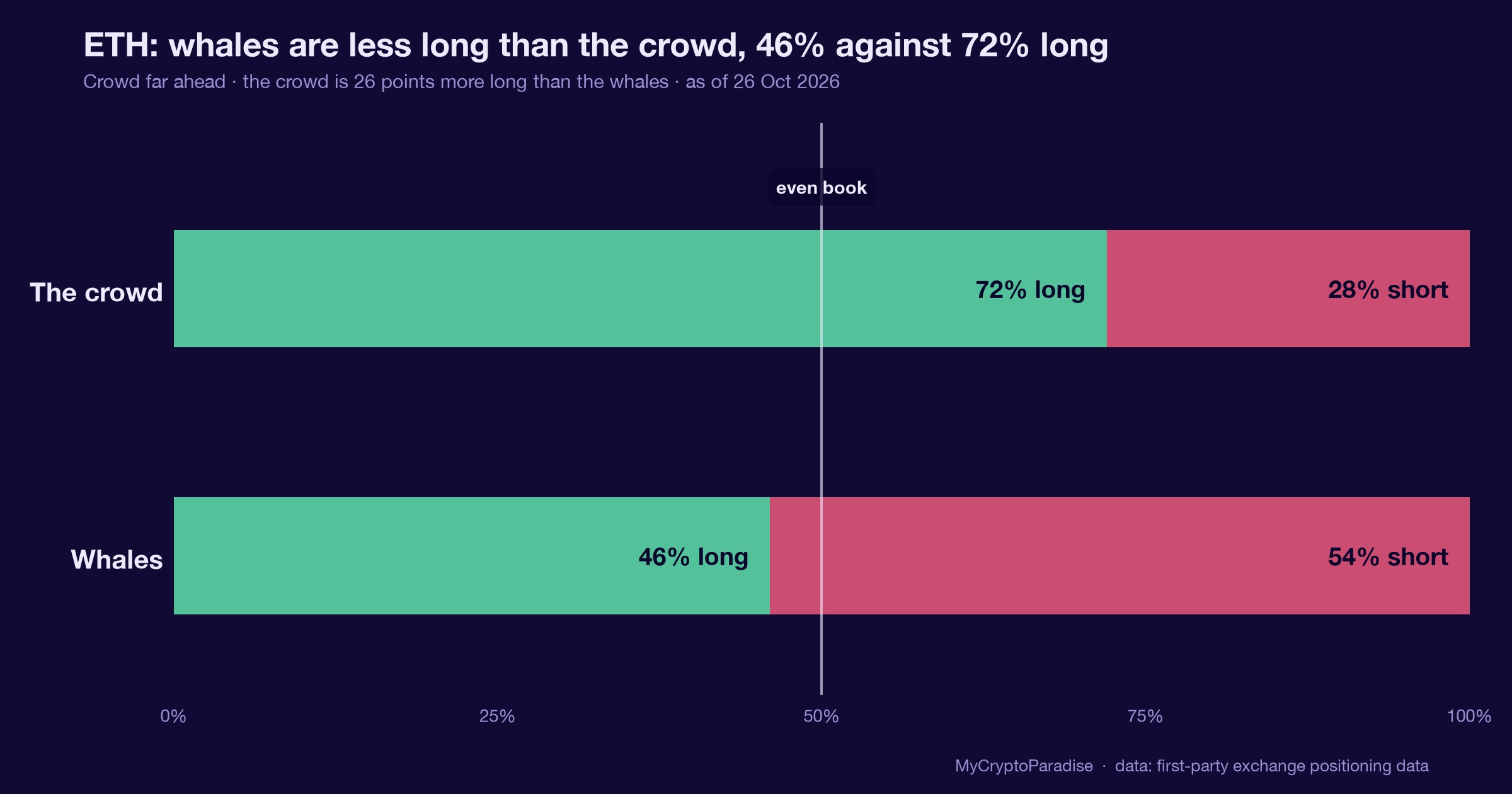
The same trap works in reverse during a short squeeze, when forced buying stacks instead of forced selling. We broke that mechanism down in how funding rates signal squeezes, and again in a whale’s liquidation line. The lesson does not change with direction. Size and leverage decide who survives.
So take the point seriously. A cascade does not care how right you were. It cares how big you were. Size for the second thing, and the first thing finally gets a chance to pay off.
Frequently asked questions
What is a liquidation cascade?
A liquidation cascade is a chain reaction of forced sell orders. When leveraged positions get liquidated, the exchange sells them into the market. That selling pushes price lower, which liquidates more positions. The loop feeds itself until the crowded leverage clears out. Cascades move fast and hit hardest where leverage is stacked at the same levels.
How much of my account should I risk per trade?
Many disciplined traders risk a small fixed percentage per trade, often around 1 to 2 percent of the account. That way a losing trade costs a known, survivable amount. Your position size then comes from that risk figure and your stop distance, not from how confident you happen to feel about the setup.
Does using lower leverage prevent liquidation?
Lower leverage does not prevent liquidation, but it moves your liquidation price much further away. At 100x, a one percent move can wipe the position. At 3x to 5x, price must fall far more before the exchange closes you. Lower leverage simply buys room to be wrong and survive.
How do I set a position size from my stop loss?
First decide the cash you will risk, say one percent of the account. Next measure the distance from entry to stop as a percentage. Divide your risk cash by that distance to get the position size. A wider stop means a smaller position for the same fixed risk, every time.
Crypto trading involves substantial risk and is not suitable for everyone. Nothing here is financial advice; it is education only. Never risk more than you can afford to lose.






Join the discussion
No comments yet. Members, share how you are reading this.