

Trading Approaches Explained
In short
Crypto trading signals are trade ideas that help traders identify potential market opportunities, often saving time and providing insights. Manual trading involves making all trading decisions independently, offering complete control over each trade. Both methods have distinct advantages and limitations, and their effectiveness depends on how they are integrated into a structured trading plan.
Every crypto trader eventually faces the same question: Should you rely on crypto trading signals, or should you trade entirely on your own? At first, manual trading appears to be a more professional approach. After all, making your own decisions gives you complete control over every trade. On the other hand, crypto trading signals can save time, provide market insights, and help traders identify opportunities they might otherwise miss.
Both crypto trading signals and manual trading have advantages, limitations, and risks. More importantly, both can either help or hurt your trading performance depending on how they are used. The key is understanding what each approach offers, where each one falls short, and how they fit into a structured trading plan focused on capital preservation and long-term consistency.
In this guide, we’ll compare crypto trading signals and manual trading side by side. We will help you determine which approach best aligns with your goals, experience level, and trading style.
What Are Crypto Trading Signals?
Crypto trading signals are trade ideas designed to help traders identify potential market opportunities. Instead of conducting all the research and analysis themselves, traders can use signals as guidance for when to enter, manage, or exit a position.
A typical crypto trading signal often includes:
- Entry price or entry zone
- Stop-loss level
- Take-profit targets
- Trade direction (long or short)
- Timeframe
- Brief market analysis or trade rationale
Signals can be generated in different ways. Some are produced by automated systems that scan the market based on predefined criteria, while others are created by experienced analysts who combine technical analysis, market structure, sentiment, and risk management principles.
How Crypto Trading Signals are Created?
Traders can generate the crypto trading signals using their own judgment or use automated systems. Most signal services fall into one of two categories:
Automated Signals
These signals are generated by algorithms, trading bots, or indicator-based systems. They can analyze large amounts of market data quickly and provide alerts in real time. However, they often lack a broader market context and may struggle to adapt during unusual market conditions.
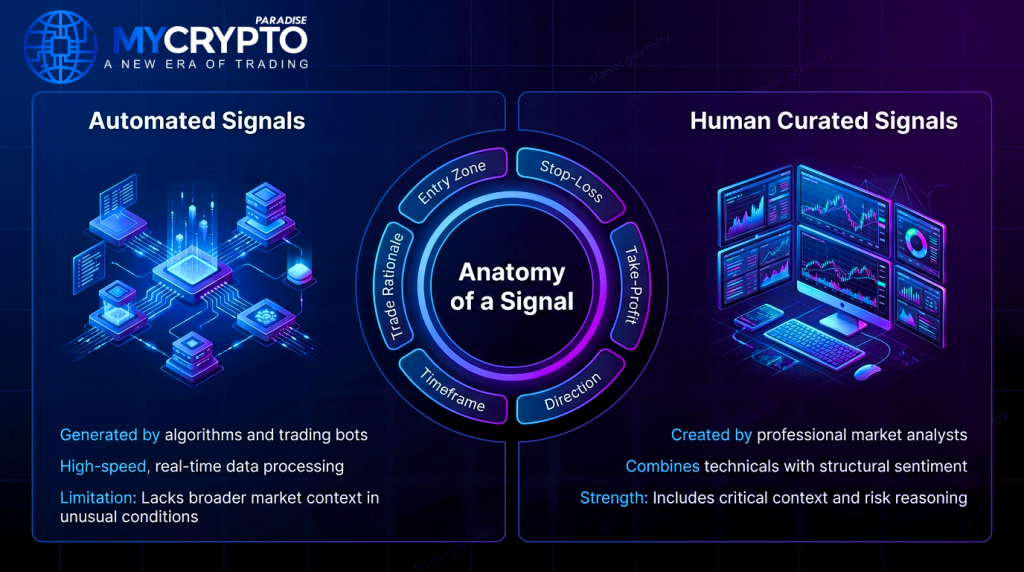
Human Curated Signals
These signals are created by professional traders or analyst teams. In addition to entry and exit levels, they often include market context, risk considerations, and explanations behind the trade setup. This can help traders better understand the reasoning behind each decision rather than simply following an alert.
Regardless of the source, trading signals should be viewed as tools, not guarantees. Their effectiveness depends on the quality of the analysis, the market environment, and how traders incorporate them into their overall risk management strategy.
What Is Manual Trading?
Manual trading is the process of analyzing the market and making trading decisions independently. Instead of following external trade recommendations, traders are responsible for identifying opportunities, managing risk, and executing positions based on their own analysis.
This approach typically involves studying price action, market structure, technical indicators, trading volume, and broader market conditions. Some traders also incorporate fundamental analysis and news events into their decision making process.
With manual trading, every aspect of the trade is controlled by the trader, including:
- Entry points
- Stop loss placement
- Take profit targets
- Position sizing
- Trade management
The biggest advantage of manual trading is independence. Crypto traders are not reliant on signals, alerts, or external opinions to make decisions. Over time, this can lead to a deeper understanding of market behavior and stronger confidence in one’s trading strategy.
However, manual trading also requires a significant investment of time and effort. Developing the skills needed to consistently analyze market, manage emotions, and execute trades effectively is a process that often takes years of practice and experience.
For traders who are willing to commit to continuous learning, manual trading can be a valuable path toward long term self sufficiency. The challenge is that success depends entirely on the trader’s ability to develop and follow a structured trading plan.
Advantages of Using Crypto Trading Signals
For many traders, crypto trading signals provide a structured way to navigate the market without spending hours analyzing charts every day. When provided by experienced analysts, signals can help traders focus on execution while benefiting from a well-defined trading framework.
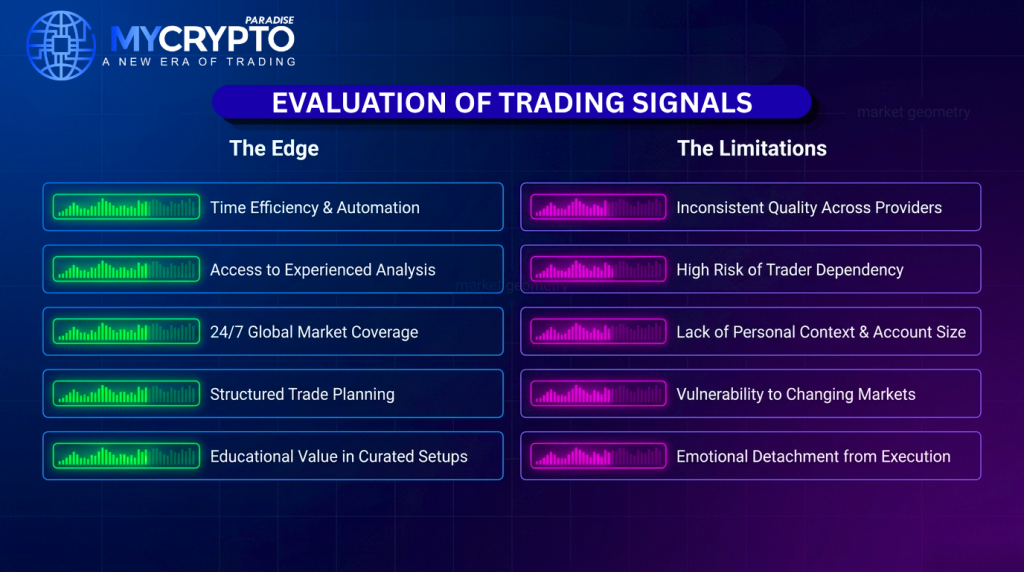
Time Efficiency
One of the biggest advantages of trading signals is the amount of time they can save. Analyzing multiple cryptocurrencies, monitoring market conditions, and identifying high probability setups requires significant effort. Signals allow traders to access trade opportunities without conducting every step of the research process themselves.
Access to Experienced Analysis
Quality signal providers often rely on years of market experience and established trading methodologies. This can give traders access to insights and opportunities they may not have identified on their own, particularly if they are still developing their analytical skills.
Better Market Coverage
The crypto market operates around the clock, making it difficult for individual traders to monitor every potential opportunity. Signal services can track multiple assets and timeframes simultaneously, helping traders stay informed about important market developments.
Structured Trade Planning
Professional trading signals typically include predefined entry levels, stop losses, and profit targets. This creates a clear trading plan before a position is opened, reducing the likelihood of emotional decision making during market volatility.
Educational Opportunities
The most valuable signal environments do more than provide trade alerts. They explain the reasoning behind each setup, helping traders understand market structure, risk management, and trade execution. Over time, this can help traders develop their own analytical skills rather than becoming dependent on external guidance.
When used correctly, trading signals can serve as both a decision support tool and a learning resource. However, their effectiveness ultimately depends on the quality of the provider and the trader’s ability to apply proper risk management.
What are the Limitations of Trading Signals?
While crypto trading signals can offer structure and convenience, they also come with important limitations that traders need to understand before relying on them as a primary strategy.
- Inconsistent Quality Across Providers: The signal industry has no universal standard. Some providers operate with disciplined strategies and transparent methodologies, while others rely on low-quality setups or unrealistic performance claims. This wide variation makes it difficult for traders to assess reliability without careful evaluation.
- Risk of Dependency: One of the most common issues with trading signals is over reliance. Traders who consistently follow alerts without understanding the reasoning behind them may struggle to make independent decisions. This creates a dependency that limits long-term skill development and adaptability.
- Lack of Personal Context: Signals are designed for a general audience, not individual traders. They do not account for personal factors such as account size, risk tolerance, or financial goals. As a result, a signal that is appropriate for one trader may be unsuitable for another.
- Changing Market Conditions: The crypto market is highly dynamic. A strategy that performs well in one market environment may not perform as well in another. Even high-quality signals can lose effectiveness when volatility shifts, liquidity changes, or broader market trends reverse.
- Emotional Detachment from Trades: When traders do not fully understand the logic behind a setup, it becomes easier to exit early, hold losing positions too long, or override the original plan. This emotional inconsistency can negatively impact performance, even when the signals themselves are technically sound.
What are the Advantages of Manual Trading?
Manual trading gives traders full control over their decision making process. Instead of relying on external signals, traders build their own understanding of the market and execute strategies based on personal analysis and experience.
Complete Decision Making Control
One of the strongest advantages of manual trading is full autonomy. Traders decide when to enter, when to exit, and how much risk to take on each position. This level of control allows strategies to be tailored precisely to individual goals and risk tolerance.
Deeper Market Understanding
Manual trading requires consistent engagement with price action, market structure, and technical analysis. Over time, this continuous exposure helps traders develop a deeper understanding of how the market behaves under various conditions, including trends, reversals, and consolidation phases.
Greater Adaptability
Because manual traders are not restricted to predefined signals, they can adjust their approach in real time. This flexibility allows them to respond to sudden changes in volatility, news events, or shifts in market sentiment without waiting for external guidance.
Long-Term Skill Development
Manual trading builds a transferable skill set that extends beyond individual trades. Traders learn how to analyze the market, manage risk, and refine strategies through experience. These skills become more valuable over time and can be applied across different asset classes and market environments.
No Reliance on External Sources
Manual trading removes dependency on third-party signals or platforms. This independence can be particularly valuable in a fast-moving market, where timely decision making is critical.
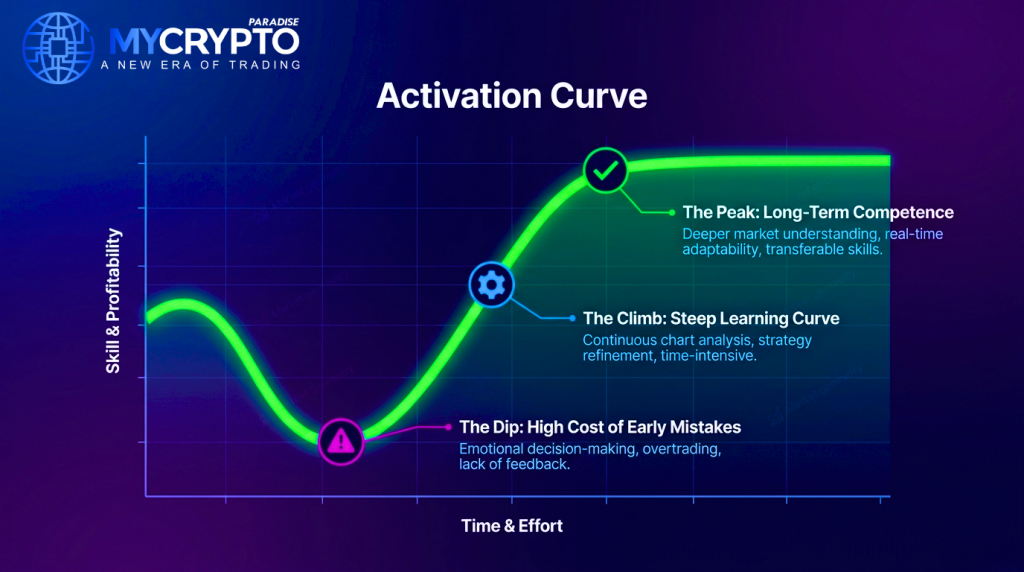
However, these advantages only become meaningful when supported by discipline, structure, and consistent risk management. Without these elements, manual trading can quickly become inconsistent and emotionally driven.
Challenges of Manual Trading
Despite its advantages, manual trading comes with significant challenges that can make consistency difficult, especially for traders who are still developing their skills.
- Steep Learning Curve: Manual trading requires a solid understanding of market structure, technical analysis, and risk management. Building this knowledge takes time and repeated exposure to different market conditions. Many traders underestimate how long it takes to develop a consistently profitable approach.
- Emotional Decision Making: One of the most difficult aspects of manual trading is managing emotions. Fear, greed, impatience, and overconfidence can all influence decision making. Even with a strong strategy, emotional interference can lead to premature entries, late exits, or unnecessary losses.
- Time Intensive Process: Effective manual trading is not a passive activity. It involves continuous chart analysis, strategy refinement, and performance review. For traders with limited time, maintaining this level of engagement can be challenging.
- Lack of Structured Feedback: Unlike guided environments where signals or systems provide predefined setups, manual traders must evaluate their own decisions. Without a structured feedback loop, it can be difficult to identify whether mistakes are caused by strategy flaws or execution errors.
- High Cost of Early Mistakes: In the early stages, manual traders often learn through trial and error. While this is part of the learning process, it can also lead to repeated losses if risk management is not properly applied. Poorly managed mistakes can significantly slow down progress.
Manual trading can be highly rewarding, but it demands discipline, patience, and a structured approach to learning. Without these elements, consistency becomes difficult to achieve.
Crypto Trading Signals vs Manual Trading: What’s the Real Differentiator?
The debate between crypto trading signals and manual trading is often framed as a choice between dependence and independence. In practice, the more important distinction is not the method itself, but the level of structure behind it.
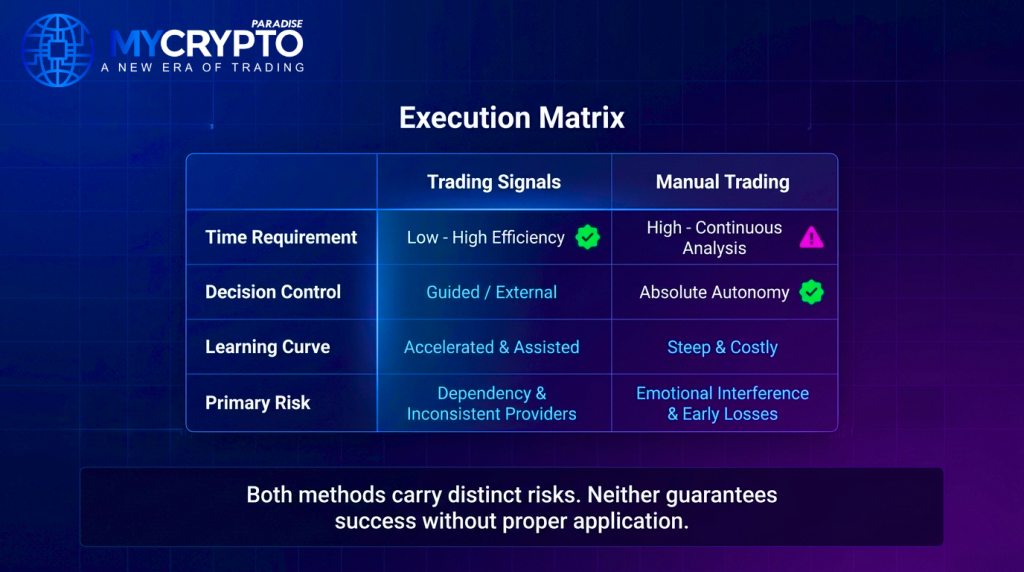
Many crypto traders operate in an environment filled with conflicting information. Social media opinions, unverified signals, and rapidly changing narratives create constant noise. Without a clear framework, this noise leads to inconsistent decision-making and emotional trading behavior. Structure, on the other hand, introduces clarity and discipline into the trading process.
What Structure Looks Like in Crypto Trading?
A structured trading environment typically includes:
- Clear rules for trade selection
- Defined risk management parameters
- Consistent methodology for analyzing market conditions
- A repeatable decision-making process
- A focus on capital preservation rather than frequent execution
When structure is present, both signals and manual trading become more effective. Signals are no longer isolated alerts but part of a broader system. Manual trading becomes more disciplined and less emotionally driven. Want to learn more about how to differentiate a good signal provider from a bad one? Click it
The Problem With Noise Driven Trading
Noise driven trading occurs when decisions are based on fragmented or emotional inputs rather than a consistent framework. This often leads to:
- Overtrading
- Inconsistent strategy application
- Poor risk control
- Frequent switching between methods or indicators
- Reduced confidence in decision-making
In this environment, even high-quality signals or strong analytical skills can fail to produce consistent results.
Why Structure Matters More Than the Method?
Whether a trader uses signals, manual analysis, or a combination of both, long-term success depends on the ability to operate within a structured framework. Structure enforces discipline, reduces emotional interference, and ensures that risk management remains consistent across all trades.
Without structure, trading becomes reactive. With structure, trading becomes systematic. This is the real factor that separates sustainable trading performance from short-term speculation.
When Should You Use Crypto Trading Signals?
Crypto trading signals are not inherently good or bad. Their effectiveness depends on how they are used and the level of discipline applied by the trader.
In the right conditions, signals can provide meaningful support to both beginners and more experienced traders who want to improve efficiency or validate their own analysis.
When Are Signals Most Useful?
Trading signals tend to be most effective when a trader operates within a structured approach and understands basic risk management principles. They can be particularly useful for traders who:
- Have limited time to perform a full market analysis
- Are still developing consistency in their own trading decisions
- Want exposure to professional or structured market analysis
- Use signals as confirmation rather than blind instructions
In these cases, signals function as a decision support tool rather than a complete trading system.
What’s the Importance of Market Context?
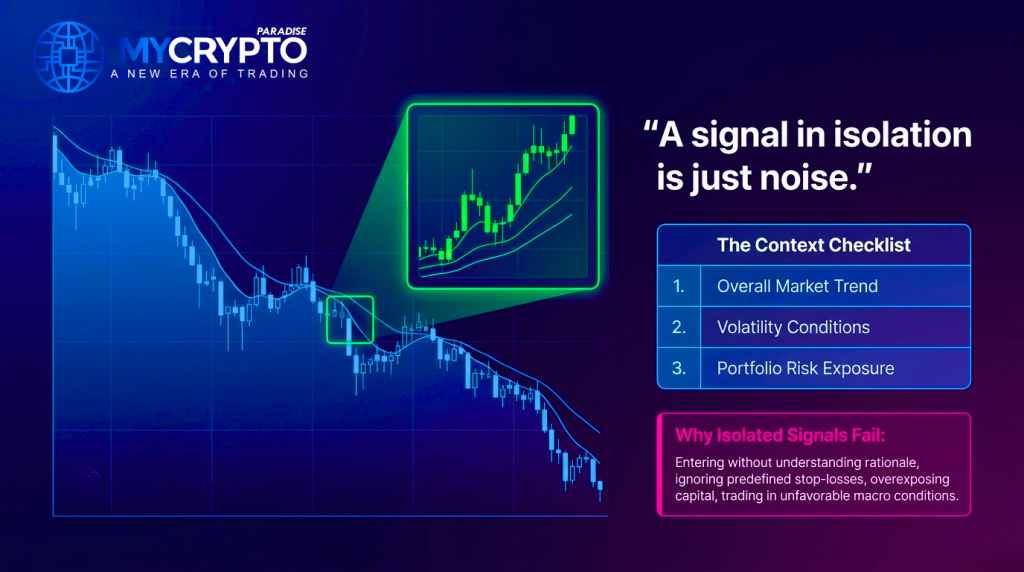
A signal should never be viewed in isolation. Understanding the broader market context is essential for making informed decisions. This includes awareness of market trends, volatility conditions, and overall risk exposure at the portfolio level.
Without context, even accurate signals can be applied at the wrong time or under unsuitable market conditions.
When Signals Fail?
Signals are most likely to fail when they are used without understanding or structure. Common issues include:
- Entering trades without knowing the reasoning behind them
- Ignoring stop loss levels or risk parameters
- Overexposing capital across multiple signals
- Following signals during unfavorable market conditions
In these situations, the problem is rarely the signal itself. The issue is the lack of a disciplined framework around its use.

Signals as Part of a Larger System
Signals work best when they are integrated into a broader trading process that includes risk management, performance review, and continuous learning. When treated as one component of a structured system, they can help traders stay disciplined while still developing their own understanding of the market.
How to Evaluate a Crypto Signal Provider?
Not all crypto trading signal providers operate at the same level of quality or professionalism. Since traders are effectively trusting external analysis with real capital decisions, evaluation should be systematic rather than based on marketing claims.
Transparency of Methodology
A credible signal provider should clearly explain how trade decisions are made. This includes whether the strategy is based on technical analysis, market structure, order flow concepts, or algorithmic systems. Lack of clarity often indicates an absence of a defined trading framework.
Verified Performance History
Performance claims should be supported by verifiable data. This may include track records, third-party verification, or consistent historical reporting. Without evidence, it becomes difficult to distinguish between genuine results and selective reporting.
Risk Management Standards
Strong signal providers prioritize capital preservation over aggressive profit claims. Key indicators of proper risk management include defined stop loss levels, 2:1 risk-to-reward structures, and consistency in position sizing guidance.
Educational Value
The most reliable signal environments go beyond trade alerts. They explain why a setup is valid, what market conditions support it, and how the trade fits into a broader strategy. This educational component helps traders develop independent thinking over time.
Consistency and Discipline
Consistency in execution is often more important than occasional high-performing trades. A structured provider maintains disciplined rules across different market conditions rather than constantly changing strategies based on short-term outcomes.
Community and Communication Quality
The way a provider communicates during both winning and losing periods is a key indicator of professionalism. A structured environment maintains clarity, avoids emotional messaging, and focuses on process rather than hype.
Evaluating these factors helps traders avoid unreliable services and focus on environments that support long-term skill development and risk awareness. Want to learn more about crypto signal providers? Click here
Which One is the Best Between Manual and Crypto Signals?
For many traders, the most effective path is not choosing between Crypto signals and manual trading, but combining both into a structured learning process. This hybrid approach allows traders to participate in the market while continuously building their own skills.
Using Signals as a Learning Framework
When used correctly, trading signals can serve as a practical reference for understanding how professional setups are formed. Instead of simply copying trades, traders can analyze each signal to understand:
Market conditions that support the setup
- The reasoning behind entry and exit levels
- How risk is defined and managed
- How trades align with broader market structure
Over time, this transforms signals from simple alerts into an educational tool.
Developing Independent Analysis Alongside Signals
A hybrid trader does not rely solely on external guidance. Instead, they gradually build their own analytical ability by comparing personal analysis with the provided signals. This process helps identify patterns, improve decision-making, and reduce dependency over time.
Strengthening Risk Management Discipline
One of the most valuable aspects of combining signals with self-development is improved risk control. Structured signals often provide predefined risk parameters, while manual review reinforces the importance of consistency in position sizing and capital protection.
Avoiding Dependency Through Active Engagement
The main risk in using signals is passive behavior. The hybrid approach avoids this by requiring active participation. Traders are encouraged to question setups, validate reasoning, and track performance over time rather than blindly executing trades.
Building Long-Term Trading Competence
The ultimate goal of the hybrid approach is progression. Traders begin by relying on structured signals, then gradually develop the ability to identify setups independently. This transition creates a sustainable path toward trading competence rather than short-term reliance on external inputs.
When implemented correctly, this approach combines the efficiency of signals with the long term benefits of manual trading skill development.
Develop a Strong Foundation First
Before choosing between signals or manual trading, it is important to build a strong foundation in market structure, risk management, and disciplined execution. Without these fundamentals, both approaches tend to produce inconsistent results. As traders progress, the next step is exposure to more advanced market interpretation and structured trading environments. This is where consistent frameworks, guided analysis, and real market application become important for skill development.
MCP provides educational resources designed to support this progression, including free learning materials and more structured trading environments for traders who want to refine their execution and decision-making process.
You can explore:
MCP University FREE, Learn market structure, risk management, and trading psychology
MyCryptoParadise Free Telegram, Daily Bitcoin analysis and market updates
YouTube Channel, In-depth video analysis and educational breakdowns
These resources are designed to help you think like a professional trader before you ever consider following a signal.
For traders ready to go further: ParadiseFamilyVIP🎖️ is where the ParadiseTeam shares structured trade setups, real-time market positioning, and strategic guidance built for serious capital.
Membership capacity is controlled for a specific reason. When too many traders enter the same position simultaneously, slippage increases, market visibility rises, and execution quality deteriorates for everyone. Fewer members means each setup retains its original edge.
This is not about creating artificial demand. It is about protecting the quality of execution for every trader inside the room.
ParadiseFamilyVIP is built for traders who already understand that risk management matters more than win rate, that patience outperforms activity, and that capital protection is the foundation of long-term growth.
If that sounds like how you already think about trading, the next step is simple: explore the memberships and decide whether it fits your approach.
FAQs
Are crypto trading signals worth it?
Crypto trading signals can be valuable when they come from a reputable provider with a transparent methodology and strong risk management practices. However, signals should be viewed as a tool rather than a guarantee of profits. Their effectiveness depends on the quality of the analysis and how traders manage risk.
Is manual trading better than using trading signals?
Neither approach is inherently better. Manual trading offers greater control and helps traders develop long-term market knowledge, while trading signals can save time and provide structured analysis. The best choice depends on a trader’s experience, available time, and trading goals.
Can beginners use crypto trading signals?
Yes, beginners can use crypto trading signals, but they should focus on understanding the reasoning behind each trade rather than blindly following alerts. Signals can be a useful learning tool when combined with education and proper risk management.
How do I know if a crypto signal provider is trustworthy?
A trustworthy signal provider should have a transparent trading methodology, a verifiable track record, clear risk management rules, and an educational approach. Traders should be cautious of providers that guarantee profits or make unrealistic performance claims.
Can I combine trading signals with my own analysis?
Yes, many experienced traders use a hybrid approach that combines trading signals with personal analysis. This allows traders to benefit from external market insights while continuing to develop their own skills, confidence, and decision-making abilities.
What is different here
Most guides stop at the theory. The MyCryptoParadise team shares the live trades, and the reasoning behind each one, inside ParadiseFamilyVIP. Everything here is education, not financial advice.
Related: Crypto signals on Telegram · How to choose a crypto signals Telegram channel
Crypto trading involves substantial risk and is not suitable for everyone. Nothing here is financial advice; it is education only. Never risk more than you can afford to lose.






Join the discussion
No comments yet. Members, share how you are reading this.