

In short: A Spring is a failed breakdown below support that returns into the range. An Upthrust is the mirror: a failed breakout above resistance. Confirm each with volume, spread and the follow-up Test, not one candle.
A Wyckoff Spring is a failed breakdown below support that snaps back into the trading range. An Upthrust is the mirror: a failed breakout above resistance. Both events ask one question: did the market accept the new price, or reject it?
Read these signals with volume, price spread and a follow-up Test, never a single candle. MyCryptoParadise is a professional crypto signals and trading-education service, operating since 2016, and this lesson keeps the method evidence-first.
What Is a Wyckoff Spring?
A Spring is a move below support that fails to hold and returns into the range. A new low alone does not create a Spring. The support must exist first, then the breakdown must fail.
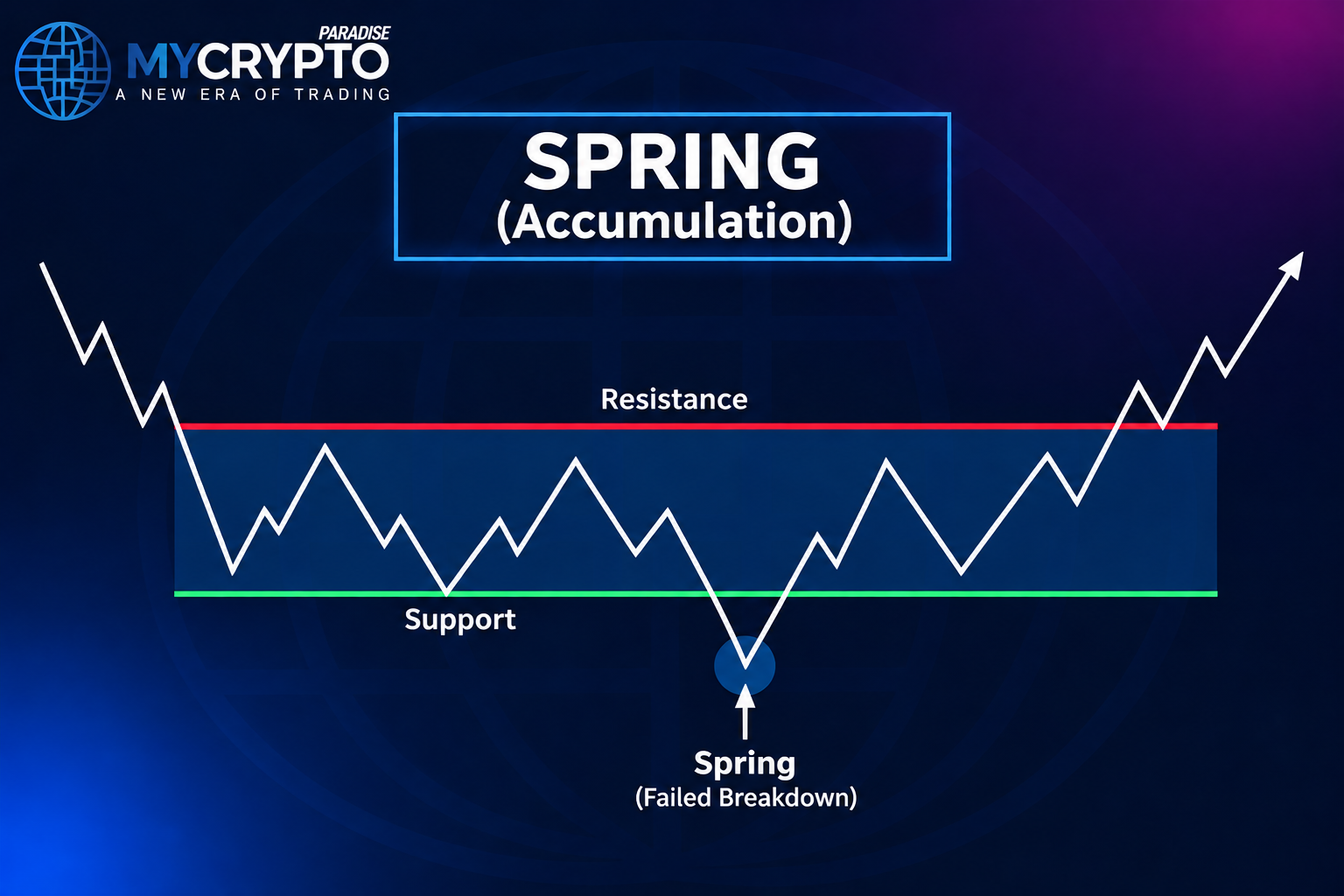
If price breaks support and stays below it, treat the move as a possible genuine breakdown. Later evidence can change that reading. The Spring is defined by the failure, not the penetration.
Where a Spring usually appears
The classic Spring develops late in an Accumulation range, often around Phase C. It can shake out weak holders and test remaining supply before stronger demand appears. A Spring is not mandatory: supply can also be tested higher in the range.
How to judge a Spring more precisely
Work through five questions. Was there a defined range? Did price penetrate support and return inside? What did volume say about the effort? How strong was the recovery? What happened on the Test?
Study the penetration and recovery
The depth of the breach matters less than the result. A shallow breach that quickly reclaims support can be meaningful in a well-established range. A deeper, high-volume shakeout can be valid too, but it deserves closer testing.
Compare volume with price spread
Wyckoff weighs effort versus result. Heavy volume with a wide down-spread and a close near the low suggests real selling pressure. Heavy volume with little downside progress can instead show selling being absorbed.
On the Test, falling volume and a narrower spread support the view that supply has thinned. A low-volume Spring or a low-volume test of a shakeout can signal readiness for an advance.
Example: volume expands hard, yet price barely extends below support and closes back inside. Great effort, little result, which fits absorption. If instead price drops sharply and stays below the low, the result favours genuine weakness.
Linking a Spring with RSI
A classic support is bullish divergence: price makes a lower low while RSI makes a higher low. The market reached a new extreme, but momentum did not confirm the weakness. Downside pressure may be fading.
How to use RSI without overriding Wyckoff
Do not treat RSI below 30 as automatic Spring confirmation. Oversold can persist through strong downtrends. Momentum tools measure the speed of price change, not structure; keep a neutral reference like indicator and market basics in mind.
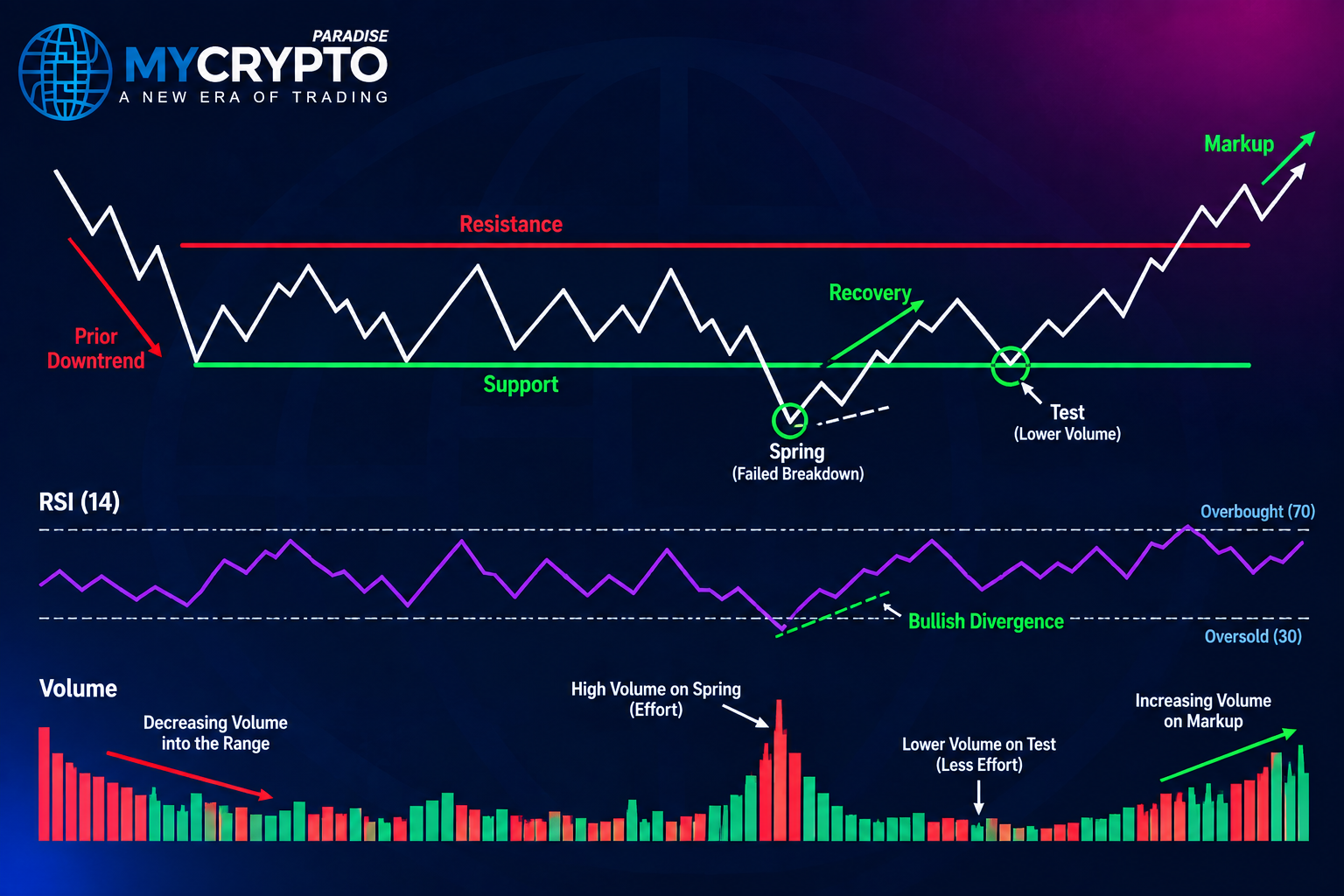
The stronger sequence is an established range, a failed support break, a recovery, a constructive Test, then improving RSI. Read RSI as supporting evidence, not the primary signal. The same discipline applies to a bullish engulfing signal.
What Is a Wyckoff Upthrust?
An Upthrust is the mirror image of a Spring. Price pushes above resistance but fails to hold the breakout and reverses back into the range. It often acts as a Secondary Test inside Distribution.
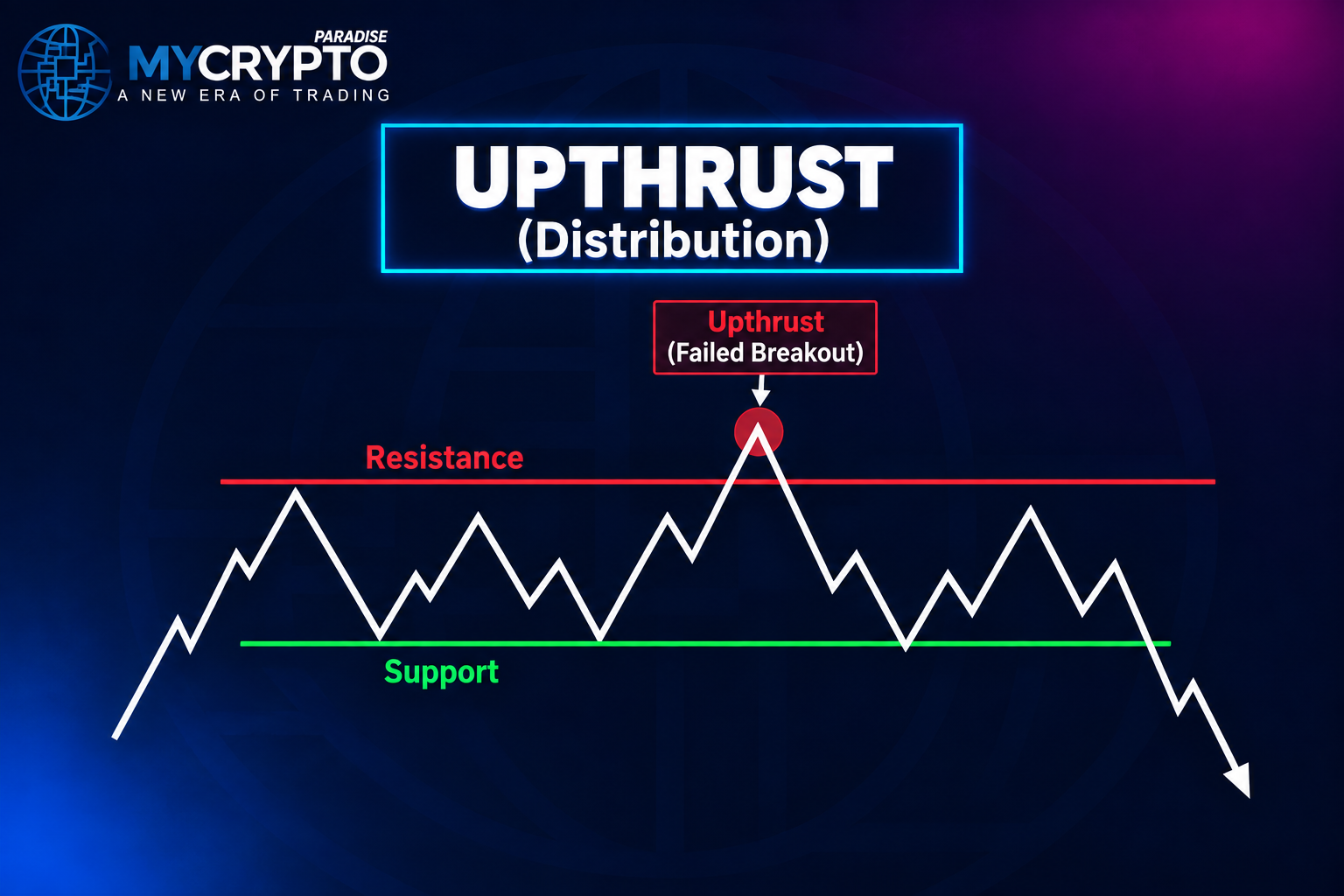
Resistance should be visible before the event. Several reactions around the same upper boundary give the breakout a real reference. A random high followed by a decline is not enough.
Judge the breakout effort and failure
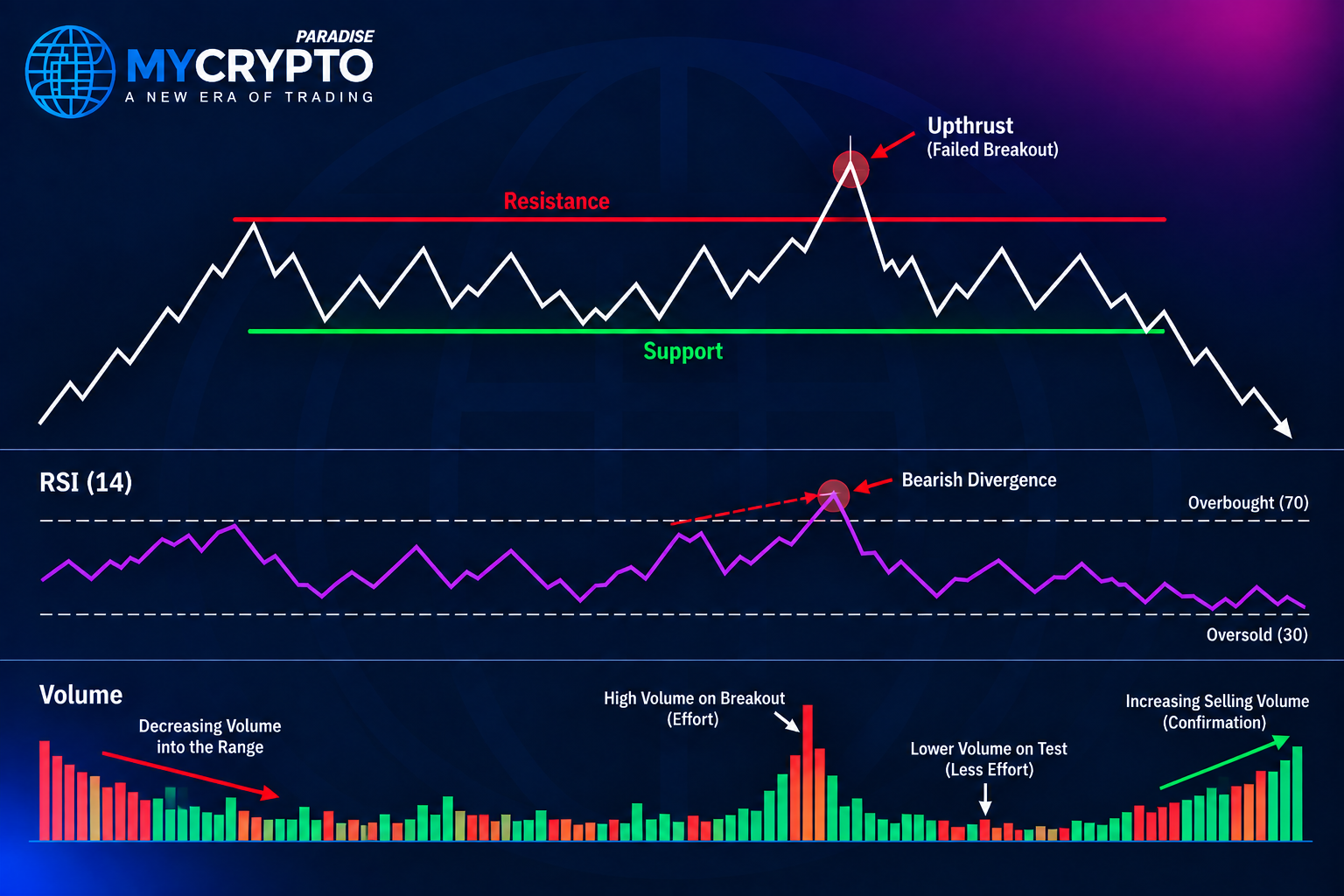
Study volume and spread as price clears resistance. Heavy volume with a narrow result or a poor close can show supply appearing into apparent strength. A decisive breakout that holds above resistance tells a different story.
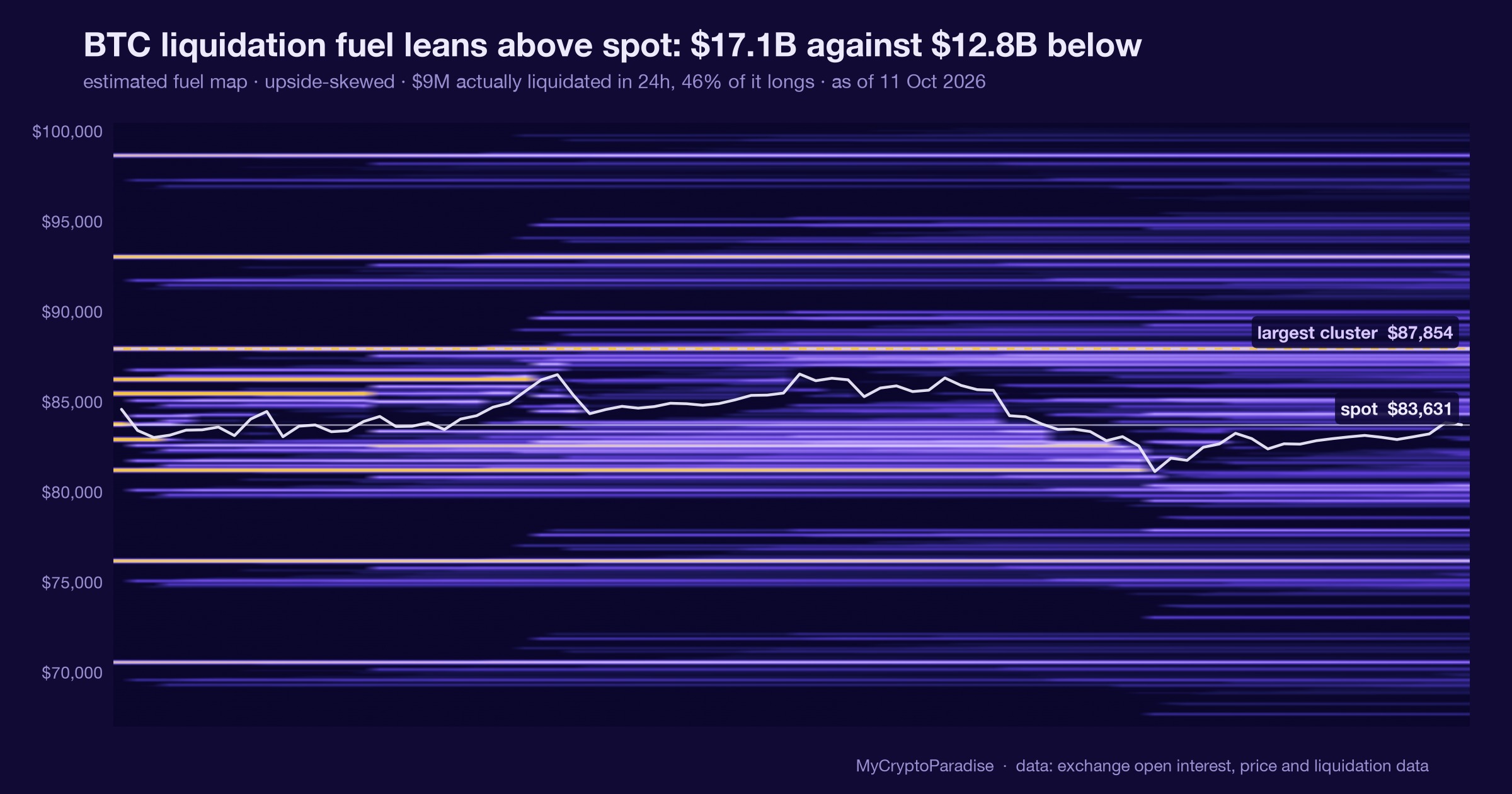
The key evidence is the return into the range. Rapid rejection with weak rallies strengthens the bearish reading. A market that reclaims and holds resistance weakens the Upthrust thesis. A liquidation heatmap can add context.
Linking an Upthrust with RSI
Negative divergence is not proof of an Upthrust. It matters more inside an established Distribution range, alongside a failed resistance break and a return inside. A weak rally that cannot reclaim resistance aligns momentum with structure.
Spring vs Upthrust
Both are failed boundary tests on opposite sides of the range. A Spring breaks below support and fails, usually tied to Accumulation with improving momentum. An Upthrust breaks above resistance and fails, usually tied to Distribution with weakening momentum.
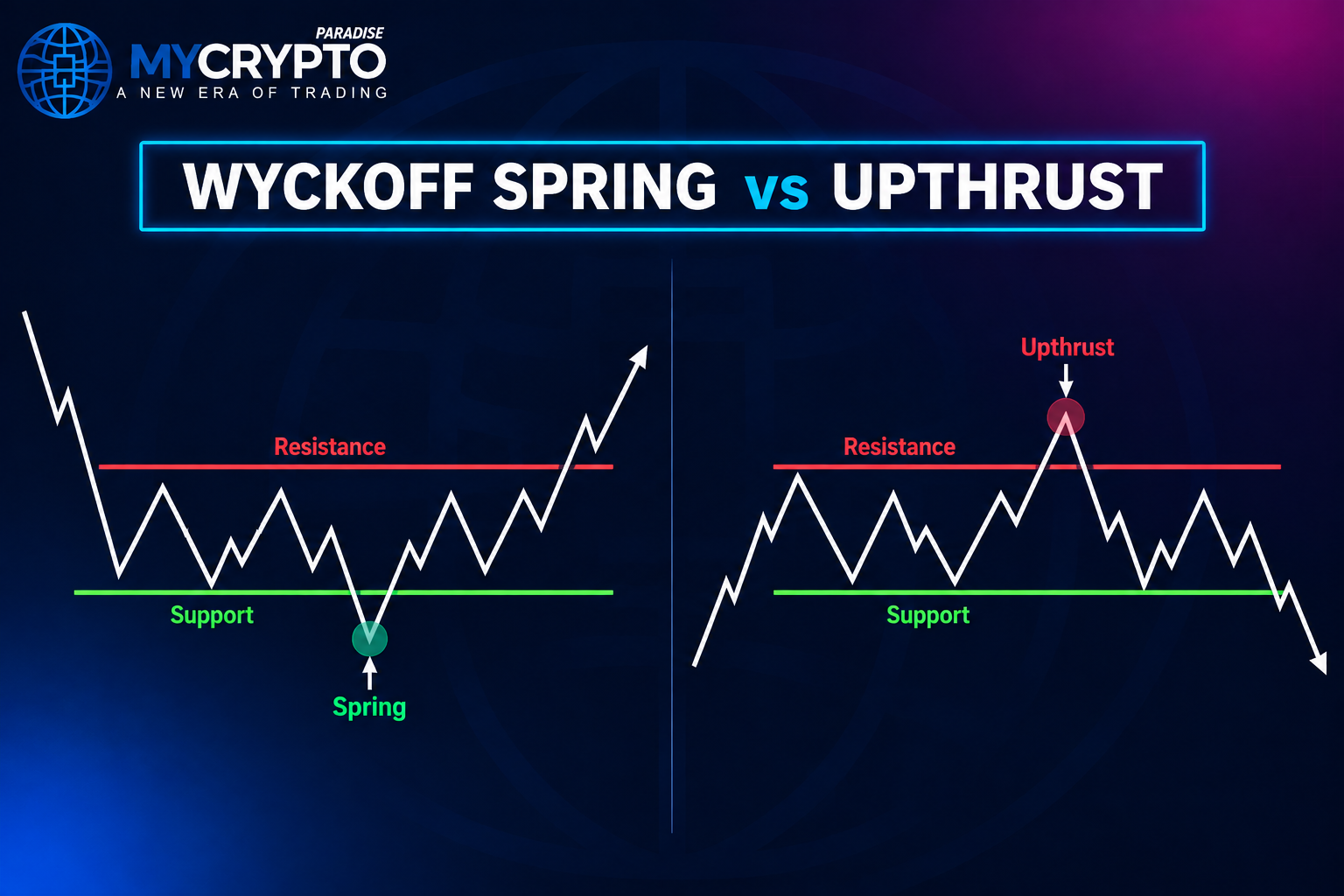
After a Spring, a constructive path can run Spring, Test, Sign of Strength, Last Point of Support, then Markup. After an Upthrust, it can run Upthrust, weak reaction, Sign of Weakness, Last Point of Supply, then Markdown.
A practical step-by-step framework
- Map the dominant range on a higher timeframe, then study the event on your execution timeframe.
- Label it a candidate Spring or Upthrust until the boundary break clearly fails.
- Read price and volume together for rejection and absorption.
- Add RSI and MACD as confirmation, never as standalone triggers.
- Wait for the Test and follow-through before acting.
- Reassess and relabel if price contradicts your read.
This chain of evidence pairs well with broader context like Elliott Wave structure and crypto funding rates.
Common mistakes
- Calling every false break a Spring or Upthrust without range and phase context.
- Using RSI or MACD as the primary signal instead of price and volume.
- Ignoring invalidation when price fails to reclaim support or holds above resistance.
- Ignoring volume and follow-through on the breakout.
- Entering before the Test or a Sign of Strength or Weakness confirms.
Practice this
Open a chart with a clear range. Mark support and resistance from prior reactions. Find one failed break on each side. For each, note the volume, the spread, the close and the Test. Write down what would invalidate the read first.
Trading involves real risk of loss. Treat Wyckoff as a framework for reading behaviour, not a guarantee, and size every idea so a wrong read stays survivable.
FAQs
Is a Spring always a bullish signal?
No. It is potentially bullish only in the right structural context and when confirming behaviour follows. A failed Spring can lead to further weakness.
Can RSI confirm a Spring by itself?
No. RSI can support the read through improving momentum or bullish divergence, but price structure and volume stay primary. Treat RSI as secondary evidence.
What is the most important confirmation after a Spring?
The Test is a key confirmation, followed by evidence of stronger demand such as a Sign of Strength. Evaluate the whole sequence in context, not one candle.
How is a Spring different from a normal breakdown?
A Spring breaks support then reclaims the range, with behaviour suggesting supply was absorbed. A normal breakdown keeps downside acceptance and continues producing weakness.
Is a UTAD required for Distribution?
No. A UTAD, the distributional counterpart to a Spring, is not a required element of every Distribution range. Distribution can form without one.
Risk disclaimer: Crypto trading involves substantial risk of loss. This class is education only, not financial advice. Never trade with money you cannot afford to lose. Past results do not guarantee future results.












Join the discussion 7
The way these springs really test your patience is something else, especially when Nifty taught you to wait for confirmations only 😅. Definitely a good reminder.
I learned the hard way about ignoring the test confirmation, thinking a low volume push was the real deal. Like a barge missing its slot.
i always try to check the volume like it mentions, otherwise those fakeouts are so tempting. thanks for the detailed reminder to stay patient with the test!
The confirmation tests are key. I remember missing these details earlier on, thinking a rebound was a definitive trend change.
That trap of seeing a fake breakout as the real deal gets me every time 🤦♂️. Always kick myself when the volume isn't there and I still go for it 🤡. Need to engrave that test phase into my brain! 🧠📈
Liam, that impulse to jump without confirmation is a familiar one. It's often the retest of the broken level, or the lack thereof, that proves most telling.
the test confirmation at the end. it feels a bit like waiting for the harvest after you already know the season's yield.