



In short: The cheat sheet matches a live price pattern to its Elliott Wave structure, then tests the one rule that can invalidate it. Motive legs run in five waves, corrective legs in three. A label raises or lowers probability but never guarantees price.
The Elliott Wave cheat sheet puts every motive and corrective structure on one chart. Match a live swing to its shape, then test the single rule that can invalidate it.
The cheat sheet on one chart
The sheet places motive structures on the left and corrective structures on the right. Read the structure name, then compare its internal sequence with the swings on your BTC or ETH chart.
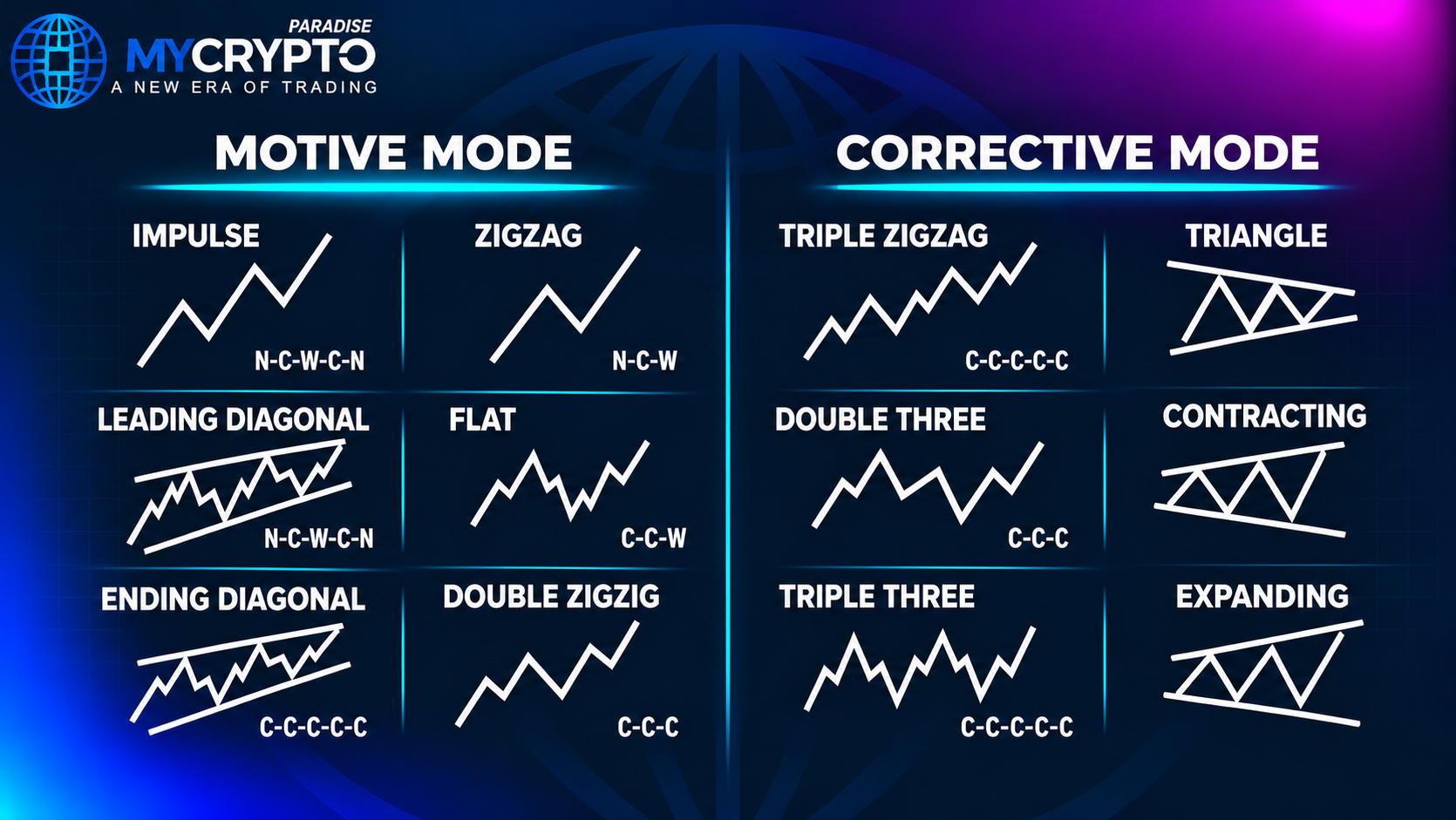
The notation is simple. M marks a five-wave motive leg. C marks a three-wave corrective leg. A sequence like M-C-M-C-M describes the internal shape, not a forecast of what price must do next.
This principle was first set out by Ralph Nelson Elliott and is summarised by Investopedia. For the full framework, see our Elliott Wave theory guide.
Motive structures: impulse and diagonals
Motive structures develop in the direction of the larger trend. The impulse is the clean five-wave form with strict non-overlap and length rules.
Three rules define a valid impulse. Wave 2 never passes the start of wave 1. Wave 3 is never the shortest of waves 1, 3 and 5. Wave 4 never enters wave 1 price territory.
Diagonals are the exception. A leading diagonal can appear in wave 1 or wave A, and an ending diagonal near the end, in wave 5 or wave C. Both allow wave 4 to overlap wave 1, so their internal form and position matter.
An ending diagonal is built from five three-wave legs, written C-C-C-C-C. If its required internal form or position fails, the count dies and you drop the label.
Corrective structures: zigzags and flats
Corrective structures move against the larger trend. A zigzag follows M-C-M. Wave B never passes the start of wave A, while wave C usually ends beyond the end of A.
Zigzags can chain. A double zigzag joins two zigzags with a three-wave X leg, and a triple zigzag joins three with two X legs. The chain never holds more than three zigzags.
Flats and their variants
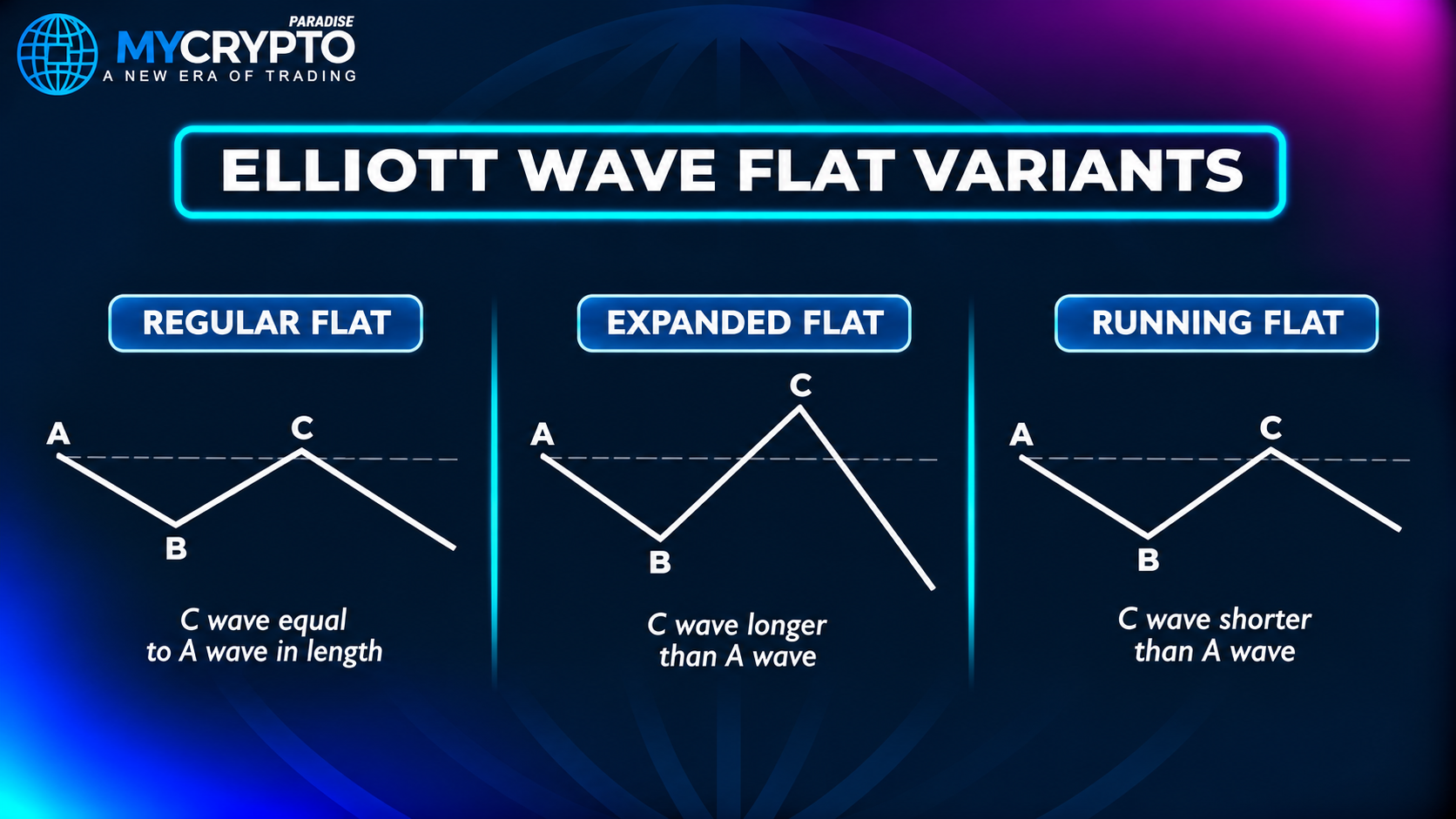
A flat follows C-C-M. Wave B retraces nearly all of wave A, about 90% or more. A much shallower B points you back toward the zigzag family instead.
The chart draws the flat family as one structure. A regular flat ends B near the start of A. An expanded flat pushes B beyond A’s start and C well past A’s end. A running flat ends C short of A.
Triangles and combinations
Triangles and combinations are also corrective. A triangle contains five corrective legs, written C-C-C-C-C. A combination joins simpler corrections through X waves and usually drifts sideways.
A contracting triangle sits between converging lines, with each leg smaller than the last. It can appear in wave 4, B or X, or at the end of a combination, but never in wave 2.
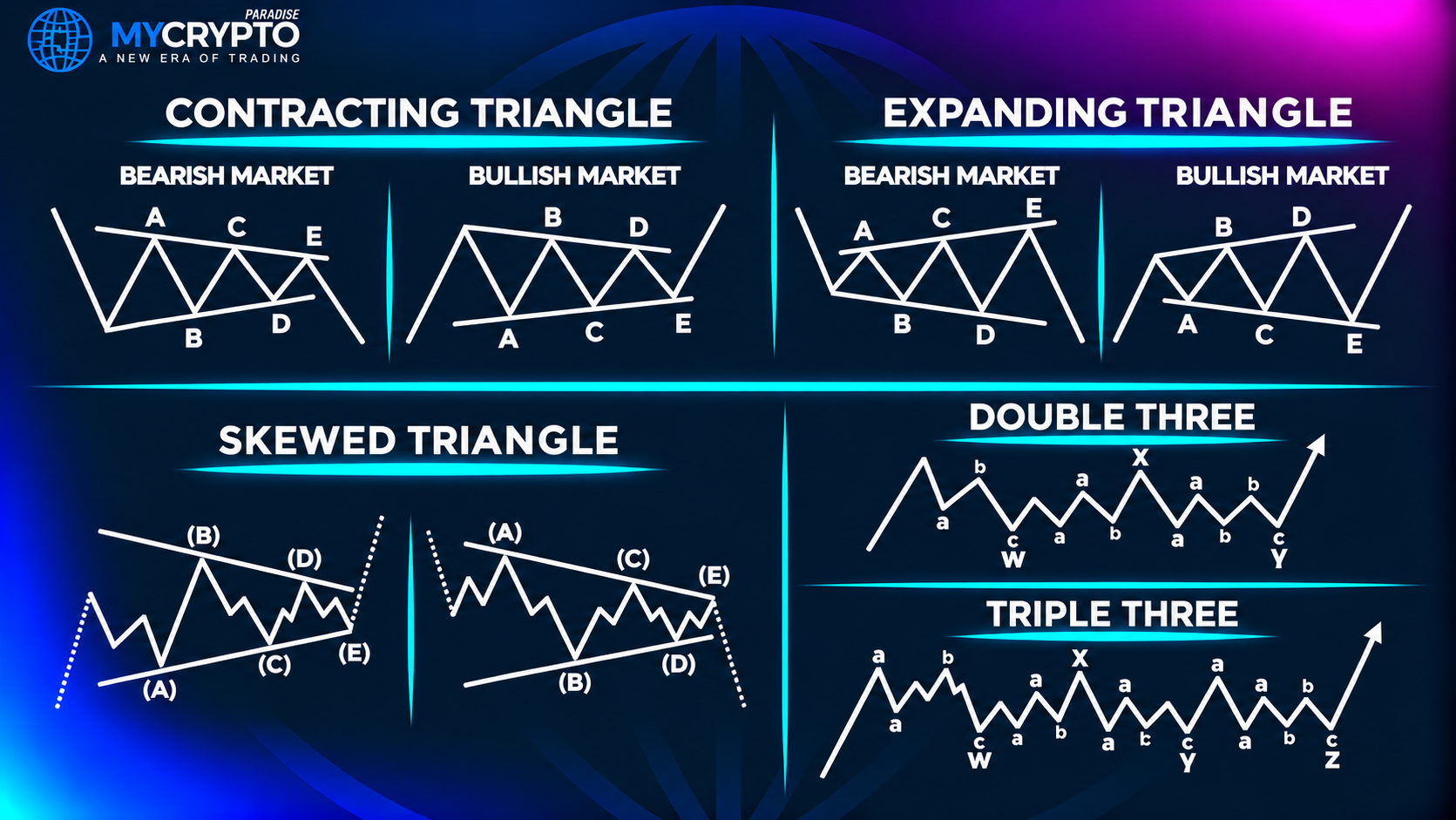
An expanding triangle diverges instead, with each leg larger than the last, and it is rare. A skewed triangle tilts its boundary lines with the main trend, usually as wave B of a zigzag or wave 4 of an impulse.
Combinations follow the same logic. A double three joins two simple corrections with one X leg, and a triple three joins three with two. A triangle can appear only as the final piece.
Rules versus guidelines
Keep a hard line between the two. A rule decides whether a label is allowed at all. A guideline describes a relationship that usually appears but can differ.
Alternation usually gives wave 2 and wave 4 different forms, such as a sharp move then a sideways one. When wave 3 extends, waves 1 and 5 are often similar in length. These are guidelines, not success rates.
Never turn a guideline into an invalidation condition. A channel across waves 2 and 4 can help you frame an impulse, but it does not prove the count. The rules decide; the guidelines only hint.
What is different in crypto
Crypto trades continuously, so its charts behave unlike markets with set sessions. Keep the same exchange and market type for an entire count.
Spot charts have no scheduled weekend close, so a wick through a rule level is a real trade and counts. Thin weekend liquidity can also add small swings that vanish on a 4H chart.
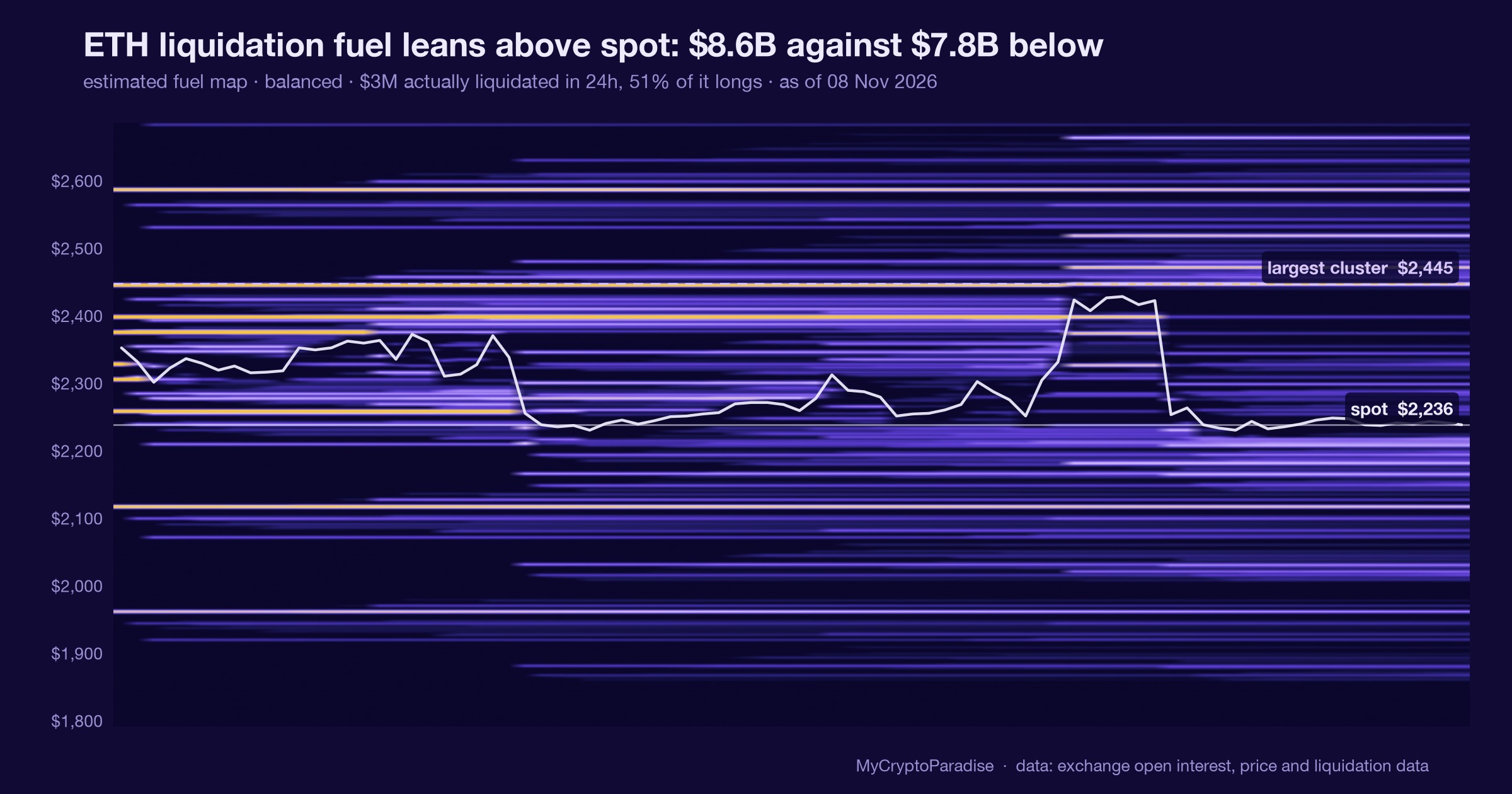
Perpetual futures can print liquidation wicks that never reach spot. Watching crypto funding rates and a liquidation heatmap helps explain those spikes. A label may break on a perp chart while holding on spot.
Use a log scale for counts spanning several years, because equal percentage moves line up better. Count BTC first, then alts, since altcoin charts are noisier and often follow Bitcoin’s broader direction.
A five-step routine
Use the sheet as a check, not a prediction. Mark the larger swings first, then test the structure trade by trade.
- Mark swing highs and lows on the daily chart, then refine them on the 4H.
- Match the visible shape to one structure on the sheet.
- Run that structure’s rule against the actual candle prices.
- Write the invalidation price beside the label before any trade.
- Check wave degree and name the larger wave that contains it.
Reading market sentiment alongside the count adds context. At turns, confirmation candles such as a bullish engulfing pattern or a piercing line pattern can support a wave C low.
Common mistakes
A cheat sheet narrows the options, but it cannot pick the right label by looks alone. A structure can look familiar and still fail one rule on the candles.
- Treating a guideline as a rule and rejecting a label that is still allowed.
- Forcing a five-wave count onto a move whose internals are corrective.
- Ignoring the rule that broke because the preferred label still looks convincing.
- Counting on a perp chart with liquidation wicks, then comparing it to spot.
- Mixing wave degrees, such as labelling a 15m swing as a daily wave.
- Keeping a label alive after price trades through its invalidation level.
A count is one allowed label, not the only one. The rules decide which interpretations remain possible. They never prove which interpretation is correct.
Practice this
Open a live BTC chart and run the routine on the last clear swing. Name the structure, write its rule, and mark the invalidation price before you judge the move.
MyCryptoParadise is a professional crypto signals and trading-education service, operating since 2016, and this lesson sits inside the MCP University FREE library. Treat every count as a probability, define risk, and let invalidation, not hope, close the label.
FAQs
What are the three rules of Elliott Wave that never break?
Wave 2 never moves beyond the start of wave 1. Wave 3 is never the shortest of waves 1, 3 and 5. Wave 4 never enters wave 1 price territory in a standard impulse.
What is the difference between a zigzag and a flat?
A zigzag follows M-C-M, while a flat follows C-C-M. In a flat, wave B retraces nearly all of wave A. The internal subdivisions tell the two structures apart.
Can wave 4 overlap wave 1?
Not in a standard impulse. Wave 4 overlap is allowed in diagonal structures, including leading and ending diagonals, where it is part of the valid form.
Does Elliott Wave work on crypto?
It can organise crypto price structure, but 24/7 trading and perpetual futures wicks demand a consistent chart choice. A wave label raises or lowers probability. It never guarantees an outcome.
Is there a printable Elliott Wave cheat sheet?
The MCP University FREE hub provides the full structure chart. This article works as the written reference that accompanies it.
Risk disclaimer: Crypto trading involves substantial risk of loss. This class is education only, not financial advice. Never trade with money you cannot afford to lose. Past results do not guarantee future results.












Join the discussion
No comments yet. Members, share how you are reading this.