

In short
Funding rates show what leveraged traders pay to hold their positions. In August 2026 we read those rates across major crypto pairs as a crowd positioning study. A positive rate means longs pay shorts, so the crowd leans bullish. A negative rate flips that pressure toward shorts. This reading is a risk lens, not a price forecast. It tells you where leverage was crowded and where a squeeze could start. We track the direction, the size, and how long the bias held. Read it to size positions with more care, never to predict the next candle.
How do we read funding rates for this study?
We read funding as a positioning signal, not a trade trigger. For each major pair we note the sign, the size, and how steady the rate stayed. Positive means longs pay shorts. We then compare that pressure against price to see where crowded leverage sat.
A funding rate is a small recurring payment between long and short traders on a perpetual futures contract. Think of it as rent on a leveraged position.
When more traders crowd the long side, funding turns positive and those longs pay to stay in. That payment is the crowd showing its hand.
What is different here
The ParadiseTeam reads funding across all major exchanges before building any setup, so a crowded rate is context, never a standalone trigger.
Our guide to funding and short squeezes explains the mechanics in more depth. For the contract basics, Binance Academy’s perpetuals explainer is a solid start.
| Funding sign | Who pays | Crowd lean | Main risk |
|---|---|---|---|
| Positive | Longs pay shorts | Bullish crowding | Long squeeze if price stalls |
| Near zero | Balanced | No strong bias | Low positioning risk |
| Negative | Shorts pay longs | Bearish crowding | Short squeeze if price rises |
What did August 2026 funding look like across major pairs?
Across August 2026, major pairs held funding close to the neutral baseline, with a mild long lean. Some large-cap alts ran hotter and cooled fast. Small-cap alts stayed the most stretched. The month looked orderly at the top and crowded in pockets lower down the market.
Many exchanges anchor funding near a small neutral baseline, often around 0.01% every eight hours. That baseline annualizes to roughly 11 percent, so even calm markets carry a holding cost.
Perpetual contracts have no expiry, so funding keeps their price tethered to spot. Investopedia’s overview of futures contracts covers the wider family.
| Pair group | Typical August lean | What it suggested |
|---|---|---|
| Majors (BTC, ETH) | Mild positive, near baseline | Modest long lean, orderly tape |
| Large-cap alts | Warmer, more variable | Faster crowding and cooling |
| Small-cap alts | Most stretched | Highest squeeze risk |
We group the month this way to see the shape, not to fix a single number to any coin.
Where did the crowd lean, and what did it risk?
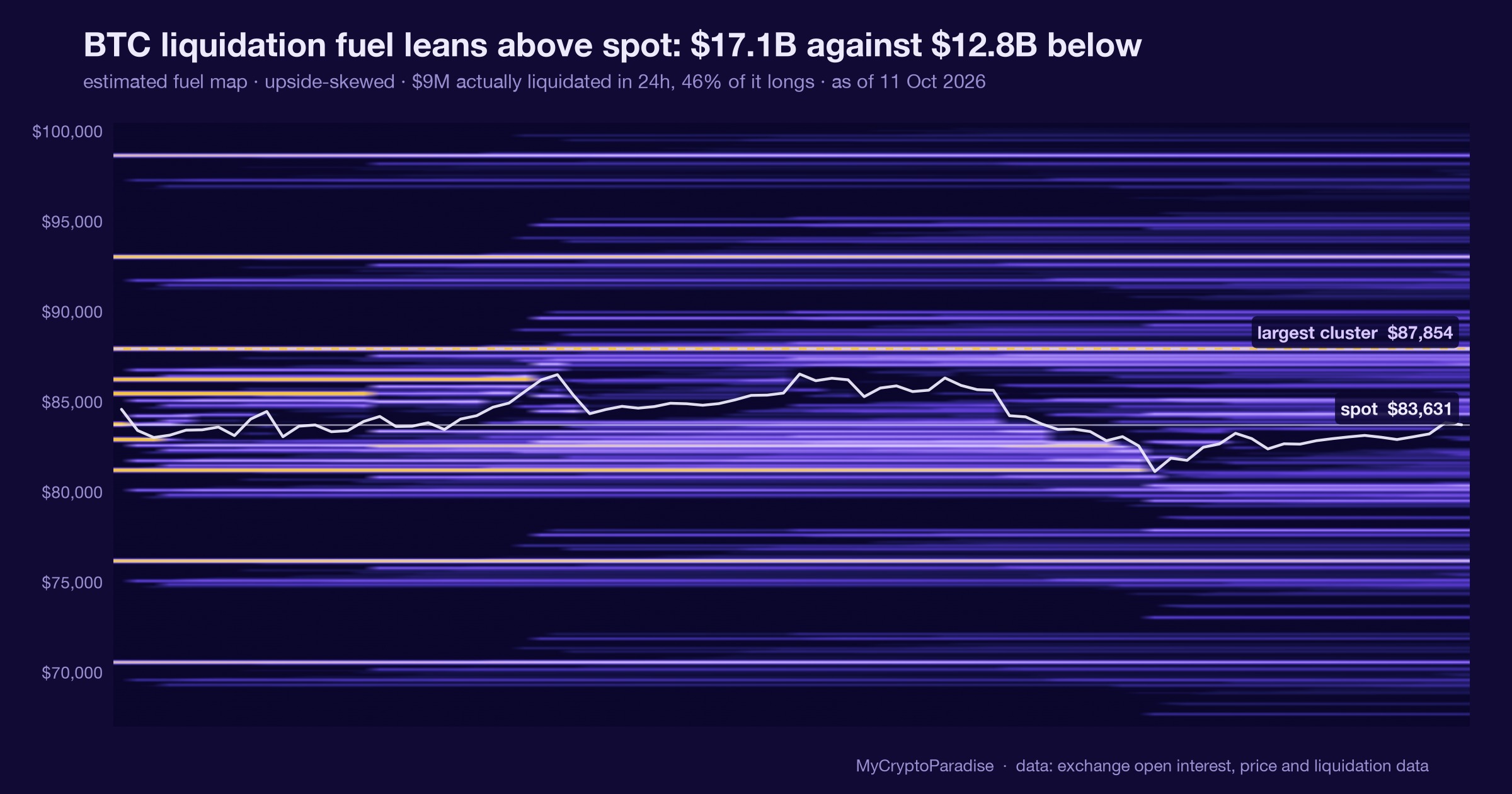
The crowd leaned long on majors and harder long on smaller alts. That crowding raised the risk of a long squeeze, where crowded longs get liquidated if price stalls or dips. The more one-sided the funding, the more fuel a sharp move can find.
When leverage piles onto one side, a small move can trigger forced selling. Our note on what liquidation cascades teach about sizing shows how fast that unwinds.
Funding also hid a split we see often: retail crowds long while larger players stay cautious. We covered that gap in a piece on retail long, whales cautious.
The lesson is simple. A crowded long squeeze setup is a risk to respect, not a short signal to fire on its own.
Funding vs price: what lined up and what did not
Funding and price agreed on the majors, where a mild long lean matched a steady, orderly tape. They diverged in pockets of alts, where hot funding did not deliver the follow-through longs expected. Positioning explained the risk, but it did not predict the direction.
This is the core lesson of a funding study. Crowded positioning tells you where risk is dense, not which way the next candle prints.
When crowd and smart money split, the spread itself becomes the signal. Our breakdown of the positioning spread walks through one clear example.
How to use a monthly funding reading in your own process
A monthly reading works well as a risk filter, applied before you size a trade. Read the sign first, then the size, then how long the bias held.
- Note the funding sign for each pair you trade.
- Check whether the bias held or flipped across the month.
- Compare crowded leverage against the recent price trend.
- Size smaller when funding and your bias point the same way.
We treat funding this way in our own process. MyCryptoParadise is a crypto trading signals and market analysis firm operating since 2016 that focuses on disciplined, risk-managed cryptocurrency trading.
If you want to feel what a month of funding costs on a leveraged position, run your own numbers below.
Use the reading to slow down, size smaller, and respect crowded leverage. It will never call the top or the bottom, and it is not built to. It is a probability read, not a forecast.
Frequently asked questions
What is a funding rate in simple terms?
A funding rate is a small recurring payment between long and short traders on perpetual futures. When it is positive, longs pay shorts, which signals bullish crowding. When negative, shorts pay longs. Exchanges settle it every few hours, so it acts like rent on leverage.
Does a high funding rate mean price will fall?
Not on its own. A high positive funding rate shows crowded longs, which raises the risk of a long squeeze if price stalls. But crowded positioning can persist for weeks in a strong trend. Treat it as a risk lens, not a timing signal.
How often should I check funding rates?
For most traders, a weekly or monthly reading is enough to spot crowding. Day traders may watch each settlement window. The value sits in the trend, not one print. A single spike matters less than a bias that holds across many sessions.
Can funding rates predict a short squeeze?
They can flag the setup, not the timing. Deeply negative funding means shorts are crowded and paying to stay short. If price rises, those shorts can be forced to cover, which fuels a squeeze. Funding shows the fuel, while price action lights it.
Crypto trading involves substantial risk and is not suitable for everyone. Nothing here is financial advice; it is education only. Never risk more than you can afford to lose.








Join the discussion 11
i definitely feel that uncertainty Zofia mentions, but still find these longer-term views super helpful for when im just sketching out ideas for things like my stablecoin stacking. 💭
yeah the crowd positioning for stablecoins on chain really helps set the context for these longer funding views, its the most honest tape for me.
your funding rate data for 2026 feels like extrapolation beyond reasonable confidence. three years out is not a snapshot its a guess.
The 2026 data... I wonder about the decay rate on these long-term signals. How quickly do you find they lose predictive power?
fatima, i think the long-dated funding still matters for understanding where liquidty is positioned, regardless of what anyone thinks about a signal decaying.
i always found the long-dated perp funding rates fascinating, a different beast than the spot basis. useful to see the market's conviction out that far, even with the confidence caveats. reminds me of my early days digging into this data.
i always check these funding rates for my small buys, the long-dated ones always feel like a good anchor. you stick with it tobias.
i struggle to see the utility in such long-dated perp funding for a swing trader... a lot can change in a week, let alone years.
true, for swing trading its less about predicting a specific level but more about understanding aggregate positioning and potential liquidation clusters. that long-dated perp basis still reflects a directional bias, even if it's slow-moving.
funding rates out that far become a sentiment gauge, less about actual carry. Mei Lin is right.
Yer man Zofia has a point, three years out is a fair stretch for sure 🔮🧐 but I still check these for the big player moves, not the nitty-gritty. 👀📉