



Technical Analysis Basics
In short
Support and resistance levels are specific price points for a crypto asset that indicate potential reversals in price movement. A support level is a price floor, where buying interest has historically stopped further drops. A resistance level is a price ceiling, where selling pressure has typically stopped further rises.
Cryptocurrency trading has become an increasingly famous way to invest and trade in recent years. While there are many mechanisms and techniques used in cryptocurrency trading, understanding support and resistance levels is one of the most important ones.
This article will delve into what support and resistance levels are, how to identify them, and how to use them in crypto trading.
What are support and resistance levels?
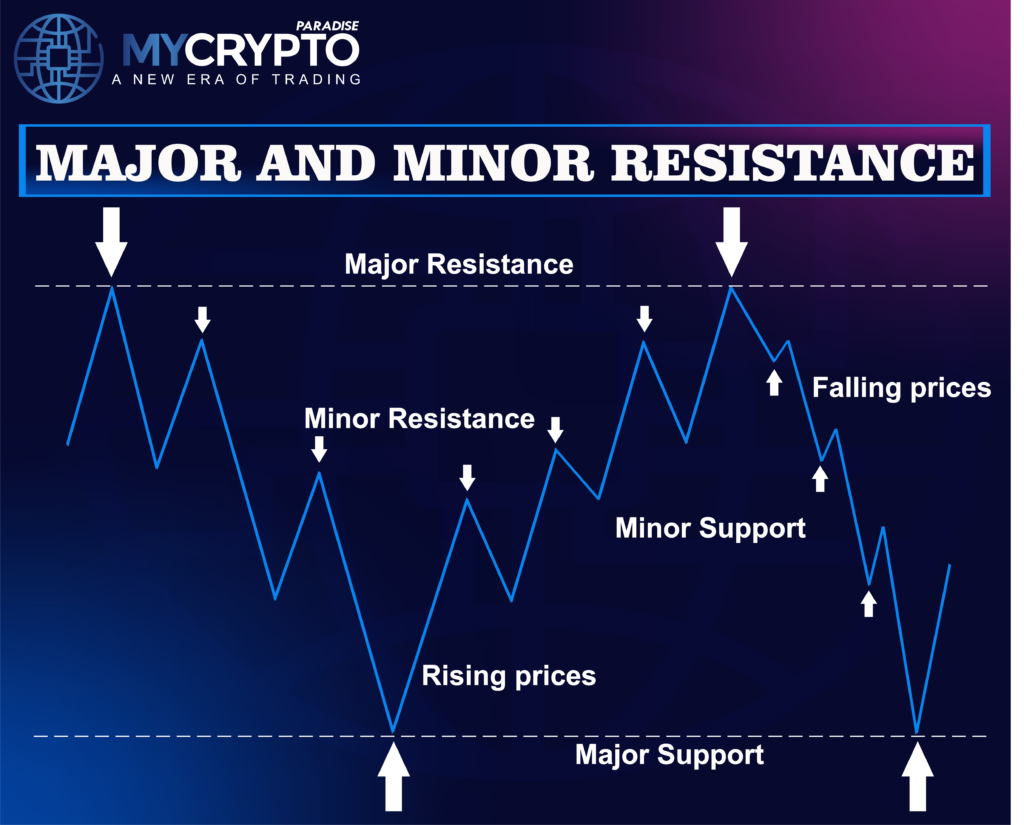
Support and resistance levels are important price levels that can indicate the strength or weakness of a particular asset. They are levels where traders and investors are likely to buy or sell. At support, that buying tends to push price back up. At resistance, selling tends to push it back down.
Support levels are areas where the price of an asset has historically had difficulty breaking below. Often a wave of buyers enters there and creates a price floor. When price reaches this level, buyers tend to step in. Demand rises and the price often bounces back up.
Resistance levels, on the other hand, are areas where the price of an asset has historically struggled to break above. Often a wave of sellers enters there and creates a price ceiling. When price reaches this level, holders tend to sell. Supply rises and the price often falls back down.
Both ideas come down to supply and demand. StockCharts ChartSchool describes support and resistance as the points where the two meet, and notes that support does not always hold.
What are the four types of support and resistance?
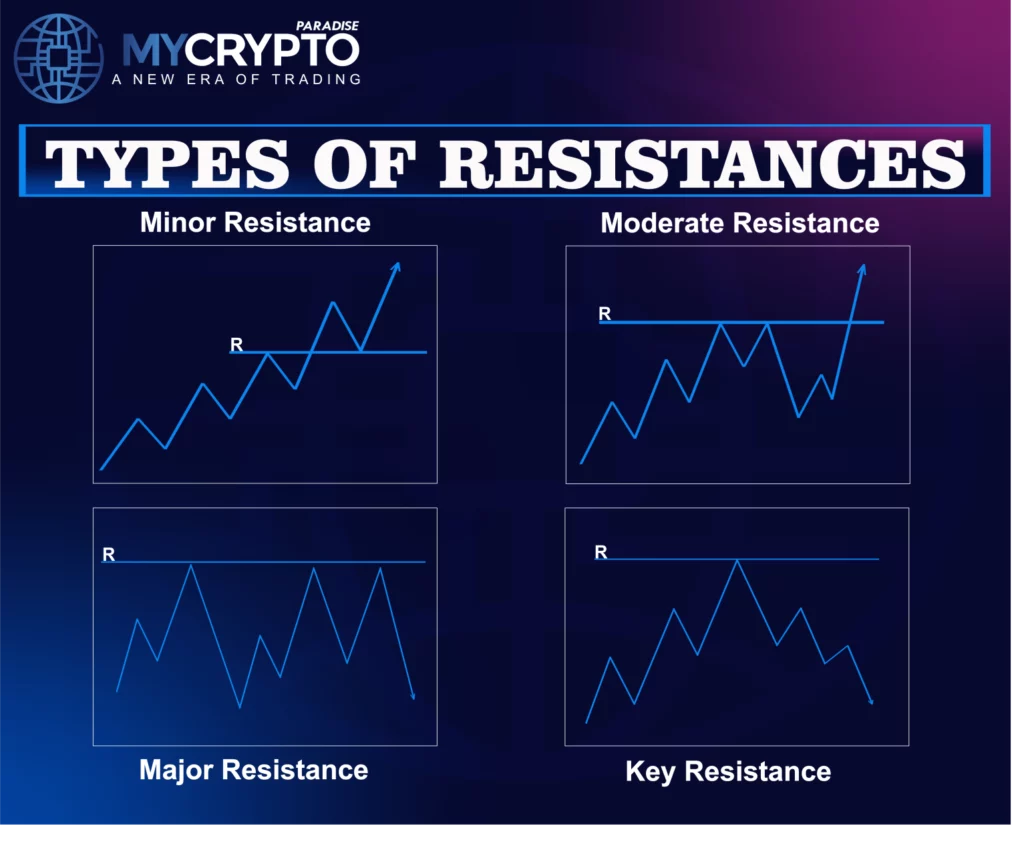
Traders grade each level by how strongly price has reacted to it. A minor level causes a brief pause on low time frames. A moderate level holds for days or weeks. A major level has stopped large moves several times. A key level is the strongest, often a multi-year high or low.
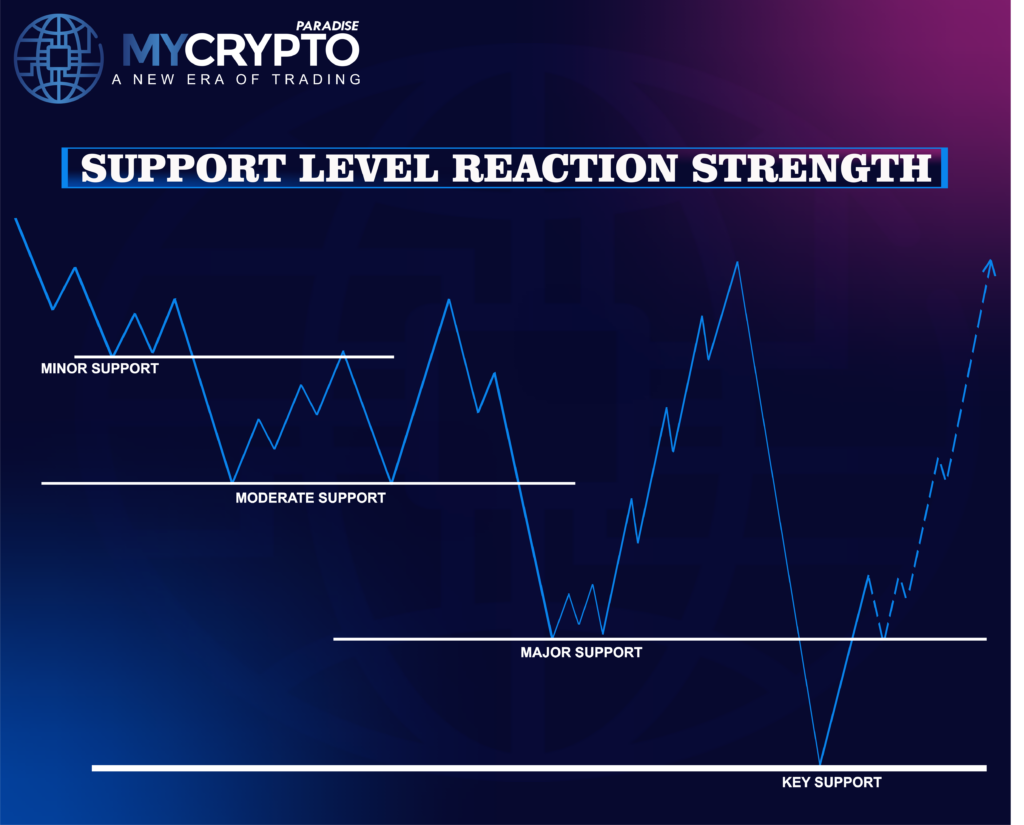
The same four grades apply on both sides of the chart. Support is graded by how much buying appears there, resistance by how much selling appears there. The table below compares them.
| Type | Where it shows up | How price reacts |
|---|---|---|
| Minor | 15-minute to 1-hour charts | A short pause, then often a break |
| Moderate | 1-hour to daily charts | Holds for days or weeks, can fail in a strong trend |
| Major | Daily and weekly charts | Stops large moves after several tests |
| Key | Weekly and monthly charts | Marks turning points in the wider trend |
Minor levels: brief pauses
A minor level shows limited buying or selling and has little history behind it. It usually appears on 15-minute to 1-hour charts, and strong momentum breaks it easily. Traders use it mainly for quick intraday trades.
Example: a coin falls from $50 to $45 but pauses at $46 for a day before dropping again. That pause at $46 was minor support. It slowed the move without reversing it.
Hypothetical example: a trader holding a coin sells into minor resistance near $20 on a 15-minute chart. They place a buy-back order near $18.50, the support below. If price closes above $20 instead, the level has failed. A buy-back just above it then works like a stop-loss.
Moderate levels: pullback zones
A moderate level carries more history and lines up with more of your other tools. It is visible on both lower and medium time frames. It tends to hold longer than a minor level, but it can still give way in a strong trend.
Example: a coin trending higher pulls back from $100 to $90, then resumes its climb. Buyers defended $90, so it acted as moderate support. On the way up, a moderate resistance is a common place to take partial profits.
Major levels: repeated reversals
A major level has been tested several times and held. It develops over long periods and usually shows on daily and weekly charts. Price often spends time near it before choosing a direction, so treat it as a zone rather than a single price. Trades around it need wider stops.
Example: a coin bounces off $200 several times over a few months. That makes $200 major support, and sellers struggle to push through it even during a sharp sell-off.
Key levels: the market’s turning points
Key levels are the strongest on the chart. They line up with several signals at once: a multi-year high or low, a round number, a Fibonacci ratio or a long-term moving average. They often coincide with major news and can mark a change in the wider trend. Long-term investors use them to plan portfolio risk.
Bitcoin’s 2017 peak near $20,000 is a well-known key level. It capped price until December 2020. In 2022, as the market fell, the same area became a battleground again.
Identifying support and resistance levels
Technical analysis is the most common way to identify support and resistance levels. It involves studying price charts and using various indicators and tools to identify trends and trading patterns.
One popular tool for identifying support and resistance levels is the horizontal line. Draw it where price has bounced up before (support) or turned down before (resistance). That line marks an area worth watching.
Price action: previous highs, lows and trendlines
Price action means reading the chart itself, with no indicator on top. Start with the obvious reference points:
- Previous swing highs and lows, where a move stalled and reversed.
- Local tops and bottoms that price revisited more than once.
- Trendlines across rising lows or falling highs, which act as sloping support or resistance.
The more often price has reacted at a level, and the higher the time frame, the more weight it carries.
Indicators: moving averages, Fibonacci and Bollinger Bands
Some indicators draw levels that move with price. Traders use them as dynamic support and resistance:
- The 10 and 20-period exponential moving averages for short-term levels.
- The 50 and 200-day simple moving averages for major levels.
- Fibonacci retracements at 38.2%, 50% and 61.8% of the last swing.
- The upper and lower Bollinger Bands, which price often reacts to.
Worked example: a coin falls from $200 to $100, then bounces. The 61.8% retracement of that fall sits at $161.80. If the bounce stalls there and prints a lower high, the Fibonacci level acted as resistance. A close above it weakens that read.
Indicators work best as confirmation, not as the reason for a trade. Our lesson on combining RSI with other indicators shows how several signals can confirm one level.
Volume: where a level gets its strength
Volume shows how much trading happened at each price. It separates a real level from a random pause:
- High volume at a previous peak points to heavy selling waiting there.
- Large clusters of resting orders near a level can absorb the other side.
- Falling volume into resistance suggests buyers are losing strength.
- Rising volume on a bounce from support suggests real demand.
Using support and resistance levels in cryptocurrency trading
A level on the chart only helps once you know what you will do when price reaches it. Here are the most common ways to put one into a trading plan.
One way to use support and resistance levels is to set buy and sell orders at these levels. For example, if Bitcoin approaches a key support level, you could place a buy order there in case price bounces. If Ethereum approaches a key resistance level, you could place a sell order there in case price turns down.
Another way to use support and resistance levels is to look for potential breakouts. Sometimes price tests a resistance level again and again, then breaks through on a large volume spike. That break can start a sustained uptrend.
This is called role reversal. The old resistance may then hold price on the way down, becoming support itself. A broken support can turn into resistance in the same way.
Buying a bounce from support
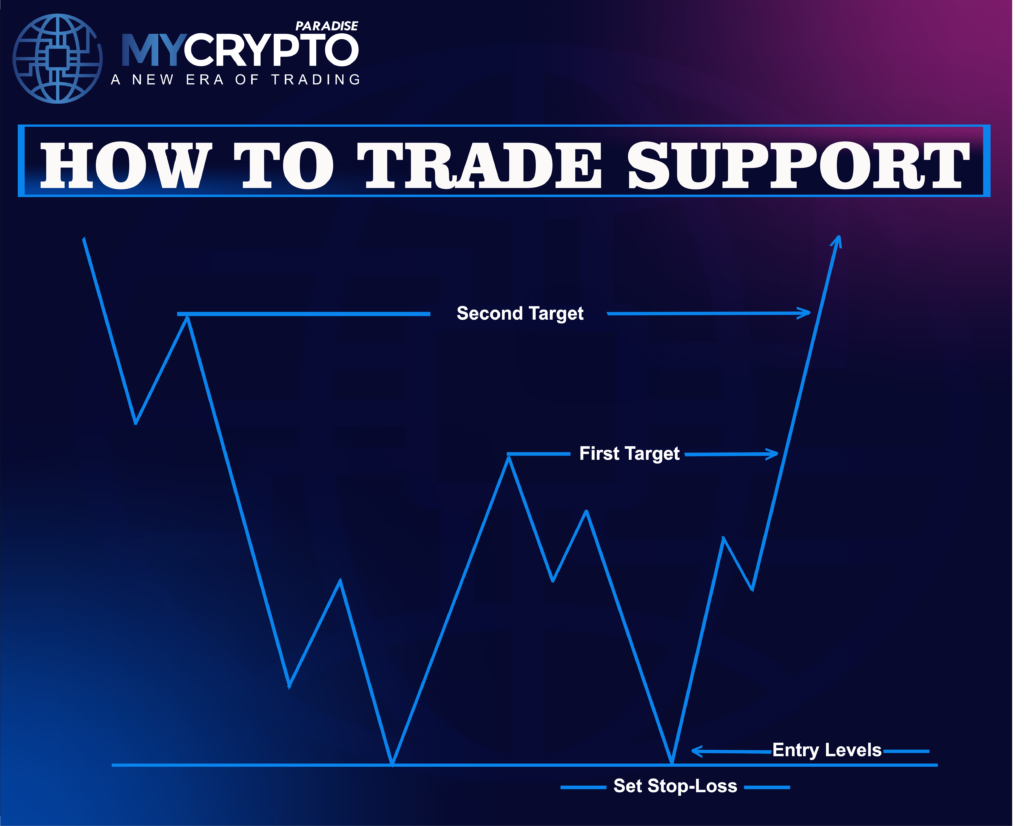
A bounce trade assumes buyers will defend the level again. Wait for proof before you act:
- Mark the support zone and note its grade, from minor to key.
- Wait for price to react there, for example with a long lower wick.
- Check that volume rises on the bounce, not on the drop.
- Enter near the zone, with the stop-loss just below it.
- Aim for the next resistance, or at least twice the distance to your stop.
Selling a rejection at resistance
A rejection trade is the mirror image. Wait for price to stall at resistance before you sell or open a short position. The best signs are rising selling volume and a bearish reversal candle, such as a hanging man pattern.
Momentum can add weight to the read. At key resistance, an RSI reading above 70 marks an overbought market. It suggests profit-taking may start soon and a high could form.
Divergence adds a second clue. Suppose price makes a higher high into major resistance, while RSI or MACD makes a lower high. That bearish divergence shows buyers pushing with less force, which adds weight to a rejection.
Take a hypothetical level near $100 that has already turned price down twice, first to $80 and then to $60. Price climbs back and edges above the previous peak, but RSI prints a lower high. That gap is the warning sign before a possible third rejection.
The mirror case works at key support: a bullish divergence there adds weight to a bounce. Our guides to bearish divergence and bullish divergence cover both.
Worked example: resistance sits at $10. After a clear rejection, a trader shorts near $10 with a stop-loss at $10.50 and targets at $9.00 and $8.50. The risk is $0.50 per coin and the targets are $1.00 and $1.50 away, a risk to reward of 1:2 and 1:3.
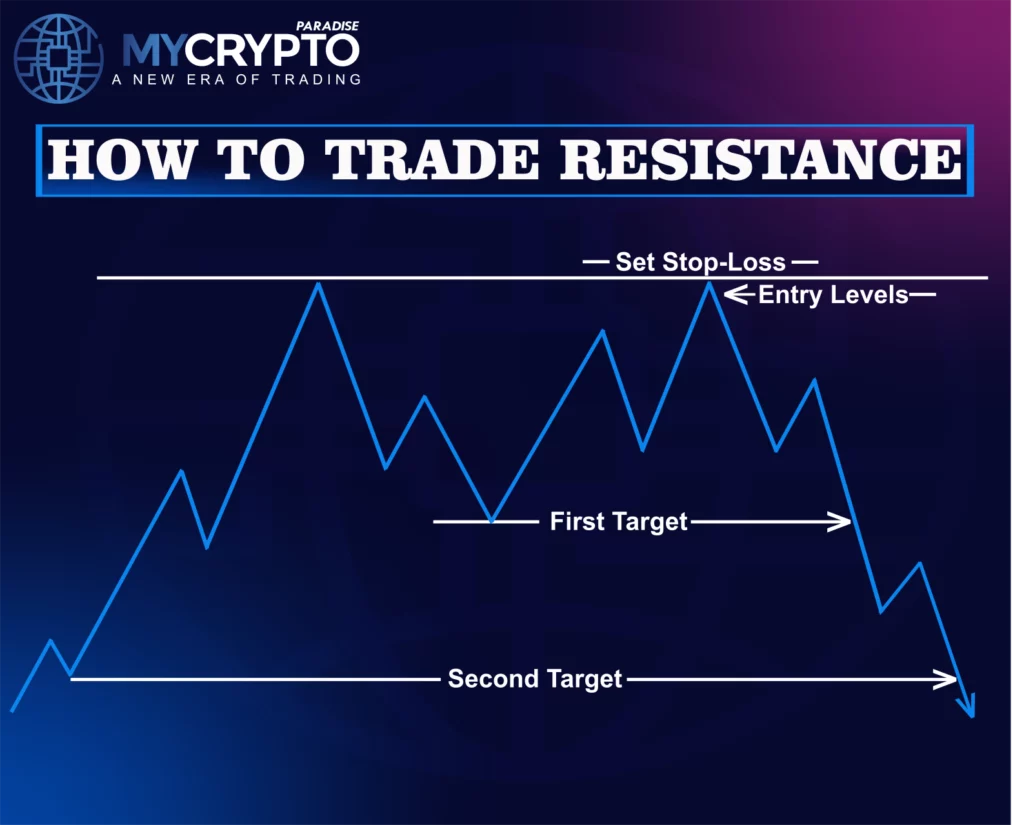
The numbers are hypothetical and for illustration only. If price closes back above the zone, the idea is wrong and the stop does its job.
Trading a breakout and retest
Not every level holds. When price closes decisively above moderate or major resistance, on volume well above average, buyers have taken control. Many traders then wait for the retest: price dips back to the broken level and holds it as new support.
Worked example: a coin breaks above resistance at $30 on strong volume. A trader buys the retest near $30 and places the stop-loss at $29.50, just under the zone. If price falls back inside the old range, the breakout has failed and the position is closed.
A breakout that fails quickly is a warning in the other direction. Price that pokes above resistance and falls straight back often continues lower.
When news meets a key level
Key levels react more sharply when they meet scheduled news. Suppose price approaches key resistance on the day of a Federal Reserve rate decision. A hawkish surprise, such as a larger hike than expected, can turn the level into a sharp rejection.
The reverse is also possible: a dovish surprise can push price straight through the same level. Define your stop-loss before the event, and consider a smaller position when news and a key level meet.
How do you set entry, stop-loss and take-profit around a level?
Enter only after price reacts at the level, not before. Place the stop-loss beyond the zone, tighter for minor levels and wider for major and key ones. Take profit at the next opposite level, or once the move covers at least twice your risk.
- Entry: wait for the reaction, then look for confluence at the same price.
- Stop-loss: beyond the zone, never on the line itself.
- Take-profit: the next level, or a 1:2 risk to reward.
- Position size: a stop-out should cost a small, fixed share of the account.
A trailing stop can follow price if the move extends past the first target. Our lesson on why your stop loss keeps getting hit covers placement in more depth.
What are the most common mistakes with support and resistance?
Most support and resistance mistakes come from treating a level as an exact price and acting too early. Traders act on the first touch, ignore the higher time frame or forget that a broken level can switch roles. Others move the stop-loss once a trade turns against them, so a small planned loss can become a large one.
- Treating a level as a thin line instead of a zone.
- Trading the first touch without waiting for a reaction.
- Ignoring the higher time frame, where a daily level outranks a 15-minute one.
- Forgetting role reversal after a clean break.
- Moving the stop-loss once the trade goes against you.
Multiple time frames help most. A weekly level that lines up with a daily level is stronger than either alone. When the two disagree, the higher time frame usually wins. For markets that range between two clear levels, see our rectangle pattern lesson.
FAQs
What is the difference between support and resistance?
Support is a price zone below the current price where buying has stopped declines before. Resistance is a zone above the current price where selling has stopped rallies before. Both are areas rather than exact prices, and a level can switch roles once price breaks through it with conviction.
How do you know if a support or resistance level is strong?
Count how many times price has reacted there, check the time frame and look at volume. A level tested several times on the daily or weekly chart, with heavy volume at each turn, is stronger. Confluence with a round number, a Fibonacci ratio or a moving average adds weight.
What happens when a support or resistance level breaks?
A clean break on strong volume usually means the other side has taken control. Broken support often turns into resistance on the next rally, and broken resistance often turns into support on the next dip. This role reversal is why many traders wait for a retest before acting on a breakout.
Which time frame is best for drawing support and resistance?
Start on the weekly and daily charts to mark the major and key levels, then move to the 4-hour or 1-hour chart to time entries. Higher time frame levels carry more weight. A 15-minute level is useful for intraday timing but rarely stops a strong trend on its own.
Where should a stop-loss go when trading support and resistance?
Place it beyond the zone rather than on the line itself, so ordinary noise does not close the trade. For a bounce from support, the stop sits just below the zone. For a rejection at resistance, it sits just above. Size the position so a stop-out costs only a small share of your account.
What is different here
Most guides stop at the theory. The MyCryptoParadise team shares the live trades, and the reasoning behind each one, inside ParadiseFamilyVIP. Everything here is education, not financial advice.
Crypto trading involves substantial risk and is not suitable for everyone. Nothing here is financial advice; it is education only. Never risk more than you can afford to lose.











Join the discussion
No comments yet. Members, share how you are reading this.