



Chart Patterns Explained
In short
An ascending triangle is a bullish continuation pattern characterized by a flat horizontal resistance line and a rising trendline connecting higher lows. This pattern indicates that buyers are consistently stepping in at higher prices, suggesting potential upward movement. A breakout above the resistance line, particularly with strong trading volume, often signals a likely upward continuation in price.
Crypto traders always look for clear signals to enter or exit the market. The ascending triangle is one of the most watched: a flat ceiling, rising lows and a breakout level everyone can see. This lesson shows how to spot it, what it says about buyers and sellers, and how to trade it with a defined stop.
It is part of the free chart pattern track at MCP University FREE.
How to Trade Crypto Signals: What is an Ascending Triangle Pattern?
The ascending triangle is a bullish pattern that forms when price keeps making higher lows under a flat resistance level. The top line is horizontal, because sellers defend the same price each time it is reached. The bottom line slopes up, because buyers step in earlier on every dip. The two lines converge into a triangle.
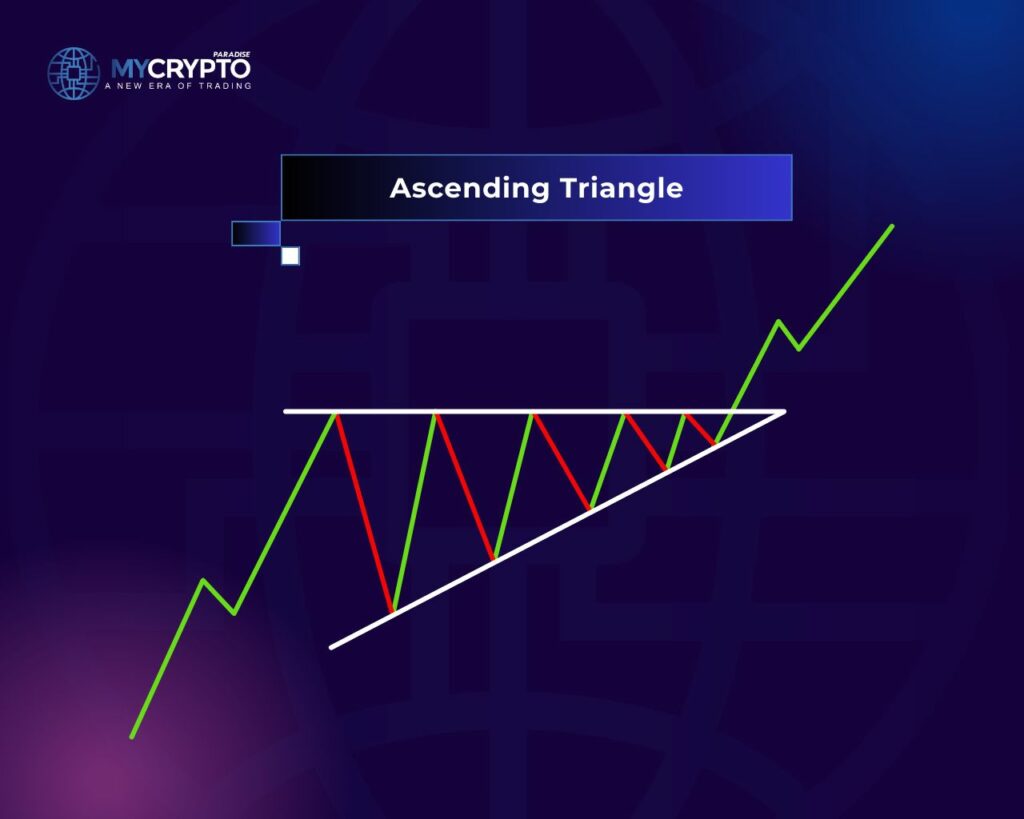
Inside the triangle, buyers are willing to pay more on each pullback. Sellers still cap the rally at resistance, but they can no longer push price back to the old lows. If buyers absorb the remaining supply, price breaks out and the prior uptrend often continues.
Key Characteristics of an Ascending Triangle
Horizontal Resistance
The upper boundary stays flat. Each time price reaches it, sellers step in and stop the advance. Every test uses up part of that supply, which is why this ceiling becomes the breakout level traders watch.
Rising Support Trendline
The lower boundary slopes upward because buyers enter at higher prices on each dip. They no longer wait for deep pullbacks. That rising line is the visible record of growing demand.
Price Compression
As the two lines converge, the trading range narrows and volatility drops. Pressure builds inside a smaller space. A longer, cleaner compression often leads to a sharper move once price leaves the triangle.
How to Identify an Ascending Triangle Pattern

Identifying an ascending triangle is mostly a checklist. You need a market making higher lows while it stalls at the same resistance level. Draw a horizontal line across the highs and a rising line under the lows. If the two lines converge, you have the pattern.
Work through these five checks before you call it:
- Flat resistance: at least two rejections from roughly the same price.
- Rising support: at least two higher lows you can join with one line.
- Compression: the gap between the two lines keeps narrowing.
- Fading volume: volume usually drops as the pattern matures.
- Confirmation: a strong candle closes above resistance on rising volume.
Until that last check passes, the pattern is only a possibility. Entering inside the triangle means betting on a breakout that has not happened yet.
Not every triangle is ascending. Descending and symmetrical triangles look similar but carry a different bias, and the comparison further down shows how to tell them apart.
Structure and Psychology of an Ascending Triangle
The structure tells you who is gaining ground. Price tags the same ceiling again and again, while each pullback ends higher than the last. As the range narrows, one side has to give way, and the rising lows suggest which one. The chart below marks the equal highs, the three higher lows and the breakout.

The Psychology Behind the Ascending Triangle
Early on, sellers win at resistance and price pulls back. Buyers return sooner on every dip, which is where the higher lows come from. Over time they absorb the supply sitting at the ceiling.
When resistance finally breaks, two groups add fuel. Breakout traders buy the move, and many traders who sold short at the ceiling buy back to close, some of them through their stops. That is why a clean breakout can move quickly.
Best Trading Signals: Ways to Trade with Ascending Triangle Pattern
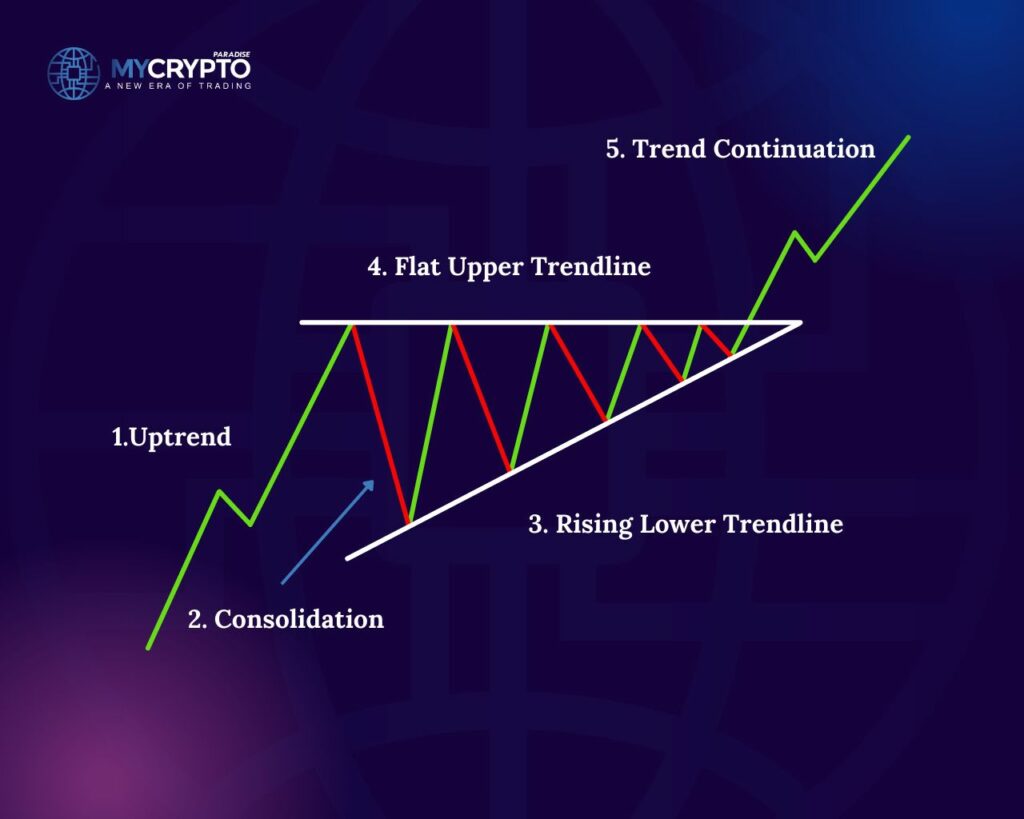
The ascending triangle gives a clear signal because both sides of the trade are defined. Buyers keep paying higher prices, and sellers cannot push price below the rising line. A breakout shows buyers have taken control, and the prior trend often continues.
There are two ways to trade it: breakout trading and pullback trading.
Breakout Trading
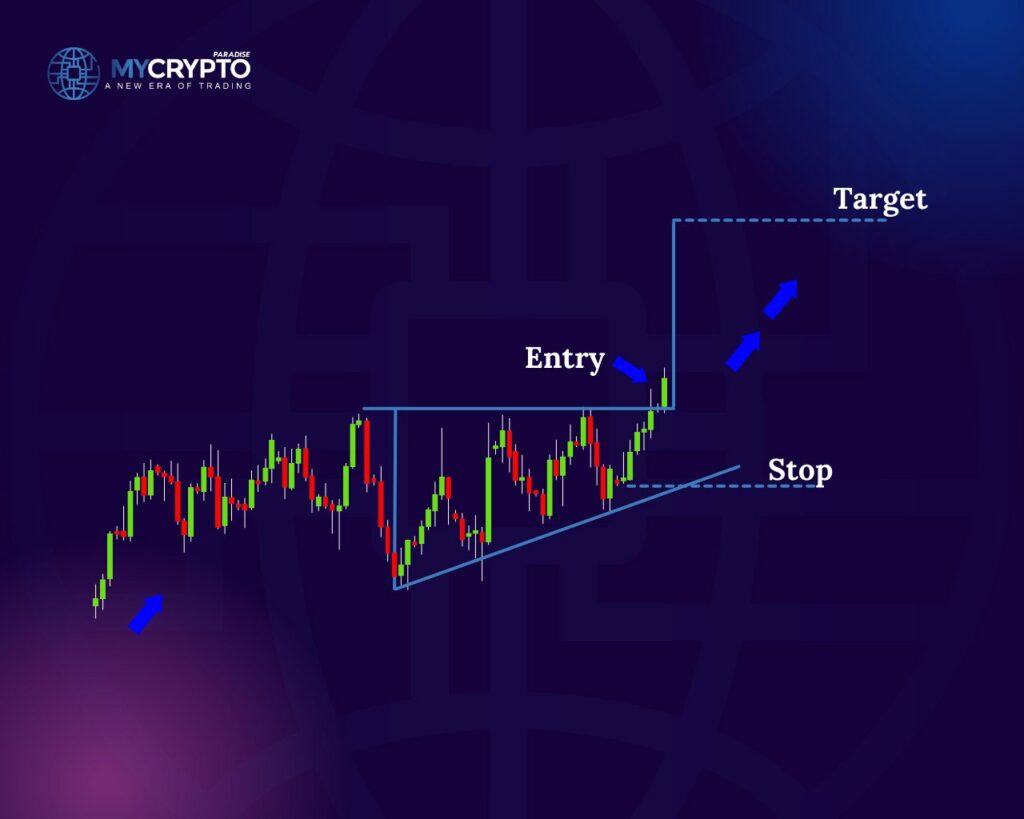
Breakout trading means buying once a candle closes above resistance. Look for volume well above the recent average, which shows real buying pressure. Place the stop loss below the rising trendline to protect against a false breakout.
The profit target equals the height of the triangle, added to the breakout level. For example, a $10 triangle with a breakout at $50 gives a target near $60.
Pullback Trading: Breakout and Retest
Pullback trading waits for price to come back and retest the broken resistance after the breakout. You give up part of the move, but you get proof that old resistance now acts as support. A retest entry has three steps:
- Price closes strongly above resistance, ideally on higher volume.
- Price pulls back to the old resistance and holds it as support.
- A bullish candle, a rejection wick or a new higher low confirms the hold.
Do not chase the first breakout candle. If the retest holds, enter on that confirmation, not before.
Set the stop loss under the retest low, or a little under the rising support trendline. That covers a failed breakout while still allowing for normal volatility. A stop that is too tight gets hit by ordinary noise, and one that is too wide weakens your risk-to-reward ratio.
The target is the same measured move as the breakout trade: the height of the triangle, projected up from the breakout level.
How Do You Confirm an Ascending Triangle Breakout?
Confirm a breakout with volume and structure. Volume usually shrinks while the triangle forms, as buyers and sellers reach a short balance. A valid breakout reverses that: a large candle, a clear close above resistance and volume well above the recent average. Weak volume on the breakout raises the risk of a fakeout.
These extra signals add weight to a breakout:
- RSI above 50 and rising, which shows momentum behind the move.
- A new higher high that breaks the market structure upward.
- A retest that holds the old resistance as support.
- A higher timeframe trend, on the daily or weekly chart, that points up.
One signal alone proves little. Two or three together make a false breakout less likely, though never impossible.
How to Properly Measure the Potential Targets When Trading with Ascending Triangle
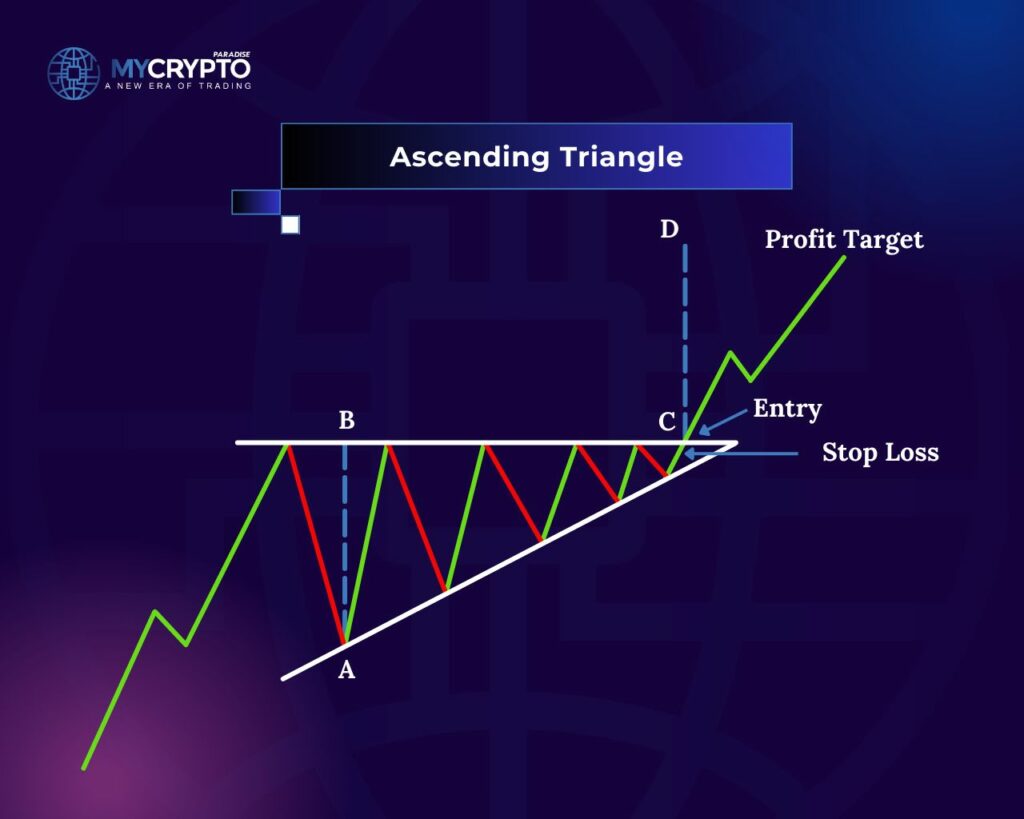
The simplest target uses the height of the triangle. Measure the distance from the resistance level down to the start of the rising trendline, then add it to the breakout level. In the chart, A to B is the height and C to D projects it from the breakout.
Using the earlier example, a triangle height of $10 and a breakout at $50 point to a target near $60.
Fibonacci tools can add reference levels. Retracements mark where price may pull back before the trend continues. Extensions mark where price may travel beyond the previous high.
In an uptrend, draw the tool from the swing low to the swing high of the move. Common retracement levels are 23.6%, 38.2%, 50%, 61.8% and 78.6%. Common extension levels are 127.2%, 161.8% and 261.8%.
Treat every level as an area to watch, not a promise. Combine it with other tools and a stop loss you set before you enter.
How Reliable Is the Ascending Triangle Pattern?
The ascending triangle is a probability read, not a certainty. It tends to work better inside a strong uptrend and when the higher timeframe agrees. Volume should fade during the pattern and expand on the breakout. In a weak trend or thin volume, false breakouts are common.
Duration matters as well. A triangle that forms over weeks usually carries more weight than one that forms in a few hours. Check the setup against trend lines, moving averages or momentum indicators before you act.
Risk management decides the outcome more than the pattern does. Set the stop before you enter, size the position so a loss is affordable, and take profit at levels you planned in advance.
Ascending Triangle vs Other Patterns
Several patterns look similar at first glance. The bias and the psychology behind them differ, so a wrong label leads to a wrong trade.
| Pattern | Usual bias | Shape |
|---|---|---|
| Ascending triangle | Bullish continuation | Flat top, rising lows |
| Symmetrical triangle | Neutral until the breakout | Falling highs, rising lows |
| Descending triangle | Usually bearish | Falling highs, flat bottom |
| Rectangle | Neutral range | Flat top, flat bottom |
| Bull flag | Bullish continuation | Short downward channel after a sharp rally |
Ascending Triangle vs Symmetrical Triangle
A symmetrical triangle shows balance: lower highs and higher lows squeeze price from both sides. The ascending triangle has a flat ceiling instead, so only buyers are gaining ground. That gives it a bullish bias the symmetrical version does not have.
Ascending Triangle vs Descending Triangle
A descending triangle is the mirror image. Support stays flat while sellers print lower highs, which points to growing selling pressure. The ascending triangle shows the opposite: rising lows under a fixed ceiling.
Ascending Triangle vs Rectangle Pattern
A rectangle pattern trades between flat support and flat resistance. Neither side is gaining ground, so there is no built-in bias. In an ascending triangle, the rising lows show buyers growing more aggressive.
Ascending Triangle vs Bull Flag
A bull flag forms right after a sharp rally, as a short pullback inside a small downward channel. The ascending triangle builds more slowly. Price compresses under a flat ceiling while the lows rise, so it reflects accumulation rather than a pause after a spike.
Common Mistakes When Trading the Ascending Triangle
Many losing trades on this pattern trace back to five habits:
- Entering before the breakout, which leaves you exposed to a fakeout.
- Ignoring volume, since a quiet breakout often lacks the buyers to hold.
- Setting the stop too tight, or so wide that the risk outweighs the target.
- Chasing a large breakout candle instead of waiting for a retest.
- Ignoring the wider market, including the Bitcoin trend and the higher timeframe.
Each of these has the same fix: wait for confirmation, then let the stop do its job.
What Happens When an Ascending Triangle Fails?
An ascending triangle fails when price breaks out and then closes back inside the pattern, or when it breaks below the rising support line. A stop below the retest low or the rising line is there to limit that loss, though a fast market can fill it lower.
When support breaks cleanly, the bullish case is gone and many traders step aside. If price then loses the last higher low as well, the equal highs start to look like a double top, a bearish reversal pattern.
Conclusion
The ascending triangle is one of the clearest continuation patterns in crypto. Flat resistance, rising lows and a narrowing range show buyers gaining ground against a fixed ceiling.
Success with it is not about predicting the breakout. It is about waiting for confirmation, reading the volume and setting the stop before you enter. Treat each setup as a probability read, and size every trade so one failure costs little.
The ParadiseTeam shares free market updates on trending coins such as BTC and ETH in our public Telegram channels:
Ascending Triangle FAQ
What is an ascending triangle pattern?
It is a bullish chart pattern with a horizontal resistance line across the top and a rising trendline connecting higher lows. The converging lines show buyers willing to pay higher prices while sellers cannot push price below the rising support.
Is an ascending triangle bullish or bearish?
It is usually bullish. Sellers hold the same ceiling, but buyers step in sooner on each dip, so the supply above thins with every test. In an existing uptrend, the break tends to come through the top. The pattern is only confirmed by a close above resistance, so treat it as a probability, not a certainty.
How should you trade an ascending triangle breakout?
Enter after a candle closes above resistance on strong volume. A more patient option waits for a retest that holds the old resistance as support. Put the stop under the rising trendline, or under the retest low if you waited, leaving room for ordinary swings. Size the position so a loss at the stop is affordable.
How do you set a price target on an ascending triangle?
Measure the widest part of the triangle, from the resistance level down to the first low on the rising trendline. Then add that height to the breakout level. For example, a $10 triangle height with a $50 breakout gives a $60 target. Fibonacci extensions can offer additional reference levels.
Is the ascending triangle a reliable signal?
Reliability depends on context, including trend strength, trading volume, and pattern duration. It tends to perform better during a strong uptrend with high volume, and weaker in low-volume conditions. Confirm with other indicators and apply proper risk management. Even a clean setup can fail, so plan the exit before the entry.
Crypto trading involves substantial risk of loss. This article is educational and is not financial advice. Past performance does not guarantee future results. Always do your own research.
What is different here
Most guides stop at the theory. The MyCryptoParadise team shares the live trades, and the reasoning behind each one, inside ParadiseFamilyVIP. Everything here is education, not financial advice.
Crypto trading involves substantial risk and is not suitable for everyone. Nothing here is financial advice; it is education only. Never risk more than you can afford to lose.












Join the discussion 1
Wow nice! Helpful! Thanks for share