

Funding rates
In short
A crypto funding rate is a small recurring payment exchanged between long and short traders in a perpetual futures market, used to keep the contract price tied to the spot price. Positive funding means longs pay shorts and the crowd is leaning long. Negative funding means shorts pay longs and the crowd is leaning short.
Funding rates are one of the most useful, and most misread, numbers in crypto. They quietly tell you where the crowd is leaning, who is paying to stay in the trade, and where pressure is building. Yet most traders either ignore funding completely or treat a single high number as a guaranteed reversal. This guide shows you how to read crypto funding rates properly, what positive and negative funding actually mean, and how to turn a screen full of numbers into one clear read.
What is a crypto funding rate?
A funding rate is a periodic payment exchanged directly between traders who are long and traders who are short on a perpetual futures contract. Unlike a traditional futures contract, a perpetual has no expiry date, so exchanges use funding to keep its price anchored to the underlying spot market. When the perpetual trades above spot, longs pay shorts. When it trades below spot, shorts pay longs. That payment is the funding rate, and it is usually settled every eight hours, though some venues settle more often (Investopedia).
The exchange does not take this money. It flows from one side of the market to the other, which is what makes it such an honest read on positioning: someone is always paying to keep their trade open, and the rate tells you who.
What is different here
Most tools show you the funding number and stop. The MyCryptoParadise funding board turns funding, open interest and price across all major exchanges into a squeeze probability read, calibrated per coin. It is a probability, not a forecast, and nothing here is financial advice.
Positive vs negative funding rates
Reading the direction of funding is simple once you anchor it:
- Positive funding: longs pay shorts. More traders are positioned long and willing to pay to stay there, so the market is leaning long.
- Negative funding: shorts pay longs. More traders are positioned short, so the market is leaning short.
The size matters as much as the sign. Funding that sits slightly positive is normal in a healthy uptrend. Funding that spikes to an extreme means one side is crowded and paying heavily to hold on, and that is the condition worth paying attention to.
How often funding is paid and how big it gets
Most exchanges settle funding every eight hours and quote the rate per interval, for example 0.01 percent. That looks tiny, but it compounds: 0.01 percent every eight hours is roughly 0.03 percent a day, or around 11 percent a year, just to hold the position. When funding runs several times higher than that for days, the cost of staying in the crowded trade becomes a real pressure on its own.
What funding rates actually tell you
Funding is a positioning read, not a buy or sell button. It answers one question: how crowded is each side of the market right now? The logic that makes it useful is simple. When one side is heavily crowded and paying to stay in, it becomes fragile. A small move against that crowd can force a wave of liquidations and stop-outs, and the price snaps hard in the other direction. That is a squeeze, and crowded funding is one of its clearest early fingerprints.
This is why funding rarely works as a standalone signal. It works as context. Extreme positive funding into a key resistance level is a very different story from extreme positive funding in the middle of a clean trend.
How to read funding rates at a glance
Here is the practical problem: funding lives on a dozen exchanges, across a hundred or more coins, and changes by the hour. Reading it raw means flicking between tabs and doing the math in your head, which is exactly why most traders give up on it.
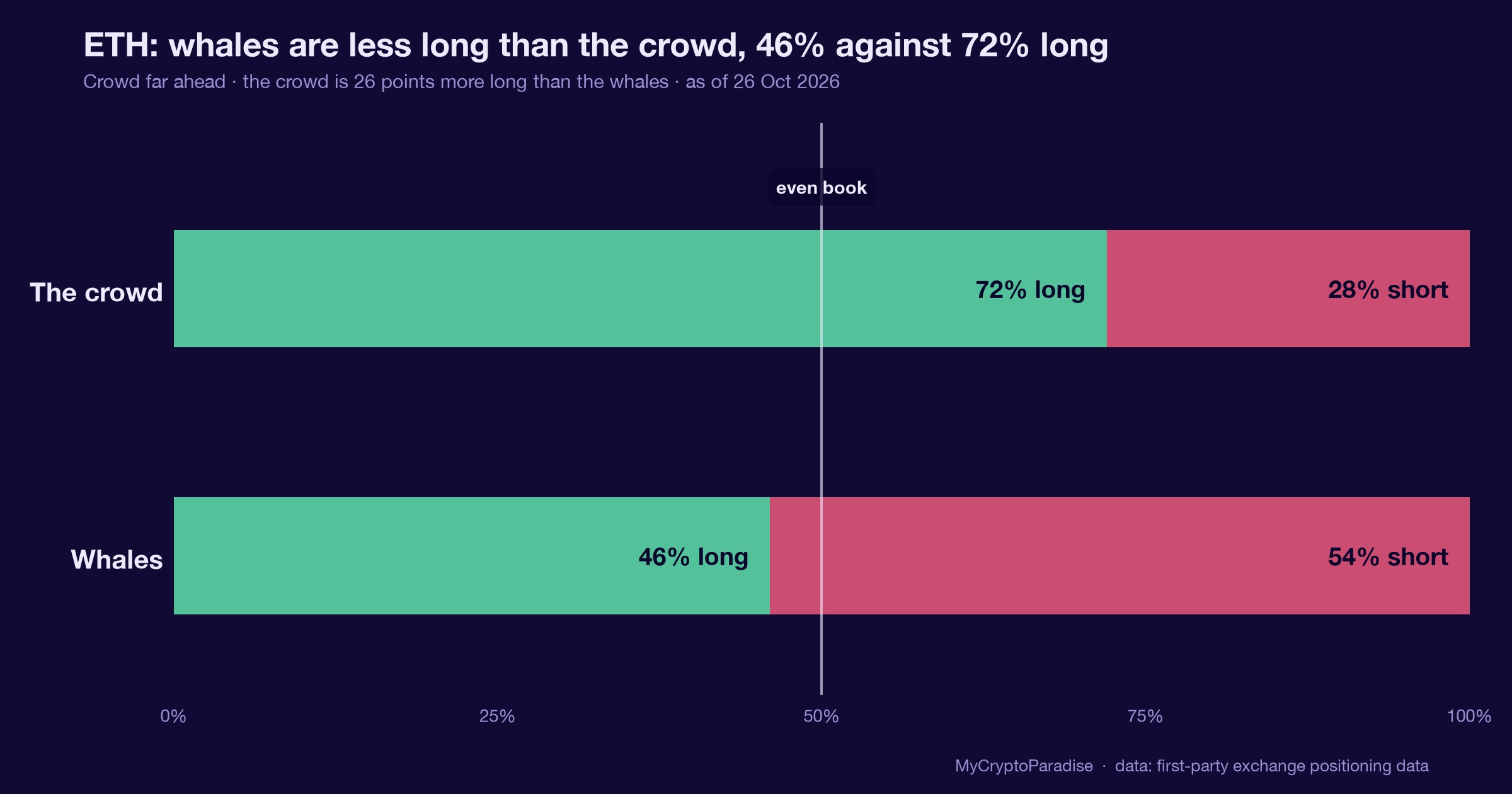
That is the gap our Live Funding Grades board was built to close. It reads funding across all major exchanges and turns it into one easy score on BTC, ETH and 100 or more coins. Most funding tools stop there and just show you the rate. Ours adds the part nobody else on the market does: a squeeze probability score, to the upside or the downside, that reads the real pressure between smart money and retail and gives you one clear number per coin, on key timeframes. One look and you see where pressure is building and which way it is leaning, without decoding anything.
Try it
Funding rate reader
Tap a funding level to see what it is telling you. Funding is usually settled every 8 hours.
Sellers are crowded and paying to stay short. If price refuses to fall, there is room for a squeeze to the upside. A probability to weigh, not a forecast.
A mild short lean. A normal market, nothing extreme to read into yet.
The crowd is not leaning hard either way. Funding is doing its quiet job of tying the perpetual to spot.
Buyers are paying to stay long. A healthy lean in an uptrend. Worth noting, not a warning.
Longs are crowded and paying up. If price stops rising, there is room for a squeeze to the downside. A probability to weigh, not a forecast.
These values are illustrative. See real funding across all major exchanges on the live board.
Common mistakes when reading funding rates
- Trading on funding alone. A high number is context, not a trade. Pair it with price structure and a clear invalidation level.
- Ignoring the timeframe. Funding pressure that matters for a scalp can be noise for a swing, and the reverse.
- Assuming extreme funding means an instant reversal. Crowded markets can stay crowded longer than expected. Funding tells you the risk is building, not the exact minute it releases.
- Forgetting risk management. No funding read removes the need for a stop, a position size you can sleep with, and a plan for being wrong.
See it live, free
Real funding rates across all major exchanges, with the squeeze read on each coin
Frequently asked questions
What does a negative funding rate mean?
A negative funding rate means short traders are paying long traders to keep their positions open, which signals that the crowd is leaning short. If shorts become heavily crowded, the market can be vulnerable to a squeeze to the upside.
Is a high funding rate bullish or bearish?
Neither on its own. High positive funding shows the long side is crowded, which is a sign of strength but also of fragility if the crowd is one sided. It is best read alongside price structure, not as a direct signal.
How often are crypto funding rates paid?
Most exchanges settle funding every eight hours, so three times a day. Some venues use shorter intervals. The rate is quoted per interval, so it is worth annualising it to understand the true cost of holding a position.
Can you trade on funding rates alone?
It is not advisable. Funding is a positioning read, best used as one layer of confluence with price levels, trend, and risk management. Used alone, it generates as many false signals as useful ones.
What is a funding rate squeeze?
A squeeze happens when a heavily crowded side is forced out of its positions at once, often through liquidations, and price snaps sharply the other way. Extreme funding is one of the earliest signs that the conditions for a squeeze are building.
Related: Live funding rates & squeeze score · How pros use funding rates · Risk management
Crypto trading involves substantial risk and is not suitable for everyone. Nothing here is financial advice; it is education only. Never risk more than you can afford to lose.







Join the discussion
No comments yet. Members, share how you are reading this.