



In short: The Wyckoff Market Cycle moves through four phases: Accumulation, Markup, Distribution, and Markdown. Each phase shows whether buyers or sellers control the market. Read the shift in supply and demand, then wait for confirmation before you act.
The Wyckoff Market Cycle maps how price moves through four repeating stages: Accumulation, Markup, Distribution, and Markdown. Each stage reflects who controls the market, buyers or sellers. Read the shift in supply and demand and you can judge which stage may be forming before you act.
This lesson teaches why the stages develop, not just how to label them. You will learn to spot weakening pressure, wait for confirmation, and avoid forcing textbook patterns onto messy charts.
What Is the Wyckoff Market Cycle?
The Wyckoff Market Cycle is a framework describing how markets rotate through four phases as the balance between supply and demand changes. Accumulation absorbs supply after a decline. Markup follows when demand takes control. Distribution builds as buying weakens. Markdown arrives when supply dominates.
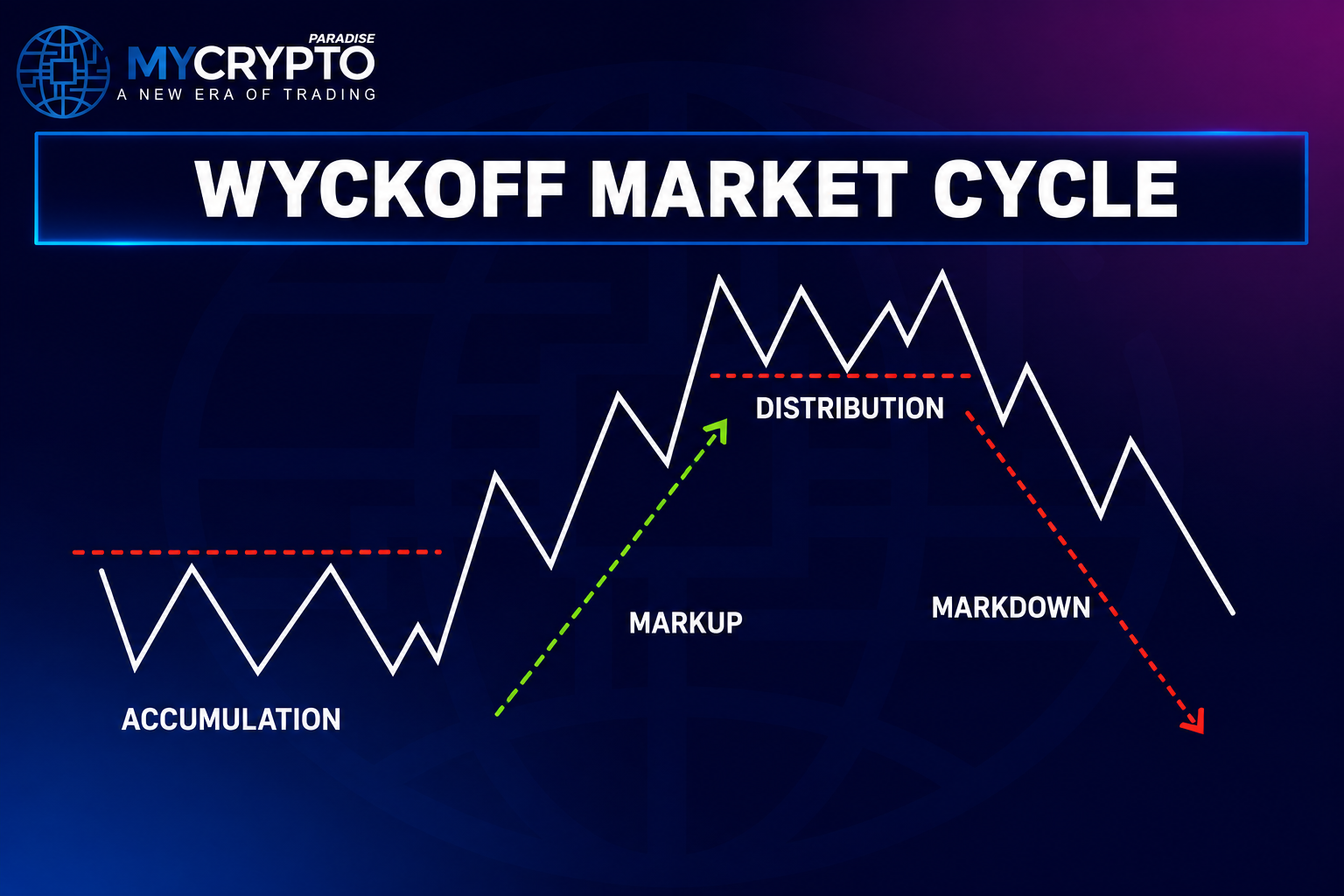
The key word is may. A trading range does not automatically mean accumulation or distribution, and markets rarely follow a perfect sequence. Wyckoff analysis focuses on behaviour and confirmation, so traders look for evidence before assigning a label.
Why the Cycle Happens
Markets constantly move between balance and imbalance as supply and demand compete. When demand outweighs available supply, buyers lift price. When supply overwhelms demand, sellers push price lower. These shifts build slowly, not instantly.
After a long decline, selling can lose force as demand absorbs supply, creating potential Accumulation. After a long advance, rising supply can absorb demand, creating potential Distribution. The goal is to read which side is gaining control.
The method traces back to Richard Wyckoff, an early 20th century trader whose work is still widely referenced in market education. See Investopedia for background on the approach.
Phase 1: Wyckoff Accumulation
Accumulation is a range that may form after a prolonged decline, when selling loses effectiveness and demand gradually absorbs supply. Instead of falling further, price stabilises as the balance between sellers and buyers begins to shift.
During this phase, repeated selling tends to produce less downside, while rallies off support grow stronger. Failed breakdowns and improving structure hint that sellers are losing grip. Still, sideways action alone is not proof.
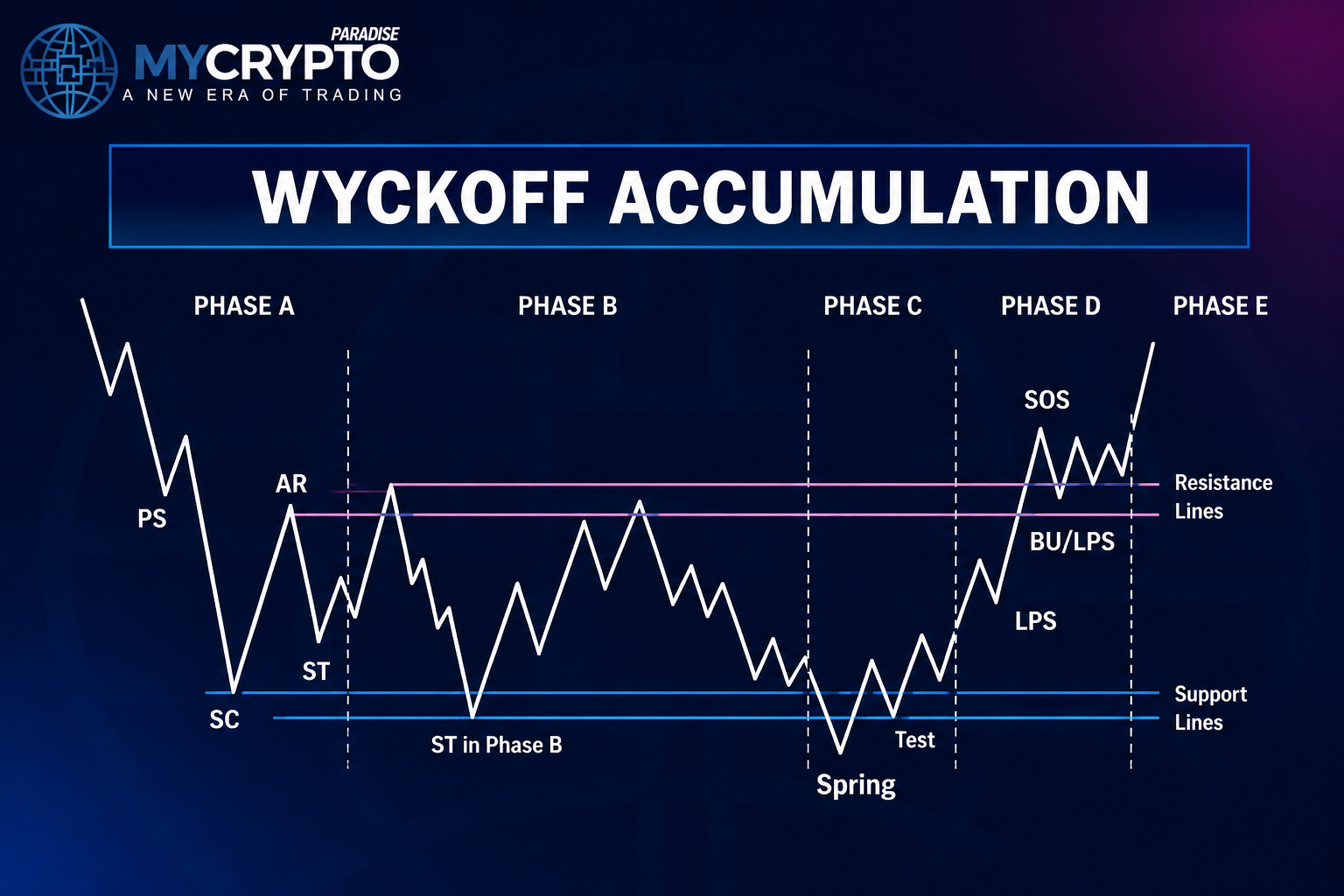
Key Components of Accumulation
- Preliminary Support (PS): early buying begins slowing the downtrend.
- Selling Climax (SC): intense selling peaks as strong demand absorbs heavy supply.
- Automatic Rally (AR): price rebounds sharply once selling fades.
- Secondary Test (ST): price revisits the lows to test remaining supply.
- Spring: price dips below support then recovers, trapping late sellers.
- Test: price rechecks the spring area with lighter selling.
- Sign of Strength (SOS): strong demand breaks resistance inside the range.
- Backup (BU): price pulls back to test the breakout as support.
- Last Point of Support (LPS): a higher low confirming demand stays dominant.
Phase 2: Wyckoff Markup
Markup is the bullish trending phase, where demand controls supply and price makes sustained upward progress. It often follows successful Accumulation as price leaves the range and builds a stronger bullish structure.
Structure and Psychology
Markup develops through higher highs and higher lows. Old resistance often becomes new support on pullbacks. Psychology drifts from disbelief toward confidence, and crowd mood tracked by tools like fear and greed tends to warm as the trend becomes clearer.
Reaccumulation During Markup
A range inside an uptrend does not automatically signal Distribution. It may be Reaccumulation, a pause where demand stays dominant. If resistance breaks and buyers renew progress, the broader uptrend can continue.
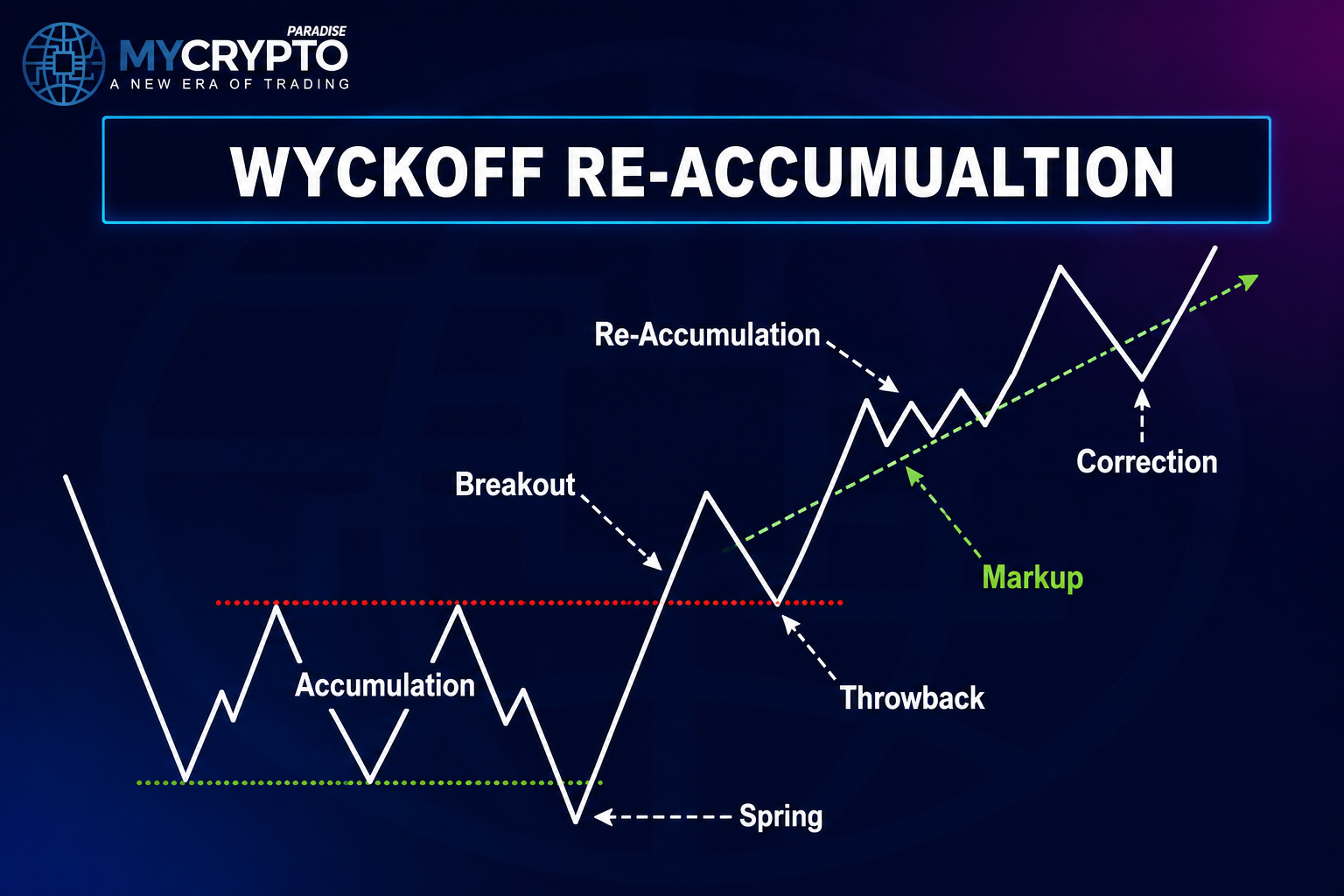
Reading Volume in Markup
Healthy Markup shows strong expansion when demand enters and softer reactions during profit-taking. Breakouts should make real progress. Volume matters most when compared with the resulting move, showing whether bullish effort actually pays off. Shifts in crypto funding rates can add context.
When Markup Weakens
Watch for smaller gains on each push, failed breakouts, deeper pullbacks, and rising activity without progress. Those signs suggest supply is absorbing demand. When several align and key support fails, buyers may be losing control.
Phase 3: Wyckoff Distribution
Distribution is a range that may form after a prolonged rally, when buying loses effectiveness and rising supply absorbs demand. Instead of climbing further, price stalls as control may shift from buyers toward sellers.
Repeated buying starts producing less upside, while rejection from highs grows more visible. As always, sideways action after a rally is not automatic proof. Look for weakening demand and strengthening supply first.
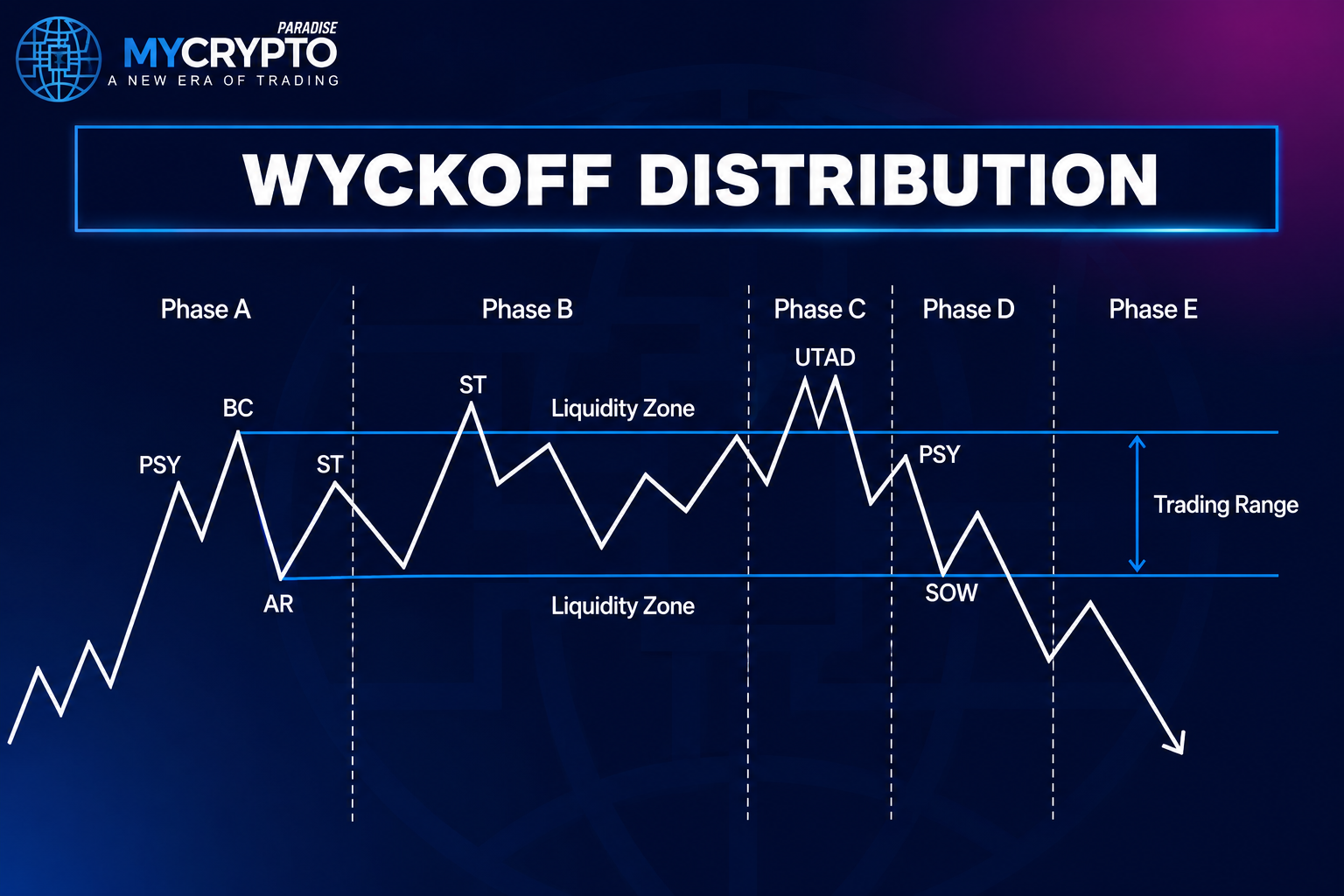
Key Components of Distribution
- Preliminary Supply (PSY): early selling slows the uptrend.
- Buying Climax (BC): intense buying peaks as supply absorbs demand.
- Automatic Reaction (AR): price drops once buying fades.
- Secondary Test (ST): price revisits highs to test demand.
- Upthrust (UT): price pokes above resistance then falls back inside.
- Upthrust After Distribution (UTAD): a late breakout fails as supply wins.
- Sign of Weakness (SOW): strong selling reveals growing supply.
- Last Point of Supply (LPSY): a weak rally confirming supply stays dominant.
Phase 4: Wyckoff Markdown
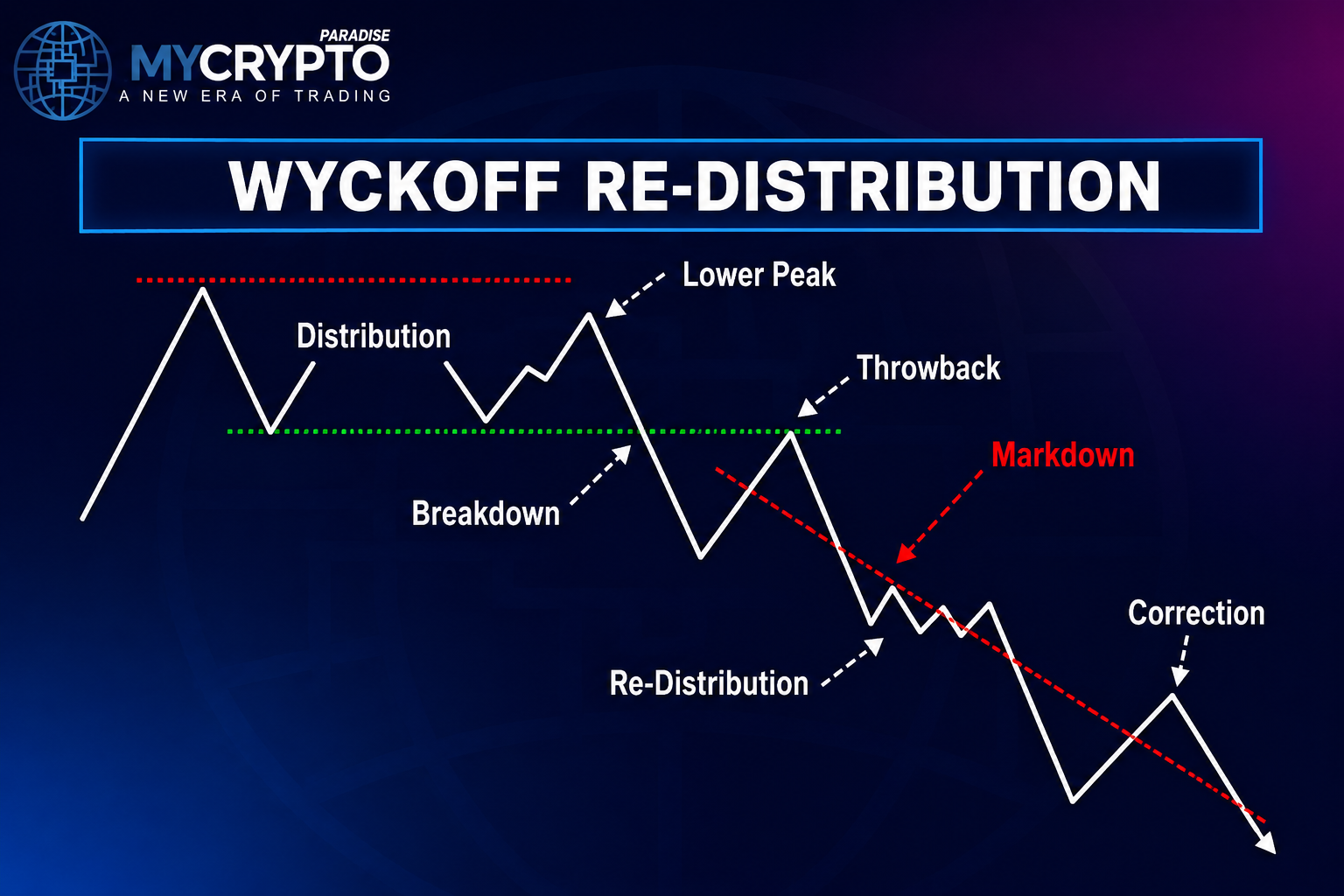
Markdown is the bearish trending phase, where supply controls demand and price makes sustained downward progress. It often follows Distribution as price leaves the range and builds a stronger bearish structure.
Structure and Psychology
Markdown develops through lower lows and lower highs. Old support often becomes new resistance on bounces. Psychology moves from denial to fear, and persistent breaks can end in capitulation as sellers dominate.
Reading Volume in Markdown
Here the pattern inverts: downside pushes tend to widen while bounces stay shallow and short-lived. A breakdown that follows through signals real intent. Track where forced selling clusters on a liquidation heatmap to gauge pressure.
Redistribution During Markdown
A range inside a downtrend does not automatically signal Accumulation. It may be Redistribution, a pause where supply stays dominant. If support breaks and sellers renew progress, the broader downtrend can continue.
When Markdown Weakens
Watch for slowing downside, failed breakdowns, stronger recoveries, and reclaimed resistance. Heavy selling with little downside also hints that demand is absorbing supply. When these signs align, sellers may be losing control.
Reversal vs Continuation Structures
Wyckoff structures can signal a reversal or a continuation, depending on where they sit in the broader cycle. Context decides the meaning, so the same range can point either way.
Accumulation follows a major decline and marks a possible bearish-to-bullish shift. Reaccumulation forms inside an uptrend and supports continuation. Distribution can flip a trend down, while Redistribution simply pauses a downtrend. For another view of trend structure, study Elliott Wave theory.
Common Mistakes
- Calling every bottom Accumulation. A big decline is not proof; wait for weakening supply.
- Calling every top Distribution. The range could be Reaccumulation and continue higher.
- Confusing Accumulation with Reaccumulation. One reverses a trend; the other continues it.
- Confusing Distribution with Redistribution. Context, not shape, decides direction.
- Ignoring volume. Price shows structure; volume shows whether effort produces results.
- Predicting the breakout too early. Ranges can stay unresolved longer than expected.
- Forcing a perfect cycle. Phases extend, repeat, compress, or fail.
- Ignoring risk management. A correct read still needs confirmation and a clear invalidation.
Practice This
Pick one liquid asset like Bitcoin or Ethereum. Mark the last major decline and advance, then label where each phase may have formed. Note the volume on breakouts and breakdowns.
Add confirmation tools you already know. A bullish engulfing pattern or a piercing line pattern near support can strengthen an Accumulation read. Always define your invalidation before entering.
Conclusion
The Wyckoff Market Cycle is more than four labels. It explains how control passes between buyers and sellers, and it rewards traders who confirm with price, volume, and structure rather than guessing.
MyCryptoParadise is a professional crypto signals and trading-education service, operating since 2016. Our education focuses on reading supply, demand, liquidity, and market structure so you can judge market context honestly and manage risk with discipline.
FAQs
What are the four phases of the Wyckoff Market Cycle?
The four phases are Accumulation, Markup, Distribution, and Markdown. They describe how markets shift as the balance between supply and demand changes over time.
What is Wyckoff Accumulation?
Accumulation is a possible bullish transition. Selling pressure weakens while demand gradually absorbs supply, often after a significant decline. Traders wait for confirmation before anticipating a Markup phase.
What is Wyckoff Distribution?
Distribution is a possible bearish transition. Buying pressure weakens while rising supply absorbs demand, often after a significant rally. Confirmation matters before anticipating a Markdown phase.
What is the difference between Accumulation and Reaccumulation?
Accumulation usually signals a bearish-to-bullish shift after a decline. Reaccumulation forms inside an existing uptrend and supports continuation rather than a major reversal. Context decides which one applies.
Can the Wyckoff Market Cycle be used for Bitcoin and crypto?
Yes. It applies to Bitcoin, Ethereum, and other liquid coins. You can study supply, demand, volume, and market structure to read shifts in market control.
Risk disclaimer: Crypto trading involves substantial risk of loss. This class is education only, not financial advice. Never trade with money you cannot afford to lose. Past results do not guarantee future results.











Join the discussion 3
This breakdown of the Wyckoff cycle is helpful... especially understanding the volume cues for accumulation. I always try to watch for that before moving any of my earnings.
Volume is a piece of it... but never forget the time in range.
my favorite phase used to be markup because everything goes up 🚀, but now I'm always looking for that accumulation zone... 🕵️♀️ that's where the real opportunity is. 📈