



In short
A prediction market price is an implied probability, not a prediction. A 59% price means the crowd is paying 59 cents for a contract that pays one dollar if the event happens. That is a mild lean, not a call. The closer a price sits to 50%, the less the market actually knows. A 59% Senate market is still close to a coin flip. Read it as a probability that can move, not a settled outcome. The same discipline applies to any crypto sentiment gauge you trust with real money.
How does a prediction market price become a probability?
A prediction market lets people trade contracts that pay one dollar if an event happens and nothing if it does not. The live price, quoted in cents, becomes the implied probability. A contract trading at 59 cents implies a 59% chance. The price is the crowd’s money-weighted estimate, not a guarantee.
The mechanism is simple. Each contract settles at one dollar if the event happens and zero if it does not. Traders buy and sell in between, and the last traded price reflects what they collectively believe. This is why a price of 59 cents reads directly as an implied probability of 59%.
In the United States, some venues run as regulated event contracts. They are overseen by the U.S. derivatives regulator, which treats the traded price as a market probability.
This crowd-pricing idea is well documented. Public research on how prediction markets work shows that liquid contracts often track real-world frequencies closely. The same logic underpins the way we explain how crypto signals work: a reading is only as honest as the process behind it.
What is different here
We read a probability the same way, as a lean and not a forecast. The ParadiseTeam checks live positioning across all major exchanges before building a setup, then treats the number as one input among several.
Why is 59% closer to a toss-up than it sounds?
A 59% price is only nine points above an even coin flip. It means the market barely leans one way and could flip on modest news. Probabilities near 50% carry the widest uncertainty, because small shifts in belief move the price the most. Treat 59% as soft confidence, not a near certainty.
Here is the same idea across a few prices.
| Market price | Implied probability | How to read it |
|---|---|---|
| 52 cents | 52% | Essentially a coin flip |
| 59 cents | 59% | A mild lean, still uncertain |
| 75 cents | 75% | A clear favorite, not a lock |
| 90 cents | 90% | Strong consensus, still fallible |
A market that is 59% sure is, put less politely, mostly unsure.
Notice the pattern. A price only reads as strong confidence once it moves well clear of the middle. At 59%, the market is still telling you it is not sure. Put plainly, the closer a price sits to a coin flip, the more it is admitting it does not know.
Liquidity, thin books and why odds wobble
Odds wobble when the order book is thin. A prediction market with few traders and small size can swing several points on one large bet. That movement reflects liquidity, not new information. Before trusting a price, check whether real volume backs it, because a thinly traded number is easy to push around.
Volume is the tell. A market with deep liquidity absorbs large bets without moving much, so its price is harder to distort. A thin market does the opposite, and a single motivated trader can nudge the odds. When you see a dramatic swing, ask whether new facts arrived or just new money.
This is the same habit good traders bring to headlines. We cover this in our guide to reading market news. The move matters less than what drives it, and thin volume rarely means real conviction.
What can a prediction market actually tell a trader?
Prediction markets tell you the crowd’s current probability estimate and how it changes over time. They cannot tell you the outcome, the timing of a move, or your own position size. A market can be well calibrated across many events yet wrong on any single one. Use it as one input, never as a signal to act.
A price gives you probability, but three things stay outside its reach:
- The final outcome of the event
- The exact timing of any move
- The right size for your position
Calibration is the subtle part. A well-run market can be right on average across hundreds of events and still miss any single one. That is not a flaw in the market. It is the nature of probability, and it is why we treat any number as one input, never a command.
Applying the same skepticism to crypto sentiment readings
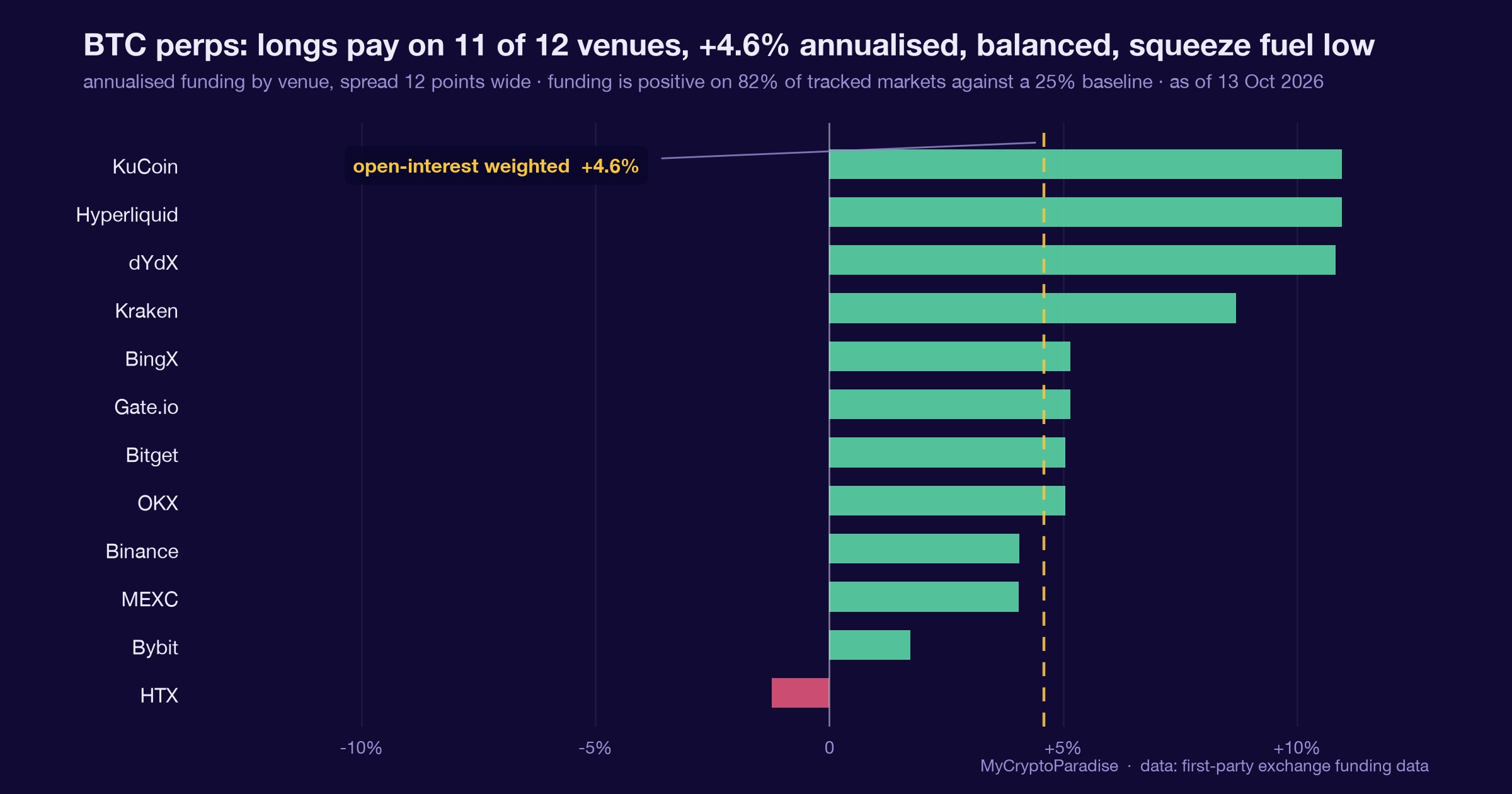
The same reading discipline applies to crypto sentiment tools. A fear and greed index, funding rates, or a probability read is a snapshot of positioning, not a promise. A number near neutral tells you the market is undecided. Treat any single gauge as one probability among many, and size your risk before you trust it.
Crypto gives you plenty of these gauges. Funding rates, open interest, and a fear index each summarise crowd positioning into one figure. They are useful, and they are not oracles. The same limits we describe for AI crypto sentiment tools apply here: a snapshot is a starting point, not a decision.
The reader’s job is always the same. Ask what the number measures, whether real volume backs it, and how far it sits from neutral. That habit separates a durable read from a hopeful one. It is also how you judge which crypto signals are reliable before you risk a cent.
Frequently asked questions
Does a 59% prediction market mean the event will happen?
No. A 59% price means the crowd assigns a 59% chance, which is only a mild lean. It sits closer to a coin flip than to a settled result. The event could easily go the other way, so treat the number as a probability, not a certainty.
How do I turn a prediction market price into a probability?
Read the price in cents as the percentage directly. A contract trading at 59 cents implies about a 59% chance, and one at 30 cents implies about 30%. The price pays one dollar if the event happens, so its cents value is the market’s implied probability.
Why is a probability near 50% the most uncertain?
A price near 50% means the crowd is almost evenly split. Small pieces of news can tip it either way, so the number moves the most and settles the least. A 90% price reflects strong consensus, while a 55% price reflects genuine doubt about the outcome.
Can traders use prediction markets for crypto decisions?
They can use them as one input, not as a trade signal. A prediction market shows the crowd’s current probability and how it shifts. It cannot set your position size or time your entry. Combine it with your own risk plan, and never treat a single price as certainty.
Crypto trading involves substantial risk and is not suitable for everyone. Nothing here is financial advice; it is education only. Never risk more than you can afford to lose.





Join the discussion 23
Yeah, I'm finding myself checking those percentages so much now... 😅 it's tricky seeing 59% and still knowing anything could happen.
Exactly, Noah! That four-hour noise is not a signal. It's why I only trade weekly closes. 📈
yes, checking is good, but how do you quantify your 'anything could happen' in your trade plan?
But what if it's like 59% on one exchange and 41% on another?! 🤯 I've seen that sometimes 🤔 where do you even start?? 🗺️ 😵💫
carlos, the price difference means something. it suggests the 59% is accurate at that moment, not that the market is confused. you can test that yourself.
The implied probability concept is sound, but framing 50% as the highest uncertainty seems to misrepresent how a clear range retest simplifies things.
Yes, Lukas, I think it's more about understanding the range itself… like how close a retest is, not just the middle number.
Hmm, 50% uncertainty makes total sense to me! 🤔 When my brother's transfer could go either way with fees, that's peak stress! 😬💸
its like when you see a forklift scale that says 59% full, you still gotta check the load yourself
Exactly! The forklift might say 59% but your gut knows if it's gonna tip 🤔. Always gotta factor in the other variables, eh? ⚖️😅
nah, tommy, i see that 59% and i'm already betting on the other side 😅 gotta fade that certainty, right?!
you betting on empty when the scale says 59% full? that's just gambling benny not checking the load for yourself
yeah, tommy, somethin like that. sometimes you just gotta trust your gut and get chopped up 🤷♂️ good luck checking those loads though.
seeing these percentages, its like my old landlord saying inflation is "transitory"... gotta make my own assessment of what really impacts purchasing power.
That's a good comparison, Diego. My Yaya always said to trust your own eyes with those things... especially when the percentages get squishy.
It's so hard to resist the feeling that 59% means "almost definitely yes" sometimes, even when my head knows better! I really have to fight that instinct. 😵💫
thats why i stick to things that move slow. a 59% chance for coffee futures in a season is much different than an hourly chart.
I used to think 59% was pretty good odds for a win and get rekt 💸😅. Now I’m like, 50-50, always a coin flip! 🪙📉
The point about 50% being peak uncertainty is correct, but the article's phrasing almost makes it sound like you can trade that uncertainty. That's hopium for rookies.
Even 51% predictions feel like a coin flip for me, especially when the invalidation isn't clear enough. I learned that the hard way, early on, with a small-cap alt.
Totally, Mateusz. And watching 4-hour noise just amplifies that coin-flip feeling. Not a signal. 🤷♀️
I still find myself looking at these numbers like the guy at my gym who keeps telling everyone about his 80% calls... but Tommy is right, the load is always different.
i still get a bit nervous seeing those numbers- i think this article helped me understand why 50% feels so scary even though its just uncertainty. sorry if that sounds silly!