

In short
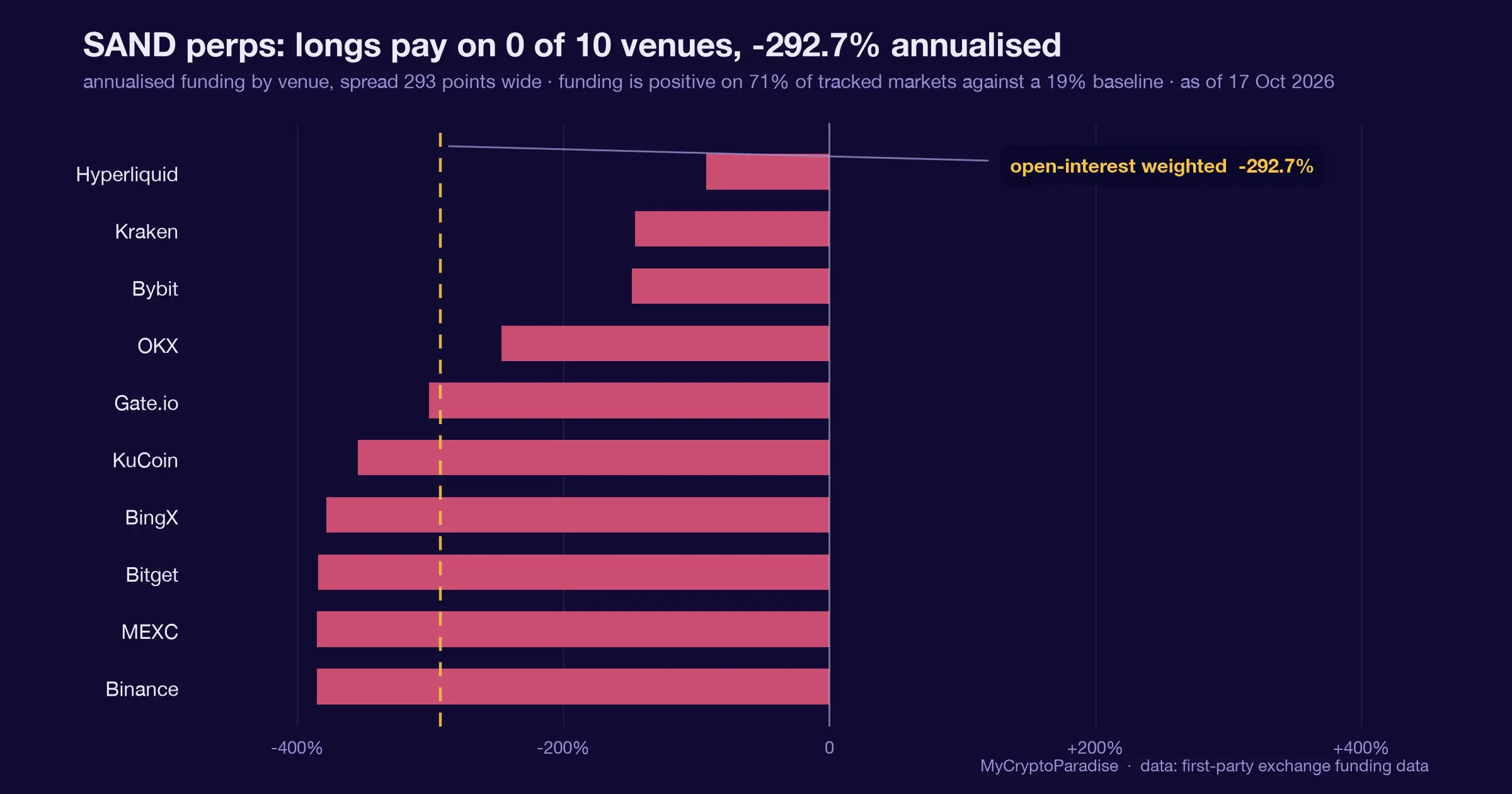
Funding rates are periodic payments between traders holding perpetual futures. When the rate is positive, longs pay shorts; when negative, shorts pay longs. Accumulated funding is the sum of these payments over time. When funding stays deeply negative, shorts are crowded and paying to hold their bets day after day. That crowding is the fuel for a short squeeze. If price ticks up, those shorts get squeezed out, and their buying pushes price higher still. Funding does not predict a squeeze. It shows you when one side has become dangerously one sided.
What are funding rates and who pays whom?
Funding rates are small recurring payments exchanged between traders in perpetual futures, usually every eight hours. They keep the perpetual price tethered to the spot price. When the market leans long, longs pay shorts. When it leans short, shorts pay longs. The rate itself tells you which side is crowded.
A perpetual future is a bet on price that never expires, unlike a traditional contract with a settlement date. To keep its price glued to spot, exchanges use funding. The funding rate is the small fee that flows between the two sides at each settlement, usually every eight hours. If you are new to these contracts, our note on how perpetuals differ from dated futures is a useful primer.
The direction of that fee is the whole point. When more traders crowd the long side, the rate turns positive and longs pay shorts. When the crowd leans short, the rate turns negative and shorts pay longs. You can watch this on any major venue, such as the live funding rate data that exchanges publish.
| Funding sign | Who pays | What it hints |
|---|---|---|
| Positive | Longs pay shorts | Crowd leans long |
| Negative | Shorts pay longs | Crowd leans short |
| Near zero | Little exchange | Balanced positioning |
Why does accumulated funding matter more than a single reading?
A single funding reading is a snapshot that can flip in hours. Accumulated funding adds up every payment over days or weeks, so it shows how long one side has been paying to stay in. Persistent cost signals conviction and crowding, which a one off spike never reveals.
Think of a single funding print as one day of rent. It tells you little. Accumulated funding is the full bill, every payment stacked up over the days a position has been open. When shorts have paid that bill for a week straight, they are both committed and exposed.
That is why we track the running total, not the headline number. A deep negative spike that lasts one settlement is noise. Deep negative funding that holds for days is a crowd that has quietly grown one sided. To see how we map that crowd, read where the crowd sits across the book.
What is different here
The ParadiseTeam reads accumulated funding across all major exchanges before building a setup. Funding on a single venue can mislead, while the aggregate reveals where the real crowd sits.
How does lopsided funding set up a squeeze?
When funding stays deeply negative, shorts dominate and pay continuously to hold. That crowd is fragile. A small upward move forces some shorts to buy back, which lifts price and triggers more buying. This feedback loop is a short squeeze. Lopsided funding does not cause it, but it loads the spring.
A short squeeze is a fast rally driven not by fresh buyers, but by trapped sellers. Shorts who bet on lower prices must buy back to close once losses mount. That buying is forced, and forced buying is the most reliable fuel a rally has.
Lopsided negative funding is the tell that the short side has grown heavy. The wider community has documented how these unwinds accelerate, and the mechanics of a classic short squeeze are well understood. We watched one play out in a squeeze in motion, and dissected a single crowded bet that funding had flagged in advance.
One more gauge sharpens the read: open interest. Rising open interest alongside deep negative funding means new shorts keep piling in, not just old ones holding on. That combination, more shorts and a growing cost to hold them, is the classic setup a squeeze feeds on.
Working an example with the funding widget
Numbers make this concrete. The tool below lets you enter a position size, a funding rate, and a hold length. You then see what staying in actually costs or earns.
Imagine a short position of roughly $10,000 while funding sits near negative 0.05% every eight hours. That short earns funding here, because shorts are paid when the rate is negative. But flip the crowd: if funding turned positive at a similar size, the same trader would pay to hold, day after day.
Now scale that across thousands of crowded shorts. The accumulated cost pressures the weakest hands first. When price nudges against them, the exit becomes a stampede. The widget shows the cost on one position; the squeeze is that same cost multiplied across a lopsided market.
Using funding as one input, not a trigger
Funding is a warning light, not a green light. Crowding tells you the fuel is present. It never tells you when the match arrives, or whether it arrives at all. We treat funding as one reading among several, weighed beside price structure, open interest, and liquidity, before we ever act.
This is why our squeeze read is framed as a probability read, not a forecast. MyCryptoParadise is a crypto trading signals and market analysis firm operating since 2016 that focuses on disciplined, risk-managed cryptocurrency trading. Discipline here means letting crowding raise your guard, then waiting for confirmation, rather than front running a squeeze that may never come.
Frequently asked questions
What is a good funding rate to watch for a squeeze?
There is no single magic number. What matters is funding staying negative and accumulating over days, not one deep print. Persistent negative funding means shorts are crowded and paying to stay in. Pair it with price near support and rising open interest before you treat crowding as a warning.
Does negative funding guarantee a short squeeze?
No. Negative funding shows shorts are crowded, not that price must rise. A crowded short book can stay crowded for weeks while price drifts lower. Funding loads the spring, but a catalyst still has to pull the trigger. Treat it as one risk input, never a standalone buy signal.
How often is funding paid?
Most major exchanges settle funding every eight hours, so three times a day. Some venues use one hour intervals for certain markets. Each settlement moves a small payment between longs and shorts. Accumulated funding is simply every one of those payments added together across your holding period.
Can I use funding on any coin?
Funding exists on any coin with a liquid perpetual market, but the signal is cleaner on larger, well traded pairs. Thin markets produce noisy funding that flips on small flows. On major coins, persistent lopsided funding is more trustworthy because it reflects real crowd positioning, not one large trader.
Crypto trading involves substantial risk and is not suitable for everyone. Nothing here is financial advice; it is education only. Never risk more than you can afford to lose.



Join the discussion
No comments yet. Members, share how you are reading this.