

In short
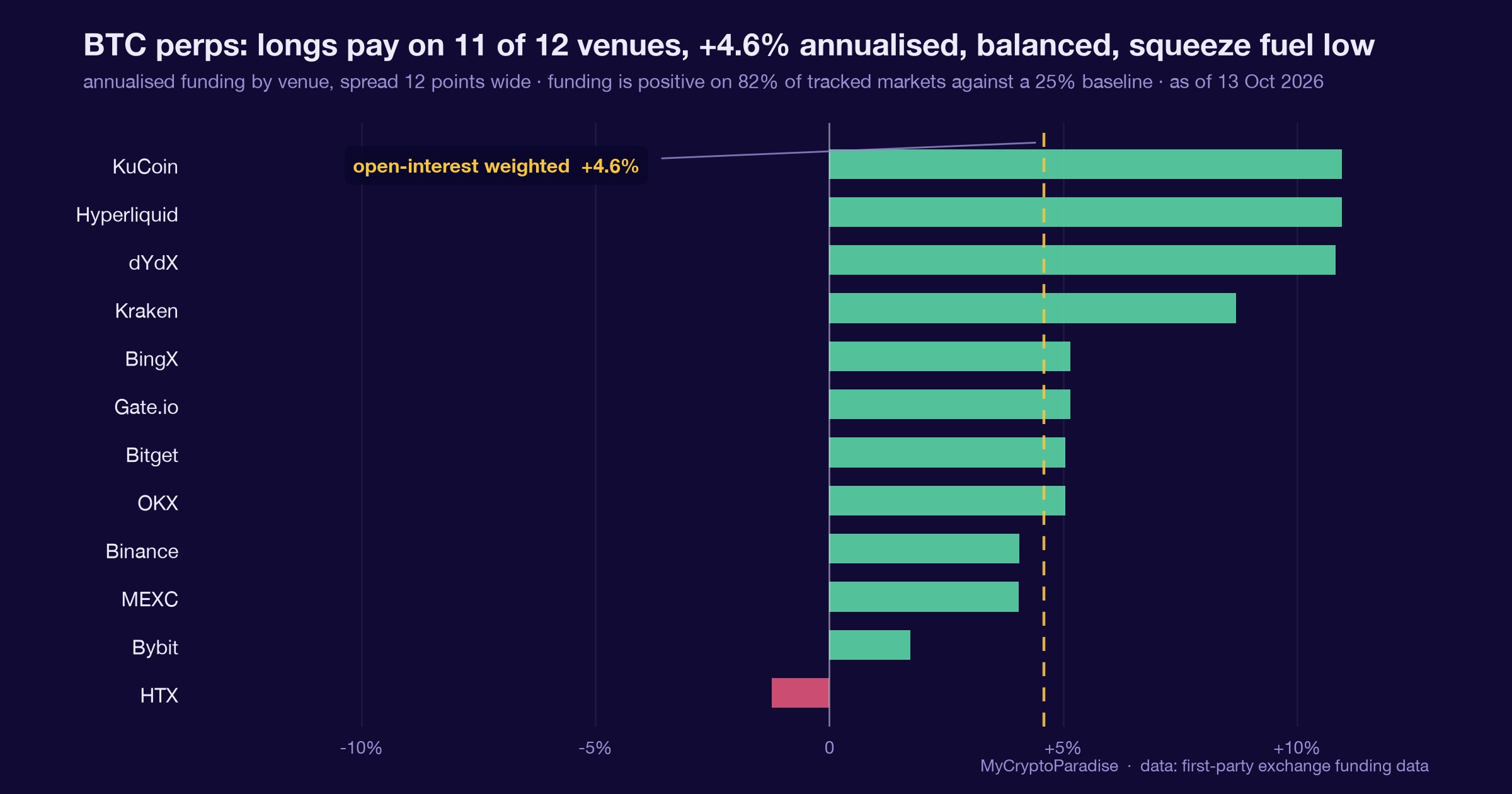
Funding is the recurring fee that longs and shorts pay each other to hold a perpetual futures position, and it reveals which side is crowded. On 13 October 2026, with BTC near $83,233, our MCP Insights funding data read balanced at about 4.6 percent annualized (APR), with squeeze fuel low: neither side is paying up to stay in. That matters because the ceiling capping price is on-chain, not in the leverage. Per on-chain cost-basis data, sellers from the 1 to 2 year cohort stalled price near $88,000, where the 6 to 12 month group breaks even, and that selling has since slowed. We called this neutral, not a top: a cap built on spot supply, not on a crowded-long overhang. This piece shows you how to read funding against overhead supply yourself, and the single level that would change the read.
Key facts
- Funding on BTC perpetuals
- +4.59% annualised, open interest weighted
- Positioning regime
- balanced, squeeze fuel low
- Markets where longs are paying
- 82% of those we track
- BTC price at the reading
- $83,233
- Open interest behind it
- $30.29B
- What would prove this read wrong
- A daily close above the $88,000 overhead-supply zone (the ceiling absorbed), or BTC funding climbing well past the 7.68 percent market median, which would add the leverage fuel absent today.
- Reading taken
- 13 October 2026
- Source
- Our MCP Insights tools, from our own MCP Insights first-party data
Leverage and supply are two different ceilings
Funding is the fee that keeps a perpetual futures contract tethered to spot. When longs crowd in, they pay shorts to hold the position; when shorts crowd, the payment flips. A stretched funding rate is stored energy: a crowd that has paid to be on one side, and that can be forced to unwind.
Overhead supply is a different kind of resistance. It is the price where a cohort of earlier buyers finally breaks even, and breakeven is where many of them choose to sell. That selling is not leverage being flushed. It is spot coins changing hands, and it clears only when fresh demand absorbs it.
The two rarely move together, and that is the point. A ceiling made of leverage breaks with a squeeze. A ceiling made of supply breaks only when someone buys all of it.
On 13 October the leverage tape is quiet
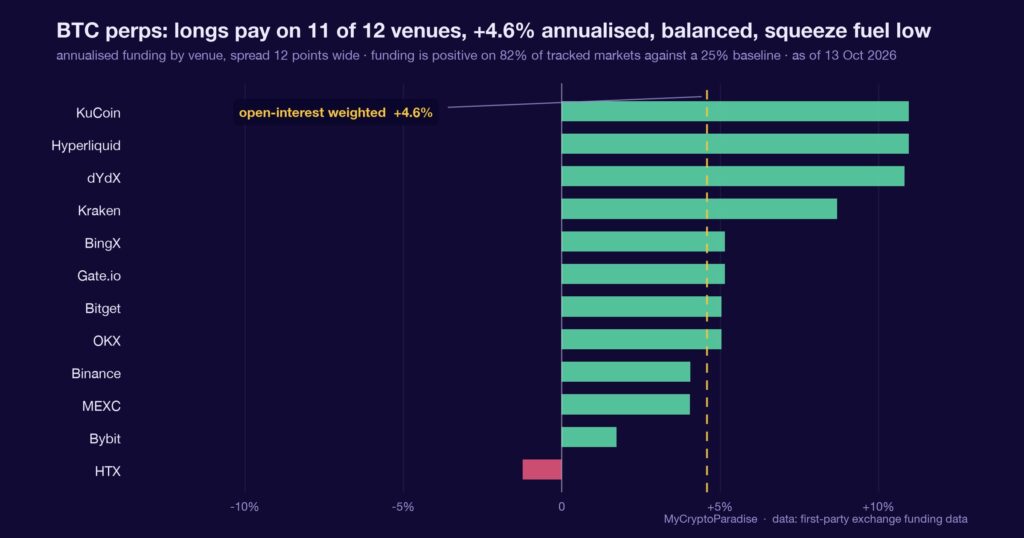
Per our MCP Insights funding data on 13 October 2026, BTC traded near $83,233 with funding balanced at roughly 4.6 percent annualized (APR) and squeeze fuel low. Open interest (OI), the total value of contracts live across venues, sat near $30.29 billion. Neither reading describes a crowd.
Breadth confirms it. Funding is positive on 82 percent of the markets we track, but the median rate is about 7.68 percent APR, so BTC is running calmer than the broad tape. Ethereum, by contrast, shows mild long crowding near 7.2 to 7.4 percent APR.
The extremes live elsewhere entirely. KORU longs pay about 40 percent APR, while BZ shorts pay a punishing 317.5 percent. BTC is nowhere near that kind of crowding in either direction.
The ceiling itself is on-chain. Per on-chain cost-basis data, the 1 to 2 year cohort sold heavily as price approached $88,000, where the 6 to 12 month buyers break even, and price stalled just beneath it. That selling has since slowed considerably.
So the cap and the leverage are telling different stories. One says supply is heavy overhead. The other says no crowd is positioned to force the issue.
Neutral funding is not a dead market
The easy misread is that balanced funding means nothing is happening, or that heavy overhead supply means the move higher is finished. Both skip a step.
Balanced funding tells you something precise: the next leg, if it comes, does not need a funding reset first. There is no crowded-long overhang to flush, so a break higher does not have to shake anyone out before it starts. The missing ingredient is not positioning. It is demand large enough to eat the supply overhead.
This is also where funding earns its keep as a risk gauge rather than a direction gauge. Low squeeze fuel means a sudden violent move in either direction is less likely to be leverage-driven today. Spot has to do the work.
A quiet funding tape is not a verdict on price. It is a statement about who is not in the trade, which is exactly what you want to know before you size one.
What is different here
The ParadiseTeam never reads funding and cost basis off one dial. We mark where each buyer cohort breaks even, then ask whether the leverage tape is crowded enough to force the move through that level, and we only lean when the supply picture and the positioning picture point the same way.
The ceiling is softening from the supply side
The one change worth marking is that the cohort selling into $88,000 has slowed. The supply ceiling is not gone, but it is being met with less urgency than it was on the way up. That is a constructive shift, and it is happening while leverage stays out of the way.
Funding is one input, not the whole read. It sits alongside the cost-basis map, open interest and spot absorption, and today it is the layer that removes a risk rather than adds a bias: it tells you the cap is not a leverage trap waiting to spring.
The deeper layers that stack these readings into a single probability live in PRO Paradiser.
The honest posture is patience. When the ceiling is spot supply and the leverage tape is empty, the next real information is whether buyers show up to absorb it, not whether funding ticks a tenth of a percent.
Reading funding against overhead supply yourself, step by step
- Open the live funding rates tool and note BTC’s annualized rate and whether squeeze fuel reads low, moderate or high.
- Compare that rate to the market median: a coin running below median is calmer than the broad tape, not more crowded.
- Check open interest for the same window, so you know whether positioning is building or bleeding alongside the funding read.
- Mark the overhead supply levels from the cost-basis map, where past buyer cohorts break even and tend to sell.
- Only then decide: a supply cap with quiet funding is absorbed by spot demand, not forced by a leverage squeeze.
The step people skip is the median comparison: a positive funding rate looks bullish alone, yet below the market median it means BTC is among the least crowded trades on the board.
Every number above is checkable against the live data. Start with the live crypto funding rates, then cross-read the MCP Insights hub and the Crypto Fear and Greed Index.
Act and invalidate
| Scenario | What confirms it | What kills it |
|---|---|---|
| Capped and range-bound | Spot stalls below the overhead supply | Daily close above the $88,000 zone |
| Spot absorbs the ceiling | Supply met without a funding spike | Funding jumps into crowded-long territory |
| Leverage flush returns | Funding climbs well past the median | BTC funding holds near 4.6 percent APR |
Posture: Defensive and patient while spot sits under the overhead supply and funding offers no confirmation either way. For most, the higher-probability stance is no trade until spot either absorbs the ceiling or the leverage tape wakes up.
Frequently asked questions
What is Bitcoin’s funding rate saying right now?
On 13 October 2026 it read balanced near 4.6 percent annualized, with squeeze fuel low. That means neither longs nor shorts are crowded enough to force a move, so the next leg in price has to come from spot flows rather than a leverage unwind.
Why does the cost basis near $88,000 matter?
It is where buyers from the past 6 to 12 months break even, and breakeven is where many choose to sell. That turns the zone into overhead supply: a ceiling that clears only when fresh demand absorbs the coins changing hands there.
Does low squeeze fuel mean the rally is finished?
No. Low squeeze fuel means a sudden move is less likely to be driven by leverage being flushed. It removes one risk rather than setting a direction. A break higher simply would not need a funding reset first, because no crowded long side exists to shake out.
Is balanced funding bullish or bearish for Bitcoin?
Neither on its own. Balanced funding is a statement about positioning, not price: it tells you who is not in the trade. Read against heavy overhead supply, it says the cap is built on spot coins, not on a leverage crowd waiting to be squeezed.
What would change this neutral read?
A daily close above the $88,000 overhead-supply zone would mean spot has absorbed the ceiling. Alternatively, BTC funding climbing well past the market median near 7.68 percent would add the leverage fuel that is absent today, turning a quiet tape into a crowded one.
Crypto trading involves substantial risk and is not suitable for everyone. Nothing here is financial advice; it is education only. Never risk more than you can afford to lose.
The private Extras feed, where the funding grade, squeeze-fuel gauge and market-breadth reads update intraday with their invalidation levels attached, is part of PRO Paradiser, the intelligence layer behind the ParadiseFamilyVIP strategies.









Join the discussion
No comments yet. Members, share how you are reading this.