

Listen: the breakdown
Developing story update (September 15, 2026, 19:46 UTC):
Turkish Foreign Minister Hakan Fidan has now explicitly stated that Turkey values the stability of its neighbor Iran. This adds a layer of nuance to Turkey’s diplomatic position regarding regional security.
This statement reinforces Turkey’s vested interest in de-escalation, aligning with its previous calls for an end to mutual attacks and the restoration of the Strait of Hormuz’s pre-war status quo.
For traders, this further clarifies the complex geopolitical landscape, which continues to be a factor in broader market sentiment.
What to watch now: Monitor for further diplomatic statements from Turkey or other regional actors regarding Iran's stability and the Strait of Hormuz.
Developing story update (September 15, 2026, 18:20 UTC):
Turkish Foreign Minister Hakan Fidan has now explicitly stated that Turkey values the stability of Iran. This clarifies Turkey’s diplomatic position, emphasizing its commitment to regional stability beyond just calling for an end to mutual attacks and the restoration of the Strait of Hormuz’s pre-war status quo.
For traders, this explicit statement reinforces the ongoing geopolitical risk narrative. While not a direct market mover, it underscores the complex diplomatic efforts aimed at de-escalation in a critical region, which can contribute to broader risk-off sentiment in traditional and crypto markets.
What to watch now: Monitor for further diplomatic statements from Turkey or other regional powers regarding Iran's stability and Strait of Hormuz passage.
Developing story update (September 15, 2026, 17:38 UTC):
Our sources confirm Turkish Foreign Minister Hakan Fidan previously accused Israel of attempting to destabilize Syria through repeated strikes. This adds a layer to his regional diplomatic stance, underscoring the complex geopolitical landscape.
For traders, this reinforces the ongoing risk-off sentiment. While not a direct catalyst, such details contribute to the broader uncertainty that smart money leverages for distribution.
What to watch now: Monitor for any further statements from Turkish officials or regional actors that clarify the implications of Fidan's stance on Israel and Syria.
Developing story update (September 15, 2026, 17:16 UTC):
Our sources confirm that Turkish Foreign Minister Hakan Fidan’s recent statements regarding regional stability and the Strait of Hormuz were made during his visit to Baku. This detail provides further context to the ongoing diplomatic efforts in the region.
The location underscores the broader geopolitical engagement Turkey is undertaking to de-escalate tensions and secure critical trade routes. While not a direct market catalyst, it reinforces the persistent geopolitical risk narrative.
Traders should continue to monitor developments in the Gulf region, as stability remains crucial for global economic sentiment, indirectly impacting risk assets like crypto.
What to watch now: Continue to monitor diplomatic engagements in the Gulf region and their impact on global stability.
Developing story update (September 15, 2026, 16:12 UTC):
Turkish Foreign Minister Hakan Fidan has broadened his regional security statements, now accusing Israel of attempting to destabilize Syria through repeated strikes. This new comment expands the scope of his concerns beyond Iran and the Strait of Hormuz.
This development adds another layer to the complex geopolitical landscape in the Middle East, highlighting multiple points of tension that could impact broader stability.
For traders, this reinforces the ongoing geopolitical risk premium in the market. While not a direct crypto catalyst, sustained regional instability can contribute to a cautious sentiment, potentially influencing risk asset allocation.
What to watch now: Monitor for further diplomatic responses or escalations related to the Syria-Israel dynamic and its impact on regional stability.
Developing story update (September 15, 2026, 14:48 UTC):
Update: The regional de-escalation push around Iran and the Strait of Hormuz has widened into broader Turkish diplomacy. The Turkish Foreign Minister held a call with Qatar’s Prime Minister and Foreign Minister on regional developments, and was received by the President of Azerbaijan on September 15. He also signalled that the Turkish President is expected to visit Syria soon.
A Turkish trade delegation led by the Trade Minister recently visited Damascus and Aleppo, with a focus on expanding investment and trade in the energy sector. For traders, this is de-escalation and reengagement signalling rather than a fresh shock, and prices continue to reflect a broader risk-off tone rather than an event-driven move.
What to watch now: Whether a confirmed Turkish presidential visit to Syria or firmer Hormuz commitments turn diplomatic signalling into an actual regional risk-premium unwind.
Developing story update (September 15, 2026, 14:06 UTC):
The diplomatic track around this story has widened since we published. Based on our sources, Iraq’s border crossings with Iran have now reopened, a concrete de-escalation signal that traders watching regional risk should note alongside the Turkish call to restore the Strait of Hormuz status quo.
Turkey is also pushing a broader regional agenda: its Foreign Minister was received by Azerbaijan’s President, held a joint news conference in Damascus, and signalled that the Turkish President will visit Syria soon, with the Trade Minister already travelling to Damascus and Aleppo. This points toward managed de-escalation rather than resolution.
For now crypto has not repriced on any of this. BTC and ETH remain within their prior 24-hour ranges and the 1-hour move is flat, so the read stays risk-off drift rather than a fresh catalyst. A durable reopening of trade and border flows would probably ease the geopolitical risk premium over time, but there is no same-day crypto trigger here yet.
What to watch now: Watch whether the Iraq-Iran border reopening and the planned Turkish visit to Syria hold, as sustained de-escalation could slowly ease the regional risk premium.
Developing story update (September 15, 2026, 13:03 UTC):
Update: There are early, concrete signs the de-escalation push is moving beyond statements. Iraq’s border crossings with Iran have reopened, a tangible step toward normalising regional movement after the recent conflict period.
In parallel, Turkey is pressing an economic angle: a trade delegation to Syria centred on lifting investment and expanding trade, with a specific focus on the energy sector, and positioning Syria as a link connecting Jordan, Saudi Arabia, Gulf states, and Iraq with Turkey and the Mediterranean. For traders, none of this is an immediate catalyst, but a genuine easing of Middle East tensions probably reduces one of the tail risks that has been feeding the current cautious, risk-off tone.
What to watch now: Whether reopened Iran-Iraq crossings and energy trade flows translate into a lasting easing of the regional risk premium, or stall.
Market briefing: Turkey is calling for calm with Iran and a return to the Strait of Hormuz's pre-war status quo. Crypto barely flinched: BTC held near $76,900, folding the news into an already cautious tape.
- Turkey's foreign minister urged an end to Iran attacks and a Hormuz reset
- A wave of calls with Iran, Qatar, Azerbaijan and Syria shows fast regional diplomacy
- BTC held near $76,900 and ETH near $2,475, absorbing the story into a risk-off mood
Turkey is pushing to calm Iran and restore the Strait of Hormuz status quo. Crypto shrugged near $76,900. So is this diplomacy a floor for risk, or just more fog?
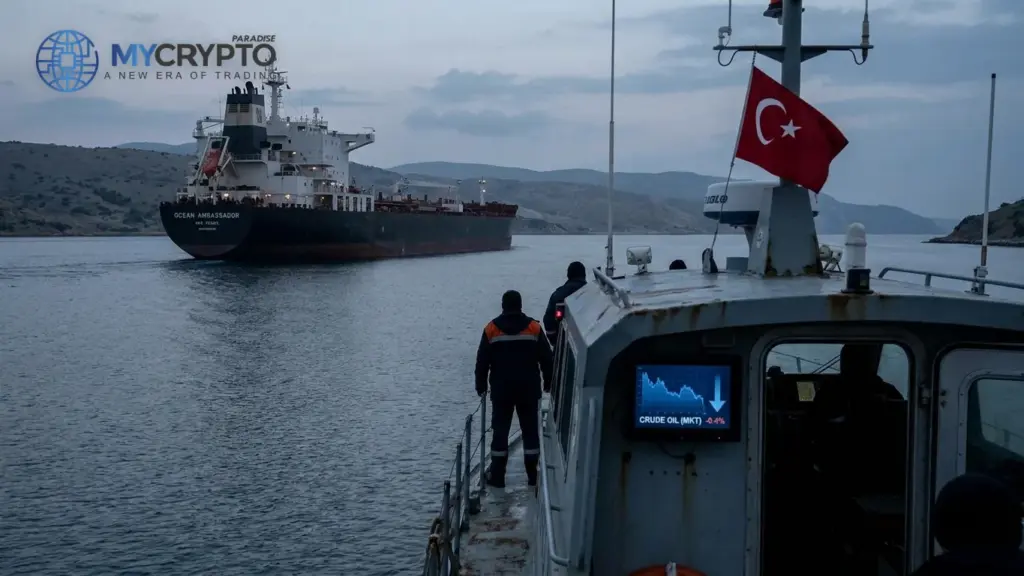
Turkey has stepped into the Iran crisis with a clear diplomatic message. Foreign Minister Hakan Fidan said Iran's security affects the whole region. He called for an end to mutual attacks and a return to the Strait of Hormuz's pre-war status quo. That last point matters most to markets, because roughly a fifth of the world's oil moves through that narrow water.
The push did not arrive in isolation. Fidan held a phone call with his Iranian counterpart and another with Qatar's prime minister. He was received by Azerbaijan's president and spoke beside his Syrian counterpart during a joint news conference in Damascus. He also confirmed the Turkish president will visit Syria soon.
This is regional diplomacy at full speed, not a single soundbite.
The backdrop is heavy. Protests in Iran that began on 28 December 2025 spread through January, and security forces killed at least 30,000 people. Iraq's border crossings with Iran have since reopened. Syria now sits as the connective tissue between the Gulf, Iraq, Turkey and the Mediterranean, which is exactly why every capital wants a voice in how this ends.
For crypto, the honest read is that this is context, not a trigger. BTC traded near $76,900 and barely moved. There is no single confirmed catalyst tying this statement to price, so we treat the market reaction as interpretation, not proof. The tape is folding the story into an existing risk-off mood rather than reacting to it as something new.
Energy risk feeds a cautious macro tape
The transmission runs through oil, not through any crypto-specific channel. The Strait of Hormuz is the single most sensitive chokepoint in global energy. When its status is in question, traders price a fatter tail risk into oil, and that risk seeps into everything priced in dollars.
Higher or more volatile energy prices lift inflation expectations. That pushes central banks toward patience on rate cuts, which keeps money tighter for longer. Tighter money means less spare liquidity chasing risk, and crypto sits at the far, thirsty end of that queue.
Turkey's call for de-escalation is, on its face, a calming signal. A restored Hormuz status quo would ease the energy premium and support risk appetite over time. So why did crypto not rally?
Because a statement is not a settlement. Diplomacy is confident by habit and slow by nature, and the region has been unstable for months. Markets have learned to discount hopeful words until oil and shipping data confirm them.
The result is a stalemate that favours caution. The news removes a small piece of worst-case fear without adding a fresh reason to buy. In a macro backdrop already leaning risk-off, that reads as a wash, and a wash at these levels does not fund a rally.
Bitcoin and ether shrug off the headline
The clearest evidence is the muted price action. BTC traded near $76,900, down about 1.1% on the day, and ETH sat near $2,475, down about 1.3%. Neither moved on the statement, which tells you the market did not read it as a fresh catalyst.
Bitcoin leads the liquidity chain, and right now it is drifting rather than trending. When BTC lacks a strong bid, capital rarely rotates outward with conviction. That starves the rest of the market of fuel.
Ether tracks Bitcoin in these conditions and offers no independent story here. A geopolitical headline about Iran and Turkey does not change Ethereum's supply, demand, or flows.
Altcoins feel this most. They are the high-beta tail of the market, so they amplify Bitcoin's moves in both directions. In a flat, cautious tape they simply bleed slowly against BTC as risk appetite thins.
Here is the mechanism that matters. Bearish or uncertain macro news at higher price zones, with retail already nervous, usually gives larger players cover to stay defensive rather than chase. Recent ETF outflows show that fear plainly. So the smart-money posture is patience, letting a thin tape and stacked sell orders do the work while retail waits for a rescue that a press conference cannot deliver.
Signals that could break the calm
The confirmation to watch is not a crypto chart first. It is energy and shipping. If oil prices settle lower and Hormuz traffic normalises, the risk premium fades and global liquidity gets a little easier. That would slowly support risk assets, crypto included.
The invalidation is the opposite. A breakdown in this diplomacy, renewed attacks, or any disruption to the strait would spike energy volatility. That flips the mood hard toward risk-off and would pressure BTC and everything below it.
On the crypto side, watch whether Bitcoin can hold its footing near current levels or slips lower on no fresh bad news. Weakness without a trigger is itself a signal that sellers still control the tape.
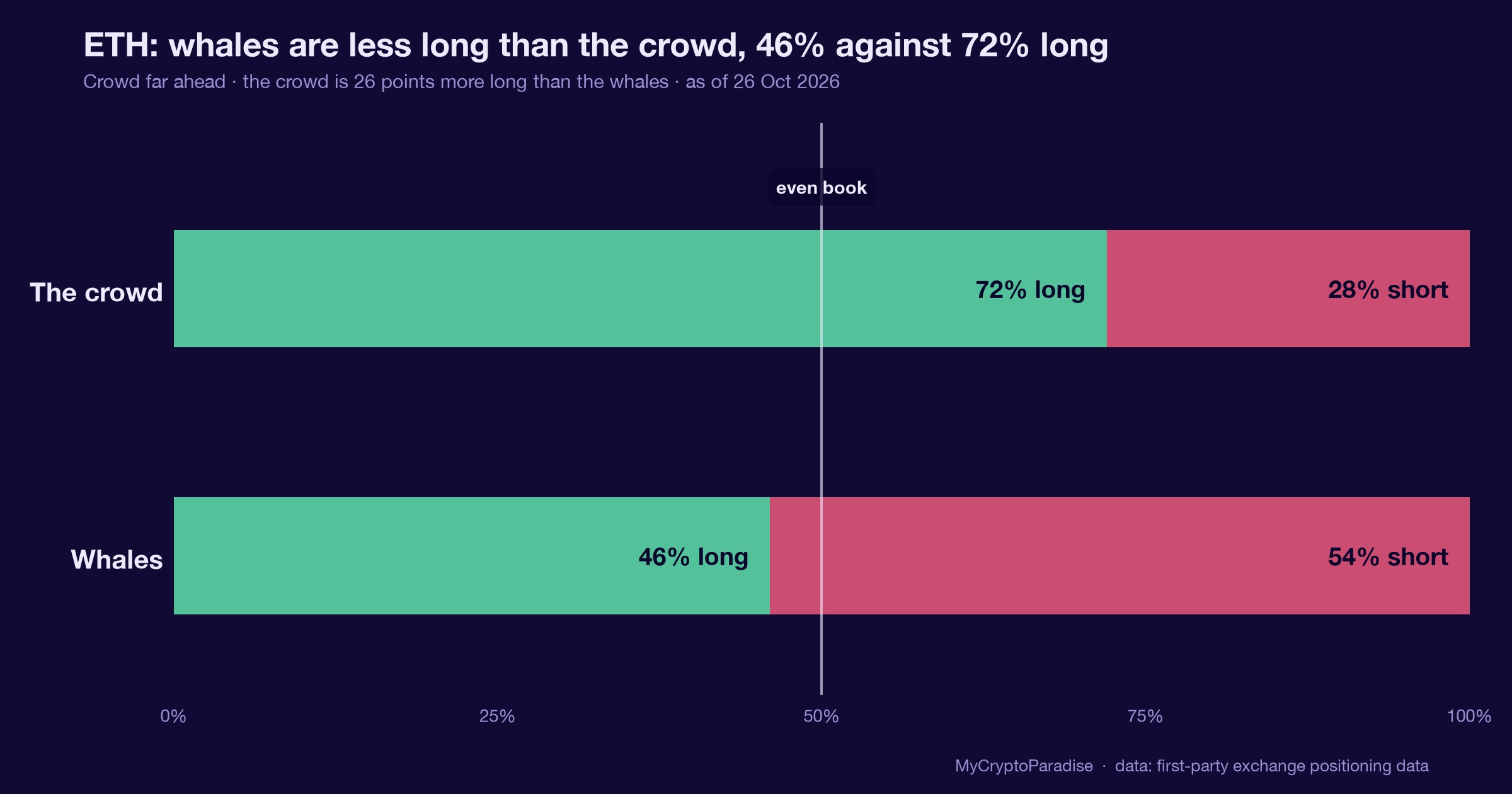
Watch OI, or open interest, the total value of live derivatives positions. A sharp rise into a flat price often marks crowded, fragile bets that liquidate fast in either direction.
Watch spot demand too. ETF flows have been leaking, and a turn back to steady inflows would be the first real evidence that fear is exhausting. Until then, treat bounces as suspect.
The cleanest tell is simple. Real de-escalation shows up in oil and flows before it shows up in a rally. Words move first, prices confirm last, and this market is waiting for the confirmation.
Distribution zone meets Middle East uncertainty
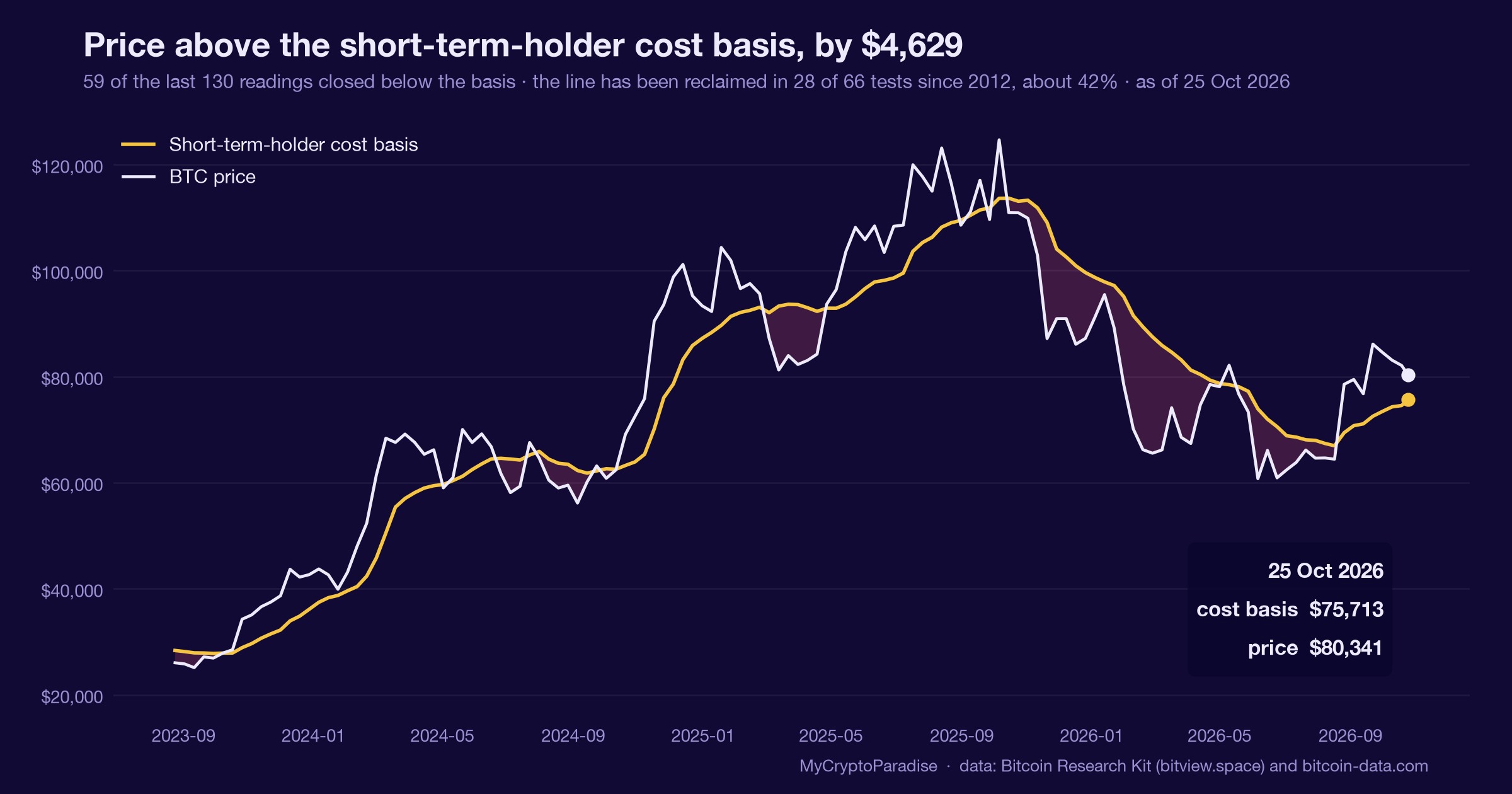
The ParadiseTeam frames this news through structure, not headlines. BTC trading near $76,900 sits just under the $79,000 zone we treat as a prior distribution area and 0.618 Fibonacci retracement, the level where a rally often runs out of buyers. A diplomatic statement does not change that map.
Our higher-timeframe bias stays bearish, with a possible short-term bounce before a deeper move. This geopolitical fog reinforces that read rather than breaking it. It adds caution without adding demand.
Watch the daily candle closely. A bearish engulfing pattern, where a red candle fully swallows the prior green one, stacked on the recent long-wicked shooting star, would strengthen the case that sellers are back in control. That structure, not the news, is the trigger we respect.
On the downside, we mark $61,000 as a prior reaccumulation zone, with $58,000 and $44,000 as deeper reference points if the structure breaks. On the upside, a clean reclaim of the $82,000 to $88,000 band into support would force us to reconsider the bearish thesis.
The smart-money posture here is patience. Larger players have been distributing at higher levels and prefer to reaccumulate far lower, so they can wait while retail chases relief headlines. Manage risk first: define your SL, stop-loss, before entry, size for a sensible R:R, risk-to-reward, and remember that a press conference is not a floor. This is analysis, not a signal.
The read behind this: we framed this story through our own market analysis, Bitcoin ETF Outflows Near $500M: Crash Next?
Track it live: our Crypto Fear and Greed Index and the live crypto funding rates both update in real time, so you can watch this shift for yourself.
Related coverage
For exact entries, targets, and stop losses with full risk management, that is what ParadiseFamilyVIP is for. New to reading these moves? Start with our crypto trading strategies guide.
ParadiseTeam is monitoring the market situation closely, and we are taking these developments into consideration while building our trading tactics inside ParadiseFamilyVIP.
Crypto trading involves substantial risk. Prices are volatile and you can lose money. This article is educational and is not financial advice. Past performance does not guarantee future results.
With Hormuz risk in focus, does BTC break below $76,000 before reclaiming $79,000?
How 21 Paradisers are calling it
The first call is still open
Free account, no password. Members just sign in.



Join the discussion 1
Remember trading the Iraq invasion news in '03? Felt exactly like this, where every headline was a coin flip. Price held then too, until it didn't.