

In short
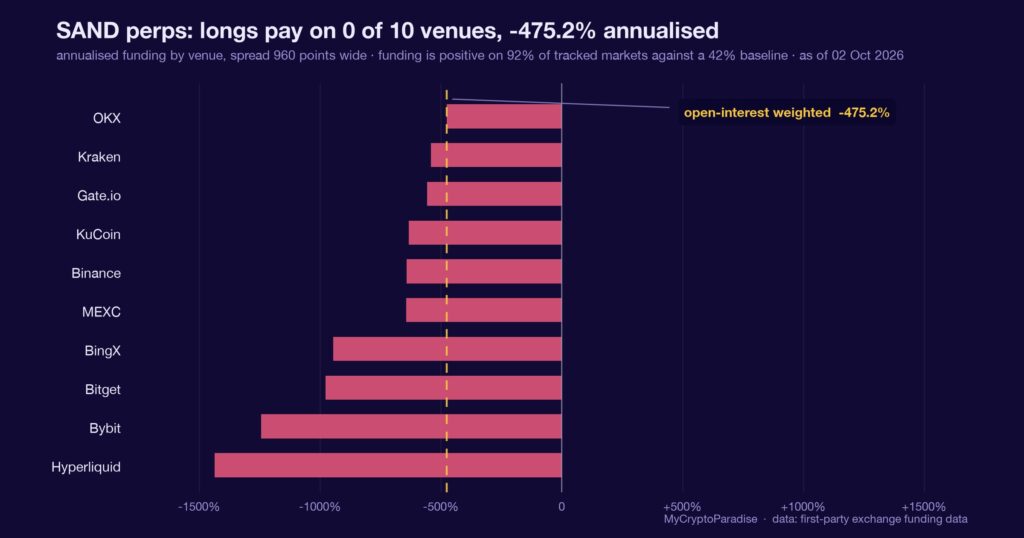
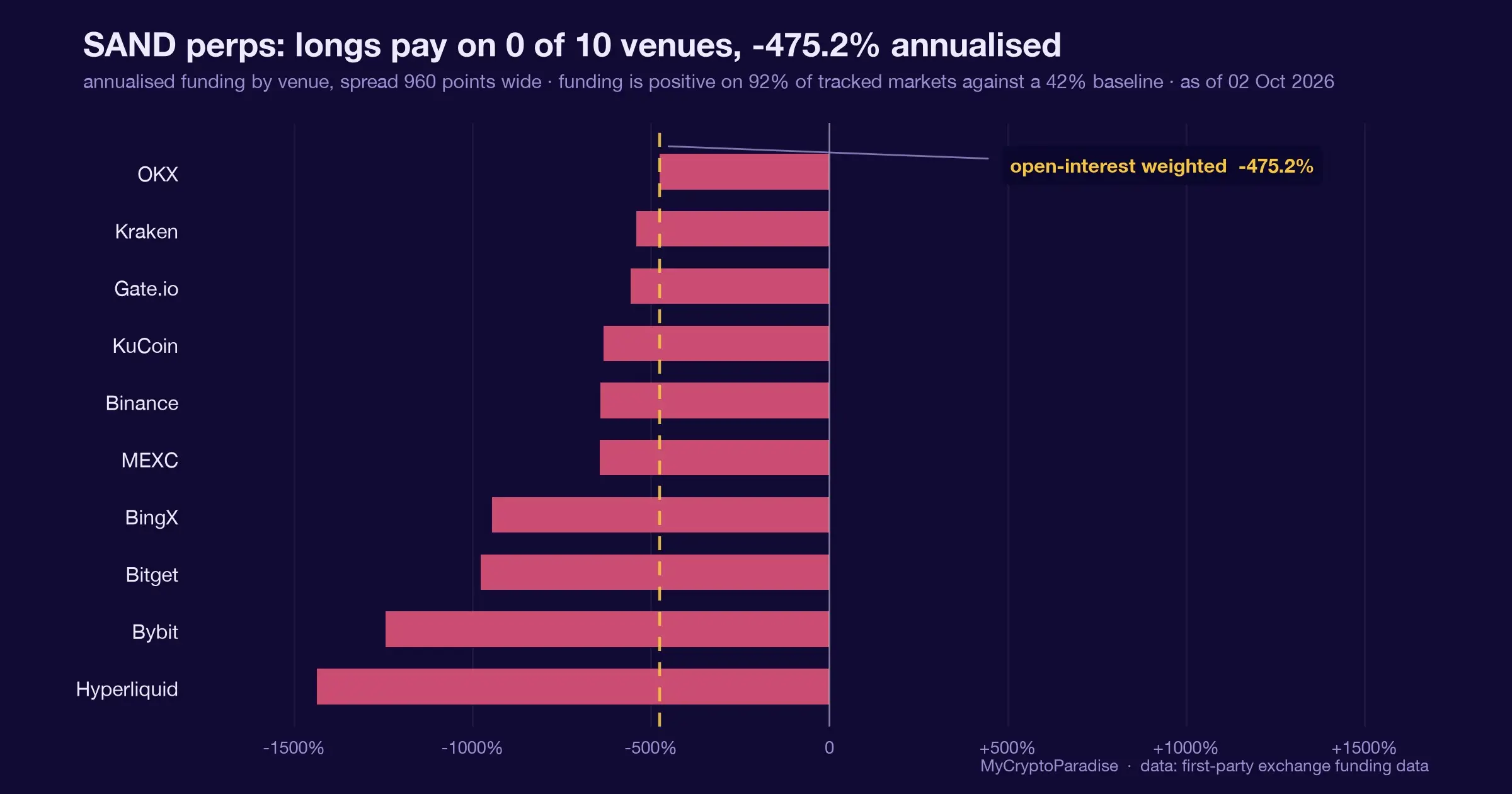
Funding is the periodic fee that keeps a perpetual swap, a futures contract with no expiry, tethered to spot: when it turns negative, the short side pays the long side to hold. On 2 October 2026 our MCP Insights funding series flagged SAND at minus 477 percent APR, its annual percentage rate, the single most stretched short-paid funding anywhere in the market that day. We read this as constructive, because a crowd paying that much to stay short is squeeze fuel, but we explicitly refuse to call it a trigger: fuel is not ignition. No base rates are wired for funding extremes yet, so we claim no historical frequency, and the lean rests on mechanics, not on a win rate we cannot verify. It invalidates if SAND makes fresh lows while funding stays this deep. This piece shows you how to read funding extremes yourself, step by step.
Negative funding means the short side is paying
A perpetual swap, a futures contract with no expiry date, can drift away from the underlying spot price, so exchanges charge a recurring funding fee to pull it back into line. When the crowd leans long, longs pay shorts; when the crowd leans short, shorts pay longs.
Deeply negative funding therefore means one plain thing: the short side is crowded enough to pay a steep, repeating fee just to keep its positions open. The market is renting conviction, and it is renting it by the hour.
A fee that large measures crowding, not correctness. A crowd can be both heavily positioned and completely right.
On 2 October SAND sat alone at the extreme
On 2 October 2026 our MCP Insights funding series read SAND at minus 477 percent APR, the single most stretched short-paid funding of any market we track that day.
Expressed as a daily cost, minus 477 percent a year is roughly 1.3 percent every single day that a short pays merely to keep the trade open. Across a week that compounds into real bleed, whatever price happens to do.
What the same series shows around SAND matters more than the headline figure: the rest of the tape sits far closer to neutral, so this is one isolated outlier rather than a coin inside a market-wide short crowd.
One coin at an extreme and a whole tape at an extreme are different readings wearing the same number. The second is a regime; the first is a story about one asset.
Who pays to stay short, and why they hold
A short paying 477 percent a year is not doing so by accident. Someone is convinced enough in lower prices to rent that conviction at a punishing rate, usually a mix of hedgers, trend-followers, and late entrants chasing a move that already ran.
The fee is also the mechanism that eventually breaks the position. Every funding window the short pays again, so time works against the crowd even when price does not move. The longer the rate stays this deep, the more the holders bleed.
Forced flow is the whole story here: these shorts are not squeezed by news, they are squeezed by their own carrying cost. Patience is their enemy, not headlines.
What is different here
The ParadiseTeam does not treat the most negative funding in the market as a trade on its own. We read it against the breadth of the whole tape first, check whether the extreme is isolated or systemic, and only then size it as one weighted input among several.
A crowded short is not an automatic squeeze
The tempting misread is that the most negative funding in the market guarantees a short squeeze. It does not. Funding is the cost of a position, not a trigger for its unwind, and a short paying a steep fee can still be the side that turns out right.
An isolated outlier also deserves more caution than a market-wide crowd. When one name carries the extreme while the broad tape stays neutral, the fee says a great deal about SAND positioning and very little about overall direction.
This is one input. It sits alongside funding breadth, open interest (OI, the total value of contracts still open), and spot absorption, and on its own it is a lean, not a conclusion. The deeper layers live in PRO Paradiser.
A gauge that names what it cannot see is worth more than one that turns every extreme into a trade. Crowding is information; it is never an instruction.
What would turn fuel into ignition
We have no base rate wired for funding extremes, so we publish no historical frequency and lean on mechanics instead. The constructive case is simple: a short side paying 477 percent a year has every incentive to cover, and covering is buying.
The honest counter is just as simple. If SAND prints fresh lows while funding stays this deep, the shorts are paying and winning, which is conviction rather than a trap, and the squeeze thesis is wrong.
A read that quotes only the half of the data that agrees with it is marketing. The disagreeing half is what sizes the risk.
Reading funding extremes yourself, step by step
- Open the live funding rates page and sort by the most negative annualised rate to find who is paying to be short.
- Check whether the extreme is one isolated name or many, because a lone outlier and a crowded tape mean different things.
- Read the funding breadth: compare that single coin against the market median to see how far from normal it truly sits.
- Cross-check open interest and price, since rising shorts into a falling price is a very different setup from shorts into a grind.
- Mark the invalidation before acting: the price level or funding behaviour that would prove the short side right rather than trapped.
The step most people skip is the breadth check. They see one eye-watering negative number and assume a squeeze, never noticing the rest of the market sits calm.
Every number above is checkable against the live data. Start with the live crypto funding rates, then cross-read the MCP Insights hub and the Crypto Fear and Greed Index.
Act and invalidate
| Scenario | What confirms it | What kills it |
|---|---|---|
| Shorts squeeze higher | Funding snaps toward neutral as price lifts | Price keeps grinding lower |
| Funding bleeds, no move | Rate stays deep, price flat for days | A sharp spot bid absorbs shorts |
| Shorts were right | Fresh lows while funding stays negative | A reclaim that forces covering |
Posture: Constructive but patient: a paying short side favours the upside, yet a lone outlier is worth one line of risk, not a core position.
Frequently asked questions
What does negative funding actually mean?
It means the short side is paying the long side a recurring fee to keep a perpetual position open. Funding turns negative when the crowd leans short, so a deeply negative reading marks a heavily one-sided, short-crowded market.
Does the most negative funding guarantee a squeeze?
No. Funding is the cost of holding a position, not a trigger for unwinding one. A crowded short can stay crowded for days, and it can also simply be correct while it keeps paying the fee to hold.
Why does an isolated outlier matter less?
When a single coin carries the market extreme while the broad tape stays near neutral, the reading describes that one asset rather than overall direction. A market-wide short crowd is a regime; a lone outlier is a story about one name.
What is minus 477 percent APR in daily terms?
Annual percentage rate (APR) annualises the fee, so minus 477 percent a year works out to roughly 1.3 percent each day that a short pays to stay in. Over a week that compounds into meaningful bleed regardless of price.
What would invalidate the constructive read?
Fresh lows on SAND while funding stays near minus 477 percent. That pattern means the shorts are paying and winning, which is conviction rather than a trap, and it removes the squeeze thesis entirely.
Crypto trading involves substantial risk and is not suitable for everyone. Nothing here is financial advice; it is education only. Never risk more than you can afford to lose.
The private Extras feed, where the funding extremes, the market-wide funding breadth and the squeeze-fuel read update intraday with their invalidation levels, is part of PRO Paradiser, the intelligence layer behind the ParadiseFamilyVIP strategies.


Join the discussion 5
hmm, i dont see how it can be a lone outlier when other tokens also had funding rates so low... feels like a pattern.
Jaysus, a -477% funding rate... 🤯 I remember getting stung on a LINK perp like that once, felt like the whole market was out to get me 😵💫. Proper humbling.
man, a -477% funding rate on SAND is wild 😱 reminds me of that time I bought a bag of a farm token and saw the yield go to zero overnight 📉😂. how do these "lone outliers" even happen, really? 🫠
that negative funding rate is crazy, but yeah, four-hour noise is not a signal. i'm still only looking at weekly closes for anything real 🙄.
i always wonder if these huge swings are just like a few big players or something. it makes me very nervous, I try to stay away from anything with a funding rate like this, even on the other side. sorry if thats a silly question!