


Listen: the breakdown
Market briefing: DeFi Saver says its automation protected 446.3 million dollars of Aave collateral during a selloff, sparing users about 8.38 million in liquidation penalties. Bitcoin traded near $86,934, up 3.6 percent on the day.
- DeFi Saver automation shielded $446.3M in Aave V3 collateral during the selloff
- 365 positions avoided liquidation, saving an estimated $8.38M in penalties
- Protected loans carried $335M debt, so forced selling that never happened
DeFi Saver says its liquidation automation shielded $446.3M in Aave collateral as markets dropped. Does quieter forced selling help crypto hold its bid?
DeFi Saver reports that its automation protected 446.3 million dollars of Aave V3 collateral while the market sold off. The tool watched health factors, then repaid debt before third-party bots could seize the positions.
The numbers behind it matter more than the headline. Those protected loans carried 335 million dollars in debt. That is a large block of leverage that could have been force-sold into a falling market, and was not.
DeFi Saver estimates its users avoided roughly 8.38 million dollars in third-party liquidation penalties during the episode. Automated repayments kept 365 Aave positions alive through the drop.
Third-party liquidation is the costliest way to unwind leverage. A borrower who steps away from the screen hands the outcome to a bot, because health factors are checked constantly, not on your schedule. The market does not wait for anyone to wake up.
This is not a same-day price catalyst, and we will not dress it up as one. No single confirmed event moved Bitcoin today. What this does confirm is quieter: the plumbing of DeFi held, and a chunk of leverage that usually feeds a cascade was repaired instead of dumped.
It arrives against a noisy backdrop. The broader market still saw a liquidation wave, and European regulators keep circling DeFi lending and gateways under ongoing MiCA review. In that climate, a working risk tool is less a novelty and more a quiet argument for the sector growing up.
The penalty 365 borrowers never paid
Forced liquidations are how a normal selloff becomes a cascade. A bot seizes collateral, sells it, the price drops further, and the next position trips the same wire. Each sale manufactures the next one.
DeFi Saver breaking that chain for 335 million dollars of debt matters structurally. That collateral was not dumped into thin books. It stayed put, which means the order book never had to absorb a wall of panic supply from 365 accounts at once.
The macro read follows from there. Less forced selling inside protocols means steadier on-chain liquidity, and steadier liquidity means fewer violent air-pockets in price. The effect is indirect, but it is real.
There is a maturity signal underneath the figures too. Smart money increasingly treats leverage as something to be managed by rule, not by nerve. Retail still tends to watch a red candle, freeze, and get liquidated at the worst possible tick.
Regulators are watching this exact surface. MiCA review consultations in Europe are proposing expanded oversight for DeFi lending, staking, and gateways. A demonstrated, working risk tool is the kind of evidence that argues the ecosystem can police its own leverage before a regulator does it for them.
None of this makes Bitcoin go up today. It does lower the odds that the next drop turns into a disorderly one, and that is worth more to a trader than most headlines.
Fewer forced sellers steady the collateral base
Start with the supply that never hit the market. Third-party bots would have sold the collateral behind 335 million in debt into a falling tape. That supply staying offline is a small but genuine support under the whole stack.
For Bitcoin, the effect is second-order, not a direct bid. BTC was trading near $86,934 as of the briefing, up about 3.6 percent on the day. The automation did not buy BTC, but it removed sellers who would have pressured the broader risk complex during stress.
Ethereum sits closer to the story. ETH was near $2,762, up roughly 2.4 percent, and much of the protected Aave collateral and debt lives in the ETH ecosystem. Fewer forced unwinds there means a cleaner ETH book when volatility spikes.
Alts inherit the benefit last and least. They rely on the same DeFi collateral rails, so a protocol layer that does not cascade protects the long tail from the worst liquidation spirals. The weakest books are always hit hardest when the chain breaks.
Here is the honest limit. This is infrastructure resilience, not fresh capital. It reduces downside tail risk; it does not create demand. So the fair read is defensive strength. The selloff found 446 million in collateral that refused to become a fire sale, and a market that does not cascade is a market that can rebuild a bid faster when buyers return.
When the next selloff tests these tools
The real test is the next sharp drop, not this one. Confirmation looks like automated repayment tools absorbing another volatility spike without a visible liquidation cascade in DeFi lending markets. If forced-selling stays muted while price falls, the resilience is structural, not a one-off.
Invalidation looks like the opposite. If the next selloff still triggers a wave of third-party liquidations across Aave-style protocols despite these tools, then today's figure was a favorable sample, not a durable shield. Watch whether protected position counts grow after an event like this or quietly fade.
Keep an eye on the regulatory thread as well. If MiCA review outcomes lean toward recognizing on-chain risk automation rather than just restricting DeFi gateways, that is a slow tailwind for the lending sector. A hostile outcome would cut the other way.
On price, the levels that matter are overhead. Bitcoin near $86,934 is pressing the $87,000 area that capped the last move. A clean break and hold above it opens the door toward $90,000; rejection there keeps the range intact.
Also watch ETH relative strength. Because the protected collateral is ETH-heavy, Ethereum holding above recent support while BTC probes resistance would quietly confirm that DeFi stress is easing rather than building.
The simple tell is cascade behavior. Next drop, does DeFi leverage unwind in an orderly repair or a disorderly dump? That answer, not today's headline, decides whether this resilience is real.
Protected collateral into the $90K magnet
The ParadiseTeam treats this news as a reason to trust the downside less, not to chase the upside more. A selloff that found 446 million in collateral unwilling to become forced supply is a market with a firmer floor than the fear suggested.
Apply that to the current map. Bitcoin near $86,934 is testing the $87,000 previous high, the exact truncation point we have flagged. Our standing lens stays bullish toward $90,000, the 1.272 Fibonacci and a volume-profile magnet, but warns that liquidity thins into it.
Here is where the smart-money read bites. Reduced forced selling means fewer trapped longs getting flushed on the way up, which lets a move toward $90,000 run cleaner. It does not remove the risk that strength into that level becomes distribution.
So the caution holds. MACD shows bullish divergence, yet RSI is not respecting it, which keeps a bear-trap scenario live near resistance. Good infrastructure news does not override a weak momentum confirmation at a historic level.
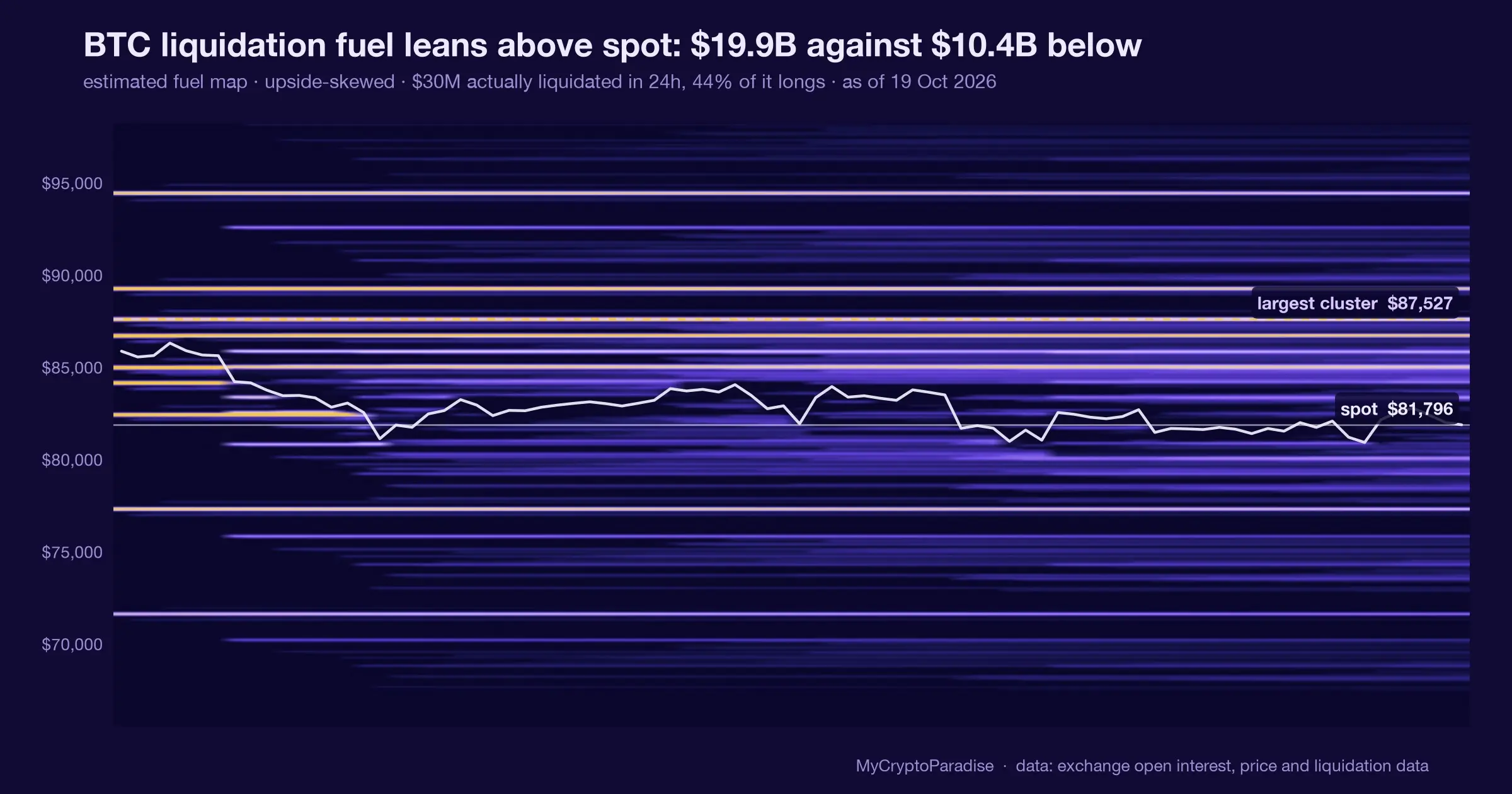
Structure beats story. The $85,000 liquidation cluster below and $82,000 defense zone are where stops and real buyers sit; that is the demand this resilience helps protect.
The ParadiseTeam view: healthier DeFi plumbing supports the bullish path toward $90,000 but does not guarantee the push holds there. We would respect a rejection at $90,000 as readily as a breakout, and let price, not the press release, confirm which one arrives.
The read behind this: we framed this story through our own market analysis, Bitcoin at $82K: Is $90K About to Trigger?
Track it live: our crypto liquidation heatmap and the live crypto funding rates both update in real time, so you can watch this shift for yourself.
Related coverage
For exact entries, targets, and stop losses with full risk management, that is what ParadiseFamilyVIP is for. New to reading these moves? Start with our crypto trading strategies guide.
ParadiseTeam is monitoring the market situation closely, and we are taking these developments into consideration while building our trading tactics inside ParadiseFamilyVIP.
Crypto trading involves substantial risk. Prices are volatile and you can lose money. This article is educational and is not financial advice. Past performance does not guarantee future results.
After this DeFi resilience, does Bitcoin break and hold above $90K next?
This is how 12 Paradisers are calling it. Tap your call.
No calls on this one yet. Tap yours to be the first.
Free account, no password. Members just sign in.
Follow this topic: Crypto liquidation news








Join the discussion 13
but what is the one level that matters
jessica, its also interesting to consider how this automation affects market structure overall, not just individual positions 🤔.
so now the 'solution' to leveraging is... more automation? cmon, people really need to understand the actual risk instead of finding fancy new ways to pretend its not there !! 🤦♂️
but Priya is so right, automating this kind of thing doesnt really help when the underlying risk is still just there... I saw firsthand what leverage does to people. 😥
Yeah Hannah, that's what I'm thinking too! 💡 It's like, you can put a helmet on, but the motorcycle 🏍️ still goes super fast.
But… isn’t it that it _did_ help, though? The article says it avoided a lot of losses. I'm sorry, I might be seeing it wrong.
but it only delayed the inevitable for many... like putting a band-aid on a gushing wound. the underlying risk of borrowing so much is still what hurts people. 😔
automating a leveraged position doesnt change the underlying risk of leverage itself. we keep trying to build better mousetraps for a problem that doesnt need one.
Yes, the automation can certainly mitigate cascading liquidations. I recall 19 May 2021 vividly. The core issue remains managing leverage exposure, but this is a useful tool for basis protection.
man, this is why i'm scared of leveraging myself... i dont even know what a liquidation penalty is... do you guys use this? 🧐
Automation is just a tool. The issue is leverage itself, a point a mechanism like this only reinforces. Nobody wants a 4 AM margin call, but this just shifts the risk.
all it does is delay the inevitable really 🤦♂️. automation just makes the casinos look smarter when its the same old game 🎲🤬.
Yeah, it just moves the goalposts, right? Like it makes it seem safer for a while... but the core risk is still there. 📉