

Listen: the breakdown
Developing story update (October 02, 2026, 15:05 UTC):
Update: Bitget has confirmed the breach stemmed from an exploited third-party zero-day vulnerability, pointing the root cause at an external component rather than its own core systems. For traders this narrows the blast radius to that specific dependency, though it keeps counterparty and custody risk on centralized venues firmly in view.
On the recovery side, based on our sources the stolen funds have since been tracked into a privacy mixing service, routed from Tron through Ethereum and THORChain into Bitcoin before mixing. That movement makes clean recovery less likely while showing on-chain intelligence is still following the trail.
One caution on framing: the North Korea link is an assessment drawn from IP behavior and on-chain analysis, not a confirmed law enforcement attribution. Treat it as a probable read rather than a settled fact.
What to watch now: Whether mixed funds resurface at identifiable off-ramps and whether Bitget discloses the affected third-party component.
Market briefing: Forensic analysts have pinned Bitget's $387 million hack on DPRK-linked actors, with funds already split across four chains. BTC trades near $86,661, up 3.4% on the day, barely flinching so far.
- Chainalysis attributed Bitget's $387 million hack to DPRK-linked threat actors.
- Stolen funds moved across Ethereum, XRP, Zcash and Tron within the first three hours.
- BTC held near $86,661 (+3.4% on the day) with no clear reaction yet.
A $387 million Bitget hack now carries a state-sponsored name, and the stolen coins are already moving across four chains. So why is crypto still green?
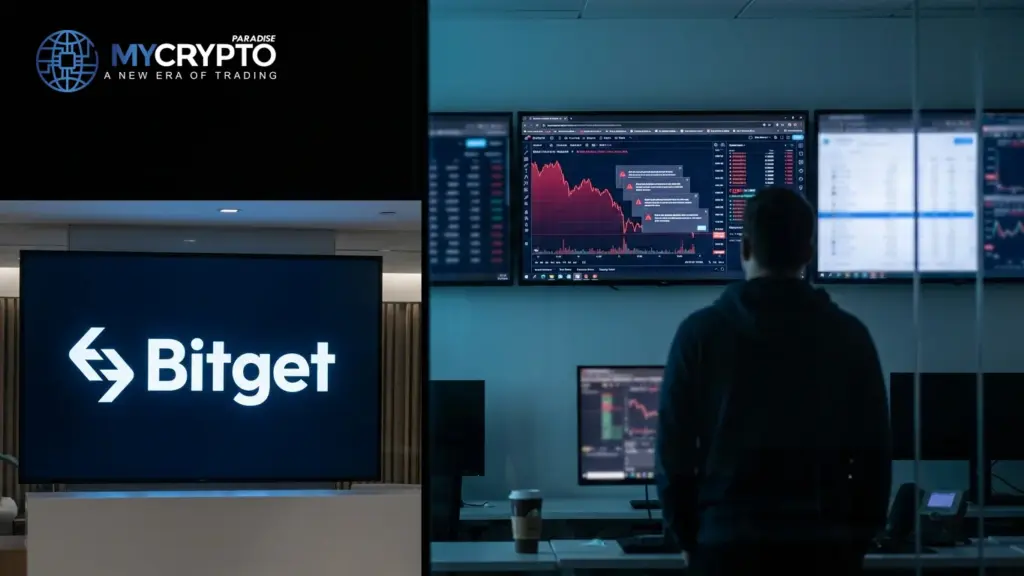
The Bitget hack just gained a name, and it is not a comforting one. Blockchain forensics firm Chainalysis attributed the $387 million theft to threat actors linked to DPRK, placing it among the larger exchange breaches the industry has absorbed. The attribution turns a messy security event into a familiar pattern: a sophisticated, well-funded operation that treats crypto exchanges as a funding source.
Speed was the tell. Within the first three hours, the stolen funds moved across Ethereum, XRP, Zcash and Tron. That is not panic. That is a prepared laundering pipeline, built in advance, designed to fracture the trail before anyone can freeze it.
Splitting funds across four chains does two things at once. It complicates forensic tracing, and it quietly spreads potential selling across markets that do not all behave the same way. Zcash in particular signals intent to obscure, since privacy rails are chosen for a reason.
Here is the part that should hold a trader's attention. A $387 million theft attributed to a state actor is a serious headline, yet BTC sat near $86,661, up 3.42% on the day, while ETH and XRP also traded higher. The market read the news and shrugged.
That gap between a grave security story and a calm tape is itself the story. We have watched enough cycles to know that markets price systemic risk loudly and isolated theft quietly. For now, this looks like the second kind.
How a state-funded breach spreads across four chains
The deeper issue is not the dollar figure. It is the attribution itself. A hack linked to DPRK actors is not opportunistic crime; it is a repeatable, funded operation that returns to the same well. That raises the baseline security cost for every crypto exchange, and those costs eventually reach users through insurance, custody fees and thinner margins.
The transmission into price, however, is weak, and we should say so plainly. There is no macro or liquidity shock attached to this event. The brief shows no systemic contagion, no exchange solvency scare, no forced deleveraging. Bitget absorbed the loss as a company event, not a market event.
That distinction matters. Exchange hacks move crypto hard only when they threaten counterparty trust or trigger a withdrawal run. This one, so far, has done neither.
What the breach does feed is a slower, structural drag. Stolen funds spread across Ethereum, XRP, Zcash and Tron eventually need to be converted, and conversion means sell pressure drip-fed into those markets over weeks. It is modest against daily volume, but it is one-directional, and it is supply that did not exist in willing hands before. Across four chains, the drip is simply harder to see, which is precisely the point of splitting it that way.
A major breach meeting a stubbornly quiet tape
Start with the obvious: the immediate price impact is close to nothing. BTC near $86,661, ETH near $2,743 and XRP near $1.53 all traded higher on the day, which tells you the broader bid is being set by something other than this hack.
That said, our verdict on this story's own facts is bearish, and the reason sits in the laundering flow rather than the tape. Stolen funds moving across four chains become slow, mechanical selling as the actors offload. The pressure is small relative to BTC liquidity, but it lands squarely on the named chains.
XRP is the one to watch most closely here. It carries less depth than BTC or ETH, so a persistent stream of stolen-coin conversion weighs more heavily per dollar sold. The same volume that BTC swallows unnoticed can leave a mark on XRP's order book.
Ethereum sits in the middle. Deep enough to absorb the flow, but still a direct recipient of the laundered supply, so it carries a touch more structural drag than a clean market would.
For BTC, the effect is close to noise. The hack does not change the liquidity picture that is actually driving Bitcoin toward the high $86,000s. It simply adds a faint, unhelpful headwind and a reminder that security risk is a permanent tax on this asset class, not a one-off event.
Signs the laundering turns into real selling
The first thing to watch is whether this stays a Bitget story or becomes a crypto-exchange story. Confirmation of the bearish read would be a widening: other platforms disclosing linked exposure, a wave of precautionary withdrawals, or any hint the loss strains Bitget's balance sheet. That would convert a company event into a trust event, and trust events move markets.
Invalidation is simpler and, frankly, the base case. If Bitget covers the loss cleanly, user funds stay whole, and no second shoe drops, the market will keep treating this as background noise. The calm tape then confirms itself.
Watch the chains directly for the real signal. Persistent, trackable movement of the stolen funds into liquid markets on Ethereum, XRP, Zcash and Tron is the mechanism to monitor, because that is where the only genuine selling pressure lives.
XRP deserves the sharpest eye given its thinner depth. If XRP starts underperforming BTC and ETH without a clear reason of its own, stolen-coin conversion becomes a plausible explanation worth respecting.
Finally, separate this story from the day's real driver. Bitcoin's push higher is being set by liquidity and positioning, not by a hack attribution. If BTC stumbles this week, look to macro and the order book first. Blaming a DPRK headline for a move it did not cause is exactly the kind of tidy narrative that feels right and usually is not.
Why state-linked theft rarely moves spot today
The ParadiseTeam frames this as a security headline that barely touches the levels that matter right now. With BTC near $86,661, Bitcoin is pressing the $85,000 to $87,000 band, and our standing read has it working toward $90,000, the next important resistance and a volume magnet. This hack does not alter that map.
Stolen-coin selling is real but small against BTC liquidity. It does not override the bullish divergence structure or the breakout participation we have tracked on the 4-hour chart. So we treat the attribution as a minor headwind layered onto an otherwise constructive picture, not a reason to flip bearish on Bitcoin itself.
The caution we do carry is the one we already held before this news. Into $90,000, liquidity fades and the risk of a reversal or rejection rises, with RSI not yet respecting the bullish divergence, a classic bear-trap warning. That caution comes from the chart, not from this hack.
Where the story has more bite is XRP. Near $1.53 and thinner than BTC, it is a direct recipient of laundered supply, so relative weakness there would be the cleanest evidence the selling is landing.
Net read: this is a reminder that security risk is a permanent cost, not a fresh catalyst. The ParadiseTeam watches the chains for the laundering flow and watches $87,000 for the push that actually matters. Probabilities, not certainty.
The read behind this: we framed this story through our own market analysis, Bitcoin at $82K: Is $90K About to Trigger?
Track it live: our Crypto Fear and Greed Index and the live crypto funding rates both update in real time, so you can watch this shift for yourself.
Related coverage
For exact entries, targets, and stop losses with full risk management, that is what ParadiseFamilyVIP is for. New to reading these moves? Start with our crypto trading strategies guide.
ParadiseTeam is monitoring the market situation closely, and we are taking these developments into consideration while building our trading tactics inside ParadiseFamilyVIP.
Crypto trading involves substantial risk. Prices are volatile and you can lose money. This article is educational and is not financial advice. Past performance does not guarantee future results.
Will the Bitget hack attribution weigh on crypto prices over the next week?
This is how 18 Paradisers are calling it. Tap your call.
No calls on this one yet. Tap yours to be the first.
Free account, no password. Members just sign in.







Join the discussion 10
damn, another one 😩. makes me wanna just hold my bag and forget about the charts for a week, just chill. anyone else ever feel that?!
It's like when a bearing goes... you can always blame the cheap grease, but the maintenance schedule needed a look too. These things... always a lesson.
I don't care who they say did it, the system needs to fix how easily these things happen. People's money just gone.. again. Liquidity always decides.
honestly it just makes me so mad 😤 like a broken record repeating 🔁 always "DPRK" but where's the real protection for our assets? 😠 My FTX money is still frozen. 💀
yeah, feels like the hacks keep coming no matter what we do. 🙄 i just stick to my weekly closes and ignore all this 4-hour noise, otherwise I’d go nuts. 🫠
Ingrid-san, I understand this feels familiar. After the Coincheck incident, I started moving assets off exchange promptly after any trade.
DPRK again 🤔? Always them. You know, sometimes it feels like a convenient excuse to point fingers when a big exchange gets rekt 🔥📉. Tommy's right, same old story!
carlos, yeah it does feel like that sometimes, a bit of a familiar tune 🎶. but then the flip side is that these guys have to prove it somehow, right 🤔??
Right? And it's always the same script, like they just copy-paste the whole thing 🤷♂️. Like, are we gonna talk about the hole in the fence this time or what?
they say the same thing every time, same actors always. its never about fixing the hole, just blaming someone else