

Listen: the breakdown
Developing story update (September 06, 2026, 14:14 UTC):
Update: US Central Command has now officially confirmed the strikes that destroyed three oil tankers linked to Iran’s Revolutionary Guards. This moves the tanker action from initial report to confirmed military event, which raises the odds that Iran’s promised response is treated as a live risk rather than rhetoric.
The strikes are now framed as retaliation for ballistic missile attacks by Iran’s Revolutionary Guard Corps on two US targets, establishing a direct tit-for-tat chain rather than an isolated hit. For traders this is the tell of a widening escalation loop. Despite it, Bitcoin and Ethereum remain almost flat over 24 hours, so the market is still not pricing the capitulation flush that smart money is waiting for.
What to watch now: Whether official confirmation triggers a real Iranian counter-strike, and if that finally forces the deeper BTC flush toward prior lows.
Developing story: This story is still unfolding. We are tracking it and will update this article as more details are confirmed.
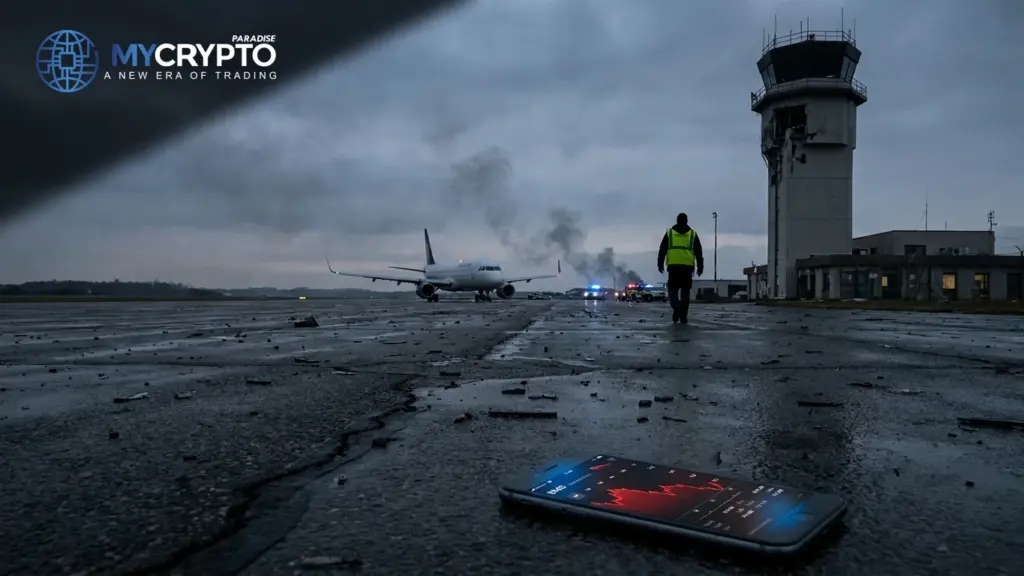
Market briefing: An airport in Jiroft has been reported struck as the US-Iran conflict widens, yet Bitcoin barely moved, trading near $79,798. The calm reads less like strength and more like a market waiting for the real flush.
- An airport in Jiroft, Kerman Province, has been reported struck as US-Iran tensions escalate.
- The US struck three oil tankers it linked to the Revolutionary Guards, and Iran vowed a more painful response.
- Bitcoin held near $79,798 with a muted 24-hour move, suggesting the risk is not yet priced by panicking traders.
A strike on Jiroft airport just widened the US-Iran conflict, yet Bitcoin held near $79,800 and barely flinched. So is this calm real, or the quiet before a flush?
An airport in Jiroft, Kerman Province, Iran, has been reported as struck. It is the latest flashpoint in a US-Iran confrontation that keeps escalating by the day.
The backdrop is heavy. The US struck and destroyed three oil tankers it said were linked to Iran's Revolutionary Guards. Iran answered with a vow of a more painful response. Senior Iranian official Mohsen Rezaee warned that the new strategy would shatter the foundations of its adversaries.
The signals of alarm are hard to miss. US Ambassador to Israel Mike Huckabee advised embassy staff to leave, telling them to do so today at 20:38 UTC. President Donald Trump gave the order to proceed with Operation Epic Fury. When embassies start emptying, markets usually notice.
And yet crypto sat still. Bitcoin traded near $79,798, up a fractional 0.18 percent on the day and down 0.2 percent on the hour. Ethereum held around $2,492.66. For a story with this much military weight, the reaction was almost eerily quiet.
That gap between the headline and the tape is the real story here. A conflict escalating this fast normally jolts risk assets. Instead, price shrugged.
We want to be honest about causation. There is no single confirmed catalyst driving today's tape, and pinning the calm on any one event is interpretation, not fact. What matters structurally is that a serious geopolitical shock landed and buyers did not rush in. That silence tells us more than the strike itself.
Geopolitical risk meets a bearish macro backdrop
Geopolitical escalation is a classic risk-off trigger, and this one has real teeth. A widening US-Iran conflict raises the odds of supply shocks, higher energy costs, and sudden dollar demand. Each of those pulls liquidity away from speculative assets like crypto.
The transmission chain is straightforward. Conflict raises uncertainty. Uncertainty raises the price of safety. Capital rotates toward cash, the dollar, and hard assets, and away from the far end of the risk curve, where crypto lives.
Here is the part traders keep underestimating. Bitcoin does not need a direct hit to fall in a risk-off wave. It falls because portfolios de-risk everywhere at once, and the most volatile holdings get sold first to raise cash. So far, that selling has not arrived with force. The muted move suggests the market is either already braced for broader conflict or is simply not reacting to this specific report in isolation.
That restraint cuts both ways. It can mean resilience, or it can mean complacency in a market that has convinced itself the worst is behind it.
Our read leans toward the second. In a macro structure we already view as fragile, a serious escalation that fails to spark a bid is not comforting. It looks like a market running low on fresh buyers, holding a level more from habit than conviction, while the risks quietly stack up in the background.
Risk-off flows press Bitcoin then altcoins
Watch how any liquidity shock moves through the market, in order. Bitcoin absorbs the first blow because it is the deepest and most liquid crypto asset. When large players de-risk, BTC is what they sell first.
Right now that first blow has been soft. Bitcoin near $79,798 with a flat 24-hour change tells us the heavy selling has not begun. The market is holding its breath, not exhaling.
Ethereum sits one step further out on the risk curve. It traded around $2,492.66, actually up on the day, which shows demand has not collapsed. But ETH tends to fall harder than BTC once fear turns real, because its buyer base is thinner and faster to flee.
Altcoins are the tail of the whip. In a genuine risk-off cascade, they bleed the most, since liquidity drains from the smallest names first. A quiet alt market today is not safety. It is the absence of the flush, not proof it is cancelled.
The uncomfortable truth is that low volatility during a live geopolitical crisis rarely lasts. Volatility is not gone. It is coiled.
If conflict headlines intensify and a real de-risking wave hits, expect the familiar sequence: BTC leads down, ETH follows harder, and alts cascade last and worst. The current calm is the setup for that move, not evidence against it. Positioning built on today's stillness is positioning built on borrowed time.
Confirmation sits at $82,000, invalidation below $58,000
The levels tell the story more honestly than the headlines. Bitcoin near $79,798 is defending a temporary support around $79,000, and how it holds there is the first thing to watch.
Confirmation of the bearish path is clean to define. A firm rejection near $79,000, followed by a decisive break of the $58,000 previous low, would open the road toward the $44,000 zone we see as the expected bottom. That is the flush scenario playing out.
Invalidation is just as clear, and this is where discipline matters. A proper reclaim of the $82,000 to $84,000 daily level would break the bearish structure. Above that, the $82,000 to $88,000 weekly resistance zone is the real wall.
Until price reclaims those zones with strength, we treat rallies as suspect. One green day does not undo the trend.
The divergences reinforce caution. Search interest peaked higher during past crashes than on this rally, which is bear-market behaviour, not the hungry demand of a real bull run.
On top of that, a large shooting star candle printed at the $82,000 to $88,000 weekly resistance. Momentum indicators show bearish crosses, with moving averages now acting as resistance rather than support. So watch the reaction at these levels far more than the geopolitical noise. Price confirms or denies the thesis. Headlines only set the mood.
Reading the muted reaction through smart money
Bitcoin near $79,798 is doing something worth studying: absorbing a serious escalation and refusing to bid. The ParadiseTeam reads that stillness as telling, not reassuring.
Our core view stays bearish on the daily and weekly. Smart money, in our read, has not been stepping in to absorb selling pressure. It is waiting for a proper exchange-of-hands zone nearer $44,000 before committing size.
That framing changes how we treat today. Normally, bearish news landing at support with retail already fearful hints at accumulation. But retail here is not fearful. Retail still believes this is a bull market, which is exactly why we stay cautious.
When the crowd is calm into escalating risk, minor rallies look like traps, not turns.
The $79,000 area is a temporary defense, not a floor we trust. A break of $58,000 would confirm the deeper leg toward $44,000. Only a clean reclaim of $82,000 to $84,000 on the daily would force us to rethink the whole structure.
For risk management, the message is patience over prediction. If you engage, respect where stops sit: clustered just under obvious support, which is precisely where a fast wick likes to hunt. Define your SL (stop-loss) before entry and keep R:R (risk-to-reward) honest. None of this is a signal or a promise. It is our probability-weighted read, and probabilities can be wrong. In this tape, waiting for confirmation costs less than guessing the bottom.
The read behind this: we framed this story through our own market analysis, Bitcoin Whale Shorts $51M: What Does He Know?
Track it live: our Crypto Fear and Greed Index and the crypto liquidation heatmap both update in real time, so you can watch this shift for yourself.
Related coverage
For exact entries, targets, and stop losses with full risk management, that is what ParadiseFamilyVIP is for. New to reading these moves? Start with our crypto trading strategies guide.
ParadiseTeam is monitoring the market situation closely, and we are taking these developments into consideration while building our trading tactics inside ParadiseFamilyVIP.
Crypto trading involves substantial risk. Prices are volatile and you can lose money. This article is educational and is not financial advice. Past performance does not guarantee future results.








Join the discussion 1
I'm still tryna grasp why the airport strike didn't hit harder... seems like a big deal, no? 🤔 I thought that kind of news usually drops prices.