


Listen: the breakdown
Developing story update (September 12, 2026, 18:07 UTC):
Our sources confirm the Muwaffaq Salti Air Base, site of the recent Iranian strikes on US assets, is operated by the Royal Jordanian Air Force. This detail clarifies the operational control of the facility.
Despite this new contextual information, the crypto market’s reaction remains largely muted, with Bitcoin and Ethereum showing only minor price drift. Our assessment of smart money positioning and overall market sentiment holds steady.
What to watch now: Monitor any official statements from Jordan regarding the base's operation or the strikes.
Developing story update (September 12, 2026, 17:02 UTC):
The picture has widened since we published. Based on our sources, the campaign is no longer confined to the single Jordanian base: the targeting now spans US embassies and military installations across the United Arab Emirates, Saudi Arabia, Qatar, Kuwait, Bahrain, Iraq, Oman, and Jordan. That is a materially larger geographic footprint of risk than a single-base incident.
For traders the read does not change, it hardens. Price reaction in BTC and ETH remains contained for now, but a multi-front regional posture raises the probability of a risk-off shift that pressures leveraged long positioning. Our smart money view is unchanged: whales likely stay patient, treating this as one more reason to wait for lower accumulation levels rather than a single catalyst for an immediate crash.
What to watch now: Watch for confirmation of strikes beyond Jordan; a second named location would be the trigger for a broader risk-off move.
Developing story update (September 12, 2026, 16:40 UTC):
Update: the scope of the damage at the Jordan air base is now clearer. Based on our sources, roughly eight F-15 aircraft took only light damage and have already returned to service, while a single A-10 Thunderbolt that lost a wing remains the one heavily damaged airframe.
For traders this matters because it frames the strike as a contained event rather than an escalating loss of capability, which is consistent with the muted crypto reaction so far. BTC and ETH remain within their recent ranges with small 24h dips, offering no sign of a geopolitics-driven break either way.
What to watch now: Watch for any official military or government response that reframes this from a contained incident into a wider escalation.
Developing story update (September 12, 2026, 15:36 UTC):
Update: A senior US political figure has now publicly disputed the reports of damage to American aircraft in Jordan, introducing a direct contradiction to the initial account. Based on our sources, the same figure framed the wider conflict as ending shortly after the US midterms, which reads as a political-timeline signal rather than a military one. Until an official confirmation settles the dispute, treat the headline event as contested.
The reported scope of Iran’s targeting is also wider than first described, with strikes and threats said to span US embassies and military installations across the UAE, Saudi Arabia, Qatar, Kuwait, Bahrain, Iraq, Oman and Jordan. A broader regional footprint raises the probability of further escalation headlines, which tend to act as accelerants for existing risk-off pressure rather than fresh independent drivers.
For traders, price action stayed muted: BTC and ETH are both down under 3% over 24 hours, consistent with the view that smart money is still sidelined and waiting for lower levels. The contested nature of the story is a reason to size for headline volatility, not to assume a confirmed catalyst.
What to watch now: Whether an official source confirms or formally retracts the aircraft-damage claim, and any spread of strikes to a second Gulf base.
Developing story update (September 12, 2026, 15:14 UTC):
Update: More concrete detail has now been confirmed on the scale of the strike on the U.S. air base in Jordan. Based on our sources, the attack hit Muwaffaq Salti Air Base overnight Tuesday into Wednesday local time, with one A-10 Thunderbolt losing a wing and roughly eight F-15s taking light damage before returning to service.
For traders the read is unchanged so far. The confirmed damage is limited rather than catastrophic, and crypto has not reacted with a fresh sell-off: BTC is around $77,411 and ETH near $2,537, both roughly flat over the last hour. This keeps the situation in the slow risk-off drift we flagged, not the sharp capitulation move that would open the door to the lower accumulation zone.
What to watch now: Watch whether any escalation beyond limited base damage triggers a real risk-off flush toward the $55k-$44k zone.
Developing story: This story is still unfolding. We are tracking it and will update this article as more details are confirmed.
Market briefing: Iran struck US jets in Jordan as the Gulf conflict widened, oil pushed above 107, and Bitcoin sat near 77,449, down about 1.5 percent on the day.
- Iran struck US jets in Jordan after Washington disabled five Iranian oil tankers on September 8.
- Brent Crude pushed above 107 as Houthi forces seized Yemen's Mocha and threatened a Saudi pipeline.
- BTC held near 77,449 and ETH near 2,539, modest drops that fall short of a real capitulation.
Iran hit US jets in Jordan as the Gulf conflict widens and oil breaks 107. So why is Bitcoin only down about 1.5 percent, and can that calm last?
The Gulf conflict just widened in a way markets cannot ignore. Iran launched strikes that hit US jets in Jordan. That came after the US military disabled five Iranian oil tankers on Tuesday, September 8, in retaliation for recent Iranian missile attacks on a US Navy warship.
The fight is no longer only at sea. Houthi forces seized Yemen's Mocha and are now threatening a Saudi pipeline. Two of the world's most important energy chokepoints are back in play at the same time.
Markets reacted where it matters most: energy. Brent Crude surged above 107. US Secretary of State Marco Rubio said the military would keep targeting Iranian oil tankers, which tells traders this is a policy, not a one-off.
Higher oil is not just a headline. It is an input cost for almost everything, and it feeds directly into inflation math that central banks watch closely.
Crypto, so far, has taken it in stride. Bitcoin was trading near 77,449 as of the current print, down about 1.5 percent on the day. Ethereum sat near 2,539, down about 2.4 percent.
That calm is the interesting part. A widening war and a record energy squeeze usually produce more than a 1 to 2 percent wobble. Either the market has decided this is contained, or the real reaction is still loading. History rarely rewards the first assumption.
How oil above 107 drains crypto liquidity
Oil above 107 is the transmission line from a Gulf war to your crypto screen. Energy sits at the base of the cost stack. When it jumps, so does the price of shipping, manufacturing, and food, which lifts headline inflation.
That matters because sticky inflation keeps real interest rates higher for longer. Higher rates raise the cost of holding anything that pays no yield, and Bitcoin pays no yield. Risk assets sit at the far end of that chain and feel the squeeze last but hardest.
There is also a liquidity effect. War premiums pull global capital toward oil, defence, and safe-haven dollars. Money that might rotate into speculative assets gets parked instead. Less incoming liquidity means thinner bids under crypto.
Rubio's statement that the US will keep hitting Iranian oil tankers removes the easy hope of a quick de-escalation. Traders now have to price an ongoing supply risk, not a single flare-up. So the chain is clean. Widening strikes, then a supply shock, then higher inflation risk, then reduced liquidity for risk assets. Bitcoin sits at the end of that chain.
The modest 1 to 2 percent crypto decline fits an early risk-off reaction. It does not yet reflect a market that has fully absorbed a sustained energy shock. The gap between the news and the price is the tension worth watching.
Energy shock reaches Bitcoin before altcoins
Risk-off does not hit every coin at once. It moves in a predictable order, and knowing that order is an edge.
Bitcoin absorbs the first blow. It is the deepest, most liquid crypto asset, so global macro fear expresses itself in BTC first. The move near 77,449, down about 1.5 percent, is that first ripple, not the full wave.
Ethereum follows and usually amplifies. ETH near 2,539, down about 2.4 percent, is already underperforming Bitcoin on the day. That relative weakness is normal in a risk-off tape, because ETH carries a higher beta to sentiment.
Altcoins sit last in line and fall hardest. When liquidity thins, the smallest, most speculative names lose their bids fastest. A calm BTC chart can hide sharp drawdowns further down the risk curve.
The quiet surface is where traps form. Leveraged long positions built during the calm become fuel. If oil keeps climbing and BTC slips, those longs get liquidated, and forced selling accelerates the very move they bet against.
Watch open interest (OI), the total value of unsettled futures contracts. Rising OI into a flat price often marks crowded positioning, not conviction. So the impact is layered. A modest headline drop can precede a deeper flush if the energy shock persists and leverage unwinds. The order stays the same: Bitcoin, then Ethereum, then the long tail of alts.
Signals that separate panic from continuation
The next move hinges on whether the market treats this as contained or escalating. A few concrete signals will settle that debate.
Watch Brent Crude first. If oil keeps grinding above 107, the inflation and liquidity pressure stays live, and crypto's downside risk stays open. A sharp reversal in oil would ease the whole chain.
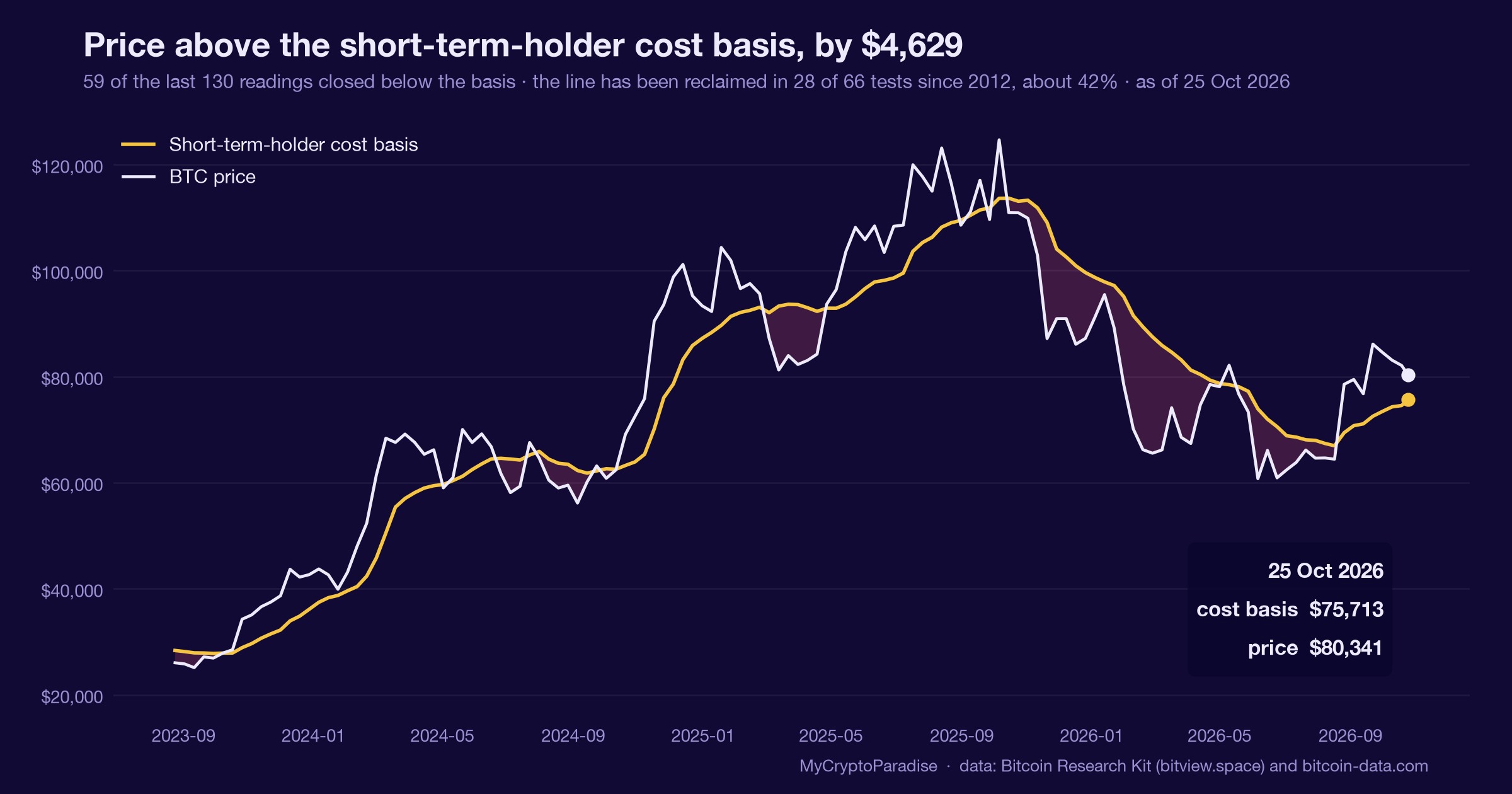
Watch the medium-term support at 77,700, which the ParadiseTeam reads as already broken. A clean reclaim and hold above it would suggest buyers are defending. A rejection back below keeps the bearish structure intact.
The key downside marker is the previous low near 58,000. A daily close under that level would confirm continuation toward the deeper zone rather than a shallow dip.
On confirmation of strength, the level that matters is the 82,000 to 88,000 band. A reclaim there would flip the higher-timeframe bias and invalidate the bearish case entirely. That is the line, not a wish.
Also watch leverage. If OI stays elevated while price stalls, a liquidation cascade becomes more likely on any fresh escalation headline.
One honest caveat. This is a developing military situation, and details are still emerging. Headlines can move faster than charts, so position sizing and a defined SL (stop-loss) matter more than usual.
The simple frame: oil down and 82,000 reclaimed argues one way, oil up and 58,000 lost argues the other.
Why a broken support changes the math
The ParadiseTeam frames this news through one fact: the medium-term support at 77,700 is already broken, and BTC is trading beneath it near 77,449. That changes how a war headline lands.
When bearish news arrives at a level that is holding, it often marks smart money accumulating from frightened retail. This is not that setup. The support gave way before the escalation, so the energy shock is landing on weakness, not on a defended floor. That tilts the near-term read bearish. The ParadiseTeam's higher-timeframe bias points toward a deeper correction, with the previous low near 58,000 the next magnet and the 55,000 to 44,000 exchange-of-hands zone the eventual target.
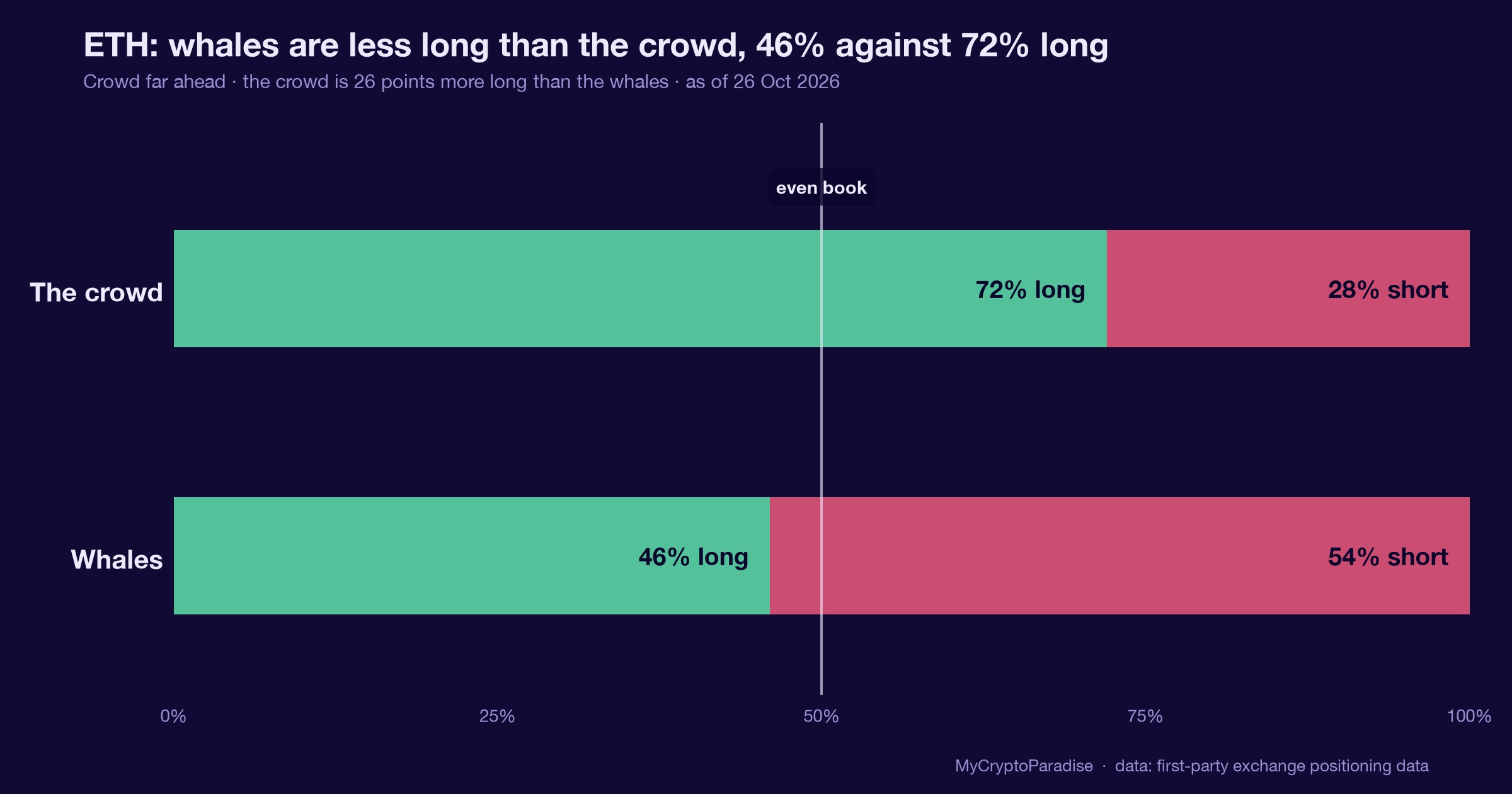
The positioning picture reinforces it. Smart money is still sitting in USDT reserves, not yet rotating into crypto. Retail, meanwhile, keeps stacking leveraged longs. That crowd provides the liquidity a long squeeze needs, and a widening Gulf conflict is exactly the kind of catalyst that triggers one.
The signal that would flip this is not subtle. A reclaim and hold of the 82,000 to 88,000 band would invalidate the bearish bias outright. Until then, rallies read as relief, not reversal.
None of this is a promise of direction. It is probability and risk management. The ParadiseTeam's stance stays patient: let the leverage clear, watch for whales moving USDT into crypto near the lower zone, and respect that a broken support rarely turns into a floor overnight.
The read behind this: we framed this story through our own market analysis, Can Bitcoin Hold This Support?
Track it live: our live crypto funding rates and the Crypto Fear and Greed Index both update in real time, so you can watch this shift for yourself.
Related coverage
For exact entries, targets, and stop losses with full risk management, that is what ParadiseFamilyVIP is for. New to reading these moves? Start with our crypto trading strategies guide.
ParadiseTeam is monitoring the market situation closely, and we are taking these developments into consideration while building our trading tactics inside ParadiseFamilyVIP.
Crypto trading involves substantial risk. Prices are volatile and you can lose money. This article is educational and is not financial advice. Past performance does not guarantee future results.
With the Gulf conflict widening, where does Bitcoin go from here in the coming weeks?
How 10 Paradisers are calling it
The first call is still open
Free account, no password. Members just sign in.








Join the discussion 2
The 15m chart already showing the pressure fr this 📈, but wonder if the bigger boys are really sitting this one out 🤔??
Hmm, I'm not sure I agree about the liquidity implications here 🤔. Seems like a lot of the capital is actually just *waiting* on the sidelines right now, not moving to support levels 🤷♀️.