


Listen: the breakdown
Market briefing: US spot Bitcoin ETFs bled $450.4 million on Tuesday, the biggest exit since June, as BTC dipped below $75,000. It has since steadied near $76,285. We read the outflow as distribution, not a dip to buy.
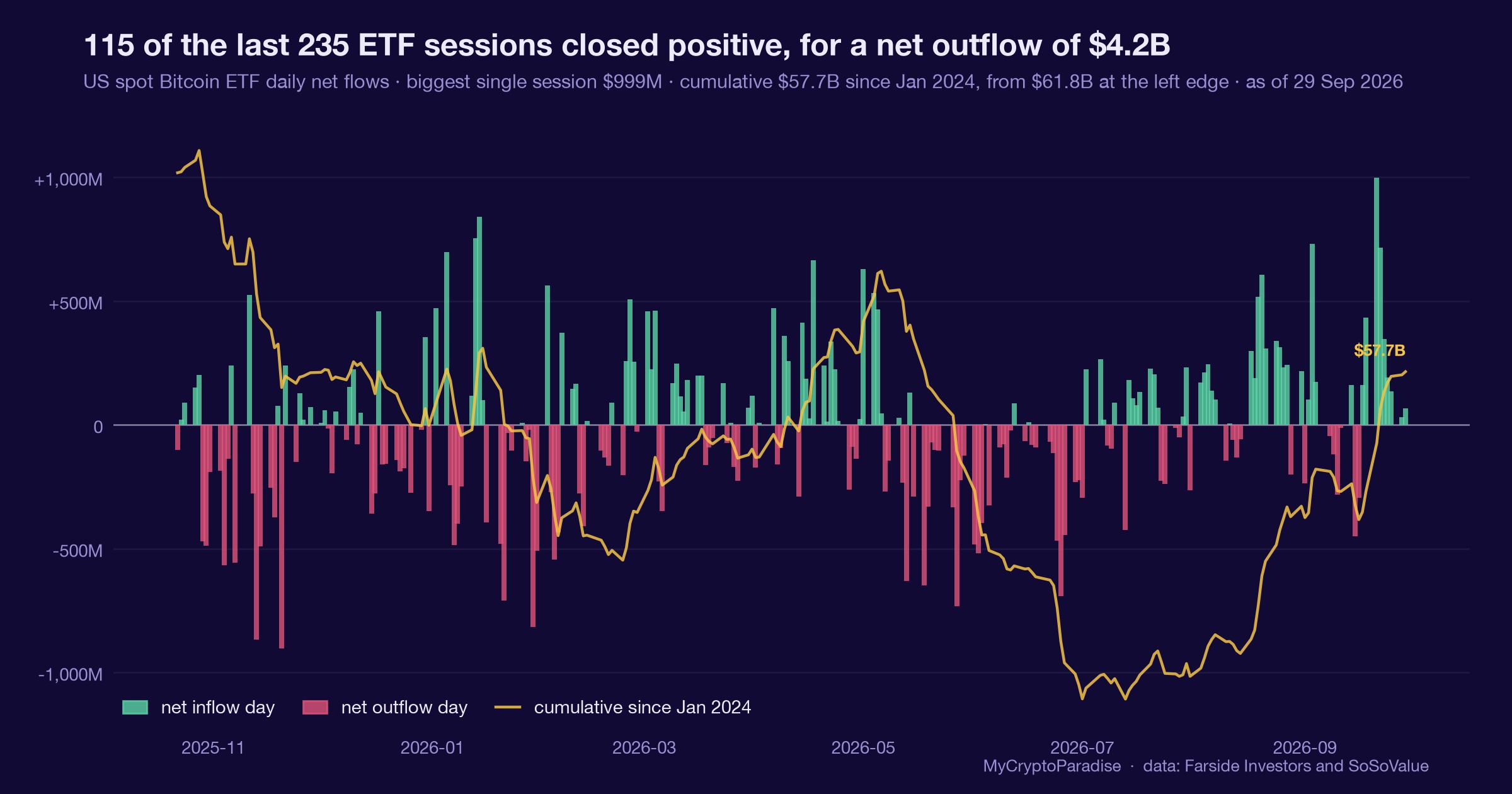
- Spot Bitcoin ETFs saw $450.4M in net outflows Tuesday, the largest since June 25.
- The move reversed Monday's $159.9M inflow as BTC traded below $75,000.
- We read the exit as smart money distribution, with $58,000 the key pivot.
A $450 million Bitcoin ETF outflow, the largest since June, just hit as BTC slipped under $75,000. Is this smart money quietly distributing, or a real bottom forming?
US spot Bitcoin exchange-traded funds just posted their heaviest single-day exit in months. On Tuesday, $450.4 million left the products in net outflows. That is the largest daily Bitcoin ETF outflow since June 25.
The reversal was sharp. Only a day earlier, these same funds pulled in $159.9 million of net inflows. Within twenty-four hours, buyers turned into sellers across all thirteen US-listed spot Bitcoin ETFs.
Price followed the money. BTC slipped below $75,000 during the session, printing a three-and-a-half-week low. By this morning it had steadied near $76,285, up 0.7% on the day.
We covered the regulatory backdrop already today. The Senate declined to advance the Digital Asset Market CLARITY Act, and that stall sits underneath this flow. What is new here is not the vote. It is the size of the capital that walked out the door once the vote failed.
Regulatory uncertainty is the excuse. The flow is the fact. When a clean legislative path stalls, allocators who need rules trim exposure first and ask questions later.
Structurally, this matters more than one red day. ETF flows have become the visible plumbing of institutional demand. A $450 million withdrawal is not retail panic on a phone app. It is larger holders reducing size through a regulated wrapper, and doing it fast.
The regulatory crack behind the exit
ETF flows now transmit macro sentiment straight into spot Bitcoin. Every share created forces an authorised participant to buy real BTC. Every share redeemed forces a sale. So $450.4 million of net redemptions is not sentiment on a chart. It is actual coin hitting the market.
The CLARITY Act stall is the trigger behind that mechanism. Institutions size positions against a rulebook. When the rulebook stays unwritten, compliance teams cap crypto exposure by default. A failed Senate vote reads to them as delay, and delay means de-risk.
That is the transmission chain. Regulatory uncertainty raises the perceived risk premium. A higher premium pushes allocators to reduce size. Reduced size shows up as ETF outflows. Those outflows convert into spot selling pressure.
Monday's $159.9 million inflow makes the reversal sharper. In one day, direction flipped from accumulation to distribution. That speed tells you the conviction was thin to begin with.
Here is the part retail tends to miss. Big holders rarely dump into strength. They distribute into any bid that shows up, including the bids created by fearful buyers hunting a bounce. The regulatory headline hands them cover to keep selling while the crowd debates the news.
None of this guarantees lower prices. It does raise the probability that supply keeps pressing until a real bid absorbs it.
Outflow pressure moves from BTC to alts
The selling starts with BTC and works outward. Bitcoin absorbs the ETF redemptions first, because that is the coin the funds hold. A sub-$75,000 print on Tuesday shows the pressure is already live.
From BTC, the pressure travels to ETH. Ethereum has no equivalent flow story here, but it rarely decouples when Bitcoin leads down. When BTC liquidity thins, ETH tends to follow with a lag and a wider range.
Then come the alts. Altcoins sit at the far end of the risk curve. They get the last bid in a rally and the first exit in a flush. A $450 million Bitcoin ETF outflow drains attention and liquidity from the whole board, and thin alt order books amplify every move.
Watch open interest, or OI, the total value of outstanding derivatives positions. If price falls while OI climbs, new shorts are pressing, and the move has fuel. If price falls while OI drops, longs are being flushed, which can exhaust faster.
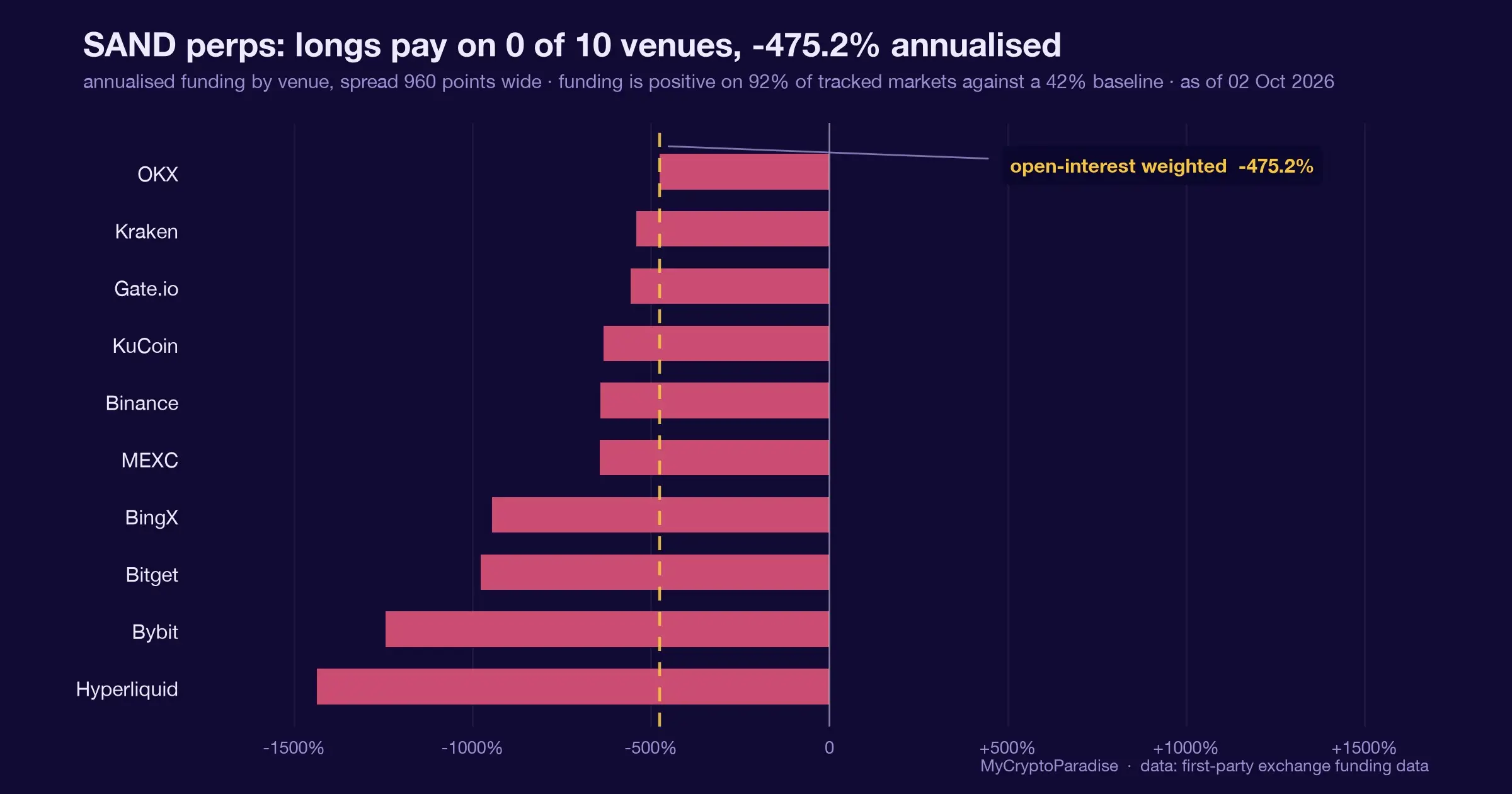
Funding rates tell the same story from another angle. Deeply negative funding near a low often marks crowded shorts, the raw material for a squeeze.
The honest read is that this is a liquidity event, not a solvency event. Nothing broke. Capital simply repriced regulatory risk and stepped back, and price is doing the discovery in real time.
The levels that decide the next leg
The next few sessions decide whether this is a flush or the start of a leg lower. Flow is the first tell. One heavy outflow is an event. Three in a row is a trend, and would confirm allocators are still trimming rather than pausing.
Price gives the cleaner signal. BTC steadied near $76,285, but the structure stays heavy while it trades under $79,000. That level has acted as resistance, and a rejection there would fit continued distribution.
Invalidation runs the other way. A daily close back above $79,000, held with rising volume and a fresh ETF inflow, would weaken the bearish case. That combination is what a real bottom needs, and so far it is absent.
The level we respect most on the downside is $58,000, the prior low. Losing it opens the door toward the $55,000 to $44,000 zone we have flagged as the macro target.
Retail behaviour is its own indicator. Extreme fear that flips to optimism on every small green candle usually marks a market still feeding liquidity to sellers, not one that has bottomed.
So the checklist is simple. Reclaim $79,000 with volume and inflows to argue for a low. Lose $58,000 to confirm the downside continuation. Between the two, treat strength as suspect until the flow data turns with the price.
What this outflow means for liquidity
The ParadiseTeam reads this outflow as distribution, not a dip to chase. BTC was trading near $76,285 as of this morning, sitting below the $79,000 resistance we have been watching. That location matters more than the headline.
Our macro bias stays firmly bearish while price holds under $79,000. The $450.4 million exit fits the pattern we have described for weeks. Larger holders reduce size, use a regulatory headline as cover, and let fearful buyers absorb the supply.
The CLARITY Act stall does not change our levels. It reinforces them. Uncertainty gives distribution a reason, and the ETF flow shows the reason turning into action.
We see $58,000, the prior low, as the pivot. Our read is that it breaks rather than holds, which would expose the $55,000 to $44,000 zone. That remains our macro target until price proves otherwise.
For the reframe: retail sees a scary number and a three-and-a-half-week low and expects a bounce to buy. Our read is that these bounces are where smart money keeps offloading. Extreme fear alone is not a bottom signal when flows and structure both point down.
What would change our mind is specific. A reclaim of $79,000 that holds, backed by ETF inflows and whale support stepping in, would force a rethink. Absent that, the ParadiseTeam treats rallies as distribution and the path of least resistance as lower.
The read behind this: we framed this story through our own market analysis, Can Bitcoin Rally From Extreme Fear?
Track it live: our live crypto funding rates and the Crypto Fear and Greed Index both update in real time, so you can watch this shift for yourself.
Related coverage
For exact entries, targets, and stop losses with full risk management, that is what ParadiseFamilyVIP is for. New to reading these moves? Start with our crypto trading strategies guide.
ParadiseTeam is monitoring the market situation closely, and we are taking these developments into consideration while building our trading tactics inside ParadiseFamilyVIP.
Crypto trading involves substantial risk. Prices are volatile and you can lose money. This article is educational and is not financial advice. Past performance does not guarantee future results.
Does BTC lose $58K before it reclaims $79K from here?
Follow this topic: Bitcoin ETF news











Join the discussion 1
These outflows are just a reminder that the institutional side tends to be a bit more reactive to immediate price action, no? I mostly track net flows over a quarter, helps smooth out the noise. 🤔