


Listen: the breakdown
Developing story update (November 06, 2026, 07:03 UTC):
Update: the scale of the drawdown is now clearer. Beyond the single-session drops, the main Asian indices have fallen deep from their record highs, with Japan’s Nikkei down about 22% and Taiwan’s TAIEX down about 24%, both in bear-market territory. South Korea’s Kospi is the hardest hit, sitting roughly 48% below its all-time high.
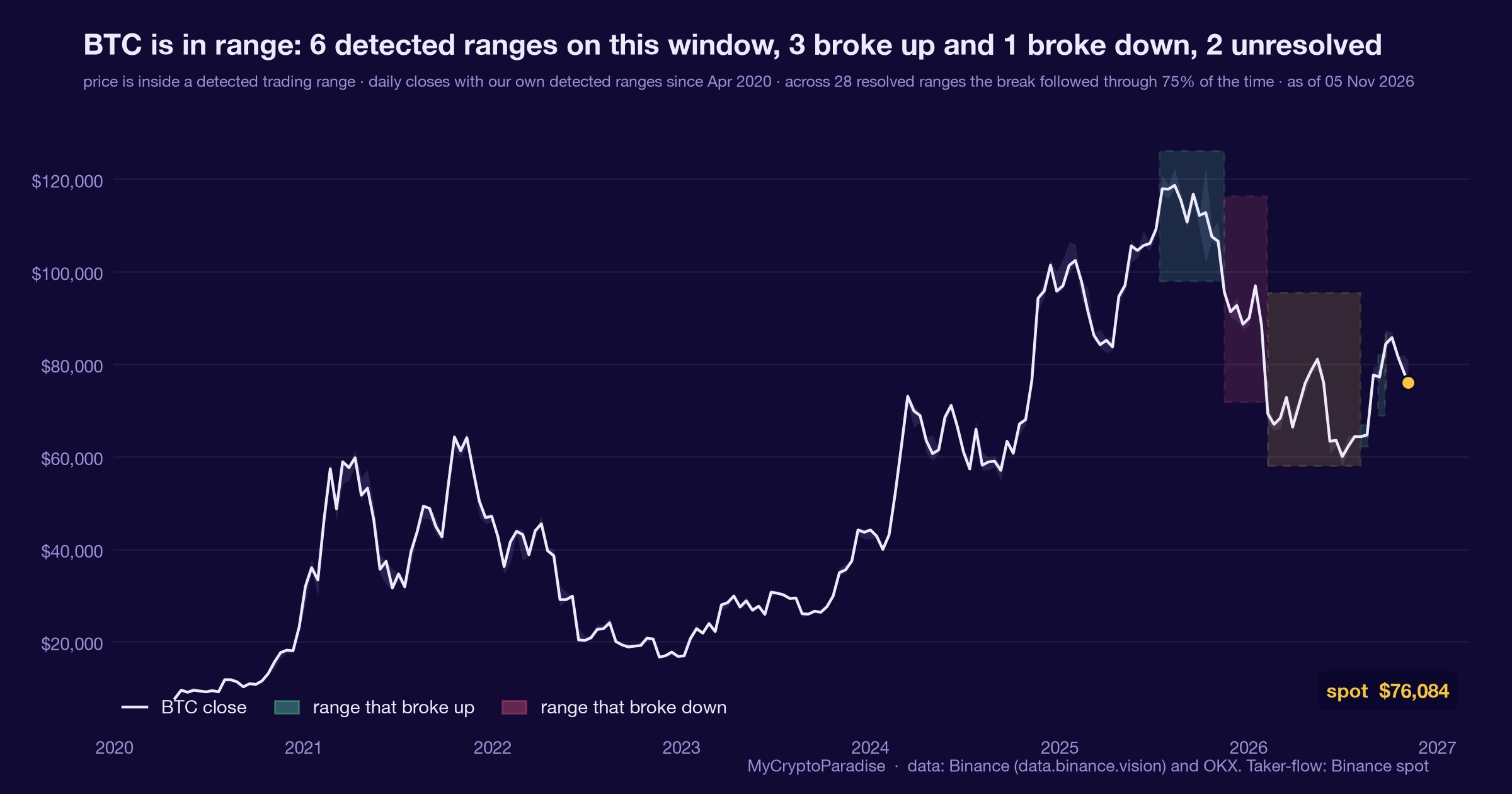
For traders this reframes the move from a one-day shock into a broader structural unwind in Asian equities. BTC is holding just under the $76,000 level we flagged, near $75,600 and down about 6% on the day, so the risk-off read stands and the defended zone remains the line to watch.
What to watch now: Whether BTC can reclaim $76,000 or the Asian bear-market unwind drags it lower.
Market briefing: An AI-driven crash erased over $1.2 trillion from Asian stock markets in one session. Crypto followed, with BTC near $75,623 down about 6% and ETH down roughly 8% as the liquidity shock spilled across risk assets.
- Asian equities lost over $1.2 trillion in a single session as the AI trade repriced hardest in chip-heavy markets
- BTC fell about 5.9% to near $75,623 and ETH dropped roughly 8%, both moving as high-beta risk proxies
- No crypto-specific trigger: the weakness was imported wholesale from a cross-asset deleveraging event
The AI bubble crash that started in Asia erased over $1.2 trillion in one session, and crypto did not sit it out. So does BTC decouple here, or lead the beta down?
Something snapped in Asia today. Over $1.2 trillion in market value vanished from the region's major stock indices in a single session, and the damage clustered exactly where the AI trade lives. Taiwan's TAIEX lost 9.0%. South Korea's Kospi fell 8.8%. Japan's Nikkei dropped 7.1%. Hong Kong's Hang Seng, more insulated, slipped 1.8%.
These are not pullbacks. The Nikkei now sits 22% below its all-time high. The TAIEX is down 24%. The Kospi has lost 48% from its peak, which is a long way from a healthy correction.
The pattern matters more than any single print. The hardest-hit markets, Korea and Taiwan, are the two most exposed to AI chips. The least-hit, Hong Kong, is the least exposed. When a selloff sorts itself that cleanly by theme, it is repricing a story, not reacting to one headline.
Crypto did not get a pass. BTC was trading near $75,623 and down about 5.9% on the day. ETH fell harder, down roughly 8%. Both moved as high-beta risk assets in a global de-risking event, not because anything changed on-chain.
This is the part retail keeps relearning each cycle. In calm markets, crypto tells a decoupling story. In a real liquidity shock, correlation across risk assets rushes toward one, and the highest-beta asset moves first and furthest. Today that asset was crypto.
When cross-asset correlation spikes to one
The mechanism here is liquidity, not sentiment. A synchronized crash across four separate economies in one session is the signature of forced selling, not a change of opinion. Margin desks issue calls, leveraged positions get unwound, and holders sell what they can rather than what they want to.
That is why correlation spikes. When funding dries up, the question stops being what an asset is worth and becomes what can I sell right now for cash. Crypto trades around the clock and is deeply liquid, which makes it the first door everyone reaches for.
The AI theme is the trigger, but the transmission is cross-asset. An AI-driven repricing in Taiwanese and Korean chip names forces growth funds to cut risk everywhere. Those same funds hold crypto exposure, directly or through correlated trades. The sell order does not care about your thesis.
ETH underperforming BTC tells the same story in miniature. In risk-off, the higher-beta leg bleeds faster, and ETH is the higher-beta leg. An 8% ETH drop against a 6% BTC drop is textbook deleveraging, not rotation.
None of this is crypto-specific, and that is precisely the point. There was no hack, no ban, no protocol failure behind this particular move. The weakness was imported wholesale from equities, which means crypto's floor here depends on when the equity bleed stops, not on anything happening inside crypto itself.
BTC and ETH trade as high-beta proxies
The cascade runs in a familiar order. BTC leads because it is the largest and most liquid, so it absorbs the first wave of selling. At roughly $75,623 and down 5.9%, it took the shock without pretending to decouple.
ETH comes next, and it fell further. Down around 8%, Ethereum behaved as the higher-beta mirror of BTC, exactly as it does whenever leverage comes out of the system at speed.
Then the alts, where we did not get clean numbers, but the structure is predictable. In a liquidity-driven flush, alts bleed hardest because their order books are thinnest and their holders most leveraged. Thin books plus forced sellers equals outsized drops.
What makes this dangerous is the feedback loop. Falling prices trigger liquidations. Liquidations become more forced selling. More selling pushes prices lower and trips the next tier of stops. That loop runs until the forced sellers are exhausted or outside liquidity arrives.
Right now there is no evidence the loop has finished. We have no on-chain or order-flow data showing accumulation into this specific drop. So we take it at face value: a broad deleveraging event, not a controlled shakeout being quietly absorbed.
The honest read is that crypto is a passenger here. It will likely keep tracking equities until the Asian and broader risk-off impulse stabilizes. Bad news is staying bad news, and pretending otherwise is how retail gets caught.
Signals that separate a flush from a floor
The first thing to watch is whether the equity bleed stabilizes. Crypto's weakness was imported, so crypto's relief has to be imported too. If Asian and global indices find a footing, the forced-selling pressure on BTC and ETH eases almost mechanically.
Correlation is the tell. As long as BTC, ETH and equities move as one block, this remains a liquidity event and the downside stays open. The first real sign of a turn is crypto refusing to make a new low while stocks are still falling.
Liquidation data matters next. A final violent flush that clears out crowded leverage, followed by prices holding, often marks the point where forced sellers run out. We would want to see that exhaustion before trusting any bounce.
Watch ETH against BTC closely. If ETH stops underperforming and starts holding its ground relative to BTC, risk appetite is quietly returning. If ETH keeps leading down, the de-risking is not done.
Invalidation of the bearish read is specific. A reclaim of lost levels on rising volume, with the tight correlation to equities breaking, would say the shock has been absorbed. Until then, every bounce is suspect.
The trap to avoid is the hero trade. Catching a falling knife in a liquidity cascade is how accounts get cut. Confirmation first, then position. The forced sellers set the timetable, not us.
What a liquidity shock means for positioning
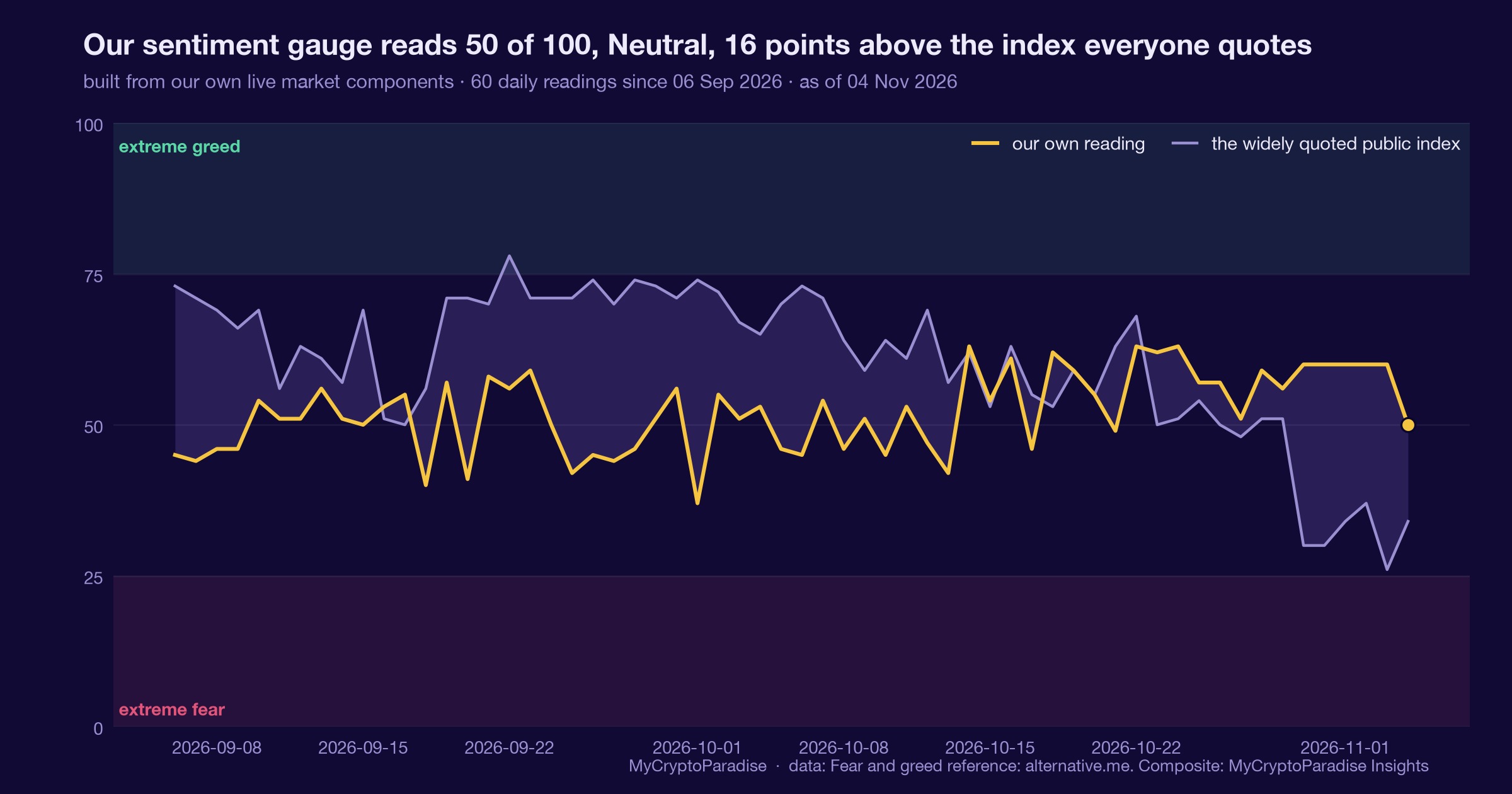
The ParadiseTeam went into today already leaning cautious, and this shock fits that frame rather than breaking it. Our standing read has whales distributing into crowded retail longs, with funding rates elevated and sentiment turning hopeful while price refused to follow. A liquidity shock is exactly what punishes that setup.
With BTC near $75,623 as of this session, the structure to respect sits overhead, not below. The weekly bear leg began back at $121,000, and recoveries toward the $90,000 area are where we have been treating strength as a chance for sellers, not a reversal.
Below current price, the map thins out fast. The exchange-of-hands zone near $55,000 is the next meaningful shelf we watch, with deeper Elliott-wave downside around $44,000 on the table if risk-off persists. A liquidity cascade can travel that distance faster than most expect.
The smart-money-versus-retail point is simple here. We have no evidence of accumulation into this drop, so we are not reading a hidden bullish divergence into it. Crowded longs and high funding were a vulnerability going in, and a forced-selling event is how that vulnerability gets resolved.
Our bias stays risk-first. We would rather miss the first part of a bounce than catch the next leg down. Respect the correlation, respect the lack of absorption, and let the forced sellers finish before trusting any low.
The read behind this: we framed this story through our own market analysis, Bitcoin Longs Pile In While 67% of Whales Sell.
Track it live: our live crypto funding rates and the Crypto Fear and Greed Index both update in real time, so you can watch this shift for yourself.
Related coverage
For exact entries, targets, and stop losses with full risk management, that is what ParadiseFamilyVIP is for. New to reading these moves? Start with our crypto trading strategies guide.
ParadiseTeam is monitoring the market situation closely, and we are taking these developments into consideration while building our trading tactics inside ParadiseFamilyVIP.
Crypto trading involves substantial risk. Prices are volatile and you can lose money. This article is educational and is not financial advice. Past performance does not guarantee future results.
Does crypto decouple from the Asian equity crash, or keep leading the beta down?
How 4 Paradisers are calling it
The first call is still open
Free account, no password. Members just sign in.










Join the discussion 1
Ha, I always have the Ostrava-Saigon transfer fees in my head when I see these liquidity shock stories 😅 Watching how fast BTC follows the Asian equity open is honestly wild to me, I keep a screenshot of the timestamps every time 📉