


Listen: the breakdown
Developing story update (November 06, 2026, 03:15 UTC):
Update: based on our sources, this deleveraging wave looks triggered by a same-day risk-off move in U.S. equities bleeding into crypto, rather than a crypto-native catalyst. The liquidation total also built steadily through the day as the selloff deepened, so the headline figure is the tail end of a climbing series.
The pain was concentrated in leveraged longs: one trader was liquidated eight consecutive times during the drop, losing a cumulative 201 BTC (around $15.6M). That pattern points to late, overleveraged long capitulation rather than fresh accumulation.
On flows, Bitcoin ETFs logged a small positive 1-day net inflow (about $16.56M) but a sharply negative 7-day net flow (around $1.12B of outflows), with Ethereum ETFs showing the same shape. That likely reads as too small and short-lived to signal larger players stepping in to absorb the move so far.
What to watch now: Whether ETF net flows flip durably positive, signaling larger players absorbing the leverage flush rather than a continued risk-off slide.
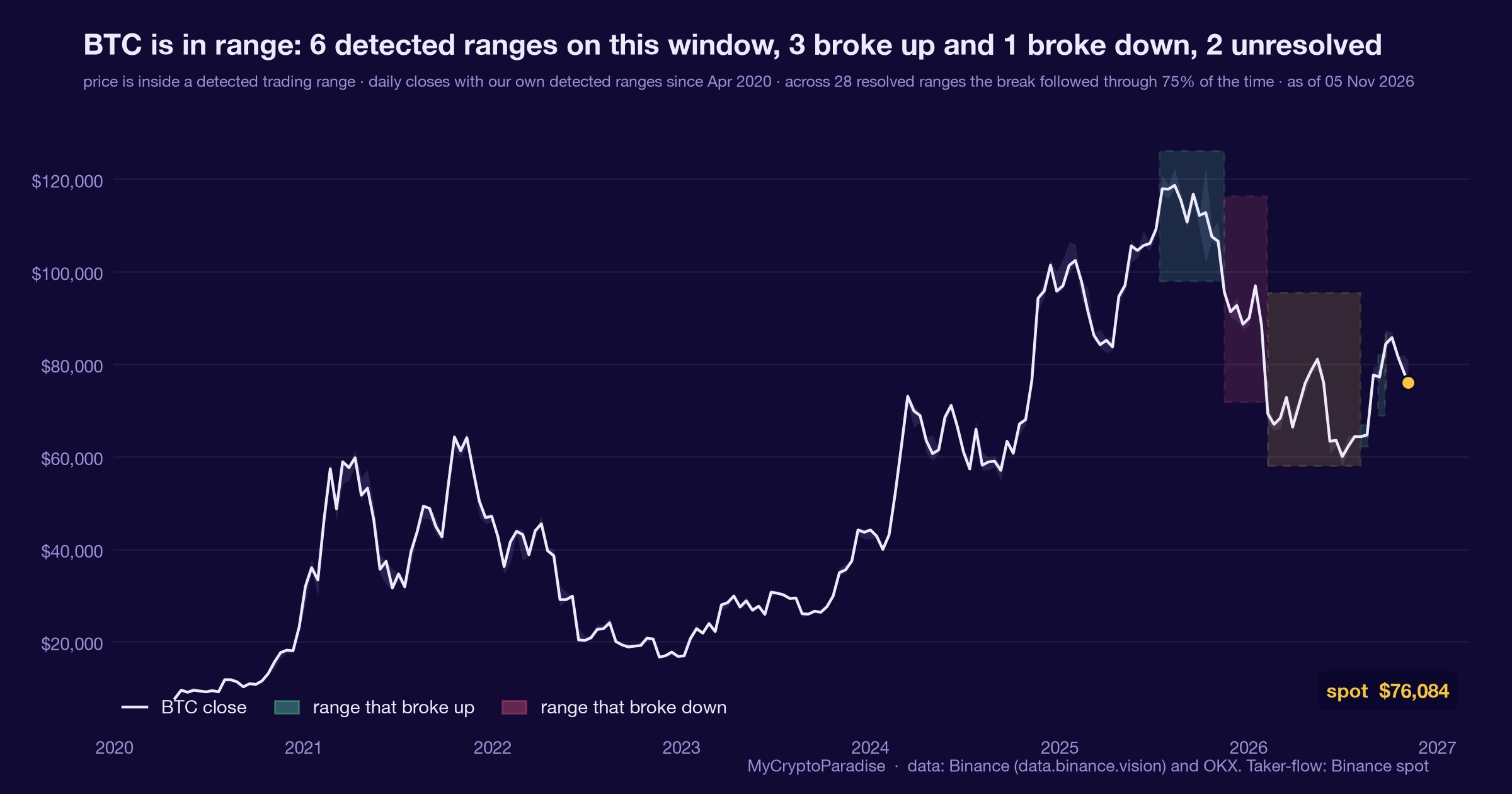
Market briefing: Over 24 hours, 235,397 traders were liquidated for $1.24 billion as BTC fell 5.8% to near $76,043 and ETH dropped 7.8%. This looks like overcrowded leverage unwinding fast, not a single news shock.
- 235,397 traders were liquidated across crypto derivatives in the past 24 hours
- Total liquidation volume hit $1.24 billion as BTC fell 5.8% and ETH 7.8%
- No single confirmed catalyst; the signature points to overcrowded leverage unwinding fast
A $1.24 billion liquidation wave carried out 235,397 traders in a single day as BTC and ETH fell hard. The real story is the speed. So what actually broke here?
The number is brutal in its simplicity. Over the past 24 hours, 235,397 traders were liquidated across crypto derivatives markets. The total erased reached $1.24 billion.
That flush landed as the majors fell hard. BTC dropped 5.8% on the day to trade near $76,043. ETH fell further, down 7.8% to around $2,236. The price slides and the liquidation wave are the same event, not separate ones.
Here is the mechanism in plain terms. Price slid, leveraged positions breached their liquidation thresholds, and exchanges force-closed them. Each forced sale pushed price lower, which tripped the next layer of stops. A cascade, in other words, feeding on itself.
What we do not have is a clean long versus short breakdown. So we will not pretend to know exactly who was carried out. But the shape tells a story. A $1.24 billion wipeout alongside a sharp drop in BTC and ETH points to overcrowded longs taking the brunt as price fell through their stops.
Notice also what is missing: a single confirmed catalyst. No one headline detonated this. That is our read, not a fact, and we will say so plainly. This looks like an overleveraged market unwinding quickly, the kind of self-inflicted damage that needs no outside help.
The real story is not the price drop. It is the speed. Leverage that took weeks to build came apart in a day.
Leverage, not news, drove this flush
Liquidation cascades matter because they rewrite the market's leverage map in hours. When $1.24 billion of positions close by force, open interest drops sharply. OI, or open interest, is the total value of contracts still live. A fast fall in OI means leverage is leaving the system.
That cleanup has two faces. In the short run it is violent, because forced selling does not wait for a good price. It sells into whatever bid exists, which deepens the move.
But forced selling is finite. Once the overleveraged positions are gone, that specific source of selling pressure is spent. The order book can breathe again. This is why big flushes sometimes mark a local low rather than the start of a deeper collapse.
The macro backdrop is worth naming. There was no obvious same-day shock driving this. Instead, the market looks to have arrived here on its own, carried by too much borrowed money chasing the same direction.
That is the recurring pattern of every cycle. Leverage builds quietly while price drifts up. Everyone feels clever. Then one sharp move exposes how much of the rally was rented, not owned.
For traders, the takeaway is structural. A $1.24 billion flush resets funding and thins out the crowd. It does not, by itself, confirm a new trend. It clears the deck. What gets built next is the real question.
BTC and ETH absorb the forced selling
The forced selling hit the majors first, and the tape shows it. BTC fell 5.8% on the day to near $76,043. ETH took the heavier blow, down 7.8% to roughly $2,236. When leverage unwinds, the most liquid assets absorb the first wave.
ETH underperforming BTC is the usual signature of risk coming off. Capital retreats toward the asset it trusts most, and inside crypto that asset is BTC. ETH, carrying more leveraged speculation, bleeds faster.
Alts sit at the end of this chain, and that is rarely a comfortable seat. When BTC and ETH drop this fast, smaller tokens tend to fall harder still, because their order books are thinner and their holders more leveraged. A liquidation wave in the majors usually drags the long tail down with it.
Here is the honest two-sided part. Right after a flush, the hourly tape can look calm. BTC and ETH both showed a small +0.33% move on the hour, a flicker of stabilisation once the forced selling paused.
We read that flicker with caution, not relief. A pause in liquidations is not the same as demand returning. It often just means the sellers who were going to be forced out already have been.
On its own facts, this event leans bearish for crypto in the near term. Fragile leverage and a sharp drop show the path of least resistance was down, and the cascade proved it.
Signs the deleveraging has run dry
The first thing to watch is open interest. If OI keeps falling and then flattens at a lower level, the deleveraging is likely done. A fresh climb in OI while price stays weak would warn that new leverage is already crowding back in too early.
Funding rates tell the companion story. Funding is the periodic payment between long and short holders that keeps perpetual contracts near spot. If funding resets toward neutral or flips negative, the crowded longs have genuinely been cleared.
Watch the quality of any bounce closely. A recovery on rising volume, with BTC holding above its recent flush low, would suggest real buyers stepped in. A limp bounce on fading volume suggests the opposite: relief, not demand.
Confirmation of further downside would look like a clean break below today's lows on expanding volume, with liquidations starting up again. That would say the first flush was an appetiser, not the main course.
Invalidation of the bearish near-term read would be a strong reclaim of lost ground, funding staying calm, and OI staying low. That combination says the leverage is out and spot buyers are back in control.
One more thing we are tracking. Whether the market behaves the way leverage-driven washouts usually do: a sharp drop, an exhausted bottom, then a nervous rebuild. The $1.24 billion number is large, but numbers like it have marked both bottoms and the first step down.
Reading the flush through smart money
The ParadiseTeam frames this flush inside a bigger picture, not as a standalone event. Our standing read stays bearish on the daily and weekly, and this cascade does not change that structure. If anything, it fits it.
Here is the tension. A $1.24 billion washout can clear crowded longs and set up a short-lived relief bounce. We respect that possibility. BTC was trading near $76,043 as the dust settled, and a bounce from here would not surprise us.
But we treat recoveries toward the $79,000 accumulation band and higher as areas where selling tends to reappear, not as a trend turn. Smart money has been distributing while retail leans long, so a bounce into resistance is exactly where that distribution usually continues.
The deeper zones matter if the washouts keep coming. Below current price, the structure points toward the $61,000 region and, in a worse case, the $55,000 exchange-of-hands area. Those are context, not predictions.
Who benefits here? Patient capital that avoided the leverage and now watches forced sellers hand over coins near the lows. Who gets hurt? The crowded longs who treated a bounce as confirmation and sized up into it.
Our stance stays risk-first. One flush does not confirm a bottom, and a bounce on fading volume does not confirm a reversal. We want to see real demand, not just an absence of sellers, before trusting any strength.
The read behind this: we framed this story through our own market analysis, Bitcoin Longs Pile In While 67% of Whales Sell.
Track it live: our live crypto funding rates tracks this in real time, so you can watch it play out for yourself.
Related coverage
For exact entries, targets, and stop losses with full risk management, that is what ParadiseFamilyVIP is for. New to reading these moves? Start with our crypto trading strategies guide.
ParadiseTeam is monitoring the market situation closely, and we are taking these developments into consideration while building our trading tactics inside ParadiseFamilyVIP.
Crypto trading involves substantial risk. Prices are volatile and you can lose money. This article is educational and is not financial advice. Past performance does not guarantee future results.
Is this $1.24B flush the clear-out before a bounce, or the first leg down?
How 2 Paradisers are calling it
The first call is still open
Free account, no password. Members just sign in.
Follow this topic: Crypto liquidation news












Join the discussion 3
ok im not so sure fast = leverage. i got chopped by a 1m wick on a thin book last month with barely any oi moving, stop just got sniped 🤦 anyone else seen books that thin do that?!
lol the 235k number is wild but honestly the speed bit is what got me, a flush that fast usually means the leverage was stacked on one side and nobody had room to add margin. watched the stablecoin funding rates tick up a few hours before, same pattern as last time so i'm not shocked
Buddy from the shop rode leveraged longs down in 2021, and I noticed too late.... Still sits with me. Benny's right about thin books, they'll chew you up before the leverage even matters.