

Listen: the breakdown
Market briefing: Yemen's Houthis have declared Saudi airspace a battleground, raising Middle East risk just as markets stayed cautious. Bitcoin held near $85,579, down about 1.2 percent, a measured risk-off lean rather than outright fear.
- A Houthi body declared Saudi airspace unsafe and a theatre of operations for its armed forces.
- The group claimed strikes on a Riyadh airport, an oil refinery near Jeddah, and a southwest air base.
- BTC near $85,579 and ETH near $2,705 slipped modestly, a risk-off lean rather than panic.
Yemen's Houthis just declared Saudi airspace a battleground, and Gulf aviation is now a stated target. Does rising Middle East risk change the near-term picture for crypto?
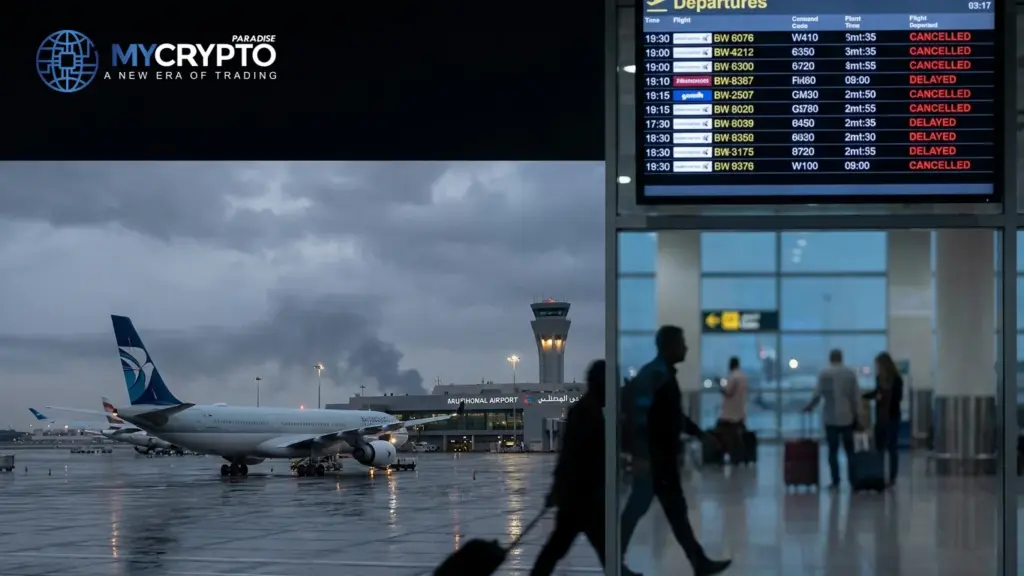
Yemen's Houthi rebels just turned Saudi Arabia's sky into a stated target. A Houthi-run maritime coordination body warned airlines that Saudi airspace is not safe while what it calls Saudi aggression continues. The language was blunt. The airspace, it said, will be the theatre of operations of its armed forces.
This did not come from nowhere. A truce struck in 2022 collapsed in July after the rebels allowed an Iranian plane to land in Sanaa, Yemen's capital. The fresh warning followed an offensive by Saudi-backed Yemeni forces against Houthi positions, which the group is clearly answering in kind.
The Houthis then claimed strikes on three sites inside the kingdom: an international airport in Riyadh, an oil refinery near Jeddah, and a military air base in the southwest. They also dismissed reports of major government advances as illusory and fictitious, the usual wartime insistence that the other side's wins never really happened.
For crypto, the mechanism is familiar. A credible threat to Gulf aviation and oil infrastructure is a risk-off signal, and risk-off tends to drain money from the fastest-moving assets first.
Bitcoin sits near the front of that queue. It was trading around $85,579 as of the latest read, down about 1.2 percent on the day. That is a nudge, not a shock, which is exactly why this story deserves a cool head rather than a headline reflex.
How Gulf risk reaches crypto liquidity
Geopolitical shocks move through oil and safe havens before they ever reach crypto. A threat to Saudi airspace and refineries raises the risk premium baked into energy prices. Higher energy costs feed inflation fear, and inflation fear complicates the market's hopes for easier policy ahead.
When those easing hopes wobble, liquidity tightens at the margin. Tighter liquidity is the natural enemy of long-duration, high-beta assets. Bitcoin and ether trade like the highest-beta risk on the whole board, so they feel that squeeze early.
There is also the simple flight-to-safety reflex. Capital rotates toward the dollar and short-dated bonds when the headlines turn to missiles and grounded airports. That rotation quietly pulls bids away from speculative markets, crypto included.
None of this is a crypto story on its own. It is a global-risk story that crypto imports second-hand.
The honest caveat matters here. This is our read of the transmission, not a confirmed cause of today's dip. BTC's 1.2 percent slide sits well within normal daily noise, and a quiet geopolitical input rarely rewrites market structure by itself. We frame the escalation as a negative weight on sentiment, one that only becomes dangerous for prices if the conflict widens from a warning into sustained disruption of Gulf shipping, flights, or oil output.
Why the selloff reaches Bitcoin first
Risk-off events hit crypto in a predictable order. Bitcoin absorbs the first blow because it holds the deepest liquidity and the most institutional eyes. BTC was trading near $85,579 as of the latest read, down about 1.2 percent on the day.
Ether follows bitcoin with a lag and usually a larger swing. ETH sat near $2,705, down roughly 0.8 percent. If the fear deepens, expect ether's percentage move to overshoot bitcoin's in both directions.
Altcoins sit at the end of the chain and feel it hardest. Thin order books mean a modest sell wave can produce outsized drops. Leverage magnifies the damage when open interest (OI, the total of open derivative positions) is crowded on one side of the trade.
The current reaction looks subdued, not panicked. Social sentiment reads mixed rather than fearful, and that tells us smart money has not begun aggressive distribution on this headline alone.
The news is a weight on the scale, not a hammer.
So our base case is mild downside pressure, contained for now. The danger is non-linear. A single escalation headline, a struck refinery or a closed air corridor, could flip this subdued tape into a fast liquidation cascade. That is the asymmetry traders should respect while the conflict stays live.
Signals that confirm deeper downside ahead
Watch the oil tape first. A sustained spike in crude would confirm that markets are pricing real supply risk from the Gulf, not just a rhetorical threat. Crypto would likely stay heavy for as long as that premium holds, because the two now share the same fear.
Watch bitcoin's behaviour around its support band. A clean hold tells us the dip is being quietly absorbed. A high-volume breakdown followed by a failed retest tells us sellers have taken control of the story.
Watch funding and open interest for signs of forced selling. Rising OI into a falling price means late longs are still adding risk. That is the fuel for a liquidation cascade if support finally cracks.
Confirmation of the bearish read would stack up quickly: fresh strike headlines, a crude breakout, and BTC losing support on heavy volume. Any one of those pushes the odds toward more downside.
Invalidation looks like the opposite. Oil fades, no further escalation lands, and bitcoin reclaims its range as volatility drops. In that case the headline becomes yesterday's noise, and the fearful crowd that sold near the lows becomes tomorrow's reluctant chase.
Geopolitical fear tends to have a short half-life once the shooting stops.
Reading this dip through smart money
The ParadiseTeam reads this through structure, not through the headline's fear. Bitcoin is pressing a support zone around $82,000, where moving-average, historical and Fibonacci levels converge. A geopolitical scare arriving right at support is exactly the spot where smart money likes to shake out weak hands and re-accumulate.
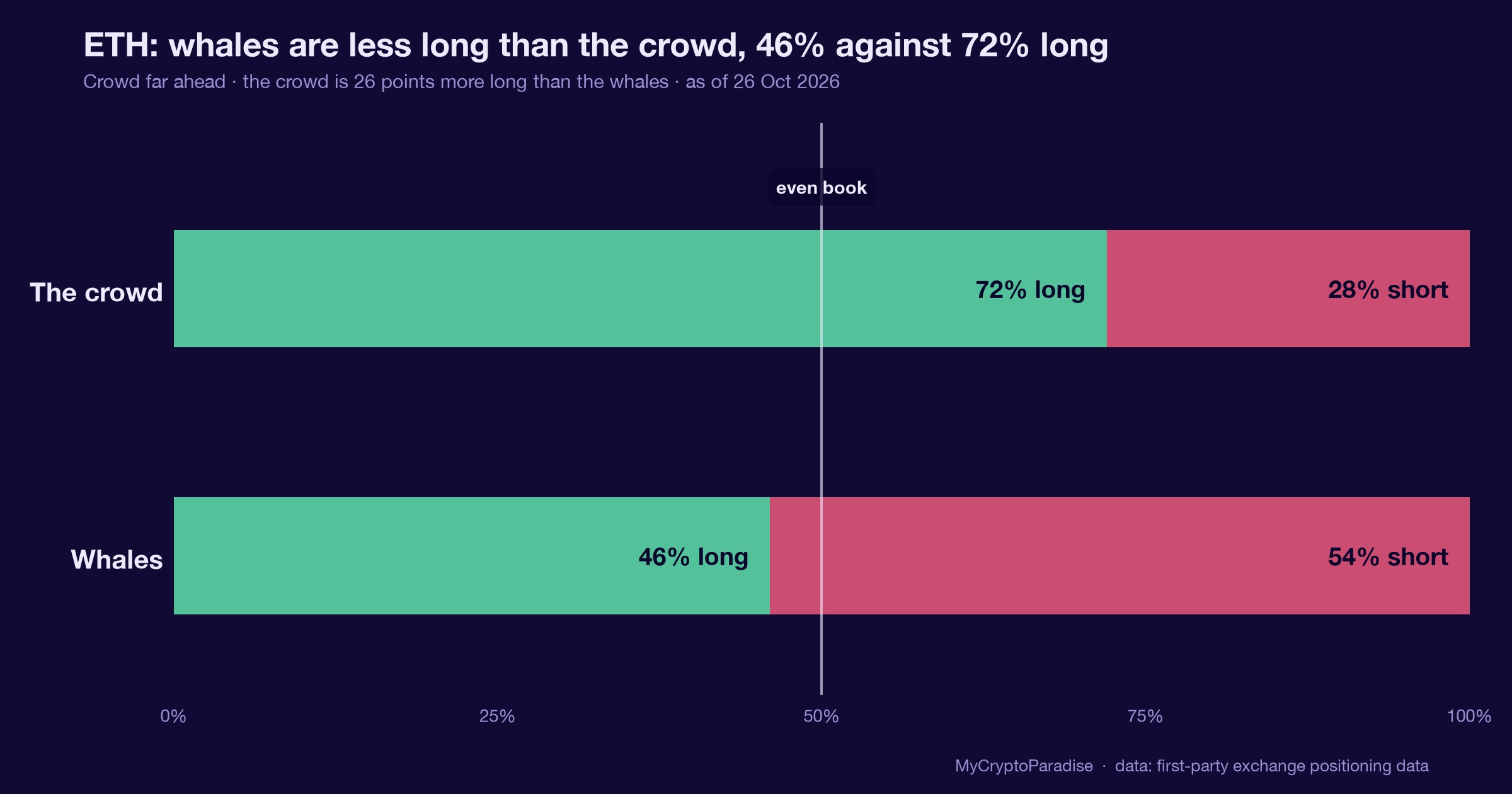
We hold our caution honestly, though. Whales are net sellers here, roughly 65 percent selling against 35 percent buying. For now that selling is being absorbed at support, which is why we lean toward a possible short-term bounce while staying macro-cautious.
The bigger risk sits overhead. We expect strength to meet sellers in the $88,000 to $90,000 resistance band. A nervous, fear-driven push into that zone would look more like distribution into hopeful buyers than a clean breakout.
Retail is already fearful, which raises the odds of a short squeeze, a sharp spike that traps short sellers and forces them to buy back. That is the bounce case. The flush case is a loss of $82,000 on volume, which over time opens the path toward the $55,000 to $44,000 exchange-of-hands zone.
We watch CVD (cumulative volume delta, net buying versus selling), whale flow at support, and the structure of any rejection at resistance.
The read behind this: we framed this story through our own market analysis, Can Bitcoin Bounce From Support?
Track it live: our Crypto Fear and Greed Index and the live crypto funding rates both update in real time, so you can watch this shift for yourself.
Related coverage
For exact entries, targets, and stop losses with full risk management, that is what ParadiseFamilyVIP is for. New to reading these moves? Start with our crypto trading strategies guide.
ParadiseTeam is monitoring the market situation closely, and we are taking these developments into consideration while building our trading tactics inside ParadiseFamilyVIP.
Crypto trading involves substantial risk. Prices are volatile and you can lose money. This article is educational and is not financial advice. Past performance does not guarantee future results.
Does Middle East escalation push Bitcoin below its 82K support this week?
How 13 Paradisers are calling it
The first call is still open
Free account, no password. Members just sign in.








Join the discussion 23
I'm so sorry, but how would this affect the stablecoins? I usually just watch BTC and ETH, so this is new for me!
I also watch stablecoin flows during these events, particularly USDT and USDC. Their mints/burns can signal shifts in capital.
I hate how these events always get the degens talking about long bids before anyone processes the actual human cost. That's the real pattern, not just crude. 😠
The initial structure reclaim after the news often shows who truly processes the human cost.
Human cost is immense, yes... also how many of these events get people scrambling for flight capital.
I hear ya Chloe, but for me, looking at the charts 📈 is actually how I process the news. It helps me understand the real impact 🌍.
yeah, and when you zoom out to a higher timeframe, you're not seeing the actual impact, just another distorted chart pattern! it's like a bad UI that hides the real user experience. 😡
Conflict in that region always makes me check crude futures. It often shows up there before the markets react to the actual news.
Yes, but those geopolitical jumps are often absorbed by the time the weekly close arrives. Four-hour noise is not a signal.
it's always the human part i get stuck on when these things happen, like what would be the actual risk for people on the ground 😔 and how does that fit into like the bigger picture for bitcoin and things 🤔
yeah I check the news for the short term but its the support and resistance levels that really matter for the long game
Remember when everyone thought the Fed was the only game in town... I learned the hard way not to discount global events.
For me, it’s about the local currency premium... always shows which way the winds are blowing before the broader market cares.
I always look at how these things affect USDT on Binance P2P... moving money across borders is already complex... this adds another layer.
but the *actual* usage here, is anyone moving remittances through crypto now, or is it still just oil traders and capital flight? 🤔 Asking for a friend... and my family. 💸✈️
yeah this always makes me check the perp basis on CME, its surprising how quickly a widening basis can cluster liquidations on these geopolitical headlines.
My ledger says crude futures definitely see a debit entry here, but I'm not seeing enough credit to ETH or BTC liquidity to close the books on this one yet. Too many unknowns. 🧐
chinedu a debit in crude often means a credit in stablecoins not just eth or btc
always watch USDC treasury flows during these events, its usually a better tell than any headline for what the real money is doing for risk-off positioning
That's interesting, Mei Lin... I've also been watching for unusual gas fees, sometimes that shows activity before anything else.
This is a reminder to review stop placement. The market does not care about the human element, only the invalidation.
Escalations like this make me wonder if the broader financial system's assumptions about risk are being challenged enough to genuinely shift the long-term thesis for decentralized assets.
How do you model impact on energy markets, given the Houthi declaration affects airspace, not direct production? My partner just asked if this means we buy more crude.