

In short
Whale flow is the running tally of large spot and perpetual orders our radar tags across eleven venues, netted buy against sell. On 5 October 2026 the MCP on-chain Insider feed reported a single $77.2M Bitcoin purchase and called it aggressive accumulation. Our own radar disagrees: over the prior 24 hours BTC whales sold a net $30.54M, the largest single order was a $24.69M sell on a perpetual venue, and our whale index reads 45 on the sell side. We called it neutral, explicitly not accumulation, because one order is not a trend and our tape was leaning the other way. No follow-through has printed yet; net flow has not flipped positive. This piece shows you how to read whale flow yourself, so one loud headline never stands in for the whole tape.
Key facts
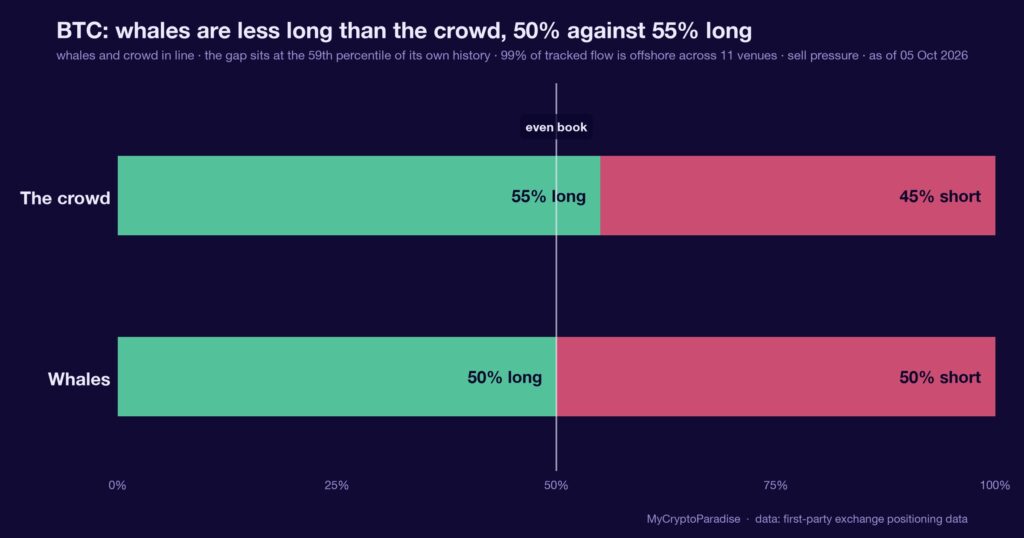
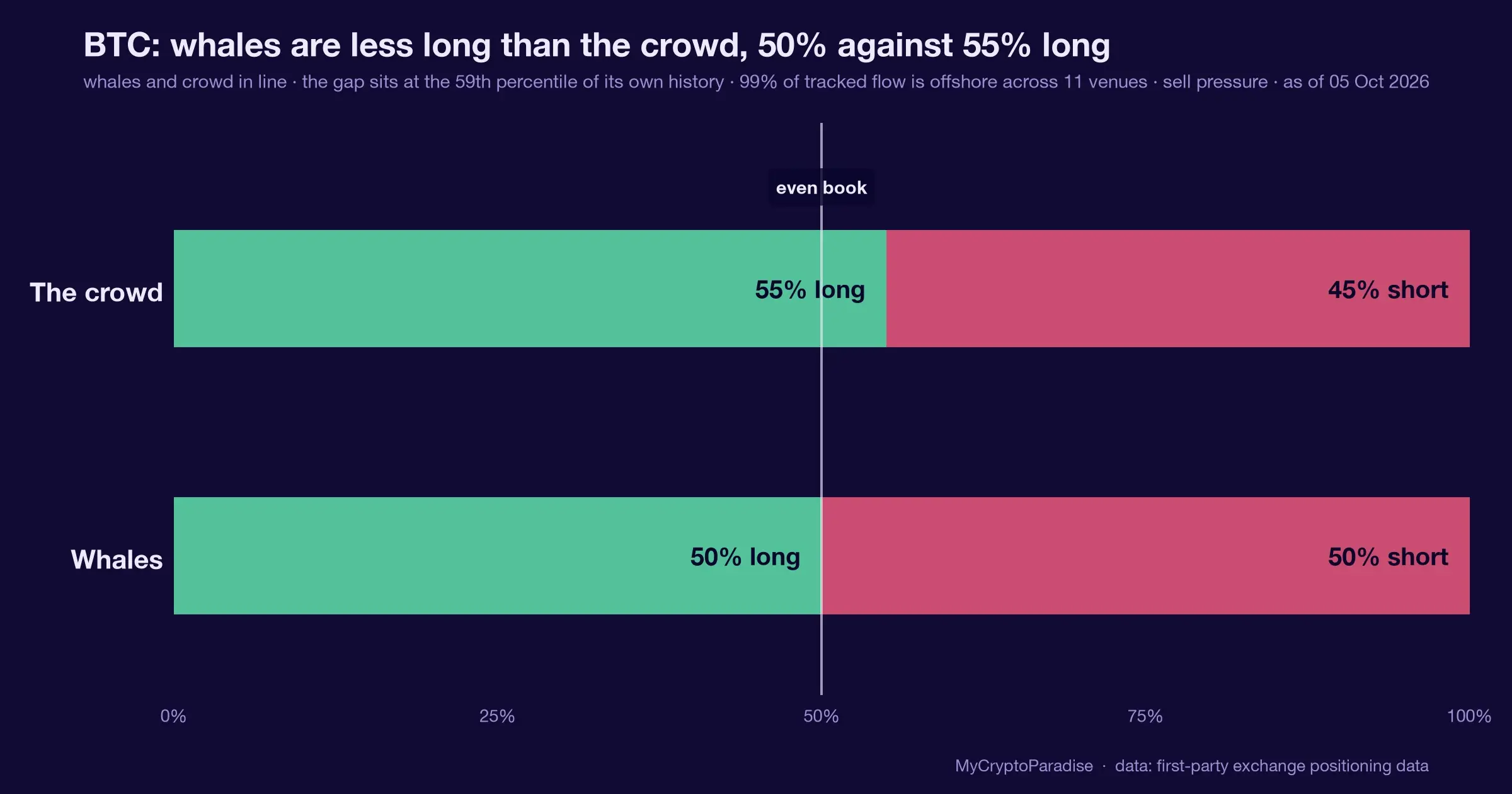
- Whale long share on BTC
- 50%
- Crowd long share on BTC
- 55%
- Where that gap sits in its own history
- the 59th percentile
- Positioning read
- whales and crowd in line
- Order flow right now
- sell pressure
- What would prove this read wrong
- Net 24-hour whale flow flipping positive and the whale index leaving the sell side (spot lean above zero) for a full session, which would make the accumulation read real.
- Reading taken
- 05 October 2026
- Source
- Our MCP Insights tools, from first-party exchange positioning data (OKX). Upstream data published by the OKX public API
One order is not the order flow
Whale flow measures where the largest participants are putting money to work: it tags big spot and derivative orders as they hit the exchanges we watch, marks each as a buy or a sell, and nets them into a single running balance.
The point of netting is that a lone purchase, however large, tells you almost nothing on its own. A market absorbs one buyer by finding one seller; what matters is whether buyers or sellers are the aggressors across the whole tape, hour after hour.
A headline that quotes one order is quoting the smallest unit of the thing. The flow is the aggregate, and the aggregate is the only part that leans.
What our radar actually logged
On 5 October 2026 the MCP on-chain Insider feed reported a $77.2M Bitcoin buy and framed it as smart money loading up. Re-checked against our own radar, the figure does not stand out: our largest single whale order in the prior 24 hours was a $24.69M sell on a perpetual venue.
Across those 24 hours our radar tagged 132 whale orders over 11 venues: $273.57M bought against $304.11M sold, a net of minus $30.54M. Not one leveraged position was liquidated, long or short. Spot price sat near $85,700.
Our whale index, which scores positioning and flow together, reads 45 on the sell side with a spot lean of minus 0.78. Per our MCP Insights whale data, the tape was net selling while one buy was being called accumulation.
A single buy can be real and still be noise. The tape is what sizes the risk, and the tape was selling.
The misread is treating size as direction
The obvious misreading is that a big buy means big buyers are in control. Size is not direction. A $77.2M order is simply one counterparty filling against whoever was selling, and on 5 October the sellers were plentiful enough that it changed nothing on the tape.
This is one input, and today it is the one that disagrees with the headline. It sits alongside funding, the crypto long/short ratio and our order-flow absorption estimate, which currently marks sellers as the aggressors.
A buy that moves nothing and liquidates no one is not a force. It is a fill.
What is different here
The ParadiseTeam does not trade a headline order. We net every large buy and sell our radar sees into one running balance, then weigh it against positioning and absorption before it earns a single line of risk. One loud purchase is the smallest input we have, not the signal.
What the tape has done since
Since the report, no follow-through has printed. Net whale flow has not flipped positive, the whale index has not left the sell side, and no liquidation cascade has forced anyone out of a position in either direction.
That is the honest grade of an accumulation call made on one order: unconfirmed, and leaning the wrong way for now. If spot buyers stack and the net flips green across a full session, the read changes and we will say so.
We publish the lean and the level that kills it. A call that cannot be wrong cannot be trusted.
Reading whale flow yourself, step by step
- Start with the net, not the biggest order: add every large buy and subtract every large sell over the last 24 hours.
- Check the size of the biggest single order on each side, and note which side it landed on.
- Count the liquidations: zero forced longs and zero forced shorts means no one was squeezed into the move.
- Read the whale index and its spot lean together, so positioning confirms or contradicts the raw flow.
- Only then weigh the headline order against that balance, and treat it as one input among funding and absorption.
The step people skip is the net. A single buy is easy to quote and feels decisive, but the balance across the tape is what actually leans.
Every number above is checkable against the live data. Start with the crypto long/short ratio, then cross-read the MCP Insights hub and the Crypto Fear and Greed Index.
Act and invalidate
| Scenario | What confirms it | What kills it |
|---|---|---|
| Accumulation is real | Net 24h flow flips positive | Whale index stays on sell side |
| Headline was noise | Net stays negative, no follow-through | A verified cluster of large spot buys |
| Sellers keep control | Spot lean below zero widens | Net flow turns green for a session |
Posture: Posture is neutral and patient: one order is not a reason to add risk, and our tape is leaning the other way. The highest-probability move here is no trade until the net flips.
Frequently asked questions
Did a whale really buy $77.2M of Bitcoin?
The MCP on-chain Insider feed reported it, and we cannot verify a single order that size in our own radar. Our largest tagged whale order over the same 24 hours was a $24.69M sell, so we treat the $77.2M figure as the source feed’s, not ours.
Does a large buy mean the price will rise?
Not on its own. A buy only moves price if it overwhelms the resting sellers, and on 5 October it did not: no positions were liquidated and the net flow stayed negative. Size is one input; direction comes from the whole tape, not one order.
What is the whale index telling us now?
It reads 45 on the sell side with a spot lean of minus 0.78, which means large participants are, on balance, leaning to sell rather than accumulate. It is a positioning gauge, so it confirms or contradicts the raw flow rather than predicting the next candle.
Why trust your radar over the breaking headline?
Because a headline quotes one order and our radar nets every large buy and sell across eleven venues into one balance. The aggregate is harder to cherry-pick than a single eye-catching number, and on this day the aggregate was selling, not buying.
What would change this read to bullish?
A full session where net whale flow flips positive, the whale index leaves the sell side, and fresh spot buying stacks rather than a lone order. Until the balance turns green and holds, one buy stays noise, not a trend we would act on.
Crypto trading involves substantial risk and is not suitable for everyone. Nothing here is financial advice; it is education only. Never risk more than you can afford to lose.
The private Extras feed, where the netted whale-flow balance, the whale index and the absorption read update intraday with their invalidation levels, is part of PRO Paradiser, the intelligence layer behind the ParadiseFamilyVIP strategies.







Join the discussion 19
Indeed, the narrative always chases the largest visible order, but liquidity tells a different story on the tape. So many parallels to the early days, back when I first printed that whitepaper. 🤔
Aggressive accumulation" implies buying pressure, but your whale radar shows net selling by a fixed value over 24h?! Is there an invalidation for how a single large order could still be considered accumulation despite the aggregate flow?
mateusz i think youre mixing up total flow from a single whale buying into multiple smaller orders, that one large buy was split up onchain over hours to fill
net selling can still be absorption Mateusz, how much matters at the invalidation level for you
absorption implies bids getting filled, not net outflows. my invalidation is simple: if the net flow is negative, its not accumulation!! how much net selling is acceptable for your "absorption" to still be accumulation, exactly?
Mateusz, for me "aggressive accumulation" means one large buyer is *entering* the market, not that the market as a whole is net buying. Hard to see the downside otherwise. 🤔
that tape is tough to read sometimes, seems like more selling than buying the last few weeks not sure how you get accumulation from that.
These volume divergence points are where many exit a position too early. The reclaim on a prior zone is what matters.
It seems the aggregated flow often conflicts with single large transactions. I would need to see the time window for the $77.2M buy versus the 24-hour net selling.
Man, it's hard to reconcile these numbers sometimes... Like, my wife thinks I'm crazy staring at charts when the news says the opposite 🤦♂️. I just see a lot more bullish momentum than y'all are seeing, for sure.
I always wonder how quickly these big buys get absorbed- I remember thinking that in 2021 too. So, the net selling means the pressure is really still on that side, despite the news?
For real! 😩 I see big buys but always wonder about the immediate impact on price, not just the absorption. 📈📉 Does it move the needle instantly or just get eaten? 🤔
Looking at order book depth over time makes it clear whether these buys get absorbed or are just noise. The overall flow doesn't lie.
This is why everyone wants to watch the whales, right?! 🐳 But so many get rekt trying to copy them. 📉 I lost a farm chasing a whale once! 😅 🇧🇷
Even whales are subject to the market's liquidity, Carlos. Opinions get repriced fast.
i'm always on the lookout for the short-term flips after these big buys, that's where the craic is 🤑🎢 like Mateusz said, it can be tricky to spot the real picture 🧐.
this is helpful for understanding the short-term flow. what would be the best way to see how these larger buys affect the thesis longer term, beyond the immediate absorption?
Totally, Priya! 💯 For long-term impact, I always connect these flows back to actual usage growth on the networks 📈, not just the trading activity. That's the real test! 🤔
The 24-hour window for whale flow analysis is often too short. We need longer observation periods to differentiate true accumulation from short-term positioning.