

Listen: the breakdown
Market briefing: The US is rotating a fresh aircraft carrier into the Middle East, yet crypto barely blinks. BTC sat near $63,597 as of this read, flat on the day, with ETH near $1,886. The market is watching its own structure, not the headlines.
- US swaps the USS George Washington in for the Abraham Lincoln after a 250-day Middle East deployment.
- BTC held near $63,597 and ETH near $1,886, both essentially flat, so the carrier news is not priced as a catalyst.
- Our read: this is noise landing on a market where smart money is quietly reaccumulating above $62,500.
A new US aircraft carrier is steaming toward the Middle East, replacing an exhausted crew after 250 days near Iran. Crypto shrugged. So what is the market actually watching instead?
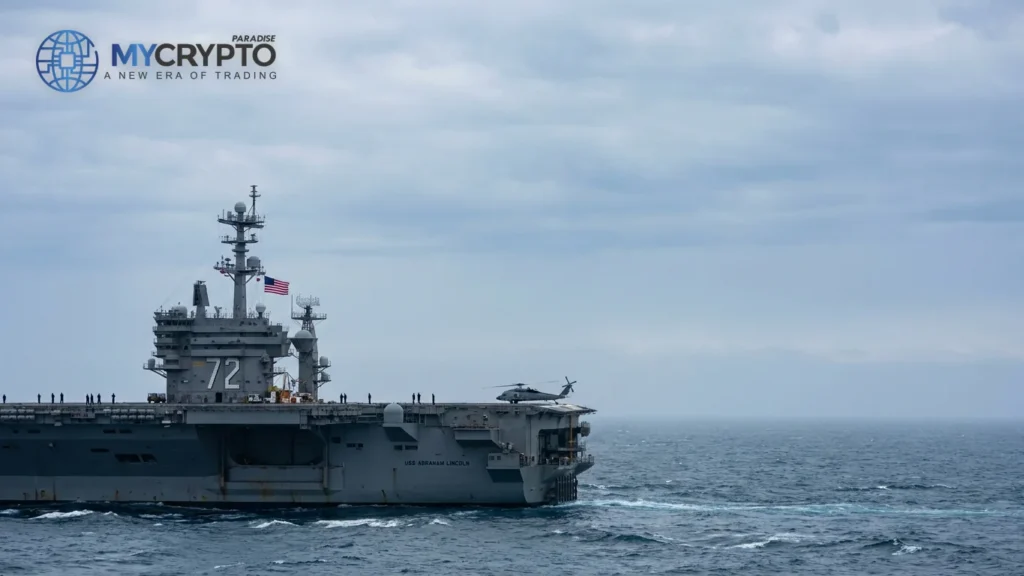
The United States is sending a fresh aircraft carrier to the Middle East. The USS George Washington will relieve the USS Abraham Lincoln, whose sailors are worn down after a 250-day deployment supporting operations against Iran. That is a long time at sea. Two hundred and fifty days is the kind of number that turns a rotation into a headline, and the exhausted crew is the human story underneath the hardware.
On paper, this is exactly the sort of geopolitical event that should rattle risk assets. A larger, sustained US military footprint in a sensitive region usually feeds uncertainty, and uncertainty usually leans risk-off.
Yet the crypto tape barely moved. BTC was trading near $63,597 as of this read, flat over 24 hours. ETH sat near $1,886, down a fraction. No spike in fear, no scramble for the exits.
That non-reaction is the real story here. When a market ignores a headline this size, it is telling you where its attention actually sits. Right now that attention is internal: liquidity, structure, and who is accumulating from whom. The carrier is moving. The order book, for now, is not.
Why the market ignored a carrier deployment
Geopolitics matters to crypto through one main channel: risk appetite. When investors fear escalation, they usually trim risk, and both equities and crypto tend to feel it first. This carrier swap could have run that playbook. A sustained US presence near Iran raises the odds of headlines that spook traditional markets, and a genuine oil or conflict shock would eventually reach BTC through global liquidity.
But the transmission mechanism needs fuel to fire. A routine crew rotation, even after 250 days, is not a new conflict. It is continuity dressed as news, and markets price continuity as close to nothing.
That is why the read here is honest rather than dramatic. There is no confirmed single catalyst moving price today. We are explaining an absence, not a shock, and it pays to say so plainly.
The deeper point is about attention. Risk-off only bites when the crowd is already nervous and looking for a reason to sell. This market did not take the bait, which suggests conviction under the surface rather than fragile hands waiting to bolt at the first siren. So the carrier tells us less about ships and more about positioning. A tape that absorbs a Middle East headline without flinching is a tape where sellers are getting scarce.
How liquidity flows through BTC then ETH
Start with the cascade that did not happen. Geopolitical fear normally hits BTC first, then bleeds into ETH, then hammers the smaller alts hardest. None of that showed up.
BTC held near $63,597, dead flat on the day. That stillness at the top of the market matters, because BTC is the liquidity anchor. If the majors are calm, the risk-off signal never reaches the rest of the board.
ETH near $1,886 was down only a fraction, well inside normal daily noise. There was no flight from ETH into BTC, no dominance spike, none of the rotation you see when traders genuinely brace for trouble.
Alts, by extension, were spared the usual first-to-bleed treatment. In a real fear event, thin alt liquidity gets pulled fast and prices gap. Quiet majors kept that pressure off them.
Here is the mechanism our edge cares about. Flat price on a scary headline is not the same as no activity. It usually means someone is absorbing every nervous sell without letting price drop, which is what patient accumulation looks like from the outside.
The theatre of a carrier deployment is loud. The order book stayed boring. In markets, boring at support is often the more bullish tell, because it means the panic found no sellers willing to break the level.
What confirms the calm and what breaks it
The first thing to watch is whether the carrier story stays a rotation or becomes an escalation. A crew swap is priced as nothing. An actual conflict shock, an oil spike, or a broad risk-off day in equities would change the input entirely.
Until then, the level to watch is not on any map of the Middle East. It is $62,500 on the BTC chart. That 4-hour pivot is the line separating our calm read from a genuine problem.
Confirmation looks like BTC continuing to hold above $62,500 while headlines like this come and go without a reaction. That pattern says the market has decided geopolitics is background noise for now.
Invalidation looks different. A clean break below $62,500 that then flips into resistance would tell us the calm was thinner than it looked, and that sellers finally showed up.
Watch the majors together, not in isolation. If BTC slips and ETH accelerates lower beneath $1,886 while alts start gapping, that is the risk-off cascade arriving late rather than never.
The honest framing is this. Today the news is a non-event, and the price agrees. Our job is to keep testing that agreement, because the moment a headline finally does move this tape, the level it breaks will tell us far more than the headline itself.
What this quiet tape signals for positioning
The ParadiseTeam reads this carrier headline as confirmation, not catalyst. It slots neatly into a cautiously bullish daily bias, where smart money is absorbing selling pressure and reaccumulating rather than reacting to distant news.
Ground it in price. BTC near $63,597 sits just above the $62,500 4-hour pivot we care about. A geopolitical scare that fails to crack that pivot is a scare that found no sellers, which favours the accumulation case.
The map above stays the same. We still see $69,000 as the zone where smart money is likely to distribute, and $79,000 as the medium-term target if the daily structure keeps building higher lows.
The map below also stays the same. $61,000 remains the reaccumulation buy interest, and the deeper $55,000 to $44,000 band is where the ParadiseTeam expects the most aggressive reaccumulation on any real correction.
Retail bears are the ones this quiet tape squeezes. Every ignored fear headline traps short sellers who bet on a geopolitical breakdown that price refuses to deliver. So the positioning read is patience with a line in the sand. Hold the bullish lean while $62,500 holds. Respect the daily divergence still needing confirmation, and treat a decisive loss of that pivot, not any Middle East headline, as the signal that the calm has cracked.
Track it live: our Crypto Fear and Greed Index and the live crypto funding rates both update in real time, so you can watch this shift for yourself.
Related coverage
For exact entries, targets, and stop losses with full risk management, that is what ParadiseFamilyVIP is for. New to reading these moves? Start with our crypto trading strategies guide.
ParadiseTeam is monitoring the market situation closely, and we are taking these developments into consideration while building our trading tactics inside ParadiseFamilyVIP.
Crypto trading involves substantial risk. Prices are volatile and you can lose money. This article is educational and is not financial advice. Past performance does not guarantee future results.



Join the discussion
No comments yet. Members, share how you are reading this.