

Listen: the breakdown
Developing story: This story is still unfolding. We are tracking it and will update this article as more details are confirmed.
Market briefing: Trezor has warned of a suspected hardware implant in a Safe 5 device sold by former reseller CryptoBilis, urging affected buyers to migrate funds. BTC was trading near $77,758, down 3 percent on the day, on separate factors.
- Trezor flagged a suspected hardware implant in a Safe 5 unit sold by former reseller CryptoBilis
- The implant allegedly captures recovery phrases and sends them over a cellular network; no CryptoBilis customer has reported lost funds
- Trezor revoked CryptoBilis as a reseller and urged buyers since March 2026 to migrate funds immediately
Trezor just flagged a suspected hardware implant inside a Safe 5 wallet sold by a former reseller. It can allegedly leak your recovery phrase. So where does self-custody trust actually break?
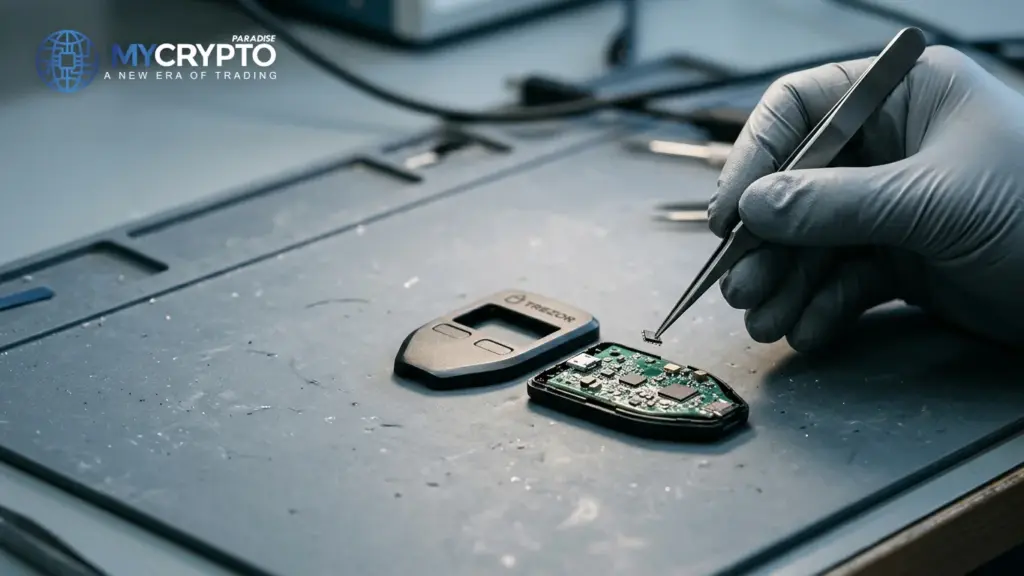
Trezor has told customers that a Trezor Safe 5 device sold by former reseller CryptoBilis is suspected of carrying a hardware implant. The company received what it calls a credible report. It has not yet held the device in hand to verify it.
The suspected implant is the quiet kind that worries custody engineers most. According to the report, it can capture a recovery phrase and transmit it over a cellular network. That turns a cold wallet into a leak, without the owner touching anything online.
Trezor acted on the supply chain, not the chip. It removed CryptoBilis as an authorized reseller. It then urged anyone who bought a hardware wallet there, especially since March 2026, to move their funds to a fresh device now.
Here is the honest edge of the story. No CryptoBilis customer has reported losing funds. Investigators have not named who installed the implant, or whether the same hands sat behind an earlier incident involving Ledger units sold through the same reseller.
Trezor also warned about the predictable second wave. Scammers love a security headline. They will send fake emails, letters and calls posing as support. Trezor repeated the one rule that never changes: it will never ask for your recovery phrase.
So this is a reseller-trust story first and a price story barely at all. It touches a narrow set of buyers acutely. It touches the broader market far less than a scary headline suggests.
Where self-custody trust actually breaks
The danger here sits in the supply chain, not in the cryptography. Trezor's hardware and firmware are not the suspected weak point. The suspected weak point is the hand the box passed through before it reached a buyer. That distinction matters enormously for how far the fear should travel.
Self-custody rests on one assumption retail rarely examines: that the device arrived untampered. A reseller sits between the maker and the owner. Insert an implant there, and the strongest firmware in the world is guarding a door someone already walked through.
That is why the migration advice is narrow by design. Trezor did not tell every owner to panic. It told CryptoBilis buyers to move, and flagged March 2026 onward specifically. The blast radius is one reseller's inventory, not the brand's entire install base.
The macro read follows from that boundary. A trust shock contained to one reseller does not drain liquidity from BTC or ETH. There is no mechanism carrying this incident into broad market flow.
Still, the reputational cost is real for the category. Every time a supply chain fails, a slice of retail quietly decides exchange custody feels simpler. That is the irony the industry keeps meeting: the tool built to remove trusted third parties can still be undone by one of them.
Why the tape barely blinked at this
Price did almost nothing with this disclosure, and that is the tell. In the hour around it, BTC moved about -0.16 percent and ETH about -0.26 percent. Those are rounding errors, not a reaction.
The larger day-on-day weakness is a separate conversation. BTC was down roughly 3 percent over 24 hours, ETH down over 4 percent. That bleed is running on broader risk-off chatter, including a widely circulated exchange-hack story, not on a single reseller's tampered unit.
We will be honest about that link, because there is not one. Nothing in the evidence ties the day's selling to the Trezor warning. Treat that connection as absent, not as proven.
Walk the normal cascade and it stalls immediately. A supply-chain scare would need to force selling to reach BTC, then ETH, then alts. Here there are no confirmed losses and no forced exits, so the chain has no first link.
Where it does land is behaviour, not flow. A sliver of CryptoBilis buyers will migrate funds, which is housekeeping, not market pressure. The rest of the market is pricing the macro tape and the hack narrative instead.
So the fair verdict is neutral for crypto prices. The story is painful for the people it touches and awkward for the brand. It is simply not a BTC or ETH liquidity event, however alarming the word implant sounds.
The returned device settles everything
The whole story hinges on one object Trezor does not yet hold: the device itself. Until it arrives for teardown, this stays a credible report rather than a confirmed implant. That is why we mark it developing, not settled.
Verification is the first fork. If forensic inspection confirms a cellular-leaking implant, the supply-chain concern becomes concrete and other CryptoBilis units come under scrutiny. If it cannot be reproduced, the scare shrinks fast.
Scope is the second thing to track. Watch whether any confirmed fund loss appears among CryptoBilis buyers. So far none has. A first confirmed theft would change the human stakes sharply, even if it still would not move BTC.
Attribution is the third thread, and the slowest. Investigators have not named who installed the implant, nor linked it to the earlier Ledger incident through the same reseller. A shared actor across two wallet brands would reframe this as a targeted supply-chain operation, not a one-off.
Then there is the predictable phishing wave. Expect fake Trezor emails, letters and calls in the coming days. The invalidation of a scam is simple: real support never asks for a recovery phrase, ever.
For the market itself, watch nothing here and everything elsewhere. The level that matters for crypto is the macro tape, not this disclosure. If this story ever reaches price, it will be through confirmed, widespread losses, and that evidence does not exist today.
A contained trust shock, not a flow event
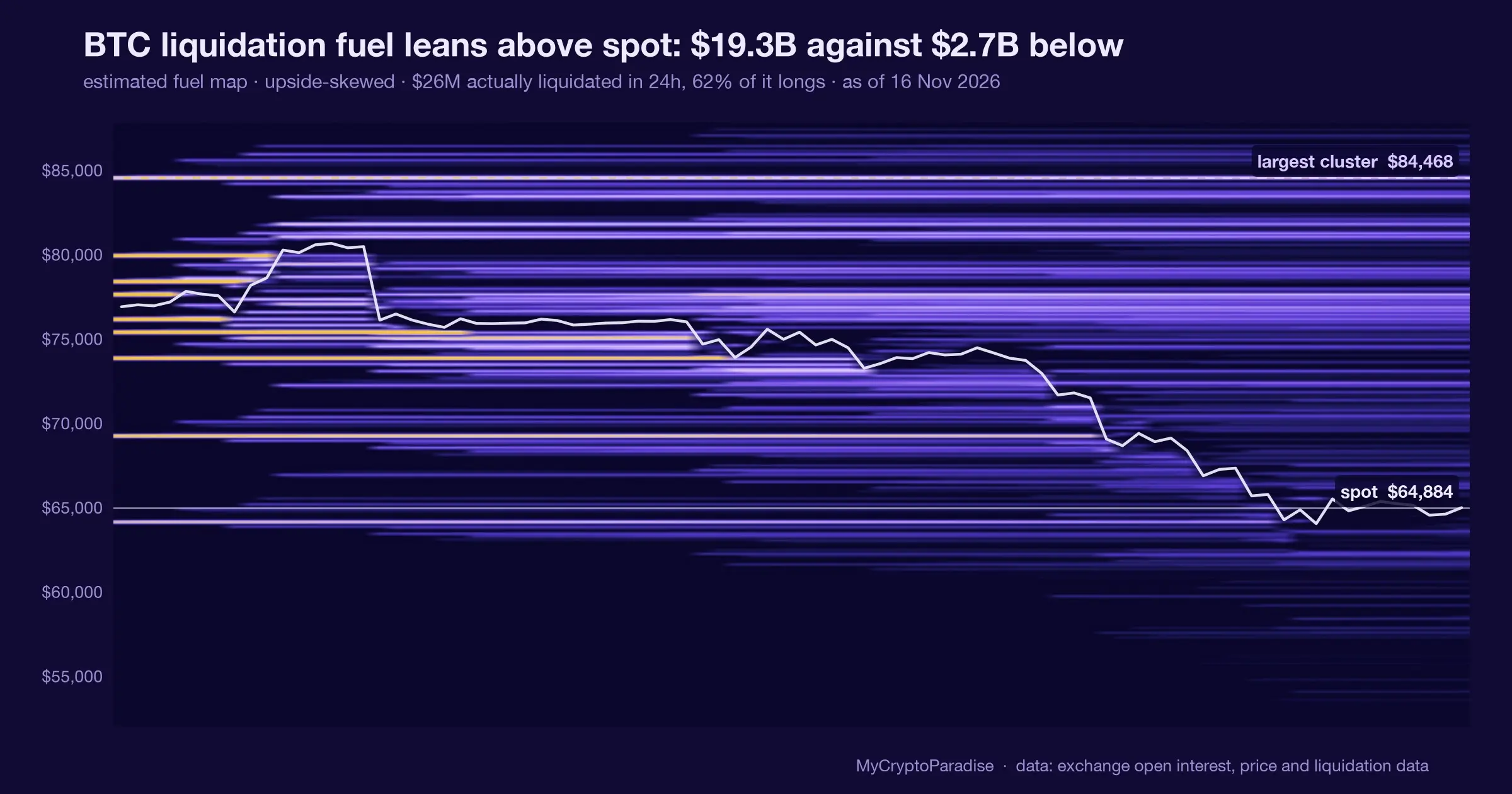
The ParadiseTeam reads this as a custody-hygiene story that leaves the chart untouched. BTC was trading near $77,758 as of the disclosure, and this news changes none of the levels that actually matter. Those levels are set by positioning, not by one reseller. Price is pressed right under the danger liquidation cluster at $79,000, the same bounce smart money already sold into for profit. Below sits support held by large buy walls, with the 0.786 level beneath that.
Notice what this disclosure does not do. It forces no leverage out, so it cannot feed the liquidation domino we are watching. The leverage imbalance still points to more liquidity above price than below, which keeps a squeeze toward $90,000 live regardless of any wallet headline.
Our standing caution stays in place and is unrelated to Trezor. We treat current strength as smart money absorbing supply while retail sits out, inside a broader weekly bias that still expects a deeper reaccumulation flush later. A security scare does not invalidate that; it simply does not touch it.
The real trader lesson here is operational, not directional. Verify your reseller, migrate if you bought through CryptoBilis, and never share a recovery phrase with anyone claiming to be support. That protects your coins.
The tape, meanwhile, keeps answering to $79,000 above and the buy walls below, not to this story.
The read behind this: we framed this story through our own market analysis, Is Bitcoin Ready for a Bigger Rally?
Track it live: our crypto liquidation heatmap and the Crypto Fear and Greed Index both update in real time, so you can watch this shift for yourself.
Related coverage
For exact entries, targets, and stop losses with full risk management, that is what ParadiseFamilyVIP is for. New to reading these moves? Start with our crypto trading strategies guide.
ParadiseTeam is monitoring the market situation closely, and we are taking these developments into consideration while building our trading tactics inside ParadiseFamilyVIP.
Crypto trading involves substantial risk. Prices are volatile and you can lose money. This article is educational and is not financial advice. Past performance does not guarantee future results.
Will confirmed CryptoBilis fund losses ever surface from this implant report?
How 10 Paradisers are calling it
The first call is still open
Free account, no password. Members just sign in.







Join the discussion 23
Honestly the part that gets me is how many people still buy these resold hardware wallets from random sellers.... I'd rather pay full price from the source and skip the surprise.
Fair point, though I'd add that the resale problem is often a supply-chain question more than a trust one. Does anyone here know whether Trezor's firmware checks would catch a tampered device before setup, or only after?
Nadia, I'd guess most of those buyers never thought of a reseller as a risk at all, its just a cheaper listing that looks the same. Price tags don't tell you who touched the box though, so the fix is checking the seal and buying direct from the maker.
Agreed in spirit, Nadia, but the bigger issue is that a sealed-looking box from a reseller still makes you trust a supply chain you can't audit. In my world we'd never accept a container with a broken seal and no chain of custody, so why accept it for something holding your keys?
Checking the seal is a good habit, Jessica, but it doesn't cover the case I'm worried about.... A tampered device can ship with a factory-fresh seal, and the reseller in the middle is exactly where that swap happens. I'd rather buy direct from the maker and skip the middleman entirely.
ngl i once thought grabbing a cheap wallet off some guy in a telegram group was a clever shortcut 🤦 the hype was doing all my thinking for me, scary how close that was!! 😅
Carlos, yes, and the scary part is that a random seller's pitch can look exactly like a shortcut. I'd add one check: if a seller can't show you the seal and firmware status before payment, I'd walk away, no matter how good the hype sounds..
Ha, the hype doing your thinking is exactly how a bad seed phrase ends up in a stranger's hands. Same lesson as the seal checks, really: if you can't verify it yourself, don't trust it. 😅
the part i dont get is why the seller would ship it with a hidden chip in the first place, if they knew it was there they had to know somebody would check. feels like the story skips that. so who installed it, and when
Ugh, the thought of a wallet that was tampered with before it even reached me.... makes me want to check every box twice. Does anyone know if Trezor's migration steps are the same for Safe 5 owners who bought used? 🐶
ok so this is the exact reason i never buy used anything with a seal already broken, got burned on a secondhand router once and never again lol. but a sealed box from some reseller is worse, you cant even tell who touched it 😬
Ok wait so you're saying the sealed box from a reseller is worse bc you cant even tell who handled it.... that part honestly makes me nervous lol. Is there any way to check a device before you use it? 😬
so if the implant is in the board itself, does migrating even help or do we just move the problem to a new box? asking because i genuinely don't know
Honestly this is why my roommate Kojo keeps teasing me about only ever buying wallets new in the box.... he says I am too careful, but after reading this I think he is wrong, so maybe I should ask Trezor directly what the safe way to move funds is?
Ah so the Safe 5 one is the reseller unit? Watching people who swore they'd never touch secondhand hardware learn this the hard way is just a special kind of entertainment 😅 Migrating funds now is the move, no waiting around 🔐
sorry im new but wait, so even a sealed one from a reseller could be affected?! i've only ever bought straight from the maker and now im really glad i did, though i never thought of the box like sterile packaging on the ward
i keep a fixed schedule on my own buys and i still check the seal on any device before it goes near a seed, sounds paranoid until you see how many resold units never get opened by the seller at all
yeah and the seal check only catches tampering you can see. with a resold unit nobody on the chain of sellers can vouch for the firmware, so i'd want the seed generated on a device i unboxed myself.
ahmed the seal check is fine but it doesnt tell you much if the implant is in the chip itself. a broken seal is only one way to catch tampering, and the article is about a unit that was sold sealed?! so i'd want to know how they found it before saying seal checks cover it.
I get the seal check, Ahmed, but I'd push back a little: a broken seal on a resold unit tells you less than you'd think, since a sophisticated tamper can be built to pass the visual check. The real question is whether the device was ever in the seller's hands unsupervised, which is what the Safe 5 warning is really about!
Ok but how did an implant survive their own firmware signature check?! If Trezor is right, I want to know which step failed before I trust any seal, including mine. I'm migrating my Safe 5 funds this week regardless.
lol not sure its the reseller thing so much, back in 2008 everyone trusted the bank and still got burned 😅 rushing to move funds in a panic is what gets people caught out imo 🤷
before anyone moves funds off that device, what is the plan for the seed already written down somewhere. i wrote my migration steps on paper before i touched anything, otherwise u just move the problem