


Listen: the breakdown
Developing story update (November 18, 2026, 15:01 UTC):
Update: The roughly $3.43 million drain on K3 Capital’s sBOLD vault is now corroborated by on-chain monitoring, based on our sources, rather than resting on the initial report alone. The attack was reported as still active at the time of our latest check, so the affected total could move.
The mechanism is now clearer: the attacker flash-borrowed wstETH, self-liquidated a Liquity V2 trove into the Stability Pool to mint sBOLD shares at a discount, then swapped collateral and redeemed other depositors’ BOLD, across roughly 34 transactions. This still reads as a contained, mechanism-specific DeFi exploit; ETH is down about 2.2% on the day with no isolated reaction tied to this story.
What to watch now: Watch for K3 Capital to confirm a final loss figure and whether the exploit path is closed, since the attack was still live.
Market briefing: K3 Capital's sBOLD vault on Ethereum was drained of roughly $3.43 million through flash loans and Liquity V2 exploits. ETH sat near $1,794 and BTC near $64,018 as the news broke, both barely moving.
- K3 Capital's sBOLD vault on Ethereum lost about $3.43 million.
- Attackers combined flash loans with Liquity V2 exploits to drain it.
- ETH held near $1,794, down 1.30% on the day, showing no broad flush yet.
Source: Liquity
The sBOLD vault exploit drained about $3.43 million on Ethereum, yet ETH barely moved. So is this an isolated strike, or the first crack in a wider Liquity V2 problem?
K3 Capital's sBOLD vault on Ethereum was hacked. Roughly $3.43 million left the contract. The attackers paired flash loans with Liquity V2 exploits to pull it off.
Flash loans borrow and repay inside a single transaction, so an attacker can wield enormous size with almost no capital. Point that borrowed firepower at a pricing or redemption quirk in a Liquity V2 vault, and a well-built strategy can bleed in seconds. That, in broad strokes, is what happened here.
The important word is vault. This was not an exchange outage or a chain-wide failure. It was one yield strategy, built on Liquity V2 mechanics, doing exactly what it should not.
So far the market has treated it that way. ETH traded near $1,794.33 as the story surfaced, down 1.30% on the day and just 0.31% on the hour. That is ordinary chop, not a risk-off stampede.
Social feeds had barely caught up, which tells you something. A $3.43 million loss is painful for the people in that vault, yet in a market this size it is a rounding error until it spreads. Right now there is no confirmed spillover into ETH spot or the broader alt complex. That is the real question the exploit leaves behind. Not whether sBOLD was hit, that is settled, but whether other Liquity V2-based vaults share the same exposed seam.
How one vault exploit tests DeFi trust
The mechanism matters more than the dollar figure. Flash loans plus a Liquity V2 vector is a repeatable pattern, not a one-off accident. If the flaw sits in how the vault interacted with Liquity V2 redemptions, every strategy leaning on the same assumptions inherits the same question mark.
That is how a small exploit becomes a confidence problem. Depositors in similar yield vaults do not wait for a forensic report. They pull first and read later, which means the first real cost is not the stolen $3.43 million but the liquidity that walks out behind it.
Confidence is the collateral in DeFi. Nobody deposits into a yield vault for the interface; they deposit because they trust the code and the economic design. One clean exploit chips at that trust across a whole category.
Still, keep the scale honest. This is a protocol-level incident against a single vault, not a market-wide liquidity event. The transmission runs from sBOLD, to Liquity V2-adjacent strategies, to the pool of capital deciding whether those yields are worth the smart-contract risk.
That chain can stay short. It stays short when the exploit is specific to sBOLD's own implementation and other vaults are built differently. It lengthens only if the same borrowed-size attack works somewhere else, and that is precisely what the next few days will reveal.
Why ETH barely flinched on the drain
Read the tape before the headline. ETH was near $1,794, down 1.30% over 24 hours and 0.31% over the last hour. That is background noise, not a reaction to a drained vault.
The honest reading is that this is bad news that stayed contained. There is no sign in the data of panic selling tied to the exploit, and no sign of opportunistic buying either. The crowd simply has not priced it, because for most of the market it has not happened yet.
BTC sets the mood, and BTC was quiet too, near $64,018 and down 1.3% on the day. When the largest asset drifts sideways, a seven-figure loss in one Ethereum vault does not get the oxygen to become a market story.
The spillover risk, if it comes, travels through DeFi liquidity rather than BTC spot. Capital parked in comparable Liquity V2 vaults is the first to flinch. If those depositors rotate out, you would see it in vault balances and localized selling of the assets those strategies hold, long before it touches ETH itself.
For now the cascade is a sketch, not an event. The first-order effect is mildly negative: another reminder that yield in DeFi is paid for with tail risk. But $3.43 million is too small to drag the broader market, and nothing in the current data suggests it is trying to.
Signs of spillover into neighbouring yield vaults
Watch the vaults, not the headlines. The single most useful signal is whether deposits in other Liquity V2-based strategies hold steady or start leaking. Steady balances say the market judges this an sBOLD-specific flaw. A visible drain across several vaults says the seam is shared.
Confirmation of contagion would look like a second exploit using the same flash loan and Liquity V2 pattern, or a coordinated rush out of similar yield products. Either would turn a contained incident into a category problem, and that is when ETH liquidity could actually feel it.
Invalidation looks quieter and more likely. A clear post-mortem isolating the bug to sBOLD's own design, unaffected peer vaults, and no repeat within a few days together say the story ends roughly where it started.
Watch the social catch-up too, but carefully. When chatter finally arrives it tends to overshoot the actual damage, so a loud feed does not necessarily mean the loss grew. Separate the noise from the balances.
Also watch whether any recovered funds or a protocol response appear, since that can cap the confidence hit fast. The base case, on today's evidence, is containment: one vault, one exploit, a modest confidence dent in Liquity V2-linked DeFi, and no confirmed reach into ETH spot or the wider alt market. We would rather be proven cautious than caught by a second drain.
Gauging contagion risk across Liquity V2 vaults
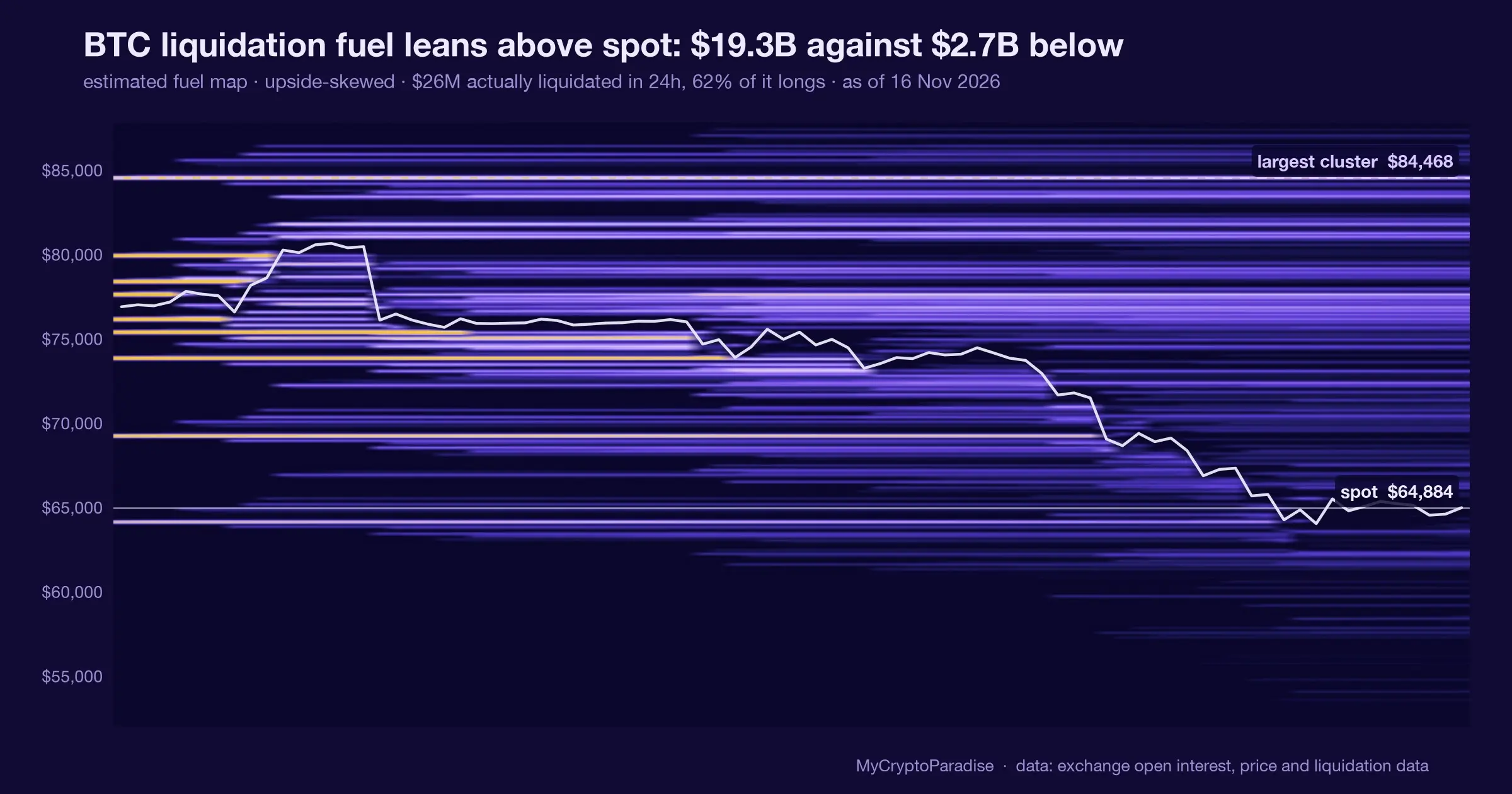
The ParadiseTeam frames this as a DeFi risk item to monitor, not a reason to reposition BTC. The exploit is real and negative for sBOLD and Liquity V2-linked strategies, but $3.43 million does not move a market where BTC was trading near $64,018 as of 13:41 UTC.
That $64,000 area matters for its own reasons. It is where a bullish hammer formed on the 0.786 retracement, and BTC is trying to build on that support. Our standing weekly bias stays cautious, with a deeper flush toward $44,000 still on the table before any durable move higher.
So the way we fit this news into that picture is simple. A localized vault hack is the kind of emotional, headline-level event retail reacts to, not the structural driver smart money positions around months ahead. It does not change where support or the re-accumulation zones near $61,000 sit.
For ETH-DeFi exposure specifically, the ParadiseTeam treats contagion into other Liquity V2 vaults as the only thread that upgrades this from a footnote to a risk. Absent that, it is noise.
The levels to respect stay unchanged: the $64,000 hammer support holding is constructive, a clean break of the $58,000 prior low opens the path toward $44,000. This exploit neither confirms nor invalidates those. Keep risk defined, size for the real possibility of a weekly flush, and do not let a single-vault headline write your BTC thesis for you.
The read behind this: we framed this story through our own market analysis, Why Did Bitcoin Crash After the Binance Hack?
Track it live: our live crypto funding rates and the Crypto Fear and Greed Index both update in real time, so you can watch this shift for yourself.
Related coverage
For exact entries, targets, and stop losses with full risk management, that is what ParadiseFamilyVIP is for. New to reading these moves? Start with our crypto trading strategies guide.
ParadiseTeam is monitoring the market situation closely, and we are taking these developments into consideration while building our trading tactics inside ParadiseFamilyVIP.
Crypto trading involves substantial risk. Prices are volatile and you can lose money. This article is educational and is not financial advice. Past performance does not guarantee future results.
Does the sBOLD exploit spread to other Liquity V2 vaults?
How 2 Paradisers are calling it
The first call is still open
Free account, no password. Members just sign in.












Join the discussion 1
Flash loan stuff always reminds me of the 2018 mess, when I kept telling myself the chart would sort itself out. Still waiting on that. Whether ETH barely moved says less to me than how fast a vault can get emptied.