

Listen: the breakdown
Developing story update (September 13, 2026, 21:08 UTC):
Update: The tokenized-equity story on Solana now has a standout single-name data point. Trading volume in tokenized Grindr stock (GRND) neared $31 million, a figure that reportedly ran close to double the volume for the same stock on its traditional NYSE listing.
For traders, this is a concrete example of the ‘markets that never close’ pull behind the RWA supply growth, not just an aggregate number. It signals that on-chain equity volume can, in individual names, rival or exceed the regulated venue. Treat it as a probability-weighted sign of demand for the narrative, not a directional catalyst for SOL, which has stayed soft over the period.
What to watch now: Whether more single tokenized names show on-chain volume rivaling their traditional listings, or if Grindr is a one-off spike.
Developing story update (September 13, 2026, 18:12 UTC):
Since we published, capital rotation into the Solana ecosystem has sharpened. A leading Solana decentralized-exchange token, Raydium (RAY), climbed to an 11-month high as part of a roughly 90% weekly rally, ranking as the second-strongest performer among the top 300 assets. Based on our sources, that move came while the wider crypto market slipped about 3.9% over the same seven days.
For traders, this looks like conviction money concentrating in the Solana real-world-asset narrative rather than broad market strength. SOL itself was softer, down roughly 4.8% over seven days to near $100, so the ecosystem outperformance is not yet lifting the base layer. The record tokenized-equity supply figures we reported are unchanged.
What to watch now: Whether RAY-style ecosystem strength starts to lift SOL itself, or stays a narrow rotation while the base layer drifts.
Developing story update (September 13, 2026, 17:43 UTC):
A fresh look at the flows adds a number worth watching: real-world asset inflows have contributed roughly $348 million to $354 million into Solana’s tokenized equities over the last 30 days. That puts a concrete size on the pace behind the record $684 million supply figure rather than just the headline total.
For traders, this reframes the story from a single snapshot to a sustained inflow trend. It supports the structural case for Solana as a real-world asset venue, though it has not shifted SOL’s price, which remains roughly flat near $101 and probably stays capped by broader market conditions rather than driven by this on-chain growth.
What to watch now: Whether the ~$350M 30-day RWA inflow pace holds or accelerates into next month.
Developing story update (September 13, 2026, 16:36 UTC):
Update: the Solana ecosystem is now showing a spillover reaction alongside the tokenized-equity record. Raydium (RAY), a Solana-based decentralized exchange token, has surged to an 11-month high, capping roughly a 90% rally on the week.
For traders, this widens the story from a single real-world-asset metric to a broader on-chain activity signal. Strength in a core Solana DEX token can reflect rising trading and liquidity demand tied to the same ecosystem growth, though it also raises the odds of sharper volatility if momentum cools. The underlying tokenized-equity figures, the record $684 million supply and the 47% three-week gain, are unchanged from our prior report.
What to watch now: Whether RAY holds its 11-month high or gives back the weekly rally as a gauge of real Solana on-chain demand versus short-term momentum.
Developing story update (September 13, 2026, 16:15 UTC):
Two fresh data points sharpen the picture on Solana’s tokenized-equity run. Tokenized shares of Grindr cleared more than $31 million of volume in their first 24 hours of trading on the network, based on our sources, an early sign that demand extends to newer single-name listings and not just the established products.
The after-hours story is also firming up. Weekends alone now account for roughly 17% of this year’s tokenized-equity volume on Solana, reinforcing the earlier read that a large share of activity happens while US exchanges are shut. For traders this is a structural edge to watch, though price action in SOL remains soft, so treat the flow as a fundamentals signal rather than a near-term directional trigger.
What to watch now: Whether single-name listings like Grindr keep pulling volume, and if weekend/after-hours share keeps climbing.
Developing story update (September 13, 2026, 15:54 UTC):
Update: The Solana DEX activity that underpins this tokenized-equity surge is now showing up in on-chain token performance. Based on our sources, Raydium (RAY) climbed to an 11-month high on Friday after a roughly 90% weekly rally, ranking as the second-strongest performer among the top 300 cryptocurrencies over that week.
The divergence is the part traders should note: RAY posted that move while the wider crypto market fell about 3.9% over the same seven days. That points to Solana-specific demand rather than a broad risk-on move, so treat the strength as localised and probability-weighted, not a market-wide signal.
What to watch now: Whether RAY holds the 11-month high or fades as broader market weakness pressures Solana-specific strength.
Developing story update (September 13, 2026, 15:12 UTC):
Fresh data adds detail on where the record tokenized-equity supply on Solana came from: based on our sources, real-world asset inflows contributed between $348 million and $354 million over the last 30 days, meaning a large share of the run to $684 million is driven by recent capital moving on-chain rather than legacy positions. For traders, this points to active, ongoing demand for the RWA use case rather than a one-off print.
The other pillars of the story are unchanged: the $684 million record was set on September 11, off-hours trading still accounts for about 63% of volume, and weekends alone make up roughly 17% of the year’s tokenized-equity volume. SOL is little changed near $100.4, down about 1.5% on the day, so this remains a localized ecosystem narrative rather than a shift in the broader macro picture.
What to watch now: Whether monthly RWA inflows keep expanding or stall, which would signal if the record supply is sustainable demand or a short-term spike.
Market briefing: Tokenized stocks on Solana just hit a record $684 million in supply, up 47% in three weeks, with most of it trading while US markets are closed. But with Bitcoin near $77,149 and ETF money leaving, the ParadiseTeam reads this as local Solana strength inside a still heavy market.
- Tokenized equity supply on Solana hit a record $684M, up 47% in three weeks
- About 63% of that volume trades while US exchanges are closed
- Raydium rallied 90% on the week as ecosystem tokens chased the flow
Tokenized stocks on Solana just hit a record $684 million in supply, and most of it trades while Wall Street sleeps. Is this a real decoupling for SOL, or an exit for smart money?
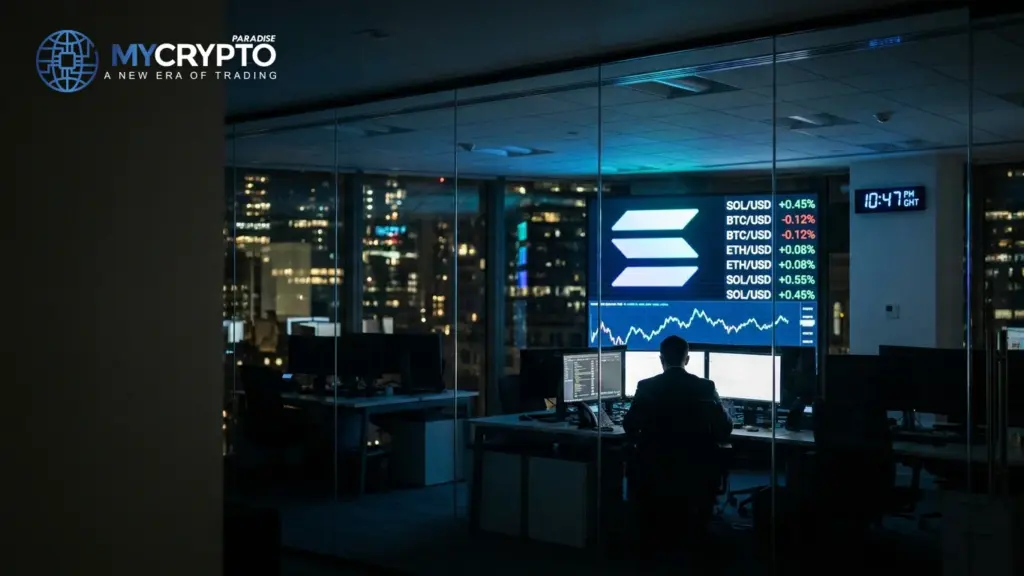
Tokenized stocks on Solana just set a record. The total supply of tokenized equities on the network reached $684 million last week. That figure is up 47% in only three weeks.
The growth is not a one platform story. xStocks, Ondo, Backpack Securities, Sunrise, Superstate, and Securitize all now issue stock products on Solana. Between them they offer hundreds of tokenized names, and the supply keeps climbing.
One example says a lot. Tokenized Grindr shares traded over $31 million in their first 24 hours on the network. That figure surpassed the stock's previous US session volume. A blockchain wrapper out-traded the primary listing on day one.
The most telling number is when this volume happens. Around 63% of tokenized equity volume on Solana trades while US exchanges are closed. Weekends alone account for 17% of the year's total. Traditional markets keep bankers' hours; this one does not.
The ecosystem tokens noticed. Raydium surged to an 11-month high on Friday and posted a 90% weekly rally. Capital is rotating toward the plumbing that clears these trades.
This matters structurally, not just as a headline. Real-world assets moving on chain give Solana a genuine use case that does not lean on pure speculation. Off hours demand is real demand from people who cannot reach their broker at 2am on a Sunday.
But context matters. This local strength arrives while the broader market looks heavy and Bitcoin trades near $77,149. A record supply figure is exactly the kind of headline that pulls retail in. The question is who is selling into that enthusiasm.
Off hours trading is the real story
The mechanism here is utility, and utility is stickier than hype. When equities settle on Solana, every trade needs the network's blockspace, its stablecoins, and its liquidity pools. That demand does not vanish when the chart turns red, because the underlying activity is people accessing markets, not chasing a candle.
The off hours data is the part that should hold your attention. If 63% of this volume trades while Wall Street sleeps, Solana is filling a gap that traditional finance structurally cannot. Weekends and overnight sessions are dead zones for brokers. On chain, they stay open for business.
That gap is worth money. It means the network is not simply competing with existing rails; it serves demand those rails refuse to serve. A trader in Asia who wants US equity exposure on a Sunday has almost nowhere else to go.
The Raydium move shows how this transmits into token prices. As tokenized stock volume grows, the exchanges and pools that route it earn fees and attract capital. A 90% weekly rally is the market pricing that plumbing higher.
Here is the sober part. Utility for Solana does not rewrite the macro tape for crypto as a whole. Bitcoin sets the tide, and the tide has been going out. So the honest read is a network gaining a real edge inside a market that still looks vulnerable to a broader correction.
Where the SOL liquidity actually lands
Start with Bitcoin, because it still writes the script. BTC traded near $77,149 as of 15:04 UTC, down on the day, with roughly $500 million in recent ETF outflows underneath it. When the reserve asset bleeds and money leaves the funds, risk appetite thins across the board.
That thinning usually hits altcoins hardest. In a normal risk off week, a coin like Solana would simply follow Bitcoin lower and the RWA story would be a footnote. SOL sitting at $100.44 and down only 1.47% on the day is mild by alt standards.
So there is a small decoupling to respect. The tokenized equity narrative is giving SOL a reason to hold up while the broader tape sags. That relative strength is real, and it is worth watching.
But relative strength is not immunity. If Bitcoin loses its footing and slides toward the lower support shelves, correlation tends to snap back hard. Alts that felt sturdy on a Friday can give back weeks of gains in a single Sunday session.
Raydium is the sharpest example of the risk. A 90% weekly rally into a heavy macro backdrop is a gift to anyone looking to sell. Parabolic ecosystem tokens are where late retail money concentrates, and where it most often gets trapped.
The cleaner read is that RWA flow supports SOL locally, but it does not lift the whole market.
Signals that separate decoupling from a bounce
The first thing to watch is whether the off hours volume keeps building. If that 63% share of overnight and weekend trading holds or grows, the decoupling thesis strengthens. Utility that persists through a down week is far more convincing than a single record print.
Watch the supply figure too. A move above $684 million that sticks would confirm real accretion, not a one week spike. A sharp reversal in supply would tell you the growth was reflexive, tied to price rather than genuine adoption.
Raydium is the honesty test. If RAY holds most of its 90% rally on a pullback, buyers are defending it. If it round trips quickly, the move was momentum chasing and the ecosystem enthusiasm was thinner than it looked.
The macro invalidation sits with Bitcoin. A clean reclaim of the higher resistance band would loosen the pressure on every alt, SOL included, and give this narrative room to run. That has not happened yet.
The bearish confirmation is the mirror image. If BTC prints a strong bearish signal on the daily and slides toward its lower support zones, expect correlation to reassert and SOL to follow, tokenized stocks or not. So it is a tug of war. A genuine, growing use case on one side; a heavy Bitcoin tape and euphoric ecosystem tokens on the other. Which force wins decides whether SOL truly separates or simply lagged the drop by a few days.
Reading the record through smart money
The ParadiseTeam reads this as local strength inside a market we still treat as heavy. Our higher timeframe bias on Bitcoin stays bearish. We have been distributing into the $79,000 zone, and we are waiting for confirmation rather than chasing strength.
With BTC near $77,149, the tape sits just under that distribution shelf. A bearish engulfing candle on the daily would tell us the final bounce is done and the path toward the $61,000 support, and lower, is open. That backdrop caps how far we let a single alt narrative carry us.
For SOL specifically, the RWA story is genuine and we respect it. But a record supply headline plus a 90% Raydium rally is exactly the profile smart money distributes into. Retail reads record high and buys; that is who provides the exit liquidity. So the ParadiseTeam treats SOL's relative strength as a reason to be selective, not fearless. We want to see the off hours volume hold through a Bitcoin down week before calling this a real decoupling.
The invalidation is clean. A confirmed BTC reclaim of the $82,000 to $88,000 band into support would shift the weekly read and let SOL's utility narrative breathe. Until then, we assume correlation wins on the next real flush, and we keep risk defined rather than betting the ecosystem story overrides the macro.
The read behind this: we framed this story through our own market analysis, Bitcoin ETF Outflows Near $500M: Crash Next?
Track it live: our Crypto Fear and Greed Index and the crypto liquidation heatmap both update in real time, so you can watch this shift for yourself.
Related coverage
For exact entries, targets, and stop losses with full risk management, that is what ParadiseFamilyVIP is for. New to reading these moves? Start with our crypto trading strategies guide.
ParadiseTeam is monitoring the market situation closely, and we are taking these developments into consideration while building our trading tactics inside ParadiseFamilyVIP.
Crypto trading involves substantial risk. Prices are volatile and you can lose money. This article is educational and is not financial advice. Past performance does not guarantee future results.
Does the tokenized stock surge let SOL decouple from a falling Bitcoin?
How 15 Paradisers are calling it
The first call is still open
Free account, no password. Members just sign in.
Follow this topic: Solana news




Join the discussion 1
what protocols are behind these tokenized stocks? i'm curious about the specific structure and liquidity provider arrangements for these RWAs.