

Listen: the breakdown
Market briefing: A cargo vessel was hit near the Strait of Hormuz, a critical energy chokepoint, and it feeds a quiet risk-off tone. BTC held near $63,344 as the market weighed the tension.
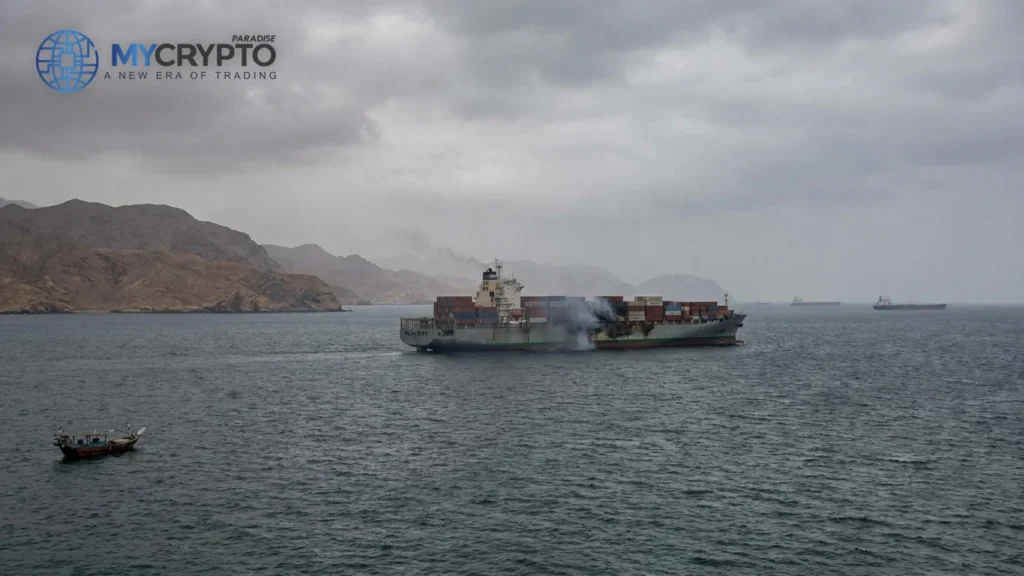
- A cargo vessel was hit by an unknown projectile near Al-Khasab on the southern Strait of Hormuz route.
- BTC traded near $63,344 with a flat +0.1% day, showing no immediate panic yet.
- The event fits our near-term bearish bias and a possible dip into the $61k to $59k accumulation zone.
A projectile hit a cargo vessel near the Strait of Hormuz, yet crypto barely flinched. Is the market ignoring the risk, or has it simply not priced it in?
A cargo vessel was struck by an unknown projectile near Al-Khasab, Oman, on the southern approach to the Strait of Hormuz. UKMTO logged the incident. This is one of the most sensitive stretches of water on the planet, the gateway for a large share of the world's seaborne oil and gas.
The strait is a chokepoint. When something goes wrong here, energy traders notice first, and everyone else notices soon after. A single damaged hull near this route can lift insurance costs, reroute tankers, and add a fresh premium to oil.
So far, the crypto reaction has been almost nothing. BTC sat near $63,344 with a 0.1% daily move, and ETH slipped a modest 1.2% to $1,852.85. On the surface, the market shrugged.
That calm is the interesting part. Geopolitical shocks rarely price in during the first hour. The tape often stays flat while desks quietly assess whether this is an isolated event or the start of something larger.
We treat this as a macro risk input, not a confirmed crypto catalyst. There is no single same-day trigger driving price here. What we can say is that a hot chokepoint raises the odds of a broader risk-off drift, and that fits the near-term caution we already carried into the week.
Why a shipping lane moves crypto
The transmission runs through energy and risk appetite, not through crypto itself. A strike near the Strait of Hormuz threatens supply, so oil carries a war premium. Higher energy costs feed inflation fears, and inflation fears complicate the rate path that risk assets depend on.
When that chain fires, capital rotates. Investors trim exposure to the most volatile holdings and lean toward assets they see as safer. Crypto sits at the far end of the risk curve, so it usually feels the outflow last but hardest.
Liquidity is the real channel here. A geopolitical scare tightens overall market liquidity as leverage comes off across stocks, commodities, and digital assets together. Correlations rise in a fright, and BTC stops trading like an island.
The honest caveat matters. Right now this is potential, not confirmed. Price has not moved, which tells us the market is either still digesting the news or does not yet see escalation.
That is exactly why we frame it as a macro input. If tensions cool, the premium fades and this becomes a footnote. If they widen, the same lane becomes a headline that no risk asset can ignore. Either way, the strait deserves a place on every trader's watchlist this week.
How the liquidity squeeze would reach alts
If risk-off deepens, the cascade follows a familiar order. BTC moves first because it holds the deepest liquidity and the most institutional attention. A slide toward the $61k to $59k zone would be the first sign the market is respecting the risk.
ETH tends to follow with a wider swing. It already lagged today with a 1.2% drop, and in a broad flush it typically loses more than BTC in percentage terms. That relative weakness is a useful tell for who is really de-risking.
Alts sit at the bottom of the waterfall. When liquidity contracts, thin order books amplify every sell, so smaller caps can drop far harder than the headline pairs. Retail often learns this the expensive way, holding longs while depth evaporates beneath them.
Here is the smart money angle. Crowded longs with no strong squeeze signal suggest retail is still holding positions into an uncertain macro backdrop. If a scare hits, those late longs become the fuel, and their stops become the liquidity that larger players harvest on the way down.
That is the mechanism worth watching. A geopolitical shock does not need to be huge to trigger a cascade. It only needs to arrive while positioning is stretched and confidence is high, which is roughly where the tape sits now.
Signals that confirm or kill the dip
The first confirmation is energy, not crypto. Watch whether oil holds a fresh premium and whether more vessels are affected along the same route. A widening incident raises the odds that risk-off spreads into equities and then into BTC.
On the chart, the $61k to $59k zone is the line that matters. A clean, high-volume break below it would confirm that macro fear is now driving price, not just headlines. Until that happens, the flat tape says the market is unconvinced.
Invalidations are just as important. If BTC reclaims and holds above the current $63,344 area with rising volume, the scare is fading and the geopolitical premium is bleeding out of risk assets. That would turn this story back into background noise.
Watch open interest, or OI, which is the total value of open derivative positions. If OI stays elevated while price drifts down, crowded longs are trapped and a liquidation flush becomes more likely. Falling OI into weakness means leverage is unwinding in an orderly way.
Sentiment is the final tell. Retail reads as mixed and undecided right now. A sudden shift to fear near support often marks the point where panic sellers hand their coins to patient buyers. The absence of that fear, so far, is why we stay cautious rather than convinced.
What this scare means at support
The ParadiseTeam reads this through our existing near-term caution, not as a new alarm. Our bias already pointed toward a possible dip into the $61k to $59k accumulation zone. A Hormuz scare is the kind of macro catalyst that can accelerate that move rather than reverse it.
With BTC near $63,344, price sits above the zone we care about. That gap is the story. We are not chasing weakness here; we are watching for the market to travel down to where the real interest sits.
Our edge is who benefits. Bearish geopolitical news pushing fear into an already stretched long book usually helps larger players, not late retail buyers. If a flush drags price toward $61k to $59k, that is where smart money tends to re-accumulate from panicking hands.
So the plan is patience over reaction. We would rather see stops sweep beneath support and hold than buy a headline that has not yet moved price. The trapped longs above are the liquidity; the accumulation zone below is the reward for waiting.
Risk-first, always. This is an interpretive macro read, not a confirmed cause, and probabilities beat certainty. If the strait calms and BTC defends the current range, our dip thesis simply does not trigger, and we stand aside rather than force it.
Track it live: our live crypto funding rates and the Crypto Fear and Greed Index both update in real time, so you can watch this shift for yourself.
Related coverage
For exact entries, targets, and stop losses with full risk management, that is what ParadiseFamilyVIP is for. New to reading these moves? Start with our crypto trading strategies guide.
ParadiseTeam is monitoring the market situation closely, and we are taking these developments into consideration while building our trading tactics inside ParadiseFamilyVIP.
Crypto trading involves substantial risk. Prices are volatile and you can lose money. This article is educational and is not financial advice. Past performance does not guarantee future results.




Join the discussion
No comments yet. Members, share how you are reading this.