

Listen: the breakdown
Developing story: This story is still unfolding. We are tracking it and will update this article as more details are confirmed.
Market briefing: South Korea just proposed detailed rules to put stocks, bonds and funds on the blockchain, with launch set for February 2027. It is a long-term adoption win, not a same-day trade. Bitcoin traded near $84,608 and barely moved on the headline.
- South Korea's FSC proposed detailed rules for tokenized securities covering stocks, bonds and funds.
- Launch is scheduled for February 4, 2027, with retail capped at KRW100 million per licensed exchange annually.
- Real adoption signal, but the distant start date means little immediate pull on crypto prices.
Source: Financial Services Commission (Korea)
South Korea just unveiled the rules to move stocks, bonds and funds onto the blockchain. Tokenized securities arrive in 2027. So why did crypto barely flinch?
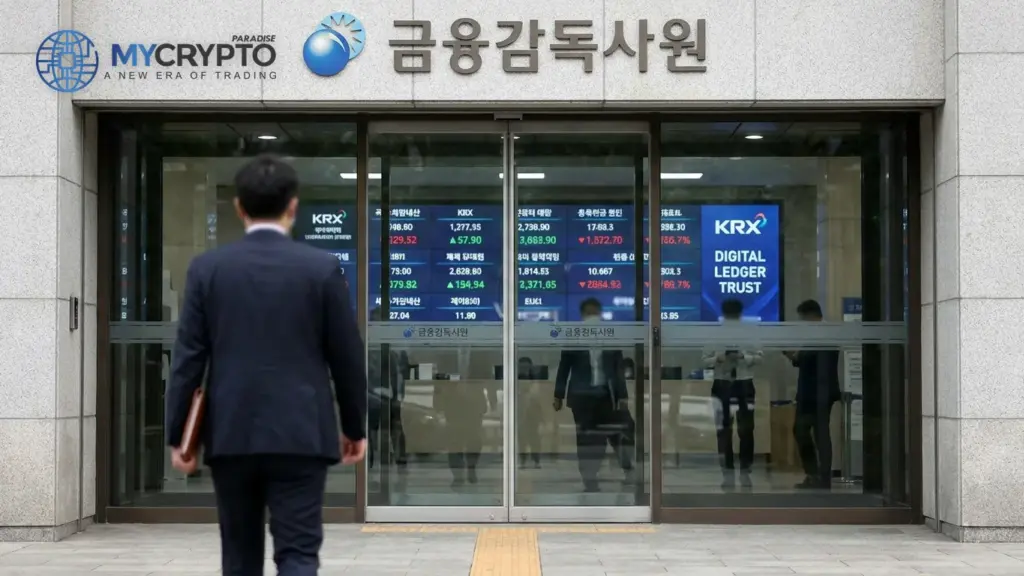
South Korea has put a date on something many markets only talk about. Its financial regulator, the Financial Services Commission (FSC), proposed detailed rules to move stocks, bonds and funds onto the blockchain. Tokenized securities are set to launch on February 4, 2027.
The framework is specific, not aspirational. It names which securities can be tokenized. It sets how the distributed ledgers must operate. It defines how issuers manage customer accounts, and it creates a new over-the-counter (OTC) licensing structure for the exchanges that will list these assets.
The first phase is deliberately cautious. It covers funds, bonds and unlisted stocks, with listed stocks slated to follow. Retail investors get a leash: up to KRW100 million, roughly $70,000, per licensed exchange each year.
The legal groundwork was already laid. Lawmakers previously revised existing statutes to permit tokenized securities at all, so these rules fill in the plumbing rather than invent the house.
A public consultation is now open and runs until November 11, which means details can still shift before anything goes live. That is the honest caveat.
Here is the part traders keep forgetting. A fully blockchain-native securities market in a major economy is a genuine structural milestone. It is also sixteen months away. Markets price the next quarter far more eagerly than the year after next, and this headline sits firmly in the latter.
Why a major economy going on-chain matters
The mechanism here is legitimacy, not liquidity. When a top-tier economy writes detailed rules for tokenized securities, it moves blockchain from the margins toward the core of traditional finance (TradFi). That reduces the perceived regulatory risk that keeps large institutions on the sidelines.
Think about the chain of effects. A clear OTC licensing structure tells banks, asset managers and brokers exactly how to participate. Defined ledger standards tell their compliance teams the technology is permitted, measured and supervised. Over time, that lowers the cost of saying yes to on-chain infrastructure.
That is the quiet part of adoption. It rarely arrives as a single buying spree. It arrives as plumbing: licenses, standards, custody rules, account requirements. The plumbing is boring, and the boring parts are exactly what unlock serious capital.
The retail cap matters too. Capping individuals at roughly $70,000 per exchange signals a market built for scale and supervision, not a speculative free-for-all. Regulators who design for durability tend to attract the institutions that also design for durability.
But legitimacy is a slow fuse. None of this forces money into Bitcoin or Ethereum tomorrow. The transmission from a 2027 securities framework to present-day crypto demand is indirect and gradual. So the honest read is that this strengthens the long-term case for blockchain as financial infrastructure. It does not rewrite the near-term supply and demand that sets this week's price.
Reading the muted crypto reaction to the news
Start with what the tape actually did. Bitcoin traded near $84,608 and was down about 0.4% on the day as the news circulated. Ethereum sat around $2,677, down roughly 1.4%. The reaction was effectively nothing.
That non-reaction is the signal. Markets discount the future, but they discount a distant future lightly. A launch in February 2027 is too far out to move spot liquidity today, and traders know it.
Walk the cascade and it becomes clear. For a headline to push BTC first, then Ethereum, then alts, it usually needs a near-term change in flows: inflows, a supply shock, an immediate access expansion. This news brings none of those on a tradable horizon.
There is no fresh capital hitting order books because of a rule that activates next year. There is no forced buying, no lockup, no liquidation trigger. So the liquidity picture is unchanged, and unchanged liquidity means unchanged price pressure.
If anything, the muted move tells you who is NOT here. Smart money is not treating a 2027 framework as a reason to bid this week, and the absence of a chase is itself information.
For altcoins the logic is even softer. Any benefit from tokenized securities flows to infrastructure narratives over quarters, not to low-cap speculation over hours. This is a foundation being poured, and foundations do not trade.
What turns this framework into real flows
The first thing to watch is the consultation itself. The rules are proposed, and the public comment window runs until November 11, so the final shape can still change. Watch for whether the scope widens or narrows, and whether listed stocks get a firmer timeline.
Next, watch the licensing. The real catalyst will not be the announcement; it will be the first exchanges and issuers actually securing OTC licenses and naming partners. That is when abstract rules become concrete rails.
Confirmation that this matters for crypto would look like named TradFi institutions committing capital or infrastructure to the build. It would look like custody providers, banks or asset managers publicly aligning with the framework. Those are the footprints of serious money.
Invalidation, or at least dilution, would look different. Delays past February 2027, a watered-down first phase, or a cap structure so tight that volume cannot scale would all blunt the thesis. A framework that launches thin is a framework the market ignores.
For near-term price, frankly, watch Bitcoin's own structure instead. This story will not set the next few weeks of trading, so the levels that matter are the ones already on the chart.
The practical posture is patience. Treat this as a milestone to track, not a trigger to chase. The calendar will do more work here than any single day's candle, and the next real tell is licenses, not headlines.
What a 2027 rollout means for current positioning
The ParadiseTeam reads this as a structural positive with no bearing on this week's tape. A February 2027 launch does not touch the levels that are live right now, so Bitcoin keeps trading its own technical story rather than this headline.
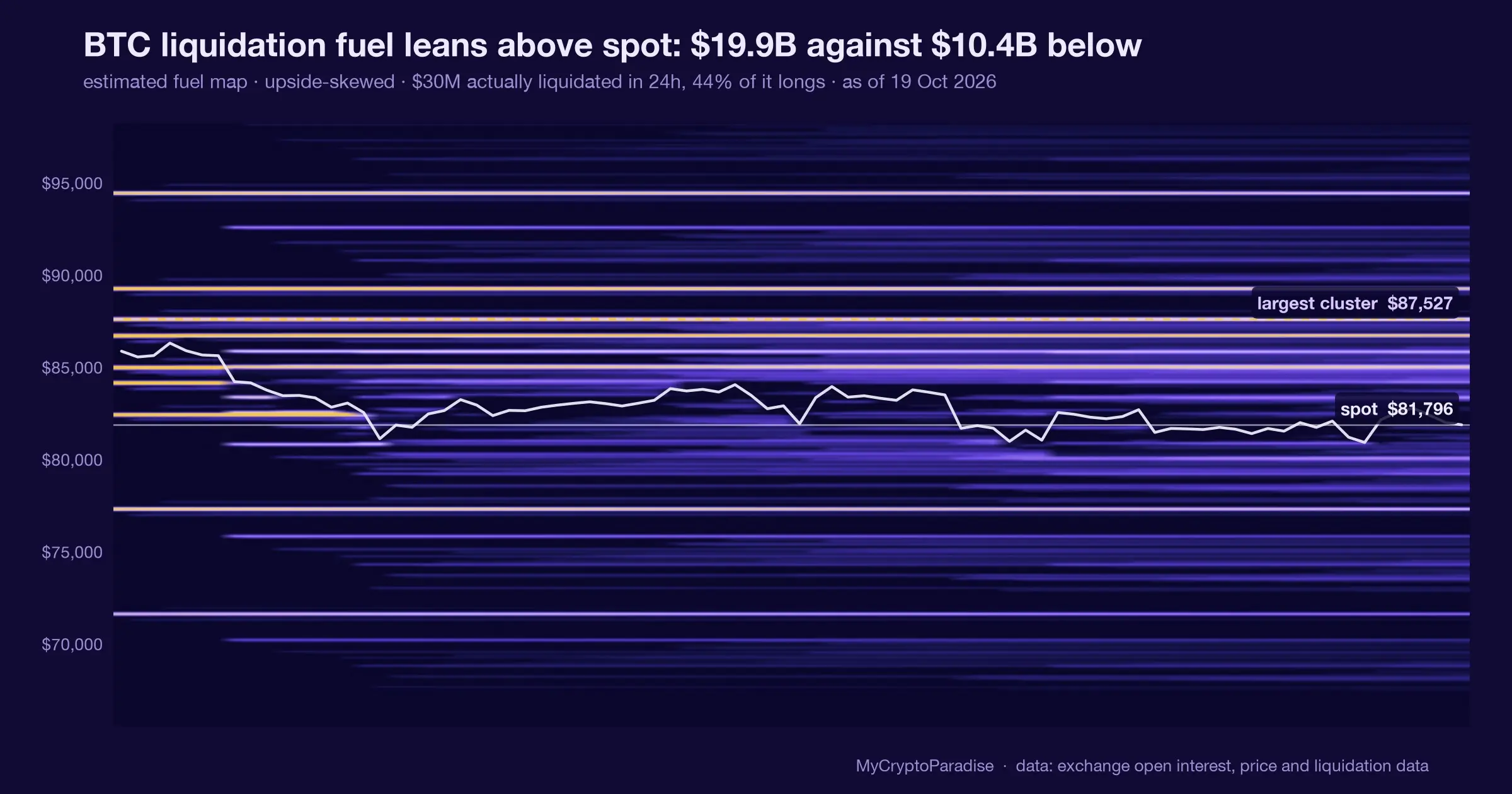
With BTC near $84,608, our standing map stays the reference. The $82,000 zone is the key defense level. Above sits $85,000, a thin resistance and a liquidation cluster where stops pile up, then $87,000 as the previous high.
Our standing bias leans toward a push at $90,000, supported by a bullish divergence on the MACD (moving average convergence divergence) and firmer participation on the bid. That read is about price structure, not about Korea's securities rules.
Here is the honest caution. Our bias toward $90,000 comes with a rejection warning: liquidity fades into that level, and the RSI (relative strength index) is not confirming cleanly, which can set a bear trap. Strength into resistance is where distribution tends to hide.
So the ParadiseTeam frames this news as context, not a catalyst. It strengthens the long-term adoption case that sits underneath the whole asset class. It does nothing to change where stops sit or who is trapped today.
The discipline is to file it under thesis, not trigger. Trade the chart in front of you, respect $82,000 as defense and $90,000 as a place sellers may wait, and let 2027 remain a calendar item.
The read behind this: we framed this story through our own market analysis, Bitcoin at $82K: Is $90K About to Trigger?
Track it live: our crypto liquidation heatmap and the live crypto funding rates both update in real time, so you can watch this shift for yourself.
Related coverage
For exact entries, targets, and stop losses with full risk management, that is what ParadiseFamilyVIP is for. New to reading these moves? Start with our crypto trading strategies guide.
ParadiseTeam is monitoring the market situation closely, and we are taking these developments into consideration while building our trading tactics inside ParadiseFamilyVIP.
Crypto trading involves substantial risk. Prices are volatile and you can lose money. This article is educational and is not financial advice. Past performance does not guarantee future results.
Does South Korea's 2027 tokenization plan move crypto before launch day?
This is how 30 Paradisers are calling it. Tap your call.
No calls on this one yet. Tap yours to be the first.
Free account, no password. Members just sign in.







Join the discussion 26
2027 feels like forever for *this* stuff, but if it means my brother's transfers aren't bleeding 7%+ in fees, I'll be watching 👀. Still, makes me wonder about that stablecoin play I almost missed! ⏳🤔
Long lead times never move anything until liquidity moves in. Until then it's all just talk, like these comments here.
rules for 2027 its a long ways but the rules themselves matter more than the date right. what about existing tokenized stuff there?
Tommy, the regulatory clarity on existing tokenized assets will be a crucial test of their framework.
tommy, exactly. the existing tokenized real world assets are already showing us what liquidity looks like.
yea, four years for a rollout is a heck of a long time to wait for a catalyst to kick in 🐢 😴. still, the regulations themselves are a good sign 📈, even if it feels like forever.
These longer timeframes are often where the significant structural shifts become visible, similar to how infrastructure projects take years to complete before their full impact is seen.
Exactly. Three years is enough time for a lot of purchasing power to vanish if you're holding the wrong asset.
seems a long way to 2027 for something that could be ready sooner. they're talking rules now but what about the actual tech?
Bram, the "rules now, tech later" framing misses how deeply intertwined they are. Markets price certainty, and regulatory clarity often precedes the serious capital commitments that fund the tech buildout.
i watch stablecoin flows around these announcements and dont see material capital rotation into KRW pegged pairs until well after launch dates
i see some rotation before too but its more about the exit liquidity right after. what about the levels then
long lead times are common for structural shifts like this. I keep tabs on these longer horizons, but my focus remains on reclaiming the monthly close.
Absolutely, Lukas. These shifts also bring a lot of clarity to how the traditional financial players will eventually integrate, which I find very interesting 🤔.
its all about reclaiming that monthly close i get it but what about the weekly close for a trend break
Always with the long lead times... I remember watching these kinds of things develop in the early days... for a different kind of market... felt the same then too.
Ray, long lead times often mean the debits and credits of development are handled in private ledgers before any public disclosure. The cost of a recall is just too high to launch a bad product! 😂
yeah, long lead times often coincide with market consolidation too... we saw that play out with the dot-com bubble.
yes these things take time, a full season from planting to harvest can be 9 months for coffee too
Is the market waiting for a big economy to do it first, like the US or EU, before we see real movement...? 🤔 I feel like that makes sense....
It's good to see more of this... helps me understand the long-term thinking... for now I'm just watching how these big announcements affect things after they happen.
long lead times like this increase the opportunity for regulatory changes and the associated risk to the trade plan. my stop-loss doesn't care about the launch date.
It's like a new software update with a two-year roadmap and no public alpha. So much can go wrong before launch, no? 😬 I worry about getting stuck holding the bag again.
The software analogy assumes a blank slate... but tokenization isn't new. We have a lot of live data on stablecoins and their movement.
a beta with stablecoins is like testing a calculator to build a whole operating system, Nadia! 😤 the complexity of actual securities will find new, *unforeseen* bugs.
And how much does a software update cost in real terms if it keeps delaying... the purchasing power erosion during that wait is the real risk.