

Listen: the breakdown
Market briefing: South Korea locked in a 22% crypto gains tax for 2027, and regional volume is already down almost 55% year over year. BTC sat near $63,065 as of 13:02 UTC while the market stayed cautious.
- South Korea confirmed a 22% tax on crypto gains, effective January 1, 2027
- Regional trading volume already fell nearly 55% year over year in the first half
- BTC held near $63,065 as caution builds toward the $61k to $59k zone
South Korea crypto tax is finally confirmed at 22% for 2027, and regional volume already fell 55%. So is this a real liquidity drain, or another delay retail will shrug off?
South Korea just made its crypto tax real. Lawmakers confirmed a combined 22% levy on crypto gains, effective January 1, 2027. It applies to gains above roughly $1,740, and it allows no offset for losses. That last detail matters more than the headline rate.
This is not a surprise so much as a long-delayed inevitability. Lawmakers first approved the tax back in 2020, aiming for a 2022 start. Then it slipped to 2025. Then to 2027. Traders have watched this can get kicked down the road for years.
Each delay trained retail to treat the tax as theoretical. Smart money read it differently.
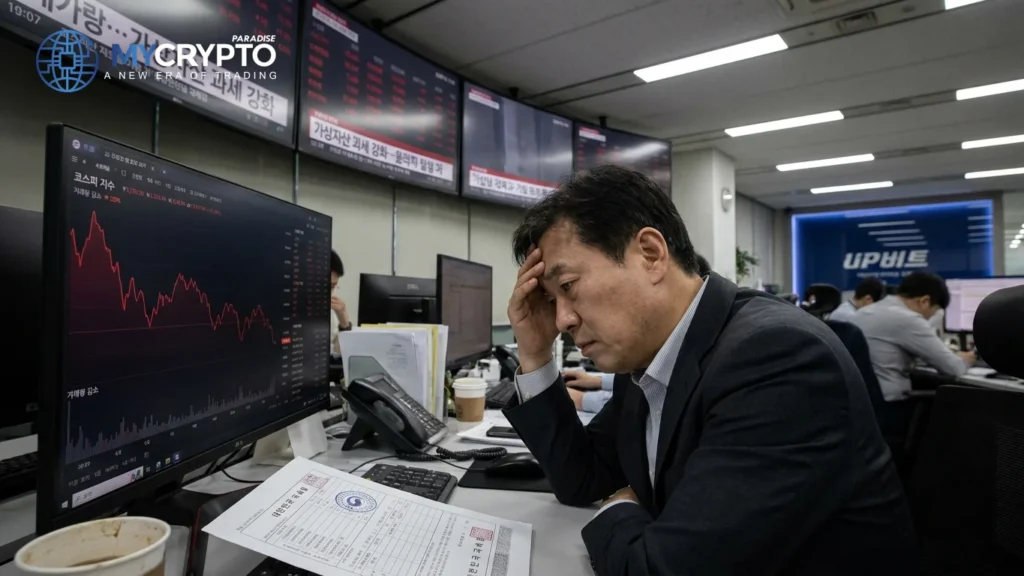
The evidence is already in the volume. South Korean crypto trading fell nearly 55% year over year in the first half. That is a serious contraction from one of the most active retail markets on earth. A tax does not need to be live to change behavior; the mere certainty of it does.
The broader Wu Blockchain summary this week also flagged Russia banning Moscow mining through 2032, Binance winning a Philippine sandbox license, Uzbekistan opening a tax-free mining zone, and Emirates adding crypto payments. We covered the Moscow ban separately. The South Korea confirmation is the one with a measurable market footprint, so that is where the real story sits.
Regulatory clarity sounds bullish on a press release. In practice, a no-loss-offset tax on one of Asia's biggest retail bases is a slow leak on regional liquidity. That is the structural change worth watching.
Why a delayed tax still drains liquidity
The transmission mechanism here is liquidity, not sentiment. A 22% tax with no loss offset punishes active trading specifically. It taxes winners fully while giving losers nothing back. That math discourages the high-frequency retail churn that South Korea was famous for.
When a large retail base trades less, order books thin out. Thinner books mean sharper moves in both directions. Regional exchanges that once absorbed size now absorb less, so price becomes easier to push.
The 55% volume drop is the tell. That decline happened before the tax is even live, which means the effect is anticipatory. Traders are adjusting now, not in 2027.
Here is the part retail underrates. Repeated postponements feel like reprieves, so the crowd relaxes. But the direction of travel never reversed. Each delay bought time, not cancellation, and smart money prices the destination, not the schedule.
Globally, this fits a fragmented and cautious regulatory backdrop. Different jurisdictions are pulling in different directions at once. That fragmentation raises the cost of moving capital across borders and adds friction to arbitrage.
For the wider market, the read is simple. A shrinking Asian retail flow removes a reliable source of speculative demand. That demand often chased alts and momentum, so its absence lands hardest on the risk end of the market, not on BTC itself. The structural signal is a slow tightening of regional liquidity, and structure like that moves quietly.

How the liquidity squeeze reaches BTC and alts
Start with BTC, because it moves first and cleanest. Lower regional liquidity does not force an immediate crash. It raises the odds of a controlled drift lower as speculative demand thins. BTC traded near $63,065 as of 13:02 UTC, flat on the day, which is exactly the muted reaction a slow-burn regulatory story should produce.
A confirmed tax two years out does not trigger panic. It removes a marginal buyer. That is a headwind, not a hammer.
ETH sits one rung down the risk ladder. When BTC drifts and volume compresses, ETH tends to underperform on the way down and lag on any bounce. Reduced Asian retail flow historically supported ETH liquidity, so its absence bites here more than at the BTC level.
Alts are where the squeeze concentrates. Smaller-cap tokens live and die on retail churn and thin order books. Strip out a chunk of that churn and spreads widen, slippage rises, and rallies fail faster. This is the mechanical reason alts bleed first when regional volume falls.
BNB traded around $581.31, roughly flat, reflecting the same wait-and-see tone across exchange tokens. Nothing here screams capitulation.
The cascade, then, is orderly rather than violent. Driver confirmed tax, macro effect cautious regional flow, liquidity effect thinner books, market effect BTC drifts while alts feel it most. The absence of a sharp reaction is itself the signal: this is distribution of patience, not a catalyst for a squeeze.
What confirms the drift versus what invalidates it
Watch the $63,000 zone first. Simon's lens treats it as resistance right now. If BTC keeps stalling there on declining bullish volume, that failure to reclaim confirms the cautious read. Weakening volume on every push higher is the classic sign of a move running out of buyers.
The cleaner confirmation is a drift toward $61,000 to $59,000. That is the accumulation zone in the current lens. A controlled slide into it, rather than a violent flush, would fit a liquidity-drain story perfectly.
Invalidation is specific and worth respecting. A decisive reclaim of $63,000 that then holds, backed by rising volume, would break the bearish structure. That would signal buyers stepping in despite the regulatory overhang, and it would flip the near-term read.
Keep one eye on regional volume data out of Korea. If the 55% decline stabilizes or reverses, the liquidity thesis weakens. If it keeps sliding, the drain is real and ongoing.
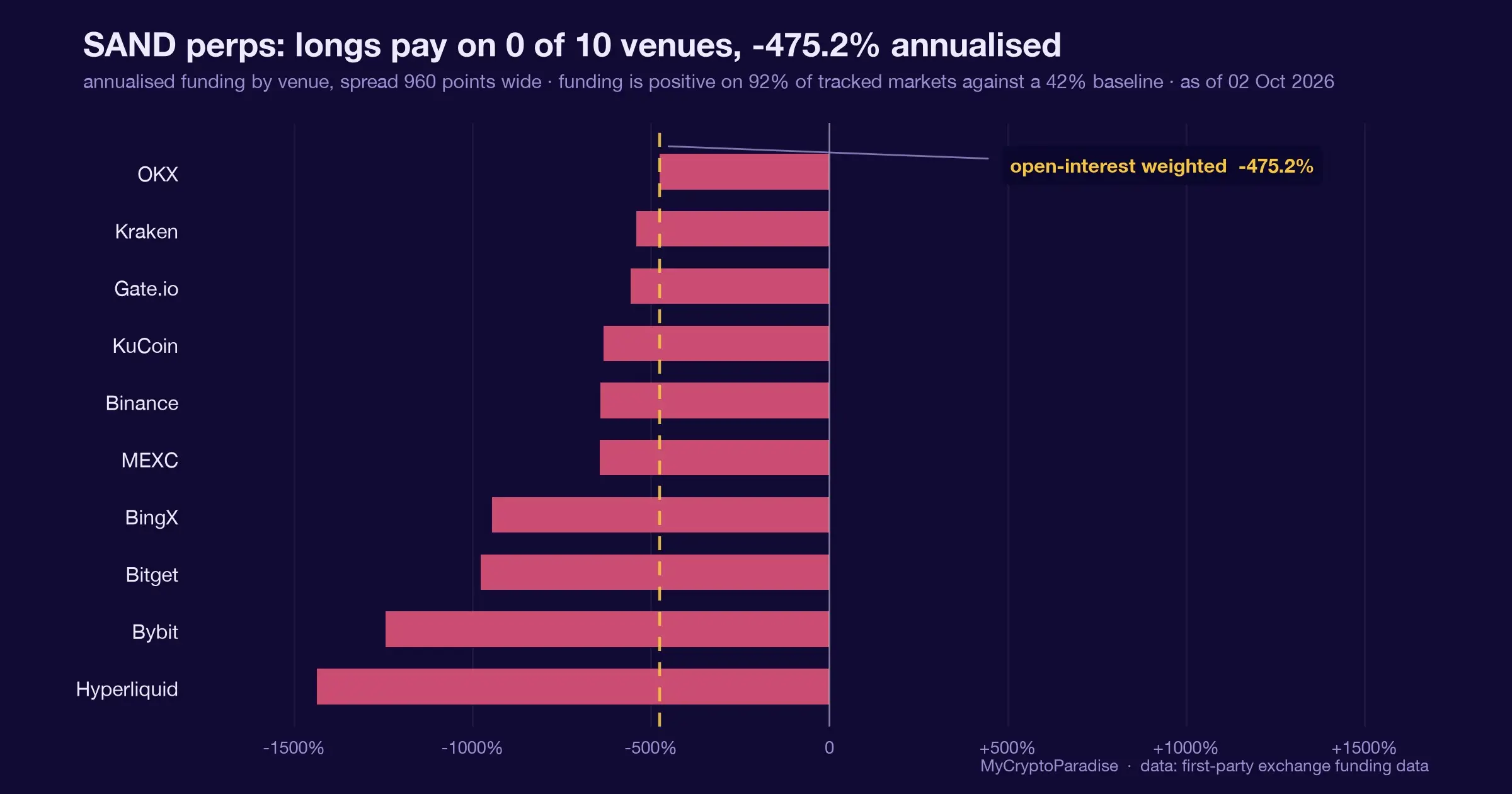
Also watch funding. Longs are crowded with positive funding, yet the long-squeeze probability reads low, near 10%. That combination means lingering long positions without a strong squeeze trigger, which usually resolves as a grind rather than a flush.
Momentum is siding with caution for now. Price, histogram, and RSI (relative strength index) all show lower lows, a bearish divergence against any reclaim attempt. Until that divergence resolves, the burden of proof sits with the bulls, and the tape has not delivered it yet.
What this tax means for smart money positioning
The ParadiseTeam reads this confirmation as reinforcement, not revelation. A delayed tax does not change the near-term map; it hardens the case for patience. With BTC near $63,065 and stalling under the $63,000 resistance zone, the structure still points toward a dip before any durable push higher.
The edge lives in who is comfortable and who is not. Retail treats each postponement as a green light. Smart money treats the confirmed destination as a reason to wait for price to come to it, specifically the $61,000 to $59,000 accumulation area. That is where this news actually matters. It adds a slow, structural headwind to regional liquidity, which raises the probability of the drift the lens already expects, rather than sparking an immediate bounce.
Stops are the tell. Crowded longs with positive funding sit above, offering fuel if price rolls over, while a low squeeze probability means bulls lack an obvious trigger. That asymmetry favors sellers into the $63,000 zone for now.
The ParadiseTeam approach here is discipline over reaction. High probability, favorable R:R (risk-to-reward) setups form at defined levels, not on headlines. This confirmation is a headline; the $61k to $59k zone is the level.
If $63,000 reclaims and holds on real volume, the plan adapts. Until then, the read stays cautious near term, constructive longer term, with the accumulation zone as the line that separates fear from opportunity.
Track it live: our live crypto funding rates and the Crypto Fear and Greed Index both update in real time, so you can watch this shift for yourself.
Related coverage
For exact entries, targets, and stop losses with full risk management, that is what ParadiseFamilyVIP is for. New to reading these moves? Start with our crypto trading strategies guide.
ParadiseTeam is monitoring the market situation closely, and we are taking these developments into consideration while building our trading tactics inside ParadiseFamilyVIP.
Crypto trading involves substantial risk. Prices are volatile and you can lose money. This article is educational and is not financial advice. Past performance does not guarantee future results.








Join the discussion
No comments yet. Members, share how you are reading this.