


Listen: the breakdown
Market briefing: Revolut handed over customer identities and full transaction records, including Bitcoin activity, after acting on a fraudulent government request. No funds were lost, and with BTC flat near $77,344 the tape barely blinked, but the phishing risk for wealthy users just went up.
- Revolut released passports, selfies, IBANs and full Bitcoin transaction histories after a spoofed government request.
- No funds were lost, but affected higher-net-worth users now face a sharply elevated phishing risk.
- BTC sat near $77,344 with a flat hour, so this is slow-burn FUD, not an immediate crash catalyst.
A Revolut KYC data leak just exposed customer identities and Bitcoin histories to fraudsters. No money moved, but does trust in regulated crypto rails just move against you?
Revolut exposed a trove of customer identity and financial records after acting on a fraudulent request that appeared to come from a government agency. The company handed the data over believing it was compliant. It was complying with a lie.
The exposed material is not trivial. It includes account statements, IBANs, withdrawal records, and full transaction histories, Bitcoin activity among them. It also includes copies of passports and driver licenses, verification selfies, names, and dates of birth. That is the full identity kit a scammer needs. Not a password to reset, but the person behind the account.
No funds were lost as a direct result. That single fact matters, because it kept the market calm and stopped this from becoming a panic headline. But it should not be mistaken for a clean bill of health.
The real damage is deferred. Phishing risk is now elevated for affected higher-net-worth users, the exact cohort a targeted attacker wants. Someone holding your ID documents and your Bitcoin transaction record can craft a message that feels authentic, because it is built from your own verified data.
Here is the quiet irony. The exposure happened through the compliance process itself, the machinery built to keep bad actors out. A fraudster did not break the vault. They asked politely, on official-looking letterhead, and were handed the keys.
Structurally, this reinforces a slow question crypto keeps dodging. Every regulated on-ramp that collects your identity becomes a single honeypot, and honeypots eventually get raided.
The privacy cost of one fraudulent request
This event matters because it attacks confidence in the regulated rails, not the price of any coin. The transmission runs through trust, and trust is the slowest, stickiest variable in this market.
Regulated exchanges and fintech platforms sell one core promise: safety in exchange for your identity. You surrender a passport and a selfie, and in return you get a compliant, insured, grown-up place to hold value. When that identity leaks through the compliance process itself, the promise cracks.
The macro effect is subtle but real. Higher-net-worth users are exactly the demographic that brings fresh capital onto regulated platforms. Spook that cohort and you slow the marginal inflow that markets need to climb.
There is a second channel. Elevated phishing risk means some affected users will move funds to self-custody or simply sit on their hands. Neither action is a firesale. Both quietly reduce the buying pressure that props up higher prices.
We want to be honest about scale here. One data exposure does not move a trillion-dollar asset class on its own. There is no single confirmed same-day catalyst driving the tape today, so treat the price context as our interpretation, not a proven cause.
What this does is add another brick to an existing wall of caution. Sentiment was already fragile. This is one more reason for a nervous holder to de-risk rather than deploy, and fragile sentiment is precisely the soil a deeper correction grows in.
Security fear meets a market already bleeding
The immediate price impact is close to zero, and that is the most useful signal here. BTC was trading near $77,344 as of the latest read, with a flat hour and a 24-hour change rounding to nothing.
A leak of this severity producing no candle tells you where attention sits. The crowd is watching macro liquidity, outflows, and the broken $77,700 support far more than a single platform's breach. Bad news that does not move price is information in itself. So the effect is not a shock lower. It is a slow leak of confidence that layers onto existing weakness.
Walk the chain down the risk curve. BTC absorbs the news without flinching, because its holders are the least likely to panic over a fintech breach. ETH follows BTC's lead, quiet for the same reason.
The alts are where residual nerves would surface first. Thinner books and jumpier holders mean any privacy-driven de-risking shows up there before it touches the majors, but even that has not materialized in force yet.
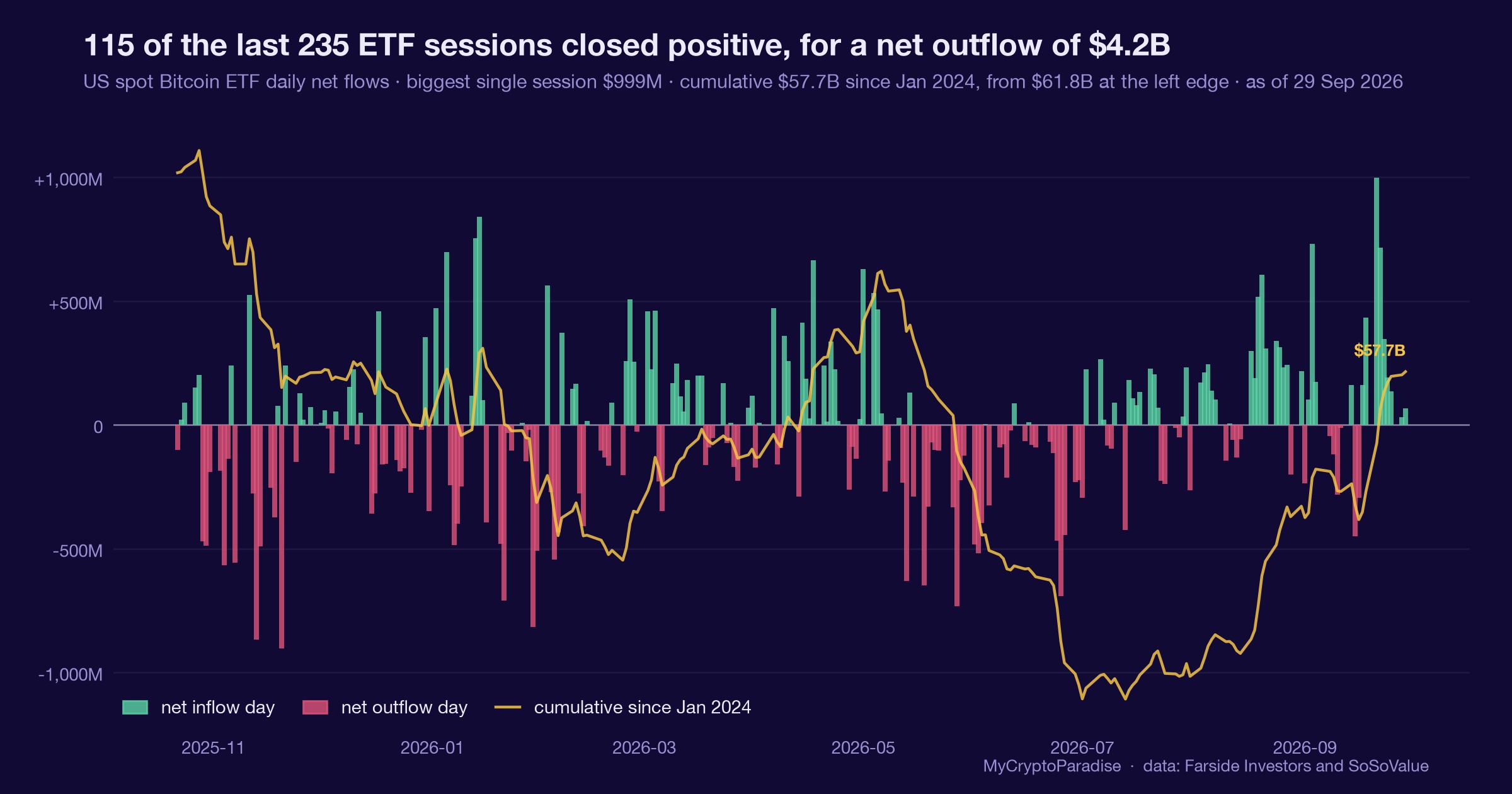
The honest read is that this news reinforces a bearish backdrop rather than creating one. Bitcoin ETF flows have bled for four straight weeks. Whales are sitting in cash. A KYC leak does not reverse any of that; it simply gives the cautious one more reason to stay cautious, and cautious money does not chase price higher.
Signals separating a slow bleed from capitulation
The first thing to watch is whether this story stays contained or metastasizes. A one-off exposure with no funds lost fades in days. A wave of follow-on phishing losses among affected users would turn a privacy footnote into a genuine confidence event.
On the chart, the level that matters is the broken $77,700 support. BTC now trades just above it near $77,344, and how price behaves around that shelf tells the real story. A clean reclaim and hold would suggest the FUD is being absorbed.
Rejection there points the other way. A failure to hold opens the path toward the previous low near $58,000, the level our read has flagged as the next real test.
Watch flows alongside price. Continued exchange-traded fund outflows plus stable or rising stablecoin reserves would confirm that capital is waiting, not buying. That combination is the signature of smart money staying patient.
Watch the crowd too. Retail keeps stacking leveraged long positions into weakness. If that continues while price grinds lower, it builds the fuel for a long squeeze, where cascading liquidations do the selling that news alone could not.
Invalidation is clean and specific. A reclaim of the $82,000 to $88,000 resistance band would flip the bearish structure and force a rethink. Until that happens, treat bounces with suspicion. And stay boringly disciplined on personal security. If your identity has ever passed through a platform's compliance funnel, assume a convincing phishing attempt is a matter of when, not if.
Where this leak sits in Bitcoin's correction
The ParadiseTeam frames this leak as sentiment texture, not a catalyst. It fits the higher-timeframe bearish structure rather than changing it, and the flat reaction near $77,344 confirms that.
Structure comes first for us. The medium-term support at $77,700 has broken, and price is now hovering just under it. That break, not a fintech headline, is what defines the current risk. On the daily we see higher highs on price against lower highs on volume, a bearish divergence that argues rallies are being sold.
Our read points lower before it points higher. The next target sits below $58,000, and the real prize is the $55,000 to $44,000 exchange-of-hands zone. That zone is where the smart-money story lives. Whales are holding USDT reserves off the table, waiting to absorb selling pressure at much lower prices, the same pattern seen at prior bottoms. A KYC leak does not pull that capital forward; it simply thickens the fear that eventually produces the capitulation they are waiting for.
Retail is playing the other side. Leveraged long positions keep building into this weakness, providing the very liquidity a long squeeze would consume.
The invalidation is unchanged and worth repeating. A reclaim and hold of $82,000 to $88,000 would flip our bias. Absent that, the ParadiseTeam treats security FUD like this as one more log on a fire that is still burning in one direction.
The read behind this: we framed this story through our own market analysis, Can Bitcoin Hold This Support?
Track it live: our Crypto Fear and Greed Index and the live crypto funding rates both update in real time, so you can watch this shift for yourself.
Related coverage
For exact entries, targets, and stop losses with full risk management, that is what ParadiseFamilyVIP is for. New to reading these moves? Start with our crypto trading strategies guide.
ParadiseTeam is monitoring the market situation closely, and we are taking these developments into consideration while building our trading tactics inside ParadiseFamilyVIP.
Crypto trading involves substantial risk. Prices are volatile and you can lose money. This article is educational and is not financial advice. Past performance does not guarantee future results.







Join the discussion 4
This is exactly why... no one should be promising anything that's out of their control. People lose so much when systems fail behind the scenes.
that's why I dont keep anything on exchange, I rather pay the gas fees than worry about a backend attack on my records
i worry about these things too, it's why i try to keep my crypto off exhanges as much as possible. sorry if this is a silly question, but how can we protect ourselves from phishing if our data is already out there?
This is why you don't keep everything with one provider. Diversification is not just for assets, it's for where you keep them too.