

In short
Max pain is the strike where the most options expire worthless, the level option sellers are least out of pocket if price settles there. Friday’s quarterly expiry carries a BTC notional of $14.5B with max pain at $78,000, and an ETH notional of $2.1B with max pain at $2,350, per our MCP Insights option-chain reading on 24 September. Spot sat at $84,502 for BTC and $2,694 for ETH the same day, which places price 6.05 and 7.41 standard deviations above each pin. We called it neutral, explicitly not a pin trade: our expiry-gravity model is parked at 11 graded receipts against a pre-registered minimum of 40, so it scores nothing here. Of the four weeklies it has logged, only the one already inside its zone settled inside. This piece shows you how to read a max-pain print yourself.
Max pain is an incentive, not a magnet
Max pain names the strike where the largest dollar value of calls and puts expires worthless. Below it, the puts are in the money; above it, the calls are. The level drifts as open interest builds, and it is a photograph of where option sellers would suffer least on settlement.
The pin theory says sellers, who are often better capitalised, nudge price toward that strike into expiry to keep the most contracts worthless. It is a real incentive. It is also a weak one, and it fades fast with distance: hedging flows that pull price a few dollars cannot drag it thousands.
An incentive that only works when price is already close is not a magnet. It is a tendency, and a tendency needs measuring before it earns a single line of risk.
Price sits far above both pins today
Per our MCP Insights option-chain reading on 24 September, Friday’s quarterly carries $14.5B of BTC notional across 93,509 call and 77,956 put contracts, a put-call ratio of 0.83, with max pain at $78,000. ETH shows $2.1B of notional, a 0.66 put-call ratio, and max pain at $2,350.
Spot printed $84,502 for BTC and $2,694 for ETH the same afternoon. That places BTC 6.05 standard deviations and ETH 7.41 above their pins, with both open-interest structures flagged as dispersed rather than concentrated. Our crowd gauge reads 56 for BTC and 68 for ETH, both neutral, both short of any extreme.
Dispersed open interest and a six-sigma gap are the two conditions under which a pin has the least to grab. The structure is loud in notional and quiet in gravity.
A big notional is not a big pull
The obvious misread is to see $14.5B expiring and $78,000 on the max-pain line and conclude price gets dragged down into Friday. Notional measures how much is at stake, not how far sellers can move spot, and the two are unrelated once price leaves the strike cluster.
At six standard deviations the pin zone runs from roughly $76,925 to $79,075, a shelf price left days ago. Dragging spot back into it would take a move no expiry-hedging flow has the size to force. The notional is real; its gravity, here, is not.
A gauge that admits it has no pull at this distance is more useful than one that manufactures a pin story from a large headline number.
What is different here
The ParadiseTeam does not read max pain as a destination. We treat it as an incentive that decays with distance, then measure the decay: a pin only earns a line of risk when spot is within a standard deviation or two of the strike, which today it is not.
The receipts say the pin needs proximity
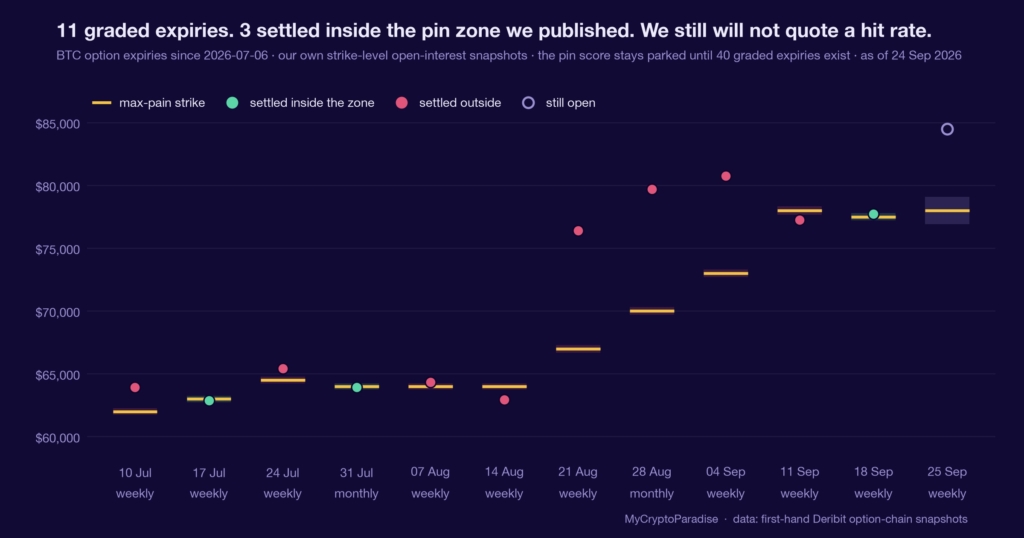
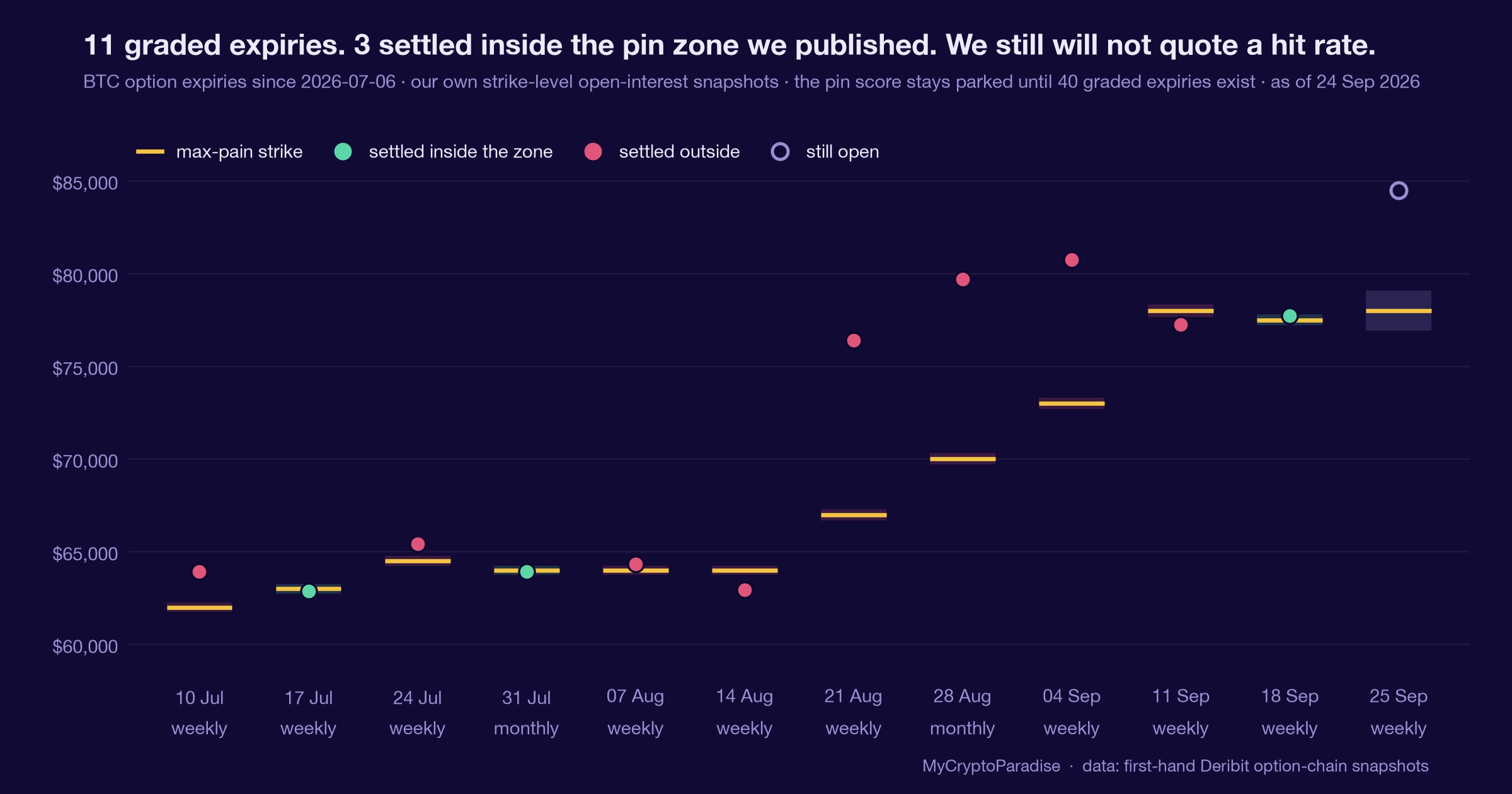
Our expiry model has logged 11 graded receipts, below its pre-registered floor of 40, so it stays parked and issues no score for this quarterly. Eleven is not a sample; it is an anecdote with a spreadsheet, and quarterly pins get receipts only because their physics differ from weeklies.
The pattern in those receipts is still instructive. The one weekly that settled inside its max-pain zone had entered expiry just 0.43 standard deviations away. The three that missed began 2.24, 25.3 and 32.6 deviations out. Proximity, not notional, decided every one.
This is one input. It sits alongside funding, open interest and spot absorption, and on an expiry this far from its pin it is the quietest of them. A model that refuses to grade a tiny sample is doing its job, not failing it.
ETH tells the same story, louder
Ethereum’s quarterly is a fifth of Bitcoin’s in notional but sits even further from its pin. At $2,694 against a $2,350 max pain, spot is 7.41 standard deviations out, with a 0.66 put-call ratio and a crowd gauge of 68, still neutral, still no extreme.
The divergence flag that fired on Bitcoin’s chain, where open interest sits at its hundredth percentile while positioning stays calm, did not fire on Ethereum. Two loud expiries, two quiet crowds, and neither pin close enough to matter this week.
When the larger and the smaller book agree that price sits far from the pin, the read is not a coin flip. It is a shrug, and a shrug is a perfectly honest verdict.
Reading a max-pain print yourself, step by step
- Find the expiry date and the max-pain strike, then note today’s spot price so you can measure the gap between them.
- Convert that gap into standard deviations if you can; a pin inside one or two has pull, a pin six out has almost none.
- Check whether open interest is concentrated at nearby strikes or dispersed across many, because a dispersed chain gives hedgers little to defend.
- Read the put-call ratio for context, but never as direction: 0.83 means more calls than puts, not a forecast of down.
- Ignore the raw notional headline; a $14.5B expiry far from its pin moves price less than a small one sitting right on it.
The step people skip is measuring the gap in standard deviations. Distance in dollars flatters a far pin; distance in sigma exposes how little grip it actually has.
Every number above is checkable against the live data. Start with the Bitcoin max pain tracker, then cross-read the MCP Insights hub and the Crypto Fear and Greed Index.
Act and invalidate
| Scenario | What confirms it | What kills it |
|---|---|---|
| Pin stays irrelevant | Spot holds far above $78,000 into expiry | Spot collapses into the $77k-$79k zone |
| Late gravity appears | Price drifts toward the pin on low volume | A trend move away from the strike |
| Model stays parked | Receipts below the 40 floor by Friday | The fortieth receipt logs and scoring starts |
Posture: Flat on the expiry itself and neutral into Friday, treating max pain as noise at this distance rather than a level to fade or chase. The pin earns attention only if spot closes back inside its zone before delivery.
Frequently asked questions
Does price always move to max pain at expiry?
No. Max pain is where option sellers lose least, not a target price is pulled toward. It tends to matter only when spot is already close; on Friday’s quarterly, price sits more than six standard deviations away, where the pull is negligible.
What does the $14.5B BTC notional actually tell you?
It measures how much option value is at stake, not how far sellers can move spot. A large notional far from its pin exerts less gravity than a small one sitting on the strike. Notional is size, not force.
Why will you not score this quarterly expiry?
Our expiry-gravity model has only 11 graded receipts against a pre-registered floor of 40, so it stays parked. Quarterly pins also behave differently from weeklies and arrive too rarely to sample, so they receive receipts only, never a grade.
Is a 0.83 put-call ratio bearish or bullish?
Neither on its own. A 0.83 ratio means slightly more open call value than put value, which is positioning, not a forecast. Read alongside dispersed open interest and a neutral crowd gauge, it points to no directional edge into this expiry.
How far is spot from the pin right now?
BTC spot near $84,502 sits 6.05 standard deviations above its $78,000 pin, and ETH near $2,694 sits 7.41 above its $2,350 pin. Both gaps are wide enough that max pain offers no measurable pull into Friday’s settlement.
Crypto trading involves substantial risk and is not suitable for everyone. Nothing here is financial advice; it is education only. Never risk more than you can afford to lose.
The private Extras feed, where the max-pain map, expiry-gravity receipts and crowd positioning update into every quarterly settlement with their zones attached, is part of PRO Paradiser, the intelligence layer behind the ParadiseFamilyVIP strategies.









Join the discussion 22
i recall chasing max pain for spot entries on early perp trades, before i properly appreciated the basis dynamics. a useful data point, but perhaps less of a directional signal.
yeah, i chased that max pain a bit too, but now i look at open interest changes around it more... gives a better sense. 🤔
six sigma above spot feels like a lot of confidence for something that still depends on people selling. my real concern is always what actually protects purchasing power, not just what looks safe on paper.
The idea of "no pull" when spot is so far from max pain... it's a new concept to me... why is that? 🤔 I'm trying to understand the relationship better.
For me, max pain is really just another data point. I track its historical correlation to actual price action, and the numbers rarely align as cleanly as some expect..
Fatima, totally agree, i use it only to check for major divergences that might signal real volatility, otherwise it's just noise.
Six sigma away, huh? Interesting. Sometimes it's these wild expiries that bring the best volatility; they paid for my chai for years! ☕️ Just another data point to consider, as Fatima said.
So many options expiring this Friday 🤯! My friend says it's just big funds playing games, but I still like to see where all the "pain" is landing 🤔📉. Does anyone here check the open interest too? 🧐
I just watch the spot price, its always been the real anchor for me after that first small bitcoin buy. is max pain a level we really track anymore or just noise.
Jessica, that's it. Price action is the anchor, even a few years back I felt options was a distraction... my journal entries from 2021 show I only logged calls if I was already seeing volume on spot.
I remember when max pain felt like gospel back in '21 😅 - now it's just another indicator to toss into the pot, like Derek said. Still interesting to see the divergence 🤔📉.
Totally, and I've been seeing that divergence widen even more as expiry gets closer... feels like a lot of movement still to come. 🤔
Six sigma feels like the engineers putting extra safety valves on the main engine before sea trials... nice to see, but I still check the pressure myself. Max pain is just one more gauge.
I've logged enough quarterly expirations to see that "no pull" is a strong claim when volume still shows activity at those lower strikes. What data supports that six sigma completely negates the max pain effect, even for institutional puts?
Katya, my observation is that spot-to-max-pain basis in perp funding still shows a positive premium, suggesting some pull persists, even at six sigma.
Katya, exactly, its about the liquidity on offer at those strikes not just the theoretical max pain point.
Nah, six sigma out just means they want it to *feel* safe up here ⬆️, right?! Max pain still has a pull. 😬 I learned that the hard way. 😂📉
Carlos, I'm still learning about max pain... but it seems like a lot of people also track how it changes before expiry day... Thank you.
six sigma distance its really just a confirmation of the trend for me, i just check off my entries and exits on my protocol, no oracle needed.
Ah, max pain... I remember chasing that one time 😩. My mentor just looked at my screen like 🤨 and said 'Aisha, we live on the 15m chart, not the crystal ball' 🤣. Still makes me laugh.
Used to watch those max pain figures too closely... thought it was some kind of oracle... then learned my Rule 3: Trade the chart, not the narratives.
six sigma is a bit strong perhaps, depending on which vol surface you use it could be less extreme. also a max pain at 78k, when did those options get written.