


Listen: the breakdown
Market briefing: A fresh S&P Flash Survey just printed a 62-month growth high, yet Bitcoin was trading near $83,436, down 2.3 percent on the day. Strong economy, soft crypto. We read that gap as distribution.
- S&P Flash Survey composite hit a 62-month high, with manufacturing and services near multi-year peaks
- Bitcoin slipped to $83,436 and Ethereum to $2,641.7 despite the upbeat economic print
- We read the divergence as smart money distributing into retail's extreme greed below the $88,000 line
The S&P Flash Survey just posted its strongest growth in 62 months, yet Bitcoin fell instead of rallying. When good news meets a soft tape, who is really selling?
The headline number looks unambiguous. The S&P Flash Survey, which tracks purchasing, manufacturing and hiring across businesses, just posted its highest composite reading in 62 months. Manufacturing hit a 53-month high. Services touched a 52-month high. On paper, the economy is humming.
And yet Bitcoin did not celebrate. Price sat near $83,436, down 2.3 percent over 24 hours, while Ethereum eased to $2,641.7. Good news arrived, and the tape shrugged.
That reaction is the story. Markets do not fall on strong data by accident. They fall when the buyers who should be excited are the same crowd already fully positioned, leaving no fresh demand behind the print.
There is no single confirmed catalyst pinning today's slide to this survey. We want to be honest about that. What we can say is that a robust economy is a genuinely two-sided input for crypto, not the clean green light retail treats it as.
A hot economy can also mean higher-for-longer policy and less urgency to chase speculative risk. The crowd read the survey as a reason to stay long. We read the muted price response as a warning that the buying is coming from the wrong hands, at the wrong level, at exactly the wrong time.
A booming economy cuts both ways
Strong growth data does not automatically loosen financial conditions. It often does the opposite. A 62-month high in business activity tells central bankers the economy can absorb tighter policy for longer, which trims the odds of the rate cuts that speculative assets crave.
That is the macro transmission the crowd keeps missing. Retail hears strong economy and buys risk. Professionals hear strong economy and price in less liquidity ahead. When those two views collide, the disagreement usually resolves through price, not headlines.
Crypto sits at the far end of the risk curve. It is the most sensitive asset to expectations about future money supply. So a survey that hints at resilient inflation pressure and steady policy quietly removes a tailwind, even as the number itself reads bullish.
There is a second layer. Strong traditional markets compete with crypto for capital. If stocks and credit offer solid returns in a firm economy, the marginal dollar has less reason to chase Bitcoin at these levels.
So the survey matters less for what it says about factories and more for what it says about liquidity. A confident economy is often a tightening economy. And tightening, historically, is not the environment that launches sustainable crypto bull markets. It is the environment that flushes out the leverage first.
Good news, and crypto still bleeds
Watch how the liquidity cascade actually moves. Bitcoin leads, and Bitcoin is the tell here. A 2.3 percent daily fade on genuinely upbeat macro data is not the signature of aggressive accumulation. It is the signature of supply meeting a crowd that is already long.
BTC near $83,436 is grinding below the levels that would confirm real strength. When the majority is heavily positioned and price still cannot lift on good news, the buyers have run out of new buyers to sell to.
Ethereum tells the same story one rung down. At $2,641.7, down 2.8 percent, it is bleeding slightly faster than Bitcoin. That is the normal order of a risk-off drift: BTC softens, ETH softens more, and the long tail waits its turn.
Alts sit at the end of that chain. In a distribution phase, they tend to hold up while attention stays high, then give way sharply once Bitcoin breaks structure. The calm in smaller tokens is often borrowed, not earned.
The mechanism underneath is exit liquidity. Extreme greed keeps retail bidding, and that steady bid is precisely what lets larger players reduce size without crashing the book. Every confident buyer absorbing a strong headline is quietly funding someone else's exit. The price barely moving is not stability. It is the market changing hands.
Reclaim 88K or lose momentum
The cleanest line to watch is $88,000. That level is current resistance, and it is the gate between our cautious read and a genuine bullish surprise. Until Bitcoin reclaims it and holds on a higher timeframe, upside remains a hope, not a trend.
A decisive weekly close back above $88,000 would force us to respect the possibility that strong data is fuelling real demand, not just retail froth. That is the confirmation case, and we stay open to it.
The invalidation case is heavier right now. If price keeps stalling and rolls over, the next reference below is the $67,000 liquidation zone, where crowded longs would come under real pressure. That is where forced selling tends to accelerate a move.
Below that sits the deeper $44,000 to $55,000 region we view as the potential exchange of hands, the area where a true capitulation could reset positioning. We are not predicting a straight line there. We are marking the path if support gives way.
So the checklist is simple. Reclaim and hold $88,000 for upside probability. Lose momentum and lose $67,000 for the correction thesis. In between is noise, and noise is where overleveraged traders get chopped up waiting to be proven right. The survey does not change these levels. It just tells us the crowd has more reason than ever to be on the wrong side of them.
Reading the distribution behind extreme greed
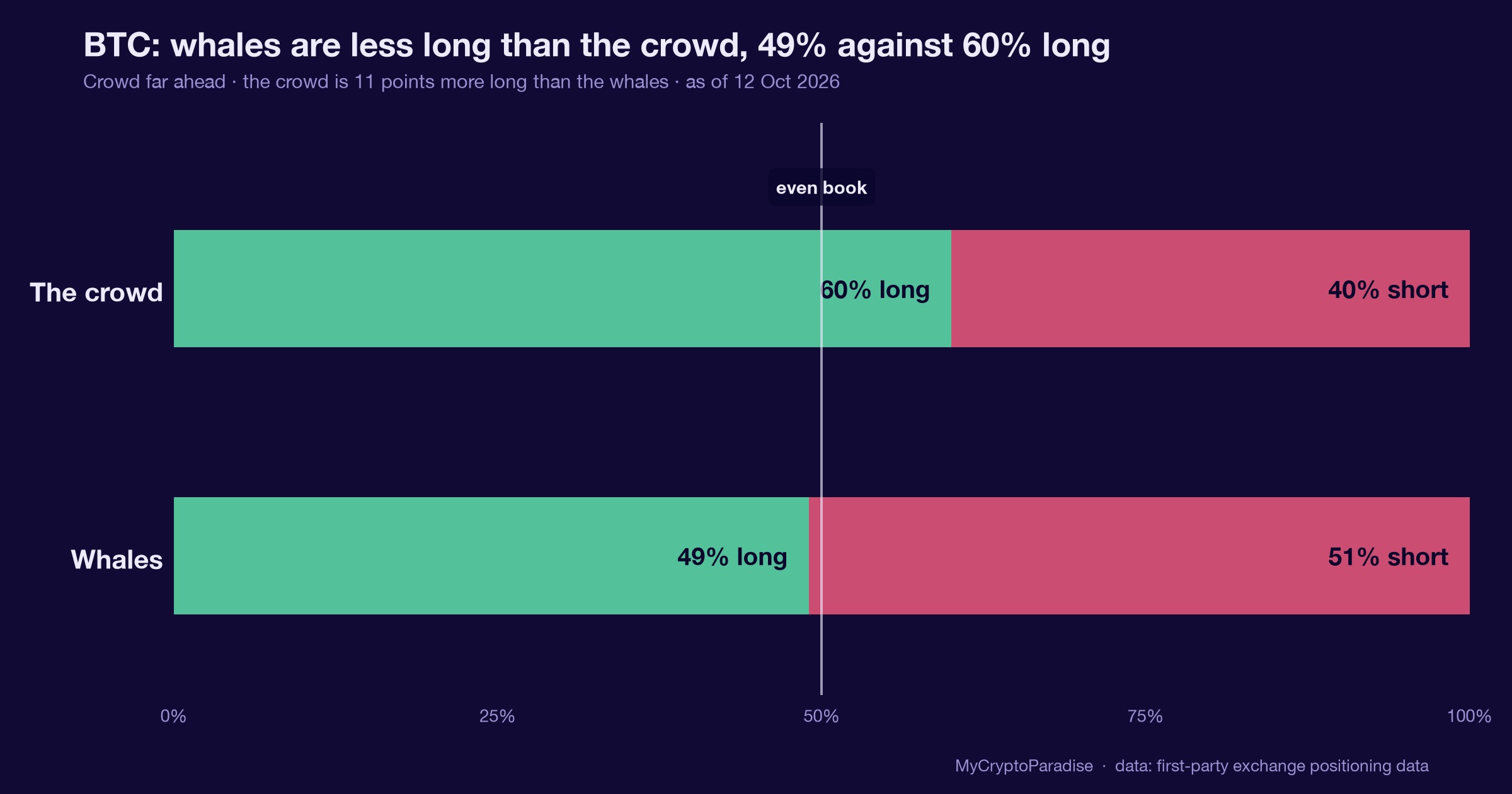
The ParadiseTeam frames this survey through a single lens: strong macro data landing while the crowd is already at extreme greed and heavily long. That combination, into resistance, reads as distribution rather than fuel.
With Bitcoin near $83,436 and stalling under $88,000, the burden of proof sits with the bulls. The ParadiseTeam wants to see $88,000 reclaimed and defended before assigning meaningful upside probability. Absent that, the path of least resistance leans lower.
On positioning, the ParadiseTeam's stance is defensive, not directional bravado. For existing longs, that means protecting gains: moving stop-loss orders, the SL that caps downside, toward breakeven or profit, and trimming size into strength rather than adding to it.
Opening fresh aggressive longs here, on a strong headline the crowd is already leaning into, offers a poor R:R, the risk-to-reward, because the obvious buy is exactly what larger players need to sell against.
The higher-probability scenario the ParadiseTeam is preparing for is confirmation of downside as price loses structure, with the $67,000 liquidation zone and the deeper $44,000 to $55,000 capitulation area as the reference map. Patience beats prediction.
This is not a forecast of certainty. It is a probability read. Good economic news that cannot lift price is rarely a gift. More often it is the market politely telling you who has already finished buying.
The read behind this: we framed this story through our own market analysis, Can Bitcoin Reach a New High at $169K?
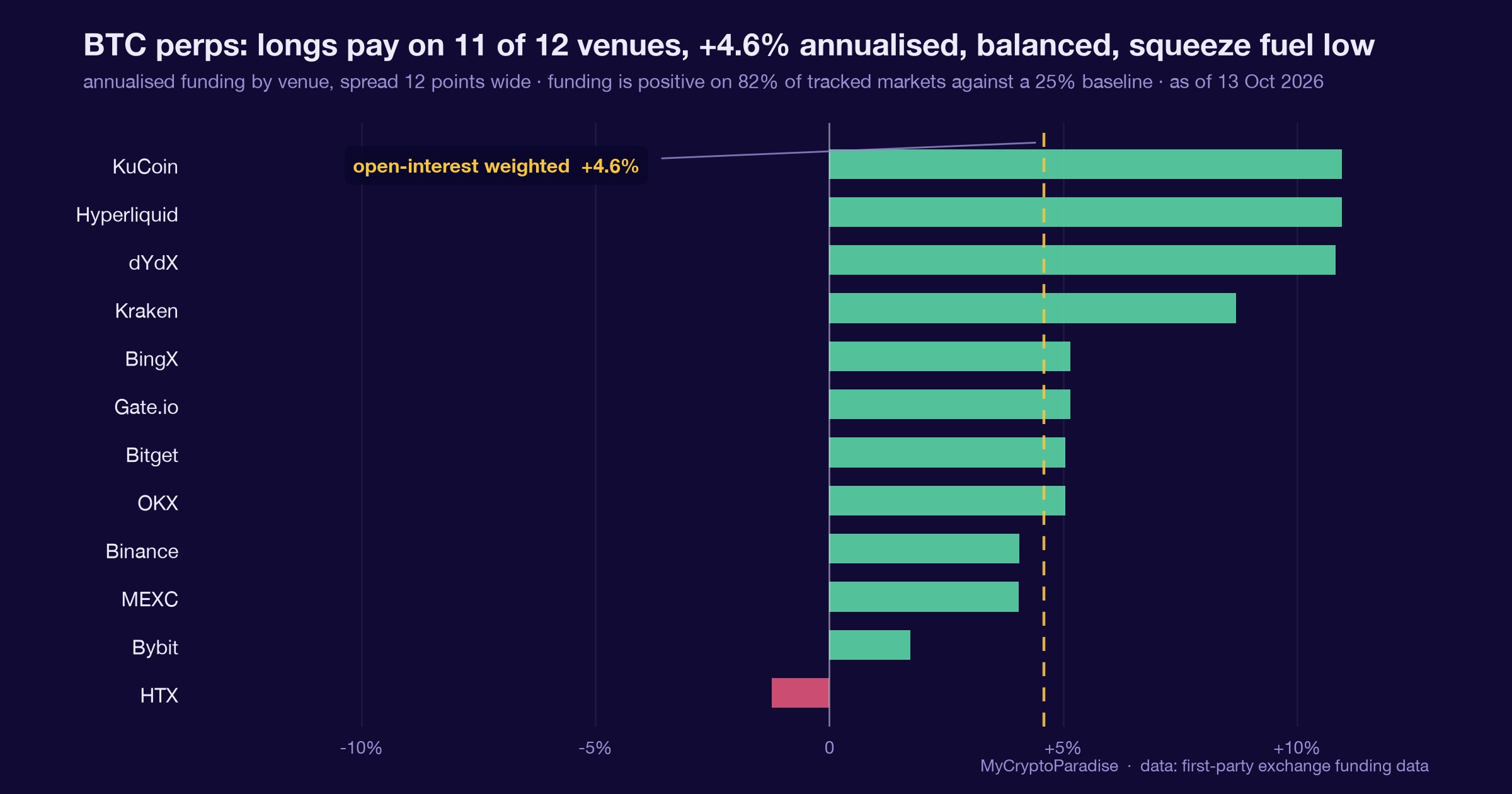
Track it live: our live crypto funding rates and the Crypto Fear and Greed Index both update in real time, so you can watch this shift for yourself.
Related coverage
For exact entries, targets, and stop losses with full risk management, that is what ParadiseFamilyVIP is for. New to reading these moves? Start with our crypto trading strategies guide.
ParadiseTeam is monitoring the market situation closely, and we are taking these developments into consideration while building our trading tactics inside ParadiseFamilyVIP.
Crypto trading involves substantial risk. Prices are volatile and you can lose money. This article is educational and is not financial advice. Past performance does not guarantee future results.
Does BTC reclaim $88,000 before it slips to the $67,000 zone?
This is how 38 Paradisers are calling it. Tap your call.
No calls on this one yet. Tap yours to be the first.
Free account, no password. Members just sign in.









Join the discussion 6
Soooo the "smart money" is distributing now 🤔 I guess my memecoin bag from 2021 was *definitely* ahead of its time, then? 🤡📉
i remember thinking "this is it!" when i first started, and then the exact opposite happened 😅 it's tricky to fight that feeling sometimes.
i'm still learning but this part about "retail greed" feels... a little harsh? sorry, but it just sounds like regular people trying to understand what's happening, you know?
it feels harsh, yes, but when i see a high volume sell-off into a narrative like "best growth in 62 months"... that's not just people understanding, its FOMO acting up.
Marta, it's a good point you're making... Sometimes what looks like "greed" is just people reacting to what they see others doing, no?
the idea that smart money is always right it's too simple the market has its own way of changing things