


Listen: the breakdown
Developing story: This story is still unfolding. We are tracking it and will update this article as more details are confirmed.
Market briefing: Moonwell is investigating an $8.7 million exploit on its MAMO Core Market on Base, with new borrowing paused. Bitcoin ignored it, trading near $79,282, up 1.3 percent on the day.
- Security firms flagged an $8.7 million exploit on Moonwell's MAMO Core Market on Base.
- The attacker allegedly manipulated MAMO collateral pricing to borrow cbBTC.
- Moonwell restricted new borrowing as a precaution while it investigates.
The Moonwell MAMO exploit drained $8.7 million on Base, yet Bitcoin near $79,282 did not flinch. So what does this really tell traders?
Moonwell is investigating an issue on its MAMO Core Market on Base. Security firms reported an $8.7 million exploit. The team has restricted new borrowing while it looks into what happened.
The mechanism, as reported, is familiar. The alleged attacker manipulated MAMO collateral pricing. With the price fed wrong, the position looked far more solvent than it was. That let the attacker borrow cbBTC against collateral that no longer backed it.
This is not a new species of attack. Oracle and collateral pricing manipulation has funded a long list of DeFi post-mortems. Each one arrives with the same shape: a mispriced input, an overstated loan, and a protocol left holding the gap. The names change; the plumbing rarely does.
Moonwell's response was the standard defensive move. Freeze new borrowing, contain the blast radius, then investigate. That protects the rest of the market from fresh bad loans, but it does not undo the $8.7 million already gone.
What matters for traders is the reaction, or the absence of one. Bitcoin sat near $79,282, up 1.26 percent on the day. Ethereum held near $2,498. Neither moved on the news in the following hour. An $8.7 million loss on one Base market is painful for those exposed, but it is a rounding error against the broader market's liquidity. The tape treated it accordingly.
Collateral mispricing keeps draining DeFi lenders
An $8.7 million exploit does not move macro liquidity. It matters for a different reason: it confirms a fragility that never fully leaves the system.
Collateral-priced lending markets live or die on their price inputs. Feed a wrong number in, and the loan-to-value math breaks. The attacker here allegedly did exactly that, inflating MAMO's apparent value to borrow real cbBTC against it. The protocol thought it was oversecured. It was not.
That is the transmission mechanism worth understanding. Not from Moonwell to Bitcoin, because there is no such pipe. The transmission is confidence. Every clean exploit chips at the assumption that a yield on Base, or anywhere, is risk-free rather than borrowed risk.
Retail tends to learn this lesson last. Late in a rally, with leverage high and attention short, the appetite for extra yield grows just as the ability to judge risk shrinks. A frozen borrow market is a cheap reminder compared with a liquidation.
So the honest read is modest. This event does not bend the macro trend. It reinforces a cautious stance that already existed. The broader market is driven by positioning and flows, not by a single Base lending market. This is a warning light, not a catalyst.
Why BTC and ETH shrugged off the drain
Start with the price, because the price is the tell. Bitcoin held near $79,282 and actually gained on the day. Ethereum firmed near $2,498. An $8.7 million exploit produced no visible flinch in either.
That non-reaction is the story. When contagion is real, you see it: correlated selling, funding stress, forced deleveraging across lenders. None of that showed here. The loss stayed contained to Moonwell's MAMO Core Market and those directly exposed to it.
The cascade, such as it is, runs downward and stops quickly. cbBTC and the immediate MAMO ecosystem absorb the direct hit. Base-native DeFi tokens may see thinner bids as risk appetite dips locally. Beyond that ring, the effect fades fast.
Alts are the natural place for any residual pressure to land. In a cautious tape, a fresh exploit gives leveraged longs one more reason to trim. But minor sentiment drag is not the same as a liquidity event, and traders should not confuse the two.
BTC and ETH remain governed by something larger: macro flows and how smart money is positioned near this resistance shelf. This exploit did not add or remove meaningful liquidity from that fight. It sits to the side of it, a local fire that the wider market barely smelled.
Signals that separate contained from spreading
The first thing to watch is scope. Moonwell says it is investigating and has paused new borrowing. Confirmation that the damage is capped at the stated $8.7 million would keep this a contained event. Any revision upward, or a second affected market, would change the tone.
Watch the borrow freeze itself. A quick, clean restoration of normal functions signals the team found and closed the hole. A prolonged pause suggests the collateral pricing issue runs deeper than one market.
Watch cbBTC and Base liquidity for stress. If the exploited cbBTC gets dumped or Base lending markets see withdrawals, that is real second-order pressure. If liquidity stays put, the market has already priced this as an isolated incident.
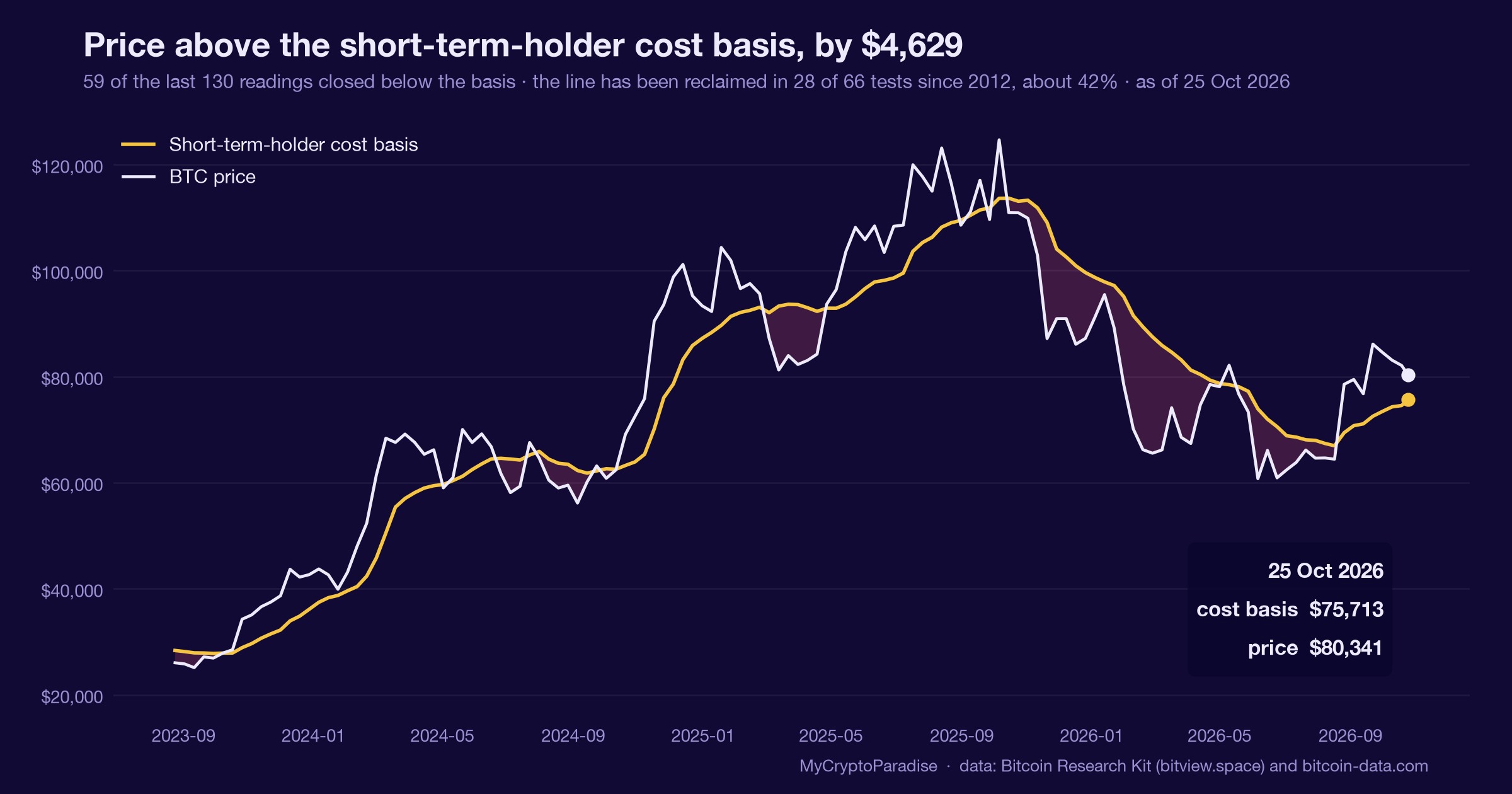
Then watch what actually matters more: Bitcoin's behavior around $79,000 to $82,000. That resistance band is the real battleground, and it has nothing to do with Moonwell. If BTC rejects there while retail stays leveraged long, the setup for downside builds regardless of any DeFi headline.
Invalidation of the broader cautious read is simple. A decisive daily close and hold above $82,000, on rising volume rather than the current bearish volume divergence, would force a rethink. Absent that, one contained exploit does not shift the structure. It just reminds everyone the structure is fragile.
What this exploit means for late-cycle risk
The ParadiseTeam frames this event by what it is not. It is not the significant capitulation the broader read is waiting for. An $8.7 million loss on one Base market, ignored by BTC and ETH within the hour, is a footnote, not a turning point.
Our lens stays bearish on the daily and weekly. Smart money is read as having distributed Bitcoin around the $79,000 to $79,500 zone, exactly where price sits now near $79,282. That distribution band is the resistance that counts, not any single protocol headline.
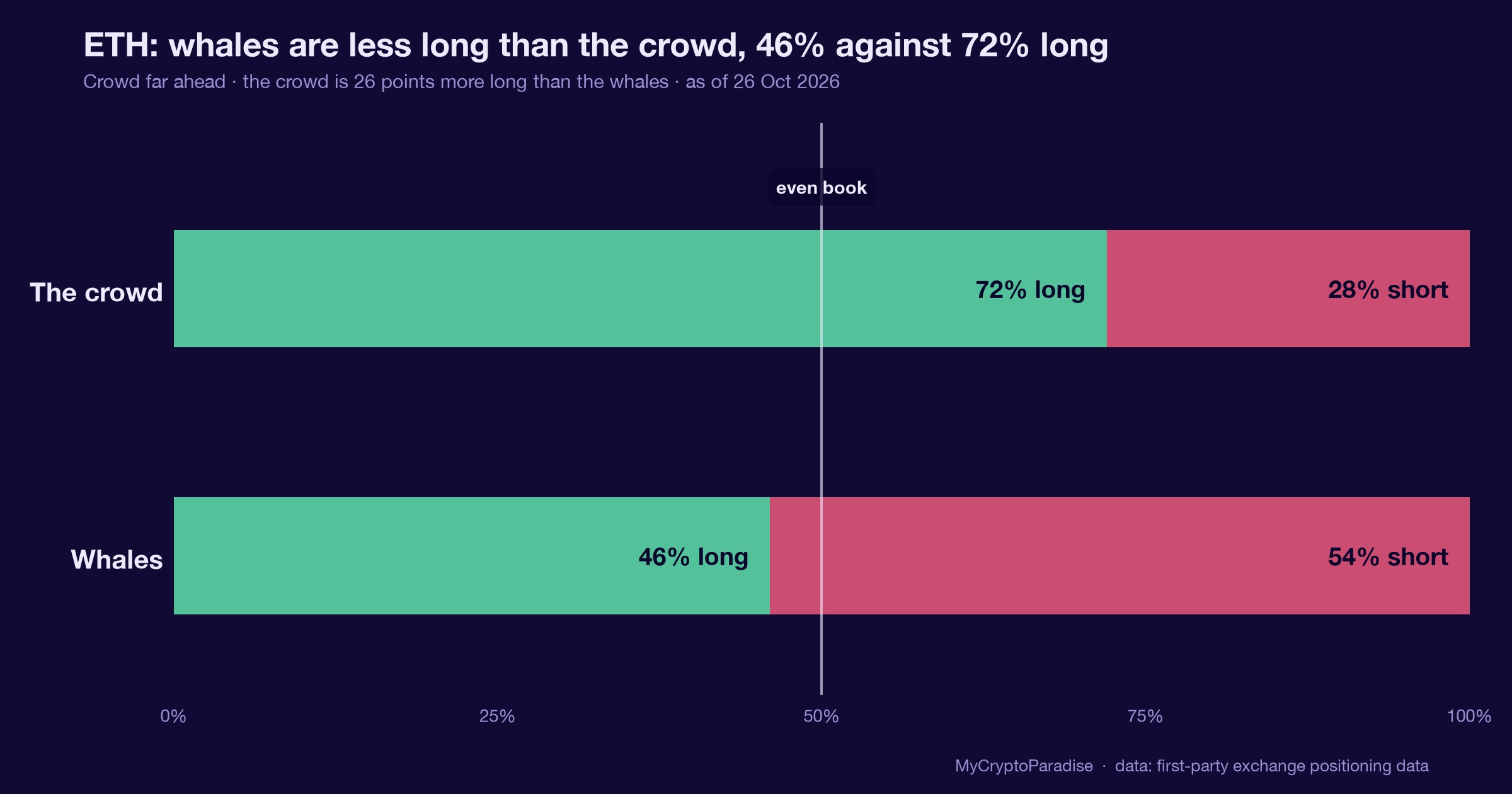
Where do stops sit? Under late retail longs that chased this rally with high leverage. Above, the $89,000 area is the upside liquidation trigger. Below, $61,000 is the major liquidation shelf, with deeper targets into the $55,000 to $44,000 reaccumulation zone. This exploit touches none of those levels. It simply adds another small note of fragility to a market already showing a bearish price-versus-volume divergence.
Who benefits? Patient capital that is not exposed to Base yield chasing. Who is at risk? The leveraged latecomer, for whom every exploit is one more crack in a story sold as easy.
The read is neutral on this event specifically, bearish on the structure around it. A daily hold above $82,000 on real volume would challenge that. Until then, the ParadiseTeam treats this as a reminder, not a trade thesis. Probabilities, managed with defined risk.
The read behind this: we framed this story through our own market analysis, Bitcoin Bull Market Back? $15B Says Be Careful.
Track it live: our live crypto funding rates and the crypto liquidation heatmap both update in real time, so you can watch this shift for yourself.
Related coverage
For exact entries, targets, and stop losses with full risk management, that is what ParadiseFamilyVIP is for. New to reading these moves? Start with our crypto trading strategies guide.
ParadiseTeam is monitoring the market situation closely, and we are taking these developments into consideration while building our trading tactics inside ParadiseFamilyVIP.
Crypto trading involves substantial risk. Prices are volatile and you can lose money. This article is educational and is not financial advice. Past performance does not guarantee future results.
Does the Moonwell exploit change anything for the broader crypto tape?
How the Paradisers are calling it
The first call is still open
Free account, no password. Members just sign in.











Join the discussion 39
The issue is always how quickly capital can flee, not just how it's valued going in.. I remember this from 2021 too.
Collateral mispricing" is just the latest way to say someone wasn't watching the store. Any system that lets purchasing power erode that fast is a broken system, on Base or anywhere else.
Collateral mispricing" feels like a polite way of saying the code didn't do its job, no? 🤔 These "exploits" always hit the folks trying to actually *use* the chain for something. 💸 🤦🏽♀️
Wait, collateral mispricing?? 🤯 No way they didnt see that coming with cbBTC 🤦♀️ feels like a setup for a quick take.📉
Collateral valuation remains a critical load path for any lending protocol. These events highlight the importance of understanding the underlying mechanics.
Ahmed, you focus on collateral valuation for lending protocols. The oracle's role in establishing that value also requires scrutiny.
Ai caramba, this is why I try to stick to spot now 😂 my degen days of chasing these farms and getting rugged like this are *over* 💀 lesson learned, no more cbBTC for Carlos 🙅♂️
yes, that's why i look to isolate basis trades where possible, these collateral mispricing risks are a persistent problem on newer chains??
The underlying mechanisms are indeed complex, Carlos, but the structure of these events often presents clearer entry and exit points for those who observe closely. One finds it is not always a matter of avoiding, but of understanding the exact leverage at play.
i hear you, it's always about the collateral risk assessment in these protocols, a small miscalculation can turn expensive fast.
Collateral mispricing" is too soft for a $8.7M hole. What oracle setup produced that valuation, and how does it invalidate in a real market downturn?! Feels like 2018 all over again.
The "collateral mispricing" explanation feels a bit thin here, frankly. It’s hard to imagine how an attacker could just *borrow* cbBTC without more going on 🤔. Four-hour noise is not a signal.
Ingrid, it is always the chase for more, no? People should be building on solid ground, not reaching for things they do not have.
Ah, this is why I always double check the collateral ratios even if it feels tedious! 🫠 It makes me a bit nervous to see these kinds of things happen on Base.
Yeah collateral mispricing is always a headache. curious how much of this was isolated to their oracle setup on Base vs a broader market impact 🤔
Indeed, Yuki. Consistent verification of collateral ratios is crucial, much like confirming rebar schedules before concrete pours. Overlooking these details can lead to unexpected instabilities.
Ah, another one bites the dust 😩. The "collateral mispricing" part seems a bit... neat for 8.7 mill, doesn't it? 🤔 Like a magic trick 🪄.
Liam, the article suggests the exploit was due to a specific technical vulnerability in the collateral valuation, rather than a trick. That difference matters for the long-term thesis.
That's a good point Liam, about the "neatness" of the mispricing... it makes you wonder what the backup pressure relief valves were supposed to be doing, doesn't it?
It's these kinds of exploits that make me so nervous about keeping any significant part of my capital on-chain. How do you even begin to spot something like mispriced collateral as a retail trader??
it does feel hard sometimes lena but just a little at a time thats all you need
That's a valid concern, Lena. On-chain data can be complex, and mispriced collateral is even harder to spot since you also need to track the off-chain value of the underlying.
the idea of easy collateral on chain is the issue here. it always brings bad actors because there is no season to it
These types of events always make for clean reclaims on the charts. Watching for the recovery of previous structural zones.
The issue is not collateral valuation itself, Ahmed. The issue is how the protocol accounts for risk exposure.
Yes, Sandra, that's exactly it. And it sounds like this particular protocol might not have accounted for the risk of oracle manipulation well enough.
so what was the one level that mattered for them to watch
where was the collateral mispricing a known risk in their protocol document, if its supposed to be "easy" collateral. that part is not adding up.
yes, it is this collateral valuation that makes the system fragile. many times you see the price feeds are the single point of failure here.
For me, it's not the collateral itself, Marco 🧐 it's how they *measure* it. The oracle is always the weakest link! 🔗💸
the liquidity drain in these situations is always a sentiment killer, particularly when the crowd assumed robust oracle feeds. feels like a setup for further deleveraging.
Another reminder why I always backtest those collateralization ratios myself before I even consider a new protocol.. can't trust the defaults.
wonder if the MAMO exit was what caused that cbETH outflow spike on Base last night and the USDT redeems that followed
Mispricing is a beast... like a corroded valve, you don't notice it until the whole system starts to shake. Carlos, I hear you, keeping it simple is often the way.
Collateral mispricing is always going to be an issue when you're dealing with anything other than sats directly. I still measure everything in sats regardless.
yes Ben, and its not just sats is it... what about your sizing and stop when your collateral itself is volatile.
This is why I stick to the majors for any yield... the long tail on Base is just not worth the risk profile right now.
it feels a bit like those rug pull things i saw online, where the numbers just don't add up suddenly. 😬 it just makes you wonder how much can be trusted really.
grace, it does raise a question on how the collateral was assessed before the exploit.