


Listen: the breakdown
Market briefing: Ostium confirms its $23.7 million exploit was an off-chain infrastructure breach, not a smart contract flaw, after the attacker faked BTC prices of $5,000 and $60,000. Trading has resumed and BTC sits near $64,021, up 0.4 percent on the day.
- Ostium exploit cost $23.7 million and lasted under six minutes
- The attacker faked BTC prices of $5,000 and $60,000 off-chain
- Trading resumed after a full migration to a new production environment
The Ostium exploit drained $23.7 million in under six minutes, yet the smart contracts held. So if the code was fine, what actually broke, and does it matter for BTC?
Ostium has told the market exactly how it lost $23.7 million, and the answer is more uncomfortable than a simple bug. The exploit was not a smart contract vulnerability. The code did what it was told. The problem was what it was told.
An attacker compromised Ostium's off-chain infrastructure and fed the platform fabricated BTC prices of $5,000 and then $60,000. Those numbers were fiction. But the vault treated them as truth, and paid out artificial profits against them.
The whole sequence took under six minutes. It started with a $100 test, the crypto equivalent of jiggling a door handle before walking in. Once the door opened, the attacker scaled up fast.
This is the part traders should sit with. The chain was honest. The oracle feeding it was not. When a protocol trusts an outside price and that price can be forged, the on-chain audit that everyone celebrates protects nothing.
Ostium has since resumed trading after migrating fully to a new production environment. The response was quick, which counts for something in a corner of the market that often responds to a breach with silence.
Structurally, this matters because it draws a hard line. A smart contract flaw is a DeFi-wide worry. An off-chain price manipulation is a platform-specific failure of plumbing. Same dollar loss, very different blast radius. Reading which one you are looking at is the difference between panic and a shrug.
Why the off-chain distinction changes the risk
The transmission mechanism here runs through trust, not through Bitcoin's price. Ostium's own read is the key fact: no smart contract was broken. That single distinction decides how far the fear should travel.
When a smart contract is exploited, every protocol sharing similar code inherits the doubt. Capital flees the category, liquidity thins, and the fear becomes systemic. That is the contagion path traders rightly dread.
An off-chain oracle breach does not spread that way. The forged $5,000 and $60,000 prints were an attack on one platform's data pipeline, not on the logic of decentralized finance itself. The blast radius stays inside Ostium's walls.
That containment is why the broader market barely registered the event. BTC still traded near $64,021, up 0.4 percent, while the story circulated. Price is the tell. A genuine systemic scare drains liquidity across the board within hours. This one did not.
There is a quieter lesson in the causation, too. Every audit-passed protocol still leans on external price feeds it does not fully control. The industry loves to advertise the parts that were verified and stay quiet about the parts that were merely trusted.
So the fear this event should generate is narrow and specific: not "DeFi is broken," but "check who feeds your protocol its prices." For BTC and ETH liquidity, the practical impact rounds to nothing. The driver is isolated, and isolated risk does not move a market this size.
How the breach filters through BTC and alts
Start with the liquidity question, because that is what decides whether a headline becomes a move. This exploit removed $23.7 million from one platform's vault. It removed nothing from BTC's order books.
Bitcoin held near $64,021 while the update spread, a 0.4 percent day that reads as noise, not reaction. That stability is the market voting that the risk is contained. When traders believed the breach was isolated, they simply did not sell the wider market.
Ethereum tells the same story by omission. There was no visible bid-pull on ETH, no cascade into perps, no spike in liquidations tied to this event. The plumbing failed on one protocol; the rest of the system kept its water pressure.
Alts are where a real DeFi scare would show first, since they carry the thinnest liquidity and the jumpiest holders. A genuine smart contract panic sends smaller tokens down hard and fast. We did not see that broad-based flush, which supports the off-chain, isolated framing.
The one place impact concentrates is confidence in oracle-dependent platforms. Users of similar price-feed designs may reprice their trust, and rightly ask harder questions before depositing. But for the market that actually sets the tone, BTC first, then ETH, then the long tail, this is a contained incident. Same dollar figure as a headline-grabbing hack, a fraction of the systemic weight. The cascade that never came is itself the data point.
What would turn this into real contagion
The confirmation path is simple: keep watching BTC's reaction, because price is the honest witness here. If Bitcoin holds its current support zone and the 0.4 percent calm persists, the market has correctly filed this as isolated. That is the base case.
Invalidation would look different. If similar oracle or off-chain breaches hit two or three more platforms in short order, the story stops being platform-specific and starts becoming a pattern. A pattern is systemic. That is the scenario that would justify real caution.
Watch the oracle-dependent corner of the market closely. Any sign that deposits are fleeing platforms with comparable price-feed designs would signal that trust is repricing broadly, not narrowly.
Watch Ostium's fresh start, too. Trading resumed after a full migration to a new production environment. Whether that new setup holds under load, or shows fresh cracks, tells us if the fix was structural or cosmetic.
On BTC specifically, the levels that matter have nothing to do with Ostium and everything to do with structure. A hold above support keeps the constructive read intact. A clean loss of the $62,500 area would change the picture, but for reasons entirely separate from this exploit.
The trap to avoid is letting a vivid, fast, six-minute story override a boring, stable price chart. When the narrative screams and the tape whispers, the tape is usually right. So far the tape is whispering that nothing changed for Bitcoin.
What this exploit signals about liquidity and positioning
The ParadiseTeam reads this Ostium exploit as market noise, not a market driver, and the price action agrees. BTC sat near $64,021 through the update, which tells us the smart money never treated an off-chain, platform-specific breach as a systemic threat.
Our wider bias remains constructive. We still see Bitcoin working through a potential final dip inside a larger upward structure, with the current support zone around $63,440 to $63,600 in focus and $62,500 as the invalidation line for that bullish read.
Here is how this event fits the accumulation logic. Isolated exploits are exactly the kind of headline that spooks retail into fleeting fear while leaving the core structure untouched. That gap between the scary story and the steady chart is where professionals prefer to buy.
The levels do not move because Ostium moved. They move on structure. We are watching for a bullish momentum divergence to confirm on the 4-hour, and for the $62,500 invalidation to hold, before treating dips as the higher-probability buying area near $60,000 to $59,000.
Where are the stops? Below support, where fear-driven sellers cluster, which is precisely the liquidity a patient buyer wants filled. Distribution risk sits higher, into the $69,000 resistance, not down here. So our stance is unchanged by this breach. Confirmation is a held invalidation plus divergence; a decisive break of $62,500 is what would make us step back, and it would owe nothing to Ostium.
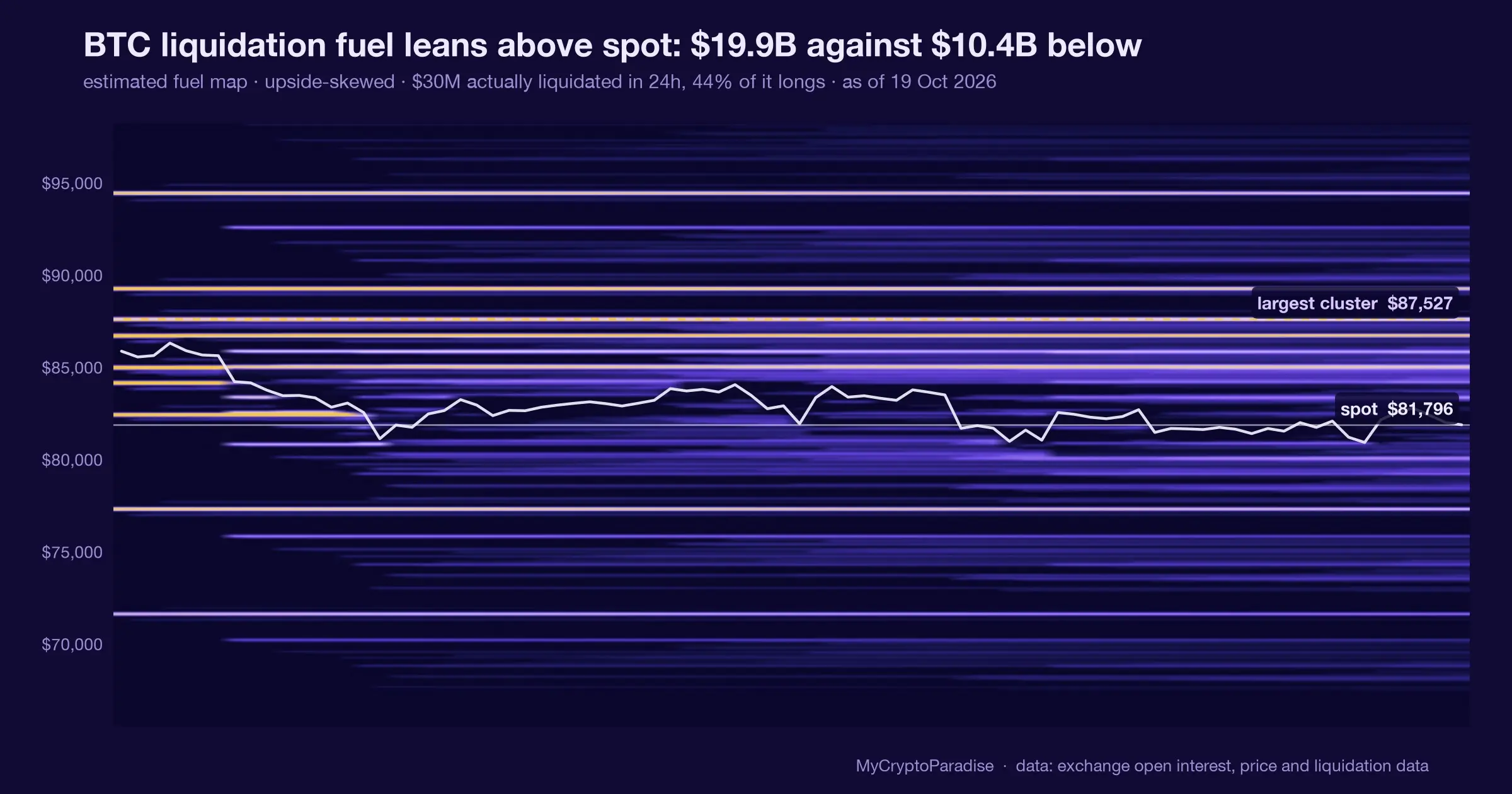
Track it live: our Crypto Fear and Greed Index and the crypto liquidation heatmap both update in real time, so you can watch this shift for yourself.
Related coverage
For exact entries, targets, and stop losses with full risk management, that is what ParadiseFamilyVIP is for. New to reading these moves? Start with our crypto trading strategies guide.
ParadiseTeam is monitoring the market situation closely, and we are taking these developments into consideration while building our trading tactics inside ParadiseFamilyVIP.
Crypto trading involves substantial risk. Prices are volatile and you can lose money. This article is educational and is not financial advice. Past performance does not guarantee future results.
Is the Ostium exploit truly isolated, or an early sign of more oracle attacks?
This is how the Paradisers are calling it. Tap your call.
No calls on this one yet. Tap yours to be the first.
Free account, no password. Members just sign in.












Join the discussion
No comments yet. Members, share how you are reading this.