

Listen: the breakdown
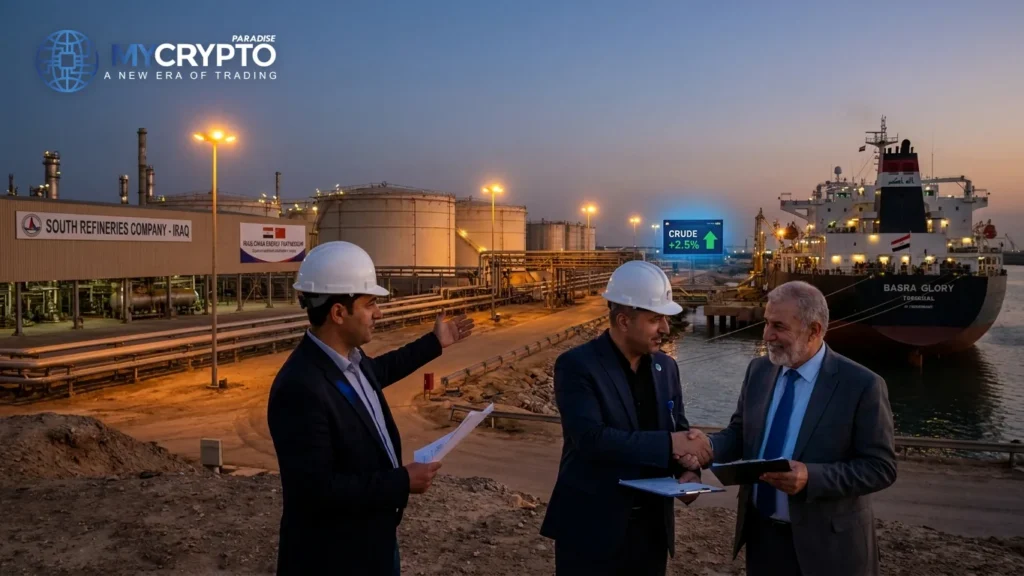
Market briefing: Market briefing. Iraq just signed sixty billion dollars in energy deals with US and British oil majors, rerouting exports away from the Strait of Hormuz. Bitcoin trades near $64,812, up 1.5 percent, but this headline is a macro footnote, not a crypto catalyst.
- Iraq signs $60 billion in energy deals with US and British oil majors
- Export routes shift away from the Strait of Hormuz, easing a chokepoint risk
- BTC near $64,812 up 1.5 percent; the move is internal structure, not this news
Iraq just signed $60bn in energy deals and rerouted oil away from the Strait of Hormuz. Big headline, but does it move a single Bitcoin?
Iraq has signed $60 billion in energy deals with US and British oil majors. The agreements shift export routes away from the Strait of Hormuz, one of the most watched chokepoints in global energy.
On paper, that matters. The Strait carries a large share of the world's seaborne oil. Reducing dependence on it lowers one tail risk that has spooked markets for decades.
So the instinct is to connect it to crypto. Energy security improves, macro fear eases, risk assets breathe. It is a tidy story.
The problem is timing. These are long-horizon strategic investments, not fresh capital flowing into risk markets this week. Pipelines and export terminals do not clear on a T plus two basis.
Meanwhile Bitcoin sits near $64,812, up 1.5 percent on the day, and Ethereum near $1,861, up 1.1 percent. Both are green, but not because of Baghdad.
That is the honest read. We see no single confirmed same-day catalyst driving crypto right now. The tape is being shaped by positioning and liquidity, not by an oil headline.
Smart money knows the difference between a story that reads well and a flow that actually moves price. This one reads well. It moves oil logistics, not the order book.
Why an oil chokepoint rarely moves Bitcoin
The transmission path from an energy deal to crypto is long and leaky. That is the whole point.
Start with the first-order effect. Diversifying export routes away from the Strait of Hormuz lowers the odds of a supply shock if that waterway is ever disrupted. Lower geopolitical tail risk is, at the margin, mildly positive for global risk sentiment.
But margin is the key word. This is a structural improvement measured in years, not a liquidity injection measured in days.
Crypto responds to liquidity, real dollars moving into or out of risk. A signed energy framework does not create that flow. No new capital is being routed toward BTC or ETH because Iraq changed a pipeline map.
Contrast that with the events that genuinely move this market. Rate decisions, ETF flows, exchange stress, large unlocks. Those hit liquidity directly and fast.
An oil deal touches the price of crude, freight, and long-term inflation expectations. By the time any of that reaches Bitcoin, a dozen other variables have overwritten it.
So we file this correctly. It is real, it is confirmed, and it is a macro footnote for a crypto trader. Treating it as a near-term BTC driver would be forcing a connection the flows do not support.
What is really steering BTC and ETH today
With no energy-driven flow to trade, price is left to internal structure. That is exactly where we see it.
Bitcoin near $64,812 is grinding, not surging. The 1.5 percent gain looks constructive on the surface, yet the internals tell a more cautious story.
Buying pressure is being absorbed as price pushes higher, which usually means someone larger is selling into the strength. That is the fingerprint of distribution, not fresh accumulation.
Ethereum near $1,861, up 1.1 percent, is following rather than leading. When ETH lags BTC on an up day, alts rarely find independent strength.
The liquidity cascade here runs inward, not outward. Instead of external capital flooding in, the market is hunting the leverage already sitting on the book.
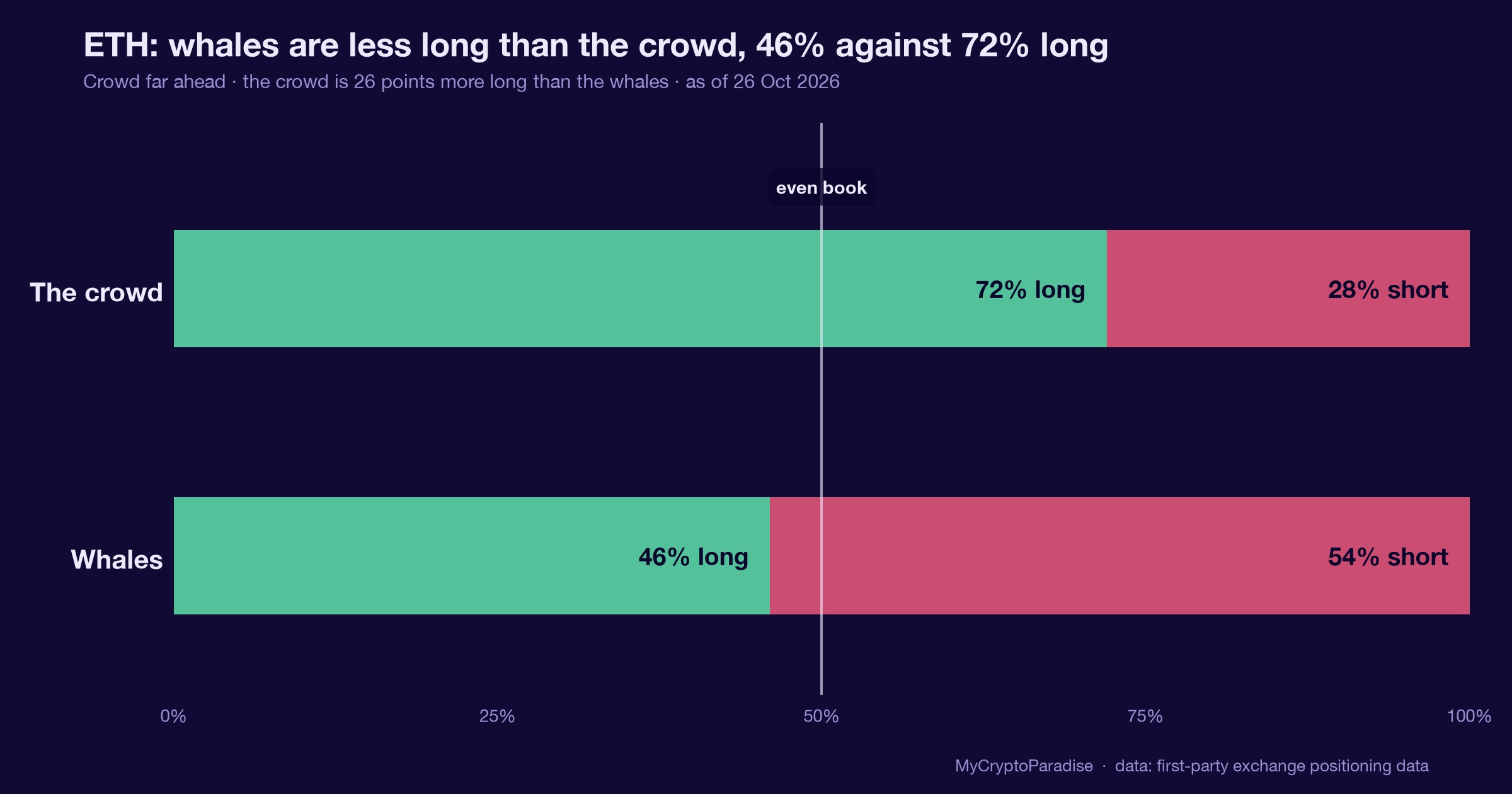
Retail has crowded into longs, stacking a large liquidation cluster below current price. Funding is heating up, a classic sign of crowded one-sided positioning.
That cluster is the real magnet. Bitcoin does not need an oil headline to drop toward it; it needs only the usual mechanics of a market clearing over-leveraged longs.
So the impact of the Iraq deal on crypto liquidity is, for now, close to zero. The impact of retail leverage is not. One is a footnote, the other is the plot.
The levels that decide the next BTC move
Forget the oil map and watch the tape. A handful of levels will tell you far more than any energy headline.
On the upside, $65,000 is the immediate ceiling, with $66,450 and $67,000 stacked above. A clean reclaim of the ascendant trend line near $64,700 as support would be the first genuine sign bulls are back in control.
Until that happens, rallies into resistance stay suspect. A daily MACD (moving average convergence divergence) bearish cross and an RSI (relative strength index) bearish cross both argue that this push is tiring, not accelerating.
The more important zone sits below. Support at $63,000 to $63,600 is the near-term shelf; lose it decisively and the path opens toward the deeper zone.
That deeper zone is $59,000 to $60,000, where the retail liquidation cluster lives. A sweep into it would be the market doing what it usually does: taking the money from the crowd that positioned late.
Invalidation of the cautious view is specific. Reclaiming $63,600 as support and pushing back through the trend line would suggest the dip thesis is wrong and bulls are defending early.
Confirmation of downside is equally specific. A rejection at resistance on weakening volume, followed by a break of $63,000, keeps the liquidation zone in play. Watch the 1-hour MACD histogram for any bullish divergence that hints bears are exhausting.
What this print means for liquidity and positioning
The ParadiseTeam reads this event as noise laid over a market that already had its own plan. The oil deal changes nothing about where the liquidity sits.
Our bias remains cautious with Bitcoin near $64,812. The risk-to-reward for chasing longs up here is poor, because price is pressing into resistance while momentum quietly rolls over.
Who benefits and who pays is the real question. Retail is loading longs and stacking a multi-billion dollar liquidation cluster below current price. That crowd is the fuel, not the driver.
Smart money tends to be patient in exactly this setup. The higher-probability long zone is $59,000 to $60,000, where those retail stops cluster, not $65,000 where the crowd is comfortable.
That gap between comfort and opportunity is the whole game. The crowd buys where it feels safe; the professional waits where it feels dangerous.
So the Iraq headline does not shift our levels. It does not add buyers, it does not drain sellers, and it does not move the liquidation magnet an inch.
What would change the read is structural, not geopolitical. A firm reclaim of $63,600 and the ascendant trend line would force a rethink toward strength. A rejection here and a loss of $63,000 keeps the deeper zone in play. The ParadiseTeam stays patient and lets the market come to the level, not the other way around.
Track it live: our live crypto funding rates and the crypto liquidation heatmap both update in real time, so you can watch this shift for yourself.
Related coverage
For exact entries, targets, and stop losses with full risk management, that is what ParadiseFamilyVIP is for. New to reading these moves? Start with our crypto trading strategies guide.
ParadiseTeam is monitoring the market situation closely, and we are taking these developments into consideration while building our trading tactics inside ParadiseFamilyVIP.
Crypto trading involves substantial risk. Prices are volatile and you can lose money. This article is educational and is not financial advice. Past performance does not guarantee future results.
Where does BTC go next from $64,812?
How the Paradisers are calling it
The first call is still open
Free account, no password. Members just sign in.





Join the discussion
No comments yet. Members, share how you are reading this.