

Listen: the breakdown
Developing story update (September 11, 2026, 04:42 UTC):
Update: based on our sources, the picture around this confrontation is wider than the Strait of Hormuz drone incident alone. Several US warplanes were reported damaged in an earlier Iranian strike on Muwaffaq Salti Air Base in Jordan, which points to a broader and more direct exchange rather than an isolated maritime event.
Price action so far remains muted. Bitcoin is near 77,085 and Ethereum near 2,458, both still modestly lower on the day, with no fresh hourly reaction to the news. That flat response likely reflects thin new liquidity and exhausted retail rather than the market dismissing the risk, so the setup stays skewed to the downside if headlines escalate further.
What to watch now: Watch for any official US confirmation or response to the reported air base damage, which could force a sharper risk-off move.
Developing story: This story is still unfolding. We are tracking it and will update this article as more details are confirmed.
Market briefing: Iran's Revolutionary Guards report attacking a US unmanned vessel in the Strait of Hormuz. Crypto barely flinched, with BTC near 76,767 dollars, down 2 percent on the day.
- Iran's Revolutionary Guards report attacking a US Saildrone-type unmanned vessel in the Strait of Hormuz
- The claim extends earlier reports of ten ships hit, including two US vessels and eight oil tankers
- BTC sits near 76,767 dollars, down 2 percent on the day, a muted reaction that tells its own story
A fresh security incident in the Strait of Hormuz just crossed the wires, yet Bitcoin barely moved. When a war headline fails to shift price, who is really in control?
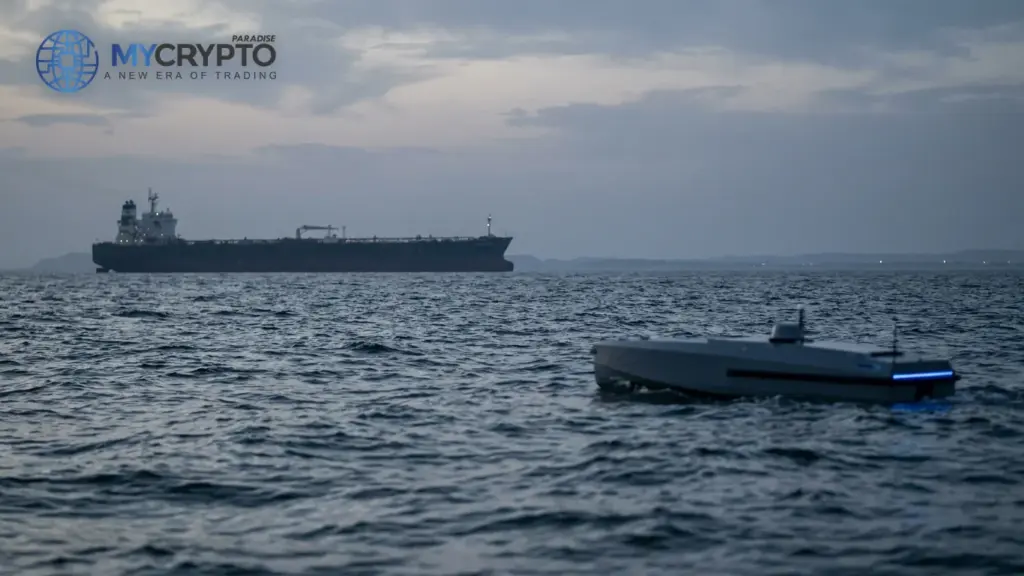
Iran's Revolutionary Guards say they attacked a US unmanned vessel in the Strait of Hormuz. State television described the target as a Saildrone-type craft, one report citing hull number 5838. The Guards claimed they thwarted its mission and destroyed it.
This is not an isolated line. The same force has previously claimed to have hit ten ships in the strait and wider Persian Gulf, among them two US vessels and eight oil tankers. Each claim adds another layer to an already tense corridor.
The Strait of Hormuz is one of the most sensitive stretches of water on earth. A meaningful share of the world's seaborne oil passes through it. So any incident there normally demands attention from every risk market at once.
And yet crypto shrugged. BTC traded near 76,767 dollars, down about 2 percent over 24 hours. ETH sat near 2,442 dollars, down 1.2 percent. Over the last hour, both barely moved.
That muted reaction is the real signal here. Markets that are genuinely frightened do not sit still when warships and drones enter the story. A tape this quiet after a headline this loud usually means the crowd is already positioned and simply exhausted.
So we treat this honestly. The incident is real and still developing. But it is not the reason crypto is soft. The bearish structure was already in place, and this news is background noise layered on top of it, not the catalyst driving the move.
A chokepoint tremor meets a weak tape
A Strait of Hormuz incident matters because of what the strait carries, not because of one drone. The corridor is a primary artery for global oil, so any threat there raises the tail risk of a supply shock. That risk normally lifts oil, strengthens the dollar as a haven, and pulls capital out of speculative assets. Crypto sits at the far, jumpy end of that chain.
The transmission runs in a clear order. Geopolitical tension raises global risk aversion. Risk aversion tightens liquidity in the assets furthest out on the curve. Reduced liquidity then shows up as thinner order books and sharper moves in BTC and ETH.
Here is the important part. That chain only bites hard when the shock is large enough to move oil and rates in a lasting way. This time, the market's own price action is telling us the shock has not cleared that bar. Oil-style fear has not spilled into a real crypto flush.
So the mechanism is present but weak. The headline adds to a general risk-off mood in traditional markets, which can quietly sap confidence and inflows into crypto over time. It is a slow drag, not a switch.
For traders, that distinction is everything. A confirmed supply shock would be a genuine macro driver worth respecting. A reported incident that the crowd ignores is a mood-setter. Right now we are firmly in the second case, and pretending otherwise would be forcing a story onto the tape.
Risk-off bid drains thin crypto liquidity
The liquidity impact of this incident is best measured by what did not happen. A true fear event drains bids from the riskiest assets first. BTC is the deepest crypto market, so it usually absorbs the first wave, then ETH softens, then alts get hit hardest as buyers step back.
We saw only the faintest version of that cascade. BTC slipped near 76,767 dollars, ETH eased toward 2,442 dollars, and neither broke down on the news. The 24-hour weakness looks like an existing downtrend continuing, not a fresh shock landing.
That matters for how alts trade from here. Alts depend on BTC and ETH holding liquidity above them. If the majors are drifting lower on internal distribution rather than panic, alts tend to bleed slowly and underperform, without the sharp capitulation wick that often marks a bottom.
Open interest, meaning the total value of live futures contracts, is the tell to watch. A geopolitical flush usually spikes liquidations and resets OI lower. A quiet grind lower with OI still elevated suggests late longs are trapped, not flushed, which leaves fuel below the market.
So the honest read is that this incident is not the liquidity event. It nudges sentiment at the margin. The dominant force remains the existing structure, where thin retail participation and no fresh inflows leave crypto vulnerable to further downside regardless of what happens in the strait.
Signals that separate noise from catalyst
The first thing to watch is oil, not crypto. If a Strait of Hormuz escalation starts to move energy prices and the dollar in a sustained way, this stops being background noise and becomes a real macro driver. Until oil confirms a supply-shock story, treat the headline as sentiment only.
Next, watch how BTC behaves around its recent range. A clean acceptance below the current area, with rising volume and expanding open interest, would confirm that sellers remain in control and that new local lows are the path of least resistance. That would validate the bearish structure already in place.
Invalidation looks different. A sharp reclaim of lost ground, on strong cumulative volume delta, meaning the running tally of aggressive buying minus selling, would suggest buyers are absorbing supply rather than fleeing it. A firm bounce that holds would tell us the distribution read is weakening.
Watch retail behaviour too. If funding stays flat and social volume stays quiet even as headlines escalate, that confirms an exhausted, disengaged crowd. Exhausted crowds rarely mark bottoms on their own.
Finally, watch for a second, independent catalyst. Today lacks a single confirmed same-day trigger, so the move is our interpretation of structure, not a proven cause. If a genuine driver arrives, inflows, an ETF flow shift, or a real Hormuz supply disruption, the picture can change fast. Keep risk defined and let confirmation, not the loudest headline, decide the next position.
Reading the muted dip through smart money
The ParadiseTeam read starts with a simple observation. Price near 76,767 dollars barely reacted to a war-adjacent headline, and that calm is informative. When bearish news lands and the market refuses to panic, it usually means the selling is controlled, not fearful.
On the higher timeframes our bias remains bearish, and this incident does not change it. We see distribution continuing into thin retail participation, with smart money offloading supply into every small bounce rather than being forced out by geopolitics.
Here the ParadiseTeam applies our core edge. Bearish news at strong support with retail capitulating often flags accumulation. That is not this. This is a soft tape with a disengaged crowd and no capitulation wick, which points to further downside toward new local lows before any durable turn.
We frame risk before reward. Late longs added into strength now sit above the market as fuel, and their stop-losses, meaning their pre-set exit orders, cluster just under recent lows. That pool of stops is exactly where a distribution phase tends to reach next.
So the ParadiseTeam treats this Strait of Hormuz story as a mood item, not a trade trigger. We want a real catalyst or a clean structural signal before leaning either way, and we keep any risk-to-reward, meaning potential reward against defined risk, honest and asymmetric. The market is being moved by internal supply and demand right now. The headlines are just scenery.
Track it live: our Crypto Fear and Greed Index and the live crypto funding rates both update in real time, so you can watch this shift for yourself.
Related coverage
For exact entries, targets, and stop losses with full risk management, that is what ParadiseFamilyVIP is for. New to reading these moves? Start with our crypto trading strategies guide.
ParadiseTeam is monitoring the market situation closely, and we are taking these developments into consideration while building our trading tactics inside ParadiseFamilyVIP.
Crypto trading involves substantial risk. Prices are volatile and you can lose money. This article is educational and is not financial advice. Past performance does not guarantee future results.







Join the discussion 4
i guess "priced in" could be a factor Milan but the futures basis barely budged either which feels like a stronger indicator for me that positioning wasnt aggressive enough to warrant a squeeze 🤔
Yea, for me a drone strike not moving BTC much is just how it is these days 🤔 - not like 2021 when everything was *so* volitile 💸. Now I just wait for the big news 🧘♀️.
Muted reaction" only tells us the market already priced in regional instability. The drone itself is a distraction.
Oh, so it was already factored in? I was wondering if maybe it's also because a drone isn't a manned ship. Sorry if that's a silly thought.