

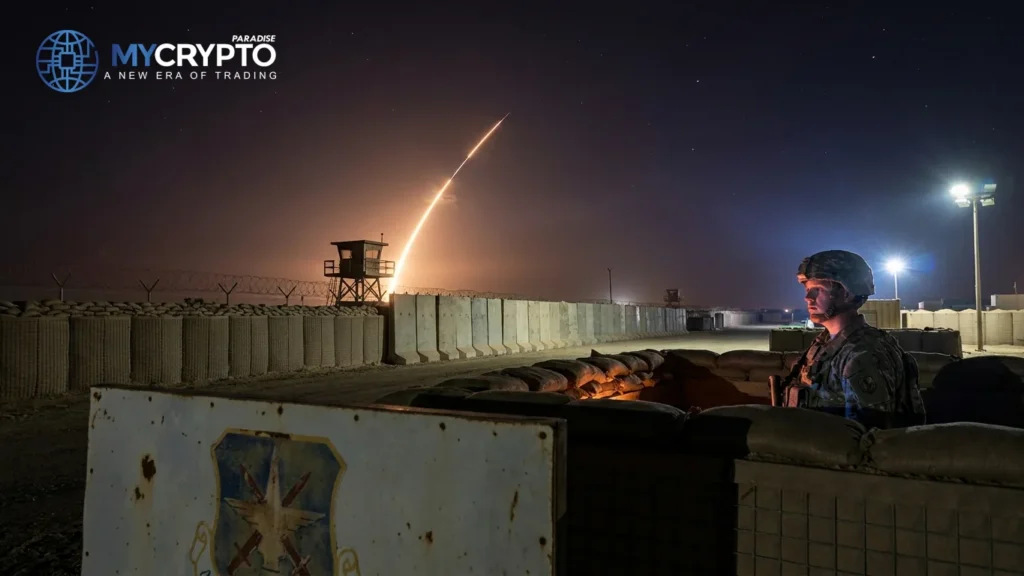
Developing story update (July 29, 2026, 12:02 UTC):
An important detail has been confirmed since we published: U.S. Central Command says every ballistic missile fired at U.S. forces in Jordan was intercepted, with no reported impact. That is a de-escalation signal rather than an escalation, and it removes some of the immediate war-premium pressure that pushed WTI crude up nearly 4%.
Bitcoin has absorbed the headline without breaking: price is roughly flat over the last hour and still up on the day near the $64,400 area. The lack of a fear reaction around the $63,440 to $63,600 support zone is the tell here. On probabilities this reads as underlying strength, and smart money would likely treat any retail-driven dip toward the $62,500 invalidation level as an accumulation opportunity rather than a reason to exit.
What to watch now: Whether BTC holds the $63,440 to $63,600 support now that the attack was fully intercepted, with $62,500 as invalidation.
Listen: the breakdown
Market briefing: Iran fired ballistic missiles at US forces in Jordan and CENTCOM says all were intercepted, oil jumped almost 4%, and Bitcoin held near $64,484, up 1.7% on the day.
- Iran's IRGC fired ballistic missiles at US forces in Jordan; CENTCOM confirmed the attack.
- CENTCOM stated every missile was intercepted, capping the immediate escalation risk.
- WTI crude jumped nearly 4% while Bitcoin held near $64,484, up 1.7% over 24 hours.
The Iran missile strike on a US base in Jordan should have crushed risk. Bitcoin held near $64,484 instead. So who is really buying this fear?
Iran's Islamic Revolutionary Guard Corps fired ballistic missiles at US forces in Jordan. US Central Command confirmed the attack. It also confirmed the part that changes everything: every missile was intercepted.
That single detail reframes the whole tape. A strike on US troops is the kind of headline that usually empties order books in minutes. The interception turned a potential war trigger into a contained incident, at least for now.
Markets still flinched where you would expect. West Texas Intermediate crude jumped nearly 4% on the familiar reflex of pricing supply risk from the Gulf. Oil always reacts first and asks questions later.
Bitcoin told a quieter story. It slipped 0.4% in the hour after the news, yet still sat near $64,484, up 1.7% over 24 hours. A missile attack on US forces produced a rounding error on the daily candle.
We covered the overnight escalation and the oil surge earlier today. What is new here is the interception and the market's refusal to panic on it.
That gap between the headline and the price is the actual event. When a genuine geopolitical shock lands and Bitcoin barely moves, the tape is telling you who already positioned before the crowd arrived. The fear is real. The follow-through, so far, is not.
Why intercepted missiles change the risk math
Geopolitics moves crypto through one channel: liquidity and the price of safety. A strike on US forces raises the odds of a wider war, and wider wars mean higher oil, higher inflation expectations, and a harder line from central banks. That chain normally drains risk assets first.
The interception short-circuits that chain. No US casualties reported, no runway to immediate retaliation priced as certain, and the escalation premium starts to bleed back out almost as fast as it came in.
Oil is the tell. A near 4% jump in WTI crude is the market buying insurance against Gulf supply disruption. It is a real move, but it is a fear move, not a confirmed shortage. If the ceasefire framework holds, that premium tends to unwind.
That matters for Bitcoin because the inflation and rate story runs straight through it. Sticky oil keeps central banks cautious and liquidity tight, which pressures long-duration risk. Fading oil does the opposite.
Here is the honest part. The direct link from one intercepted strike to Bitcoin's price is thin. What we are really reading is positioning and sentiment, not a mechanical cause. So we frame it as analysis, not fact: the news supplied the fear, and the fear is what smart money tends to buy from.
How the shock rippled from oil to alts
The cascade started in commodities. Oil led, jumping nearly 4% as the first reflex trade. Crypto sat downstream, waiting to see whether the conflict widened or capped.
Bitcoin absorbed the hit and held. The 0.4% hourly dip against a 1.7% daily gain is not capitulation. It is a market that priced a scary headline and then declined to extend the move, which usually means sellers were thin and buyers were waiting.
That holding pattern in BTC matters most for everything below it. Bitcoin is the risk gate for the whole asset class. When it refuses to break on genuinely bad news, the pressure that would normally flush ETH and the alts never fully arrives.
Ethereum typically amplifies whatever Bitcoin does, up or down. A contained BTC dip means ETH avoids the sharper drawdown that a real risk-off cascade would force. Stability at the top buys stability one layer down.
The alts are the honest fear gauge. In a true panic, thin liquidity there breaks first and hardest. The fact that nothing snapped suggests the leverage was cleaner than the headline implied, and forced selling stayed muted.
The read is simple. A war headline that fails to move price is not a weak market. It is a market where the nervous money already left and stronger hands are quietly setting the floor.
What confirms or breaks the calm from here
The first thing to watch is oil, not Bitcoin. If WTI crude gives back a large share of its nearly 4% jump over the coming sessions, the escalation premium is unwinding and the risk-off case weakens fast.
The second is any sign of a US response or a second Iranian strike. Interception bought calm, but the situation is live. A confirmed retaliation would reopen the whole risk trade and override the current stability.
On the chart, the structure is clean. Holding the current support zone keeps the bullish case intact and treats this dip as noise inside a larger move higher.
Invalidation is specific. A decisive break and hold below $62,500 would flip the near-term structure and force a rethink, regardless of how the geopolitics reads. Below that, the $60,000 to $59,000 band is where we would expect stronger, higher-timeframe buyers to step in.
Confirmation comes from momentum, not price alone. We want to see the 4-hour bullish divergence mature into a series of higher lows on momentum, a clean MACD (moving average convergence divergence) cross, and Stochastic RSI (relative strength index) turning up from oversold.
Upside is capped until the levels break. $69,000 is the first real 4-hour resistance. Reclaim and hold there, and $72,000 opens up. Fail on a bearish divergence into resistance, and that stall is where distribution usually hides. So watch which side of the fear the tape actually trades.
What the intercepted strike means for positioning
The ParadiseTeam reads this through one lens: who is buying the fear and where their stops sit. A missile strike on US forces is exactly the kind of headline that makes retail sell the low. That is usually the wrong side.
With Bitcoin near $64,484 and holding the current support zone, this dip fits the pattern of a final shake before continuation, not the start of a breakdown. The 0.4% hourly wobble on genuinely bad news is a fear print, not a trend.
We frame the near-term structure as bullish while $62,500 holds. That level is the line in the sand. Lose it decisively and the accumulation thesis is wrong; we respect that, not argue with it.
The mechanism favours patient buyers. Momentum is building a bullish divergence on the 4-hour, with RSI and Stochastic RSI turning from oversold. That is the footprint of stronger hands stepping in while headlines scare weaker ones out.
Stops are the map. Retail long stops likely sit just under support and below $62,500, which is exactly where a fast wick would hunt liquidity before reversing. Short stops build up toward $69,000.
So the risk-first stance is this. Above $62,500, the higher-probability path leans toward $69,000 and, on strength, $72,000 to $79,000. Below it, we stand aside. Probabilities, not promises. The interception lowered the tail risk; it did not remove it.
Track it live: our Crypto Fear and Greed Index and the live crypto funding rates both update in real time, so you can watch this shift for yourself.
Related coverage
For exact entries, targets, and stop losses with full risk management, that is what ParadiseFamilyVIP is for. New to reading these moves? Start with our crypto trading strategies guide.
ParadiseTeam is monitoring the market situation closely, and we are taking these developments into consideration while building our trading tactics inside ParadiseFamilyVIP.
Crypto trading involves substantial risk. Prices are volatile and you can lose money. This article is educational and is not financial advice. Past performance does not guarantee future results.
Does Bitcoin hold above $62,500 and push toward $69,000 from here?
How the Paradisers are calling it
The first call is still open
Free account, no password. Members just sign in.







Join the discussion
No comments yet. Members, share how you are reading this.