

Listen: the breakdown
Developing story update (September 10, 2026, 02:51 UTC):
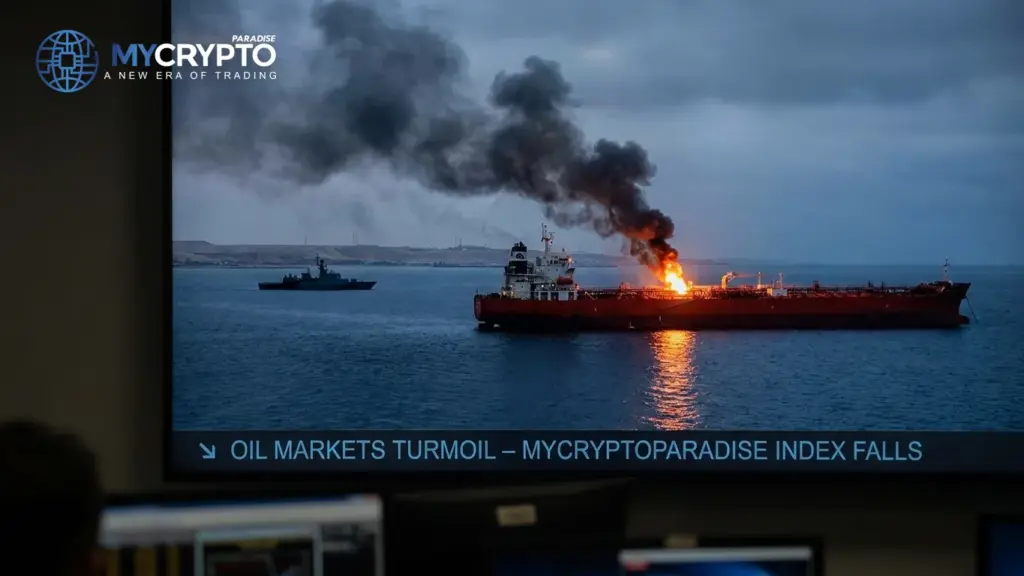
The picture in the Strait of Hormuz has sharpened. Based on our sources, Iranian state media now describes the earlier blast as an oil tanker being hit, rather than an unspecified explosion. The Revolutionary Guard maintains that targeted vessels had entered an area it calls forbidden and unsafe, and shipping through the strait remains below its 10-day average after being largely blocked since late February.
The market reaction stays contained. Bitcoin is holding around $78,200 and Ethereum near $2,470, both down under 1 percent on the day. A confirmed strike on a tanker raises the tail risk around energy supply and regional escalation, but for now traders are absorbing it rather than repricing sharply, which is consistent with a market already in slow distribution rather than one reacting to a fresh shock.
What to watch now: Whether a confirmed tanker strike draws an official shipping, insurance, or military response that finally moves oil and forces a crypto risk repricing.
Developing story update (September 10, 2026, 02:29 UTC):
The reported blasts have widened beyond the Strait of Hormuz and Jask to additional points along Iran’s southern coast, with explosions now reported near Bandar Abbas, Minab, and Sirik. Based on our sources, this broadens the affected area rather than confining it to the strait alone.
Crypto’s response stays muted. Bitcoin holds near $78,000 and is down about 1% over 24 hours, with Ether little changed, so this remains an escalating geopolitical risk sitting on top of an already weak, distribution-phase market rather than a fresh, sharp catalyst. Traders should treat headline risk as a probable accelerant of existing downside, not as a standalone driver.
What to watch now: Whether the widening blast reports trigger any confirmed disruption to regional energy flows or a sharper risk-off move.
Developing story update (September 10, 2026, 01:24 UTC):
The reported blasts appear to be widening geographically. Alongside the earlier reports near Jask and Qeshm Island, explosions have now been heard near Minab and Sirik, based on our sources. This points to activity spread across a broader stretch of the southern Iranian coast rather than a single isolated location.
For traders, the market read has not changed. Bitcoin and Ethereum are still showing only slight negative movement, with BTC near $78,232 and both assets down under 1 percent on the day. The muted price reaction to a wider set of reported incidents continues to suggest thin new inflows and a market already positioned for downside, which keeps the higher timeframe bias tilted risk off.
What to watch now: Whether reported incidents keep spreading along the coast or any official confirmation of vessel damage lifts oil and risk volatility.
Developing story update (September 10, 2026, 00:41 UTC):
Update: the confrontation around the Strait of Hormuz has escalated. Iran’s IRGC now states it directly struck American vessels and oil tankers in the strait, a sharper claim than the earlier line that ships had simply crossed a zone it called ‘forbidden and unsafe’. A senior Iranian official also warned the United States of ‘dark months ahead’, based on our sources.
For traders the setup is little changed on the tape: BTC is near $78,239 and ETH near $2,468, both slightly negative on the day with small hourly bounces. The risk is not this hour’s price but the tail: a direct US-Iran naval exchange is the kind of macro trigger that can spark the flush to new local lows into which larger players have been distributing. Watch for any confirmed US response, since that is what could move risk assets in size.
What to watch now: Any confirmed US military or official response to the IRGC claim of hitting American vessels.
Developing story update (September 10, 2026, 00:19 UTC):
Update: based on our sources, the disruption at the Strait of Hormuz is deeper than an early dip in traffic. Shipping through the strait has been largely blocked by Iran since February 28, 2026, in the wake of US and Israel air strikes against Iran, which reframes the recent blasts as part of an extended standoff rather than an isolated incident.
For traders, this raises the probability that an energy supply premium stays in the background as a macro risk factor. Crypto is not reacting sharply so far, with BTC around $78,281 and ETH around $2,468 and only small mixed moves, which suggests smart money has already positioned and retail is largely absent. A sustained blockage could still act as the macro trigger for a flush to new local lows rather than a direct upside catalyst.
What to watch now: Whether the blockage stays in place or eases, and any energy price spillover that forces a broader risk-off move in crypto.
Developing story update (September 09, 2026, 23:58 UTC):
Our sources now confirm additional reports of explosions near Qeshm Island within the Strait of Hormuz, expanding the geographical scope of the reported incidents.
Crucially, shipping traffic through the Strait of Hormuz has now fallen below its 10-day average, indicating a measurable impact on this critical global energy choke point.
While these developments add to geopolitical uncertainty, crypto markets, with BTC and ETH showing minor downside, continue to reflect a broader risk-off sentiment rather than a safe-haven flight. Smart money likely continues its distribution strategy amidst these reinforcing headlines.
What to watch now: Monitor further reports of specific targets or confirmed damage, and any official responses impacting shipping routes.
Developing story update (September 09, 2026, 23:37 UTC):
Our sources now confirm that U.S. forces directly targeted and hit IRGC-linked oil tankers in the region. This development clarifies the extent of direct engagement by the United States in the ongoing conflict.
This escalation adds another layer of geopolitical risk, which smart money continues to factor into its distribution strategy. Traders should monitor for further direct actions from either side, as this could impact broader market sentiment.
What to watch now: Monitor for further direct military engagements and their impact on global energy markets and broader risk assets.
Developing story update (September 09, 2026, 23:17 UTC):
Our sources confirm Iran now claims two U.S. vessels and eight oil tankers were attacked in the Gulf, providing more specific details on the reported incidents in the Strait of Hormuz. This quantification offers a clearer picture of the alleged scale of the recent engagements.
In a direct market reaction, oil prices are nearing $100 a barrel. This significant surge underscores the heightened geopolitical risk in a critical global shipping lane, potentially signaling broader economic volatility that crypto traders should monitor closely.
What to watch now: Monitor ongoing geopolitical tensions and their impact on global energy markets and broader economic sentiment.
Developing story update (September 09, 2026, 22:56 UTC):
Based on our sources, a further oil tanker has now been reported hit near Dubai, with the crew casualty being the first confirmed loss of life tied to this escalation. The named location broadens the incident beyond the Iranian coast into busier Gulf shipping lanes.
For traders the read does not change from a fresh casualty alone. BTC near $77,900 and ETH near $2,452 remain only slightly lower on the day, consistent with methodical distribution rather than panic. A confirmed death and a wider blast radius raise the probability of a sharper risk-off move if energy or shipping headlines accelerate, so watch the $77,700 and $77,000 support zones for a decisive break.
What to watch now: Whether the widening incident zone toward Dubai forces a break of the $77,700 and $77,000 BTC supports.
Developing story update (September 09, 2026, 22:15 UTC):
A new element has been added to the Strait of Hormuz situation: based on our sources, the naval arm of Iran’s Revolutionary Guard reportedly captured a U.S. unmanned submarine at the entrance to the strait. This widens the confrontation beyond the earlier reports of struck tankers and vessels.
For traders, the read is unchanged so far. Bitcoin near $77,900 and Ethereum near $2,450 are still down under 1.5 percent on the day, a muted response to escalating headlines. That continued lack of a sharp move is consistent with an exhausted retail base and ongoing distribution, and probably keeps the bias tilted toward further downside to local lows rather than a fresh catalyst.
What to watch now: Watch for official U.S. confirmation or response to the reported submarine capture and any oil-price spike that could feed back into crypto risk sentiment.
Developing story update (September 09, 2026, 21:34 UTC):
Update: based on our sources, Iran’s Revolutionary Guard Navy has now captured a U.S. military unmanned submarine at the entrance to the Strait of Hormuz. This is a fresh escalation on top of the earlier reported blasts, tanker strikes and the shipping blockage in place since late February.
For traders the takeaway is unchanged in direction but stronger in intensity: the risk-off backdrop is deepening rather than resolving. Bitcoin near $78,250 and Ethereum near $2,469 are still showing only minor intraday moves, so the market has not yet priced a sharper flare-up. Any headline-driven flight-to-safety bounce is more likely to be used by larger players to keep offloading than to start a durable rally.
What to watch now: Watch for an official U.S. or Iranian response to the submarine capture and whether it forces a real crypto volatility spike beyond the current flat tape.
Developing story update (September 09, 2026, 21:13 UTC):
The escalation has now reached Kharg Island, Iran’s main oil export terminal, where several blasts were reported on Tuesday. A strike on that specific node matters far more to oil supply than earlier open-water incidents, and it keeps a hard floor under crude prices already pressing toward $100 a barrel.
Iran has also put a firmer number on its retaliation claim, saying two U.S. vessels and eight tankers were hit in the Gulf. For crypto the read is unchanged: BTC near $78.2K and ETH near $2,469 are still moving less than 1 percent, so this remains a macro risk-off backdrop being absorbed by weak structure rather than a flight into crypto. We continue to lean bearish on higher timeframes and would expect short-term bounces to be faded.
What to watch now: Whether the Kharg Island damage forces a confirmed cut to Iranian oil export volumes, which would push crude through $100 and sharpen the risk-off tone.
Developing story update (September 09, 2026, 20:52 UTC):
The confrontation in the Strait of Hormuz has widened. Based on our sources, Iran has seized a U.S. underwater drone at the entrance to the strait today, and reports indicate Iranian ballistic missile launches toward a U.S. aircraft carrier and a navy destroyer preceded the earlier U.S. strikes.
For traders, the more important read is oil, which is now nearing $100 a barrel. A sustained energy spike is the channel through which this conflict could eventually pressure risk assets, even though crypto itself remains muted.
BTC and ETH are still holding sub-1% 24h moves. That muted reaction continues to line up with a distribution phase rather than any flight-to-crypto-safety bid, and we would treat strength into this news with caution rather than chase it.
What to watch now: Watch whether oil holds above $95 to $100; a sustained energy spike is the real risk-off channel into crypto.
Developing story update (September 09, 2026, 19:50 UTC):
UPDATE: The picture around the Strait of Hormuz has widened. Based on our sources, at least five people were killed earlier in the week during a US action in the area, and Iran now claims its forces targeted a further 10 ships attempting to transit the strait, on top of the tankers already reported struck.
Context traders were missing: shipping through Hormuz has reportedly been largely blocked since late February, after an air campaign launched against Iran by the United States and Israel. This is a prolonged disruption, not a one-day flare-up, which is part of why the market reaction stays muted.
Despite the escalation, Bitcoin and Ethereum remain flat to slightly lower, with BTC near $78,300 and ETH near $2,471. This continues to point to low retail participation and a market where smart money is likely observing rather than reacting, keeping the probability of a further flush to local lows in play.
What to watch now: Whether a formal Hormuz shipping halt or a new named state actor forces a real volatility spike in oil and crypto.
Developing story update (September 09, 2026, 19:09 UTC):
There is now a confirmed human toll attached to this episode: at least five people were killed earlier in the week during a U.S. strike on Iranian oil tankers, based on our sources. This hardens what had been a series of vessel-damage reports into a confirmed loss of life and raises the stakes for any further Iranian retaliation.
For traders, the immediate crypto reaction stays muted. Bitcoin is near $78,381 and Ethereum near $2,478, both roughly flat over 24 hours, so the market is still absorbing this inside the existing risk-off, higher-timeframe bearish structure rather than treating it as a fresh directional catalyst. Confirmed casualties raise the probability of escalation, but so far there is no sign of a panic bid or a capitulation flush from this alone.
What to watch now: Whether confirmed casualties trigger a fresh Iranian or U.S. escalation step that finally moves oil and forces a risk-off crypto flush.
Developing story update (September 09, 2026, 18:48 UTC):
Iran’s Revolutionary Guard has now put an official framing on the incident, stating the vessels involved had attempted to cross a zone of the Strait of Hormuz it designates as forbidden and unsafe. Based on our sources, this is the first formal justification attached to the strikes, which raises the probability that Iran intends to enforce access restrictions on the corridor rather than treat this as a one-off exchange.
For traders the read is unchanged in the immediate term: Bitcoin and Ethereum are still barely moving, with BTC near 78,500 and both assets showing only fractional 24-hour declines. The market continues to absorb the headlines inside its existing bearish structure, and an official enforcement posture on Hormuz keeps the energy-shock risk live as a slow-burn catalyst rather than a sudden one.
What to watch now: Whether Iran actually enforces the 'forbidden' Hormuz zone on further shipping, and any energy-price spillover into risk assets.
Developing story update (September 09, 2026, 18:06 UTC):
The picture around the Strait of Hormuz has widened since our first report. Based on our sources, Iran now says its forces targeted a further 10 ships attempting to pass through the strait, in addition to the eight oil tankers and two U.S. vessels it had already claimed to have struck in retaliation for U.S. strikes on five Iranian tankers.
A human cost has also been confirmed. At least five people were reported killed earlier in the week during U.S. strikes tied to this escalation.
For traders, the read is unchanged despite the heavier headline. Bitcoin near $78,747 and Ethereum near $2,493 are still only marginally positive over 24 hours, with no meaningful risk-off flight to safety. A muted reaction to a wider conflict at a major oil chokepoint continues to suggest thin new liquidity and an exhausted market, which keeps the probability of further downside in focus before any durable reversal.
What to watch now: Whether the confirmed casualties and the wider ship count trigger any delayed risk-off move in oil or crypto.
Developing story: This story is still unfolding. We are tracking it and will update this article as more details are confirmed.
Market briefing: Explosions were reported near the Strait of Hormuz and an oil tanker was said to be hit, yet Bitcoin held near $78,831 and barely moved. The calm is our concern, not our comfort.
- Blasts were reported near the Strait of Hormuz and the port of Jask, with state media citing a tanker strike.
- Shipping through the strait has been largely blocked by Iran since 28 February 2026 after an air war began.
- Bitcoin sat near $78,831, up 0.3% on the day, showing almost no reaction to a major energy shock.
A tanker blast near the Strait of Hormuz just rattled global oil markets, yet Bitcoin barely moved past $78,800. So what is that eerie calm really hiding?
Explosions were reported near the Strait of Hormuz and the southern Iranian port city of Jask. State broadcaster IRIB said an oil tanker had been hit. The IRGC claimed the targeted vessels had crossed an area it labelled forbidden and unsafe.
This is not an isolated flashpoint. It sits inside a wider conflict that has run for months. Shipping through the strait has been largely blocked by Iran since 28 February 2026, after the United States and Israel launched an air war against Iran.
The violence has escalated in stages. Iranian state media claimed its forces struck eight oil tankers and two U.S. vessels, and targeted another ten ships. The U.S. military said it destroyed five Iranian oil tankers after attempted strikes on its warships. At least five people were killed earlier in the week during a U.S. action. Several blasts were heard on Iran's Kharg Island on Tuesday.
Here is what should stop you. The Strait of Hormuz moves close to a fifth of the world's seaborne oil. An attack on a tanker there is the kind of headline that normally jolts every risk asset on the screen.
And yet Bitcoin barely blinked. It was trading near $78,831 as of the latest print, up around 0.3% on the day. Ethereum sat near $2,495, almost flat. A missile finding a tanker in the planet's most important oil corridor produced a shrug in crypto. That gap between the noise and the price is the real story.
A choke point for a fifth of seaborne oil
The Strait of Hormuz is not just a map feature. It is the narrow gate through which a huge share of global crude and gas must pass. Disrupt it, and the price of energy for the whole world moves.
The transmission chain is simple to state. A tanker strike threatens oil supply. Threatened supply lifts crude prices. Higher energy costs feed inflation. Sticky inflation keeps central banks cautious and liquidity tight.
Tight liquidity is the enemy of risk assets. Crypto lives or dies on the flow of abundant liquidity. When that flow slows, speculative bids thin out first, and Bitcoin usually feels it before most.
So the textbook reaction to this news is risk-off. Money should rotate toward safety. Bitcoin, still traded as a high-beta risk asset in these windows, should have sold on the headline.
It did not. That refusal to react is what matters more than the blast itself. A market that ignores a genuine supply shock is telling you something about who is left holding it.
In our read, the muted print is not strength. It is thinness. New money is not arriving to bid the dip or chase the fear. The people who wanted in are already in. When a market stops responding to news that should move it, the marginal buyer has usually gone quiet, and only the sellers still have work to do.
Why crypto barely twitched on the news
Start with the reaction that did not happen. There was no flight to safety into Bitcoin, and no panic dump either. Both would have been a real signal. Instead the tape gave us almost nothing.
Bitcoin held near $78,831, a rounding error from where it opened. Ethereum tracked it, flat near $2,495. In a normal cascade, BTC leads, ETH follows, and alts amplify the move in both directions. Here the chain barely fired at all.
That stillness is the tell. A slightly green print on a day like this looks like calm. We read it as absorption. Someone is quietly meeting demand and supplying coins into every small bounce, keeping price pinned while positions change hands.
This is what distribution often looks like from the outside. Not a crash. A drift. Price stays boring while ownership moves from patient hands to tired ones.
The alt market makes it clearer. With no fresh liquidity entering, there is nothing to power a broad risk bid. Alts need Bitcoin strength plus new money, and today they have neither.
So the muted reaction is not the market shrugging off risk with confidence. It is a market too thin and too tired to price the risk properly. That is a fragile place to be. Fragile markets tend to move suddenly once the absorption runs out, and the direction is rarely kind to the last buyers.
Oil, the dollar, and the $77,700 line
Watch oil first, because oil is the messenger here. A sustained spike in crude confirms the market takes the supply threat seriously. If oil rips while Bitcoin stays heavy, the tightening-liquidity pressure on crypto grows, not fades.
Watch the dollar next. A firm dollar and firm oil together are a classic squeeze on risk assets. That combination would strip away any excuse for a crypto bounce.
Then watch our levels. Bitcoin has broken below the $79,000 zone and is now retesting $77,700 as the next key support. That line is the hinge for the near term.
Invalidation of the bearish case would be a clean reclaim of $77,700 from below, with rising volume, and price holding back above $79,000. That would suggest the shock was absorbed by buyers, not sellers. We would respect that and step back.
Confirmation of the bearish case is the opposite. A loss of $77,700, then $77,000, on a market that still refuses to bounce on bad news, points toward the deeper support at $58,000 that we expect to eventually give way.
The key question is honest to ask. Is this a genuine catalyst, or noise on an already-tired chart? There is no single confirmed same-day trigger for the price action. So treat the geopolitics as context, not proof. The structure was heavy before this blast, and one headline does not rewrite it.
What the silent tape says about liquidity
The ParadiseTeam sees the absence of a reaction as the signal, not the presence of one. A major oil-corridor strike met a flat crypto tape. On our higher timeframes, that fits a market being distributed, not accumulated.
The backdrop is a bearish weekly and daily bias, with price already broken below $79,000. Bitcoin near $78,831 is now retesting $77,700, the next key support. On our read, smart money accumulated far lower, near $61,000, and has since offloaded most of it without moving price much.
So when a real shock lands and nobody bids the fear, it confirms the picture. Retail participation is near record lows. New money is not arriving. The last natural buyers have mostly already bought, often at higher prices.
That is the trap. Retail sees a green candle on scary news and reads resilience. We read a thin book being managed lower. Momentum indicators have crossed down, volume is fading on rallies, and the structure points to one more flush.
Our invalidation is clear and honest. A strong reclaim of $77,700 with real volume, holding back above $79,000, would force us to reassess. Until then the levels that matter sit below: $77,000, then the $58,000 zone we expect to break.
Probabilities, not promises. The muted reaction to a Hormuz blast leans bearish because it exposes who is missing from this market. When the crowd has stopped showing up, the path of least resistance is usually the painful one.
The read behind this: we framed this story through our own market analysis, Bitcoin Breaks $79K: Where Is Next Support?
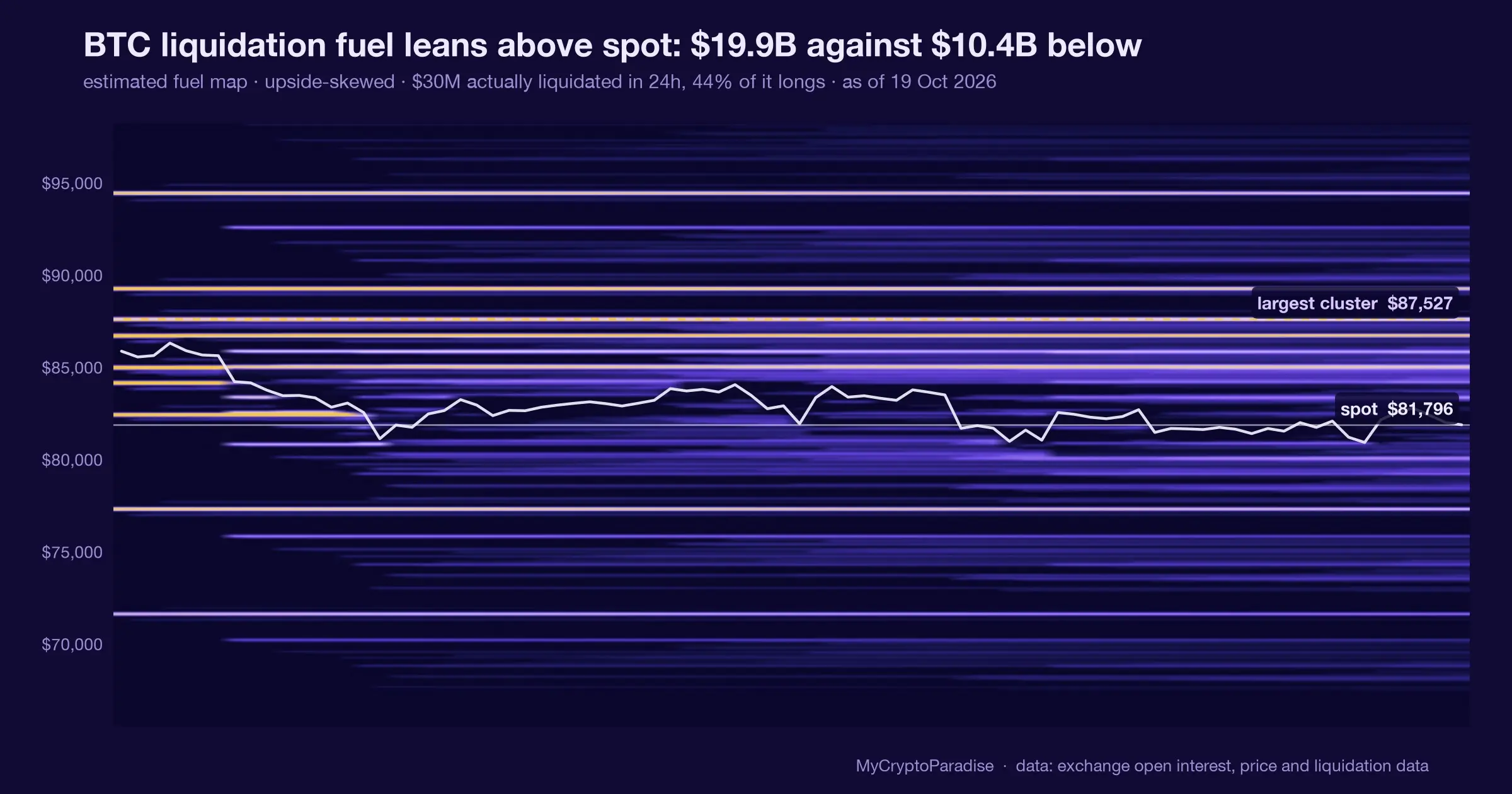
Track it live: our Crypto Fear and Greed Index and the crypto liquidation heatmap both update in real time, so you can watch this shift for yourself.
Related coverage
For exact entries, targets, and stop losses with full risk management, that is what ParadiseFamilyVIP is for. New to reading these moves? Start with our crypto trading strategies guide.
ParadiseTeam is monitoring the market situation closely, and we are taking these developments into consideration while building our trading tactics inside ParadiseFamilyVIP.
Crypto trading involves substantial risk. Prices are volatile and you can lose money. This article is educational and is not financial advice. Past performance does not guarantee future results.
After the Hormuz blast, where does Bitcoin go from $78,800 next?
This is how 15 Paradisers are calling it. Tap your call.
No calls on this one yet. Tap yours to be the first.
Free account, no password. Members just sign in.







Join the discussion 1
It is true the move was muted, but is it not also the case that $78,000 has been a consistent pivot point for several weeks now, regardless of external factors?