

Listen: the breakdown
Market briefing: Greece just approved a 10% tax on crypto gains and 15% on staking and DeFi income, but it only bites in 2027. BTC was near $75,929, down over 5% on the day, and that red is coming from somewhere else entirely.
- Greece approved a 10% tax on crypto capital gains, effective January 1, 2027.
- Staking and DeFi income face a 15% rate; net annual gains under 500 euros stay exempt.
- The policy is long-dated and local; today's 5% BTC drop reflects broader risk-off, not this law.
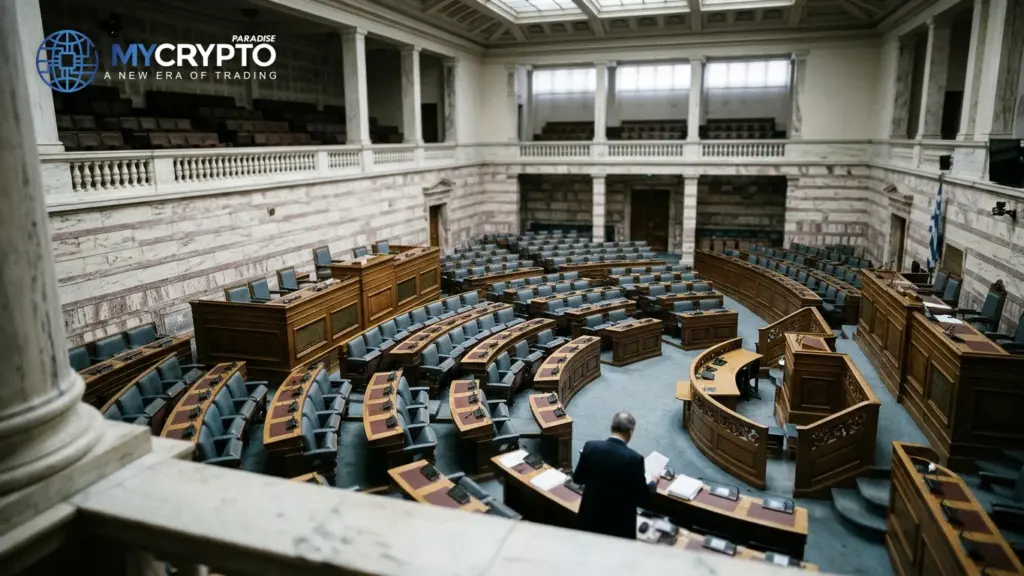
Source: Hellenic Parliament
Greece just approved a 10% crypto tax that lands in 2027, yet your screen is bleeding today. So why does a slow regulatory headline get breaking-news panic while the real driver hides in plain sight?
Greece has approved a 10% tax on cryptocurrency capital gains. It takes effect on January 1, 2027.
The same law adds a 15% rate on staking and decentralised finance income. Smaller holders get a break: net annual crypto gains that stay under 500 euros fall outside the charge. In plain terms, Athens has drawn a line, handed itself more than a year of runway, and left room for the modest retail investor to pass underneath it.
This is a single jurisdiction writing rules for a future tax year. It is not a seizure, a ban, or a forced sale. Nothing about it demands that anyone move a single coin this week. Which makes the timing almost comic. The headline arrived into a tape that was already falling hard, and the two facts got welded together by reflex.
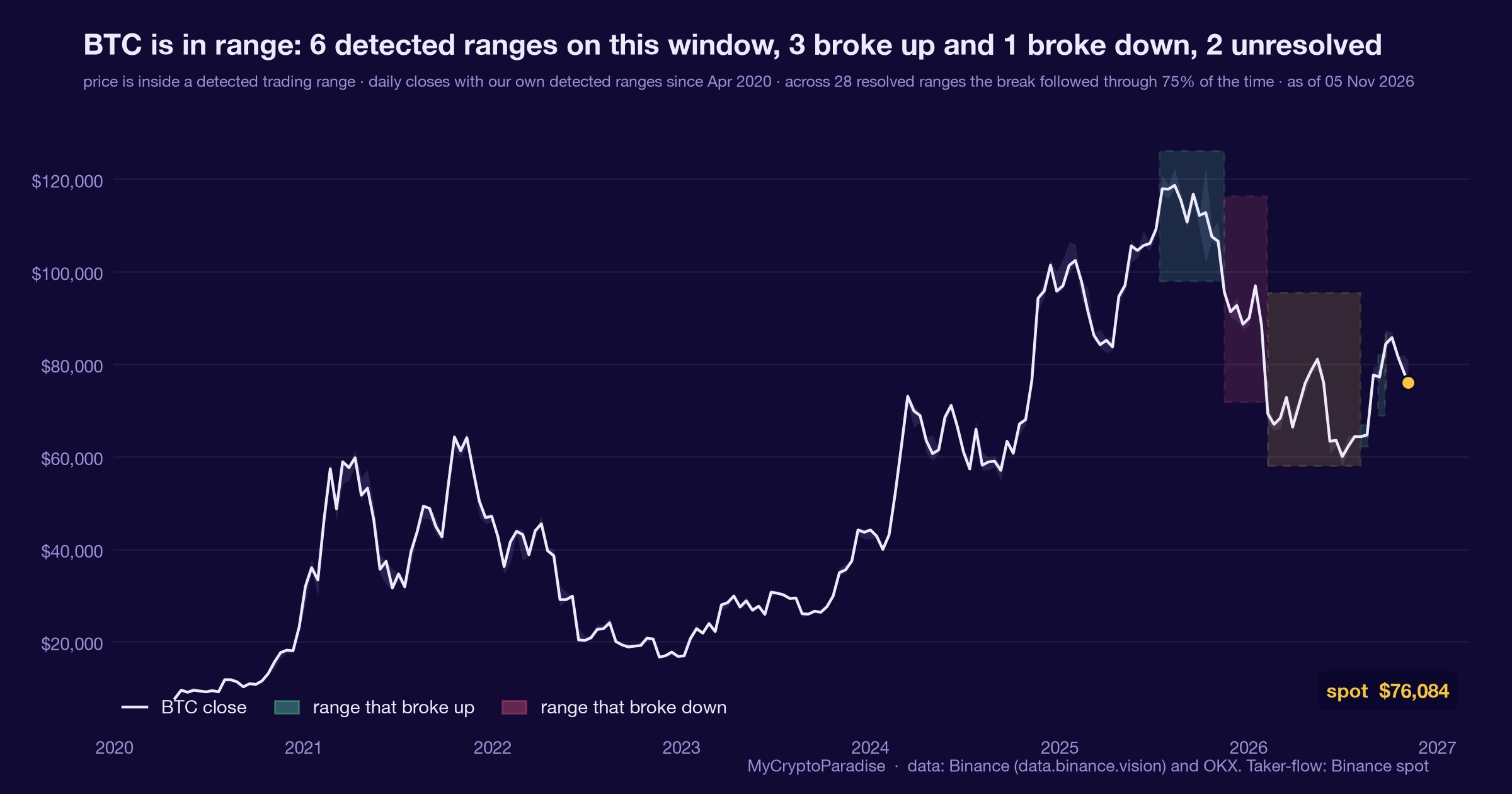
Because the facts on the screen tell a different story. BTC was trading near $75,929, down more than 5% on the day, while ETH shed closer to 8%. A tax that collects its first euro in 2027 does not produce that kind of same-session damage.
So we separate the two threads cleanly. The Greek law is a confirmed, real piece of regulation with a long fuse. The selloff is a broad, risk-off move across majors, and it is not explained by one country's capital-gains schedule. Treating a slow-burn policy as the cause of a fast move is exactly how traders mislabel a market.
A long fuse on EU crypto taxation
The mechanism here is friction, not force. A 10% gains tax raises the long-run cost of trading and holding crypto for one group of EU investors. It does not drain liquidity today, and it does not change the supply of coins on exchanges this quarter.
Transmission runs through behaviour over years, not through order books this week. When a tax takes effect in 2027, it slowly shapes how often people realise gains, how they structure positions, and whether they chase short-term moves. That is a gradual, local adjustment, and the 500-euro exemption deliberately spares the smallest accounts.
For the wider market, the signal that matters is direction of travel. More EU states are formalising crypto inside normal tax codes. That is a sign of maturing regulation, which over time tends to support institutional comfort rather than undermine it. But maturity is not a catalyst. A rule you can plan around for fourteen months does not force anyone's hand, so it rarely moves macro liquidity on the day it is announced.
The honest read is that this headline changes the compliance picture for Greek retail and nudges the EU framework forward. It does not tighten global liquidity, pull capital out of the asset class, or alter the rate environment that actually drives risk appetite. Those are the levers that move BTC and ETH, and none of them turned today because of Athens.
Why spot barely registers the Greek levy
Look at the clock on the policy and the price action separates itself. On the hour, BTC and ETH were essentially flat, moving a fraction of a percent, while the 24-hour tape showed the real damage. A delayed, exempt-floored tax simply has no channel to hit spot flows in a single session.
The liquidity cascade people fear from regulation runs driver to macro to BTC to ETH to alts. Here, the first link is missing. There is no immediate macro effect, so there is no fresh selling pressure flowing down into the majors from this specific law.
That leaves the actual decline needing a different author. A broad risk-off move was already underway across the board, and crypto sat inside it rather than leading it. BTC near $75,929 and ETH down close to 8% is the fingerprint of wider deleveraging, not a Greek tax form.
The cleaner framing is a disconnect. A regulatory story is getting emotional weight it has not earned, while the heavier force moving your portfolio is less headline-friendly.
For alts, the read is the same, only amplified. They carry more beta to risk sentiment, so they fall harder when majors wobble, and they too are reacting to the broad tape, not to Athens. In liquidity terms, this law is background noise against a foreground of genuine selling that started somewhere else.
Separating the tax headline from the tape
The thing worth tracking is whether this policy spreads, not whether it sold anyone today. If other EU members move toward similar gains taxes, the long-run framework tightens and the compliance cost for European retail rises across the bloc. That is a multi-year watch item, and it confirms a direction of travel rather than a trade.
Nearer term, keep the Greek story and the selloff in separate columns. If BTC stabilises while this headline is still circulating, that confirms what the facts already suggest: the tax was never the driver. If the broad risk-off deepens, it will deepen regardless of Athens.
Watch the actual mover instead. The same-day weakness looks like broad deleveraging, so the signals that matter are liquidation flows, funding, and whether majors find a floor, not the detail of a 2027 tax schedule.
Invalidation of the "non-event" read would be concrete: a wave of EU jurisdictions announcing accelerated, near-dated crypto taxes, or Greece pulling its effective date forward. Neither is on the table in the facts we have.
So the discipline is simple. Do not let a slow policy headline anchor your bias on a fast tape. The law is real and worth filing for 2027. Your risk today lives in the broader market, where the genuine pressure is coming from, and that is where attention belongs.
Reading the gap between policy and price
The ParadiseTeam treats this tax as a filing item, not a trading input. It does not move our levels, because a 2027 law has no bearing on where liquidity sits this week. The decision that matters is the broad risk-off move, and that is where our map applies.
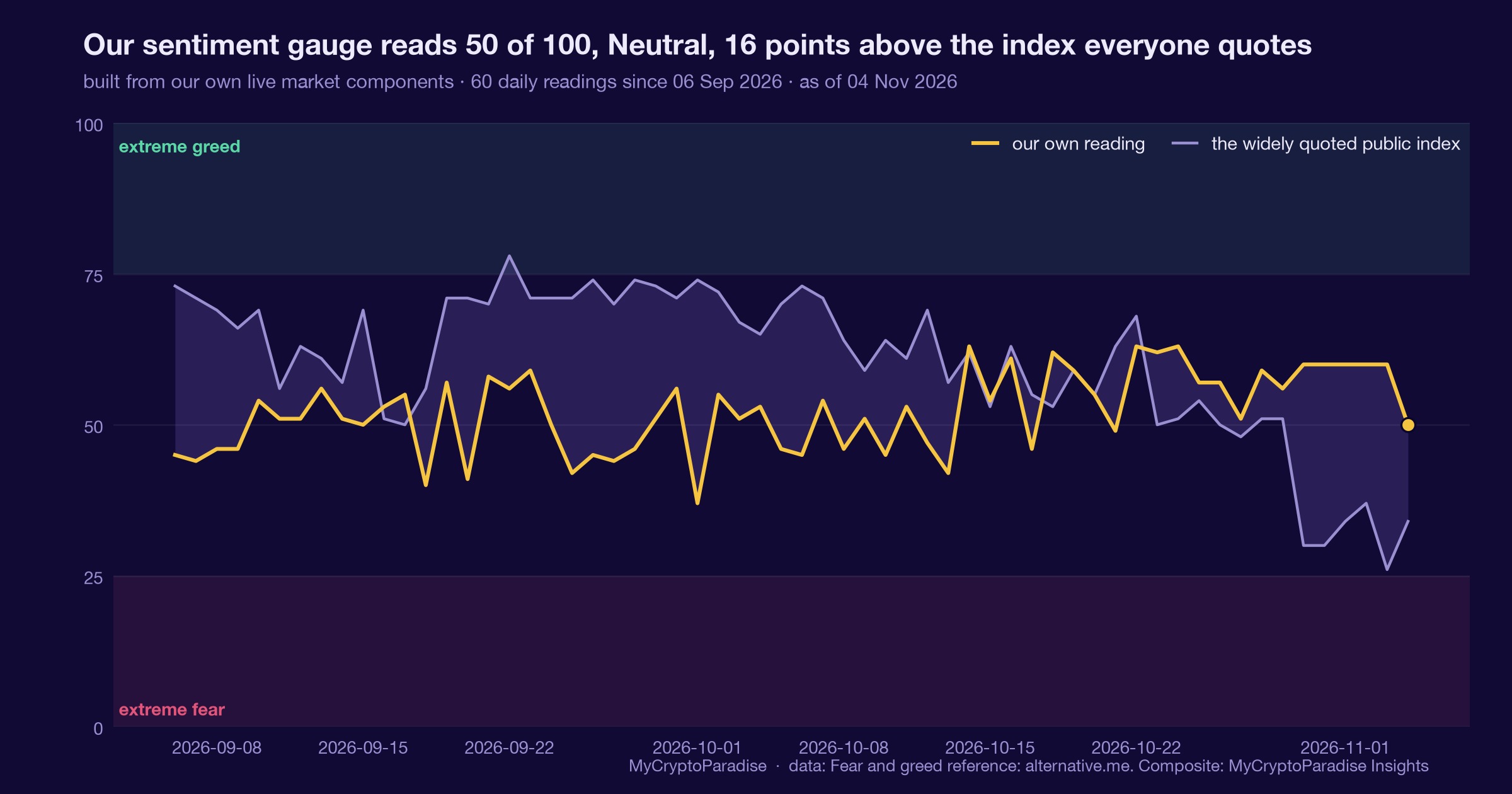
BTC was near $75,929, hovering right at the $76,000 line we flag as key support and invalidation. That proximity is the real story, not Greece. Whales have been net buyers into this dip, absorbing sell pressure while retail fear sits near 20, so we read the zone as accumulation rather than capitulation.
The path of least resistance still leans toward a short-term squeeze. A heavy short-liquidation cluster sits up at $81,700 to $82,500, and over-leveraged shorts can get hunted toward it before the bigger picture reasserts.
We stay honest about that bigger picture. Our dominant daily and weekly bias remains bearish toward $44,000 until invalidated, so any bounce reads as relief and short covering, not a trend change.
The levels to respect are clear. Hold $76,000 and a squeeze toward $82K stays live; lose it with a clean retest from below and the $70,000 to $71,000 cluster opens up. None of that hinges on Athens. The Greek tax is a slow headline; your real risk is the fast one playing out at support right now.
The read behind this: we framed this story through our own market analysis, Bitcoin Squeeze to $82K or Crash to $44K?
Track it live: our live crypto funding rates and the Crypto Fear and Greed Index both update in real time, so you can watch this shift for yourself.
Related coverage
For exact entries, targets, and stop losses with full risk management, that is what ParadiseFamilyVIP is for. New to reading these moves? Start with our crypto trading strategies guide.
ParadiseTeam is monitoring the market situation closely, and we are taking these developments into consideration while building our trading tactics inside ParadiseFamilyVIP.
Crypto trading involves substantial risk. Prices are volatile and you can lose money. This article is educational and is not financial advice. Past performance does not guarantee future results.
Does a slow EU tax headline like this belong in your trading decisions at all?
How 1 Paradiser is calling it
The first call is still open
Free account, no password. Members just sign in.












Join the discussion
No comments yet. Members, share how you are reading this.