

Listen: the breakdown
Market briefing: Forward Industries booked a $69 million quarterly loss, yet it raised its Solana treasury to 7.55 million SOL. Bitcoin sat near $63,701 as the market barely blinked.
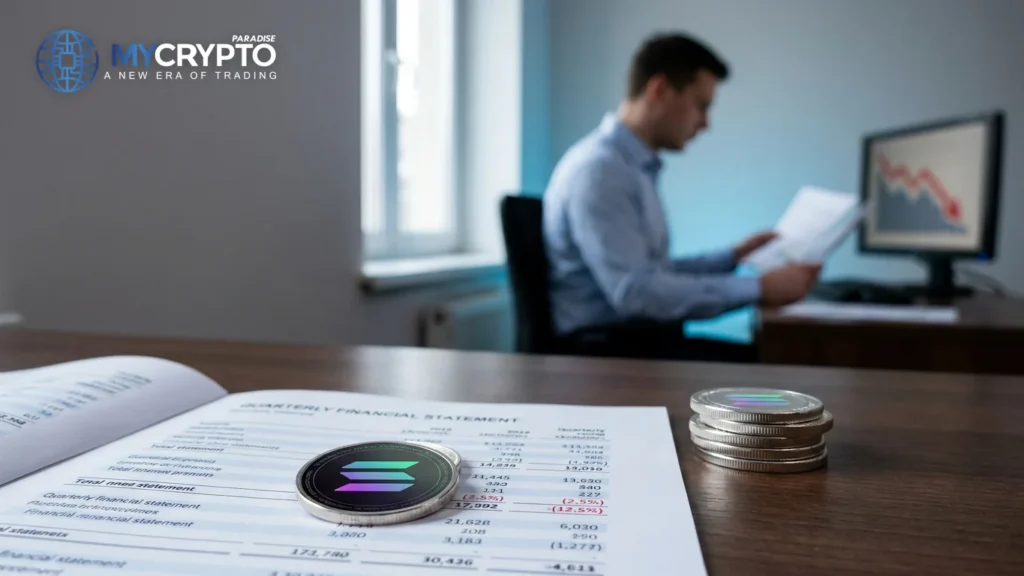
- Forward Industries posted a $69 million net loss for the quarter ended June 30, including $65 million in digital asset charges.
- The Solana treasury company still lifted its holdings to 7.55 million SOL, up from 7.04 million a quarter earlier.
- SOL traded near $76.15, up 0.5% on the day, a muted reaction that fits quiet accumulation, not panic.
Forward Industries reported a $69 million loss, then bought more SOL anyway. When a treasury adds through the pain, who is it buying from?
Forward Industries just did something that looks contradictory on the surface. The company reported a net loss of $69 million for the quarter ended June 30. Then it increased its Solana holdings anyway.
Most of that red ink came from one line: $65 million in digital asset charges. In plain terms, the value of tokens already on the balance sheet was marked down, and that markdown flowed straight into the loss. The cash did not vanish. The accounting simply caught up to a lower market.
Here is the part that matters. A firm nursing a paper loss usually trims risk. Forward Industries did the opposite. It raised its SOL position to 7.55 million tokens at quarter-end, up from 7.04 million the quarter before.
That is roughly half a million more SOL bought while the headline screamed loss.
We read corporate treasuries the same way we read any large, patient buyer. They rarely chase strength. They add when the number on the statement is ugly and the crowd has stopped paying attention. SOL barely moved on the news, trading near $76.15. A quiet tape during accumulation is not a bug. It is often the point.
We should be honest about the limits here. There is no confirmed same-day catalyst tying this filing to a price move. This is our interpretation of behavior, not a proven cause. But the behavior itself is documented, and it lines up with a pattern we watch closely: buy the asset, book the accounting hit, keep stacking.
Why a loss and a bigger buy coexist
The transmission mechanism here runs through psychology, not just balance sheets. A $65 million digital asset charge is a mark-to-market event. It tells you what the tokens were worth on a date, not what management believes they will be worth later.
When a treasury absorbs that charge and still adds size, it is separating price from value out loud. That is the exact posture we associate with strategic buyers across a cycle. They treat drawdowns as inventory restocking, not as a verdict.
This matters for the wider alt market because Solana treasuries are now a real, standing bid. Every quarter they add is a quarter of supply pulled off the float and parked in patient hands. Thin float plus a persistent buyer is the raw material of a slow squeeze.
Retail tends to read the opposite way. A big loss headline reads as a reason to sell or stay away. So the crowd steps back exactly as the professional bid steps forward. That gap is where the transfer happens.
We are not claiming this single filing moves SOL. The 0.5% daily change says it did not. What it does is confirm a direction of travel. The treasury is a net accumulator through weakness, which quietly firms the floor under SOL over time. A firming floor under a major alt eventually feeds back into broader risk appetite, and that is why one company's boring quarterly print is worth reading closely.
How this ripples from SOL into risk
Start with the liquidity picture in SOL itself. A buyer adding half a million tokens does not need a violent rally to do it. It needs a quiet, liquid tape where large orders get absorbed without alerting the crowd. That is precisely what a 0.5% day looks like.
So the immediate price impact is small by design. The structural impact is larger. Supply shifts from weak hands, likely retail and short-term traders, into a treasury that reports quarterly and thinks in years.
Now trace it up the risk ladder. Bitcoin remains the market's anchor, trading near $63,701 as this print landed. BTC sets the tone; ETH follows; alts like SOL move last and hardest in both directions.
When a flagship alt shows a documented institutional buyer accumulating through a loss, it subtly raises the floor for the whole alt complex. It signals that professional money still wants beta exposure, not just Bitcoin. That said, alts stay hostage to BTC. If Bitcoin loses its footing, SOL will not be spared by one treasury's conviction.
The honest read is a split-screen. Short term, this changes almost nothing on the SOL chart, and it should not. Medium term, it reinforces the case that smart money is absorbing supply while retail sentiment drifts elsewhere, distracted by louder headlines. The cascade here is patient, not explosive, and patient is usually how real accumulation looks before anyone agrees it happened.
What confirms the accumulation read next
The cleanest confirmation is behavioral: does the treasury keep adding? One quarter of buying through a loss is a data point. Two or three consecutive quarters of it becomes a policy, and a standing policy of accumulation is far harder for the market to ignore.
On the SOL chart, watch whether $76 area holds as a base while Bitcoin works higher. If SOL grinds sideways to up on quiet volume, that is consistent with absorption. If it snaps lower on rising volume, the accumulation story weakens and supply is winning.
Invalidation is specific. A sharp SOL breakdown that the treasury bid fails to defend would tell us the patient buyer is either done or overwhelmed. Price is the referee, not the press release.
We are also watching Bitcoin, because it governs everything downstream. Our lens has BTC leaning toward $79,000 before any deeper reset, with $62,500 as the near pivot to hold. If BTC keeps that pivot, alts including SOL get room to firm. If BTC breaks and reclaims $62,500 as resistance, risk appetite thins and SOL's floor gets tested regardless of who is buying.
One caution on interpretation. There is no confirmed catalyst linking this filing to any imminent move. Treat it as evidence of intent, not a timing signal. The thing to track is repetition: buyers who mean it show up again. The market rewards the pattern, not the promise, so let the next prints do the confirming.
What the SOL buy signals for alt liquidity
The ParadiseTeam reads this through the same frame guiding our current bias. Bitcoin was trading near $63,701 as of 08:56 UTC, and our daily lean stays cautiously bullish toward $79,000 while smart money absorbs supply and short-side retail gets trapped.
Forward Industries adding SOL through a $69 million loss fits that frame cleanly. It is a documented example of the exact behavior we expect from patient capital: buy weakness, wear the accounting hit, keep the position growing.
For positioning, the message is about the alt floor, not an entry. We map SOL's fate to Bitcoin's structure. As long as BTC defends the $62,500 four-hour pivot and works toward $69,000, alts like SOL have cover to build a base. That is where a standing treasury bid quietly matters most.
We stay risk-first and two-sided. Our lens still flags an eventual deeper correction into the $55,000 to $44,000 macro reaccumulation zone for Bitcoin. If that plays out, SOL will feel it hard, treasury buyer or not, and the smartest money would likely reaccumulate more aggressively down there.
So we hold this as confirmation, not invitation. The signal to us is where the marginal buyer sits: not chasing green candles, but absorbing supply into a loss while the crowd looks away. That is our edge stated plainly. When the statement looks worst and the tape looks boring, check who is still buying. Here, it was the treasury, and that tells you more than the loss line does.
Track it live: our live crypto funding rates and the Crypto Fear and Greed Index both update in real time, so you can watch this shift for yourself.
Related coverage
For exact entries, targets, and stop losses with full risk management, that is what ParadiseFamilyVIP is for. New to reading these moves? Start with our crypto trading strategies guide.
ParadiseTeam is monitoring the market situation closely, and we are taking these developments into consideration while building our trading tactics inside ParadiseFamilyVIP.
Crypto trading involves substantial risk. Prices are volatile and you can lose money. This article is educational and is not financial advice. Past performance does not guarantee future results.



Join the discussion
No comments yet. Members, share how you are reading this.