


Listen: the breakdown
Market briefing: Ethereum staking just set an all-time high, with 41.9 million ETH now locked, over a third of supply. ETH sits near $1,875 and BTC near $62,836, both quiet while the supply story builds underneath.
- Staked ETH reached 41.9 million, an all-time high above 34% of total supply.
- The average staking yield now sits at 2.6%, thinning the freely tradable float.
- ETH barely moved on the news, trading near $1,875 while the market waits on Bitcoin.
Ethereum staking just locked a record 34% of supply, yet ETH slipped instead of surging. So who benefits when a third of the coins stop trading?
On August 13, Ethereum staking crossed a line it had never crossed before. The total amount of ETH locked in staking pushed past 34% of the entire supply, reaching 41.9 million coins. That is an all-time high, and it means more than a third of every Ethereum in existence is now committed rather than freely traded.
The reward for locking that ETH is modest. The current average annual yield sits at 2.6%, hardly the kind of number that makes headlines on its own. Yet holders keep locking anyway, which tells you they are pricing time, not this quarter's payout.
Here is the part the tape ignored. ETH did not rally. It slipped about 1.1% over the day and traded near $1,874.99, up a rounding-error 0.1% on the hour. A record supply lock met a shrug.
That gap between the fundamental and the price is the whole story. Supply that stops moving is a slow, structural tailwind, not a same-day catalyst. It does not force a green candle on the afternoon it prints.
So the market did what markets do when the long-term signal and the short-term mood disagree. It waited. Ethereum, as usual, is standing at the door watching Bitcoin decide which way the room moves.
Why a locked float quietly changes everything
Locked supply is the transmission mechanism here, and it works through scarcity rather than sentiment. When 41.9 million ETH sits in staking contracts, those coins are not on exchange order books waiting to be sold into the next rally. The freely tradable float shrinks, so the same amount of buying pressure has to fight over fewer available coins.
That matters because price is set at the margin. A market does not need every holder to buy; it needs demand to overwhelm the coins actually for sale. Take a third of supply off the table, and the coins that remain become more sensitive to inflows.
The 2.6% yield is the quiet enforcer of that lock. It is not a jackpot, but it is a reason to stay put through chop. Every holder earning it is a holder less likely to panic-sell at the first red daily candle, which stiffens the float against downside.
There is a catch worth naming honestly. Staked ETH is not permanently frozen; withdrawals exist, and a sharp price drop could tempt holders to exit. Scarcity is a lean, not a lock in the literal sense.
Still, the direction is clear. Record staking is long-term fundamental strength, and it feeds straight into the liquidity picture. Fewer sellable coins today plus steady demand tomorrow is exactly the setup that turns a patient accumulation phase into an impulsive one later.
How the squeeze filters through BTC to ETH
The liquidity story starts with Bitcoin, because it always does. BTC was trading near $62,836 as of 09:29 UTC, down about 1.2% on the day, pinned just under a stack of resistance. Until Bitcoin picks a direction, Ethereum's own supply news stays background noise.
That is why the staking record landed with a thud instead of a bang. ETH held near $1,875 and waited. Asset-specific fundamentals rarely override the whole-market gravity of a Bitcoin pinned at resistance.
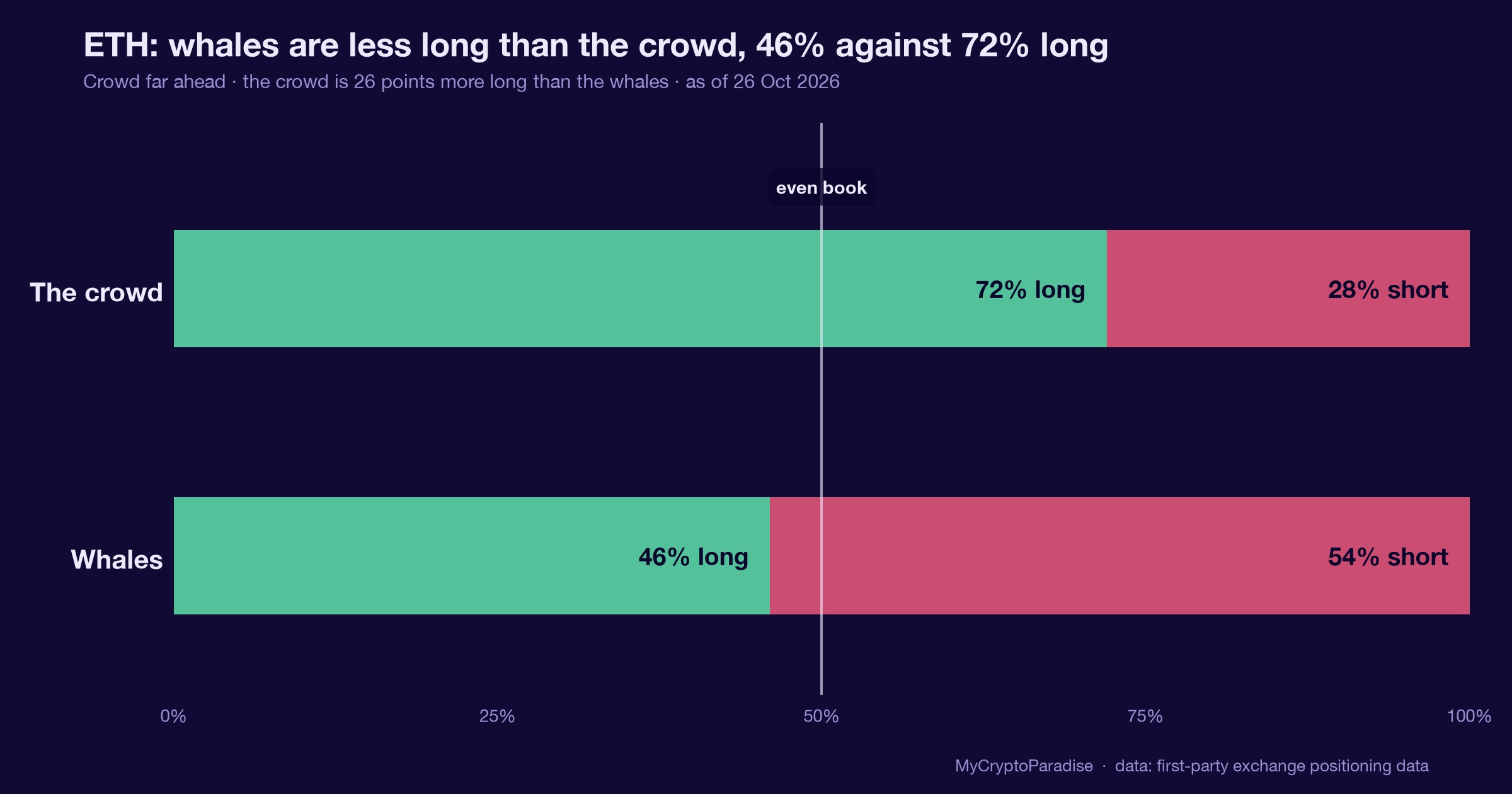
Underneath, the positioning is more interesting than the price. Retail sentiment reads as extreme fear, yet funding rates show longs getting crowded, a contradiction that usually ends with someone getting squeezed. Some whales are opening risky shorts right at support, effectively lining themselves up as liquidity.
Here is the smart-money read. A shrinking ETH float plus over-leveraged shorts is fuel, and smart money tends to accumulate quietly while retail argues about the last candle.
When the move comes, the order is predictable. Bitcoin leads out of its range first, forcing short liquidations that add momentum. Ethereum follows, and its thinner tradable supply can make that follow-through sharper than the fundamentals alone would suggest.
Alts sit last in the queue. They need BTC and ETH to confirm strength before capital rotates down the risk curve, so patience beats chasing the first green hour.
What confirms the squeeze and what kills it
The first thing to watch is Bitcoin's reaction at resistance, because ETH's fate is tied to it. A clean reclaim of the $63,200 area, then acceptance above, would signal the range is breaking upward and the staking tailwind can finally express itself in price.
Confirmation stacks from there. A push toward the $64,500 to $64,800 zone would put whale shorts directly in the firing line, and their liquidations are exactly the kind of fuel that turns a grind into an impulse.
Invalidation is just as concrete, and this is where honesty matters. If Bitcoin loses the $62,800 support and starts accepting below it, the crowded longs become the victims instead, and a long squeeze flushes the over-leveraged before any upside resumes.
On Ethereum specifically, watch whether staked ETH keeps climbing or starts leaking. Continued lockups reinforce the scarcity thesis; a sudden wave of withdrawals during weakness would tell you conviction is thinner than the record suggests.
One caution. We cannot pin this exact move to a single confirmed same-day catalyst, so treat the squeeze framing as our interpretation of positioning, not a proven cause.
The cleaner tell is behavioural. If retail keeps selling fear into a market where supply is quietly disappearing, that is usually the tape handing coins to patient buyers. When the crowd is most certain the floor is gone, the floor is often being built beneath them.
What record staking means for positioning now
The ParadiseTeam reads this staking record as long-term conviction fuel, not a trigger to chase today. It reinforces why we are patient buyers on weakness rather than breakout chasers into resistance.
Applied to the current tape, the levels do the talking. With BTC near $62,836, our near-term bias stays constructive toward the $69,000 region, provided Bitcoin can reclaim the $62,500 structure and push through the $64,500 to $64,800 whale-liquidation band. That break is what would let ETH's shrinking float actually matter to price.
The positioning tell is the crowded-long problem. Funding says longs are stacking while sentiment screams fear, so an impulsive move up that liquidates whale shorts is the higher-probability path before any deeper pullback.
After a run toward $69,000, we get more selective. The plan favours fading strength tactically, then looking for a higher-conviction long back in the $61,000 to $59,000 zone, where smart money is likelier to reload for the next leg.
Risk framing stays first. A loss of the $62,800 support flips the near-term read and warns that the crowded longs, not the shorts, are the ones about to be flushed.
The staking data does not change any single level. What it changes is the backdrop: fewer sellable coins over time, which is precisely the environment where accumulation into fear tends to age well. Probabilities, never promises, and the risk comes first.
Track it live: our live crypto funding rates and the Crypto Fear and Greed Index both update in real time, so you can watch this shift for yourself.
Related coverage
For exact entries, targets, and stop losses with full risk management, that is what ParadiseFamilyVIP is for. New to reading these moves? Start with our crypto trading strategies guide.
ParadiseTeam is monitoring the market situation closely, and we are taking these developments into consideration while building our trading tactics inside ParadiseFamilyVIP.
Crypto trading involves substantial risk. Prices are volatile and you can lose money. This article is educational and is not financial advice. Past performance does not guarantee future results.
With 34% of ETH now staked, which happens first from here?
How the Paradisers are calling it
The first call is still open
Free account, no password. Members just sign in.









Join the discussion
No comments yet. Members, share how you are reading this.