

Developing story update (August 05, 2026, 12:53 UTC):
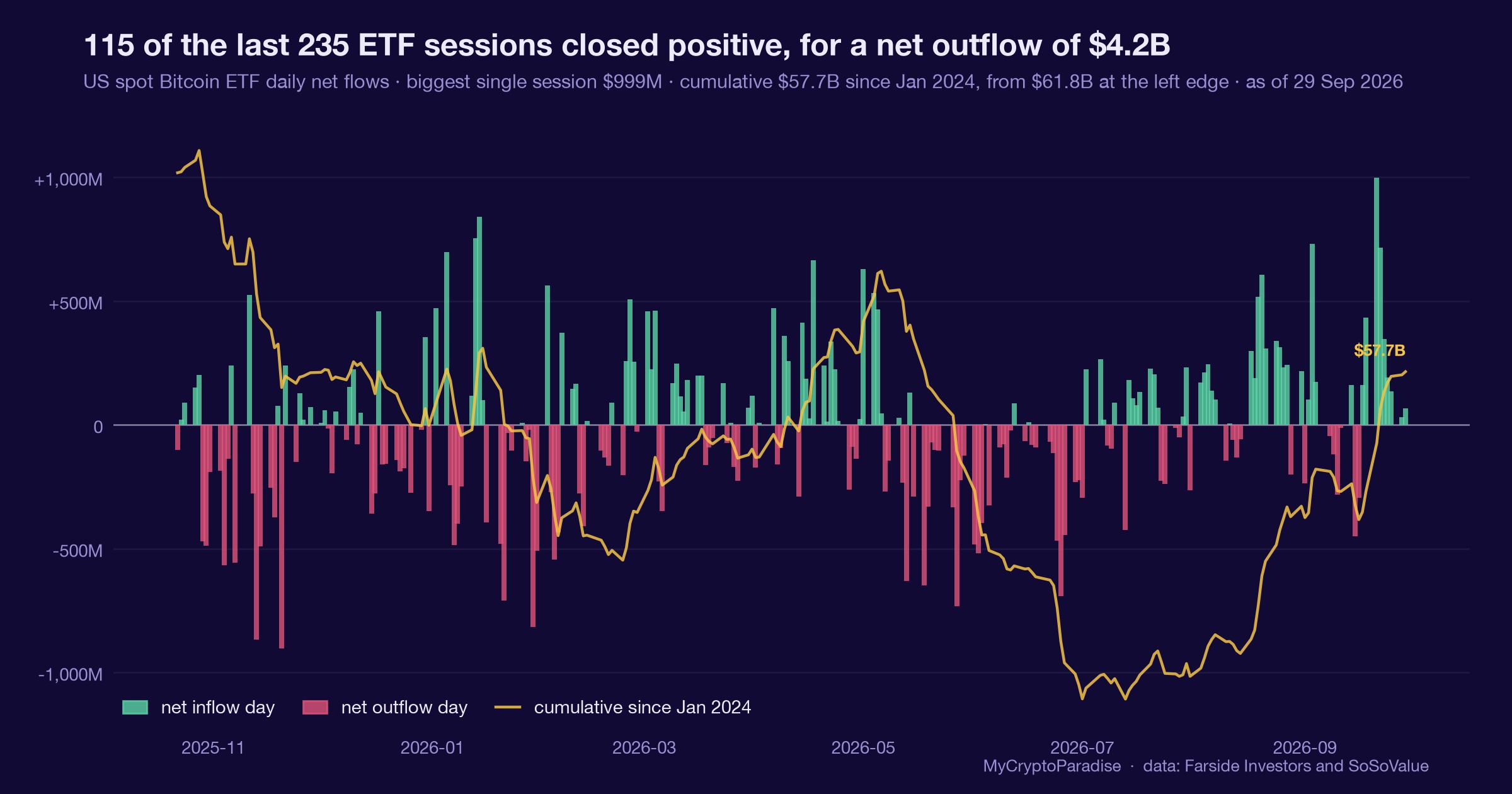
The ETF flow picture now has a number behind it: US spot Bitcoin funds pulled in roughly $382 million over two days, and Galaxy’s product flipped back to positive after prior outflows. That confirms the institutional bid we flagged is still active rather than fading.
For traders the read stays the same. Steady inflows can mask a crowded long book, and with funding positive and the Fear and Greed Index pushing toward 60, squeeze risk is elevated. A flush toward the $62,500 support, or the deeper $61,000 to $59,000 reaccumulation zone, remains a realistic scenario even while flows look strong. Price is little changed near $64,400.
What to watch now: Whether daily ETF inflows keep climbing or stall as BTC holds the $62,500 support.
Developing story update (August 05, 2026, 11:29 UTC):
US spot Bitcoin ETF products have now taken in roughly $382 million over a two-day stretch, a fresh confirmed figure that puts a number on the institutional interest our original piece flagged. Based on our sources, the flow is steady rather than explosive.
For traders the setup is unchanged in character: these inflows are landing into a market with crowded longs and positive funding, so the probability of a long squeeze stays elevated if buyers get absorbed by whale selling or key support around $62,500 gives way. Price is flat near $64,000, so treat the inflow number as confirmation of demand, not as a fresh breakout signal.
What to watch now: Whether ETF inflows keep pace or reverse, and whether $62,500 support holds against crowded longs.
Listen: the breakdown
Market briefing: US spot Bitcoin ETFs pulled $382 million over two days as a cold wallet breach revived custody fears, yet BTC only edged to $64,040. Positive news, quiet price, our read is caution.
- US spot Bitcoin ETFs drew $382 million across two days as custody worries resurfaced.
- Galaxy's Bitcoin ETF swung back to gains while BTC barely moved at $64,040.
- Inflows stalling near resistance with crowded longs point to distribution, not breakout.
A cold wallet breach rattled self custody this week, yet Bitcoin ETF inflows swelled by $382 million in two days. So who is really buying, and who is being sold to?
US spot Bitcoin ETFs took in $382 million over two days, and Galaxy's Bitcoin ETF swung back to gains. On paper, that is a clean vote of confidence in regulated exposure.
The timing is what makes it interesting. Those inflows arrived just as a Coldcard incident put a fresh scare through the self custody crowd. Losses tied to that breach have already run past nine figures across today's coverage, so the fear is real and it is fresh.
Here is the quiet mechanism. When a hardware wallet story frightens holders, some retail investors stop trusting their own keys and reach for a product that hands custody to someone regulated. A breach in one corner of the market can, paradoxically, feed the ETF machine in another.
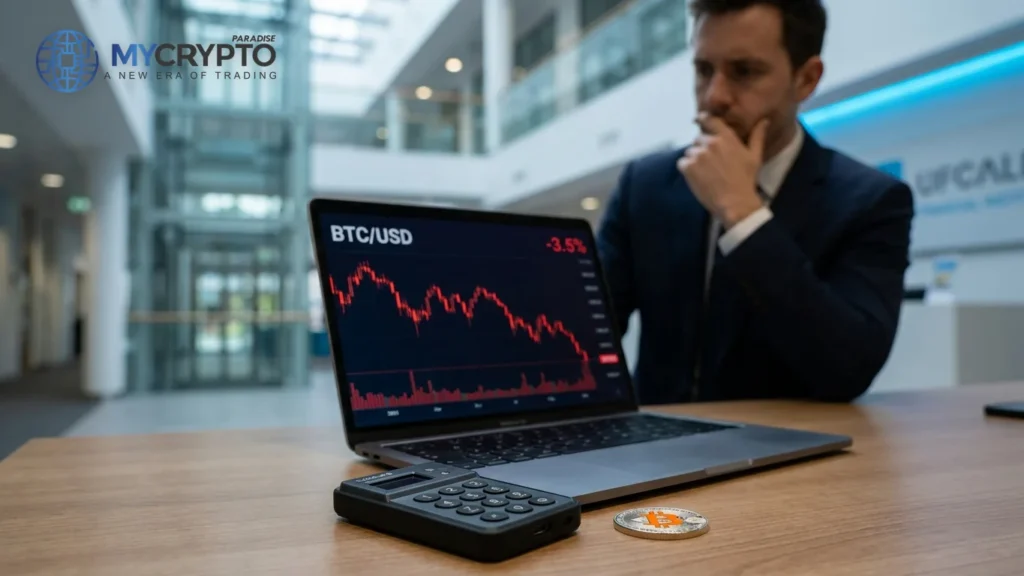
And yet Bitcoin barely reacted. BTC sat near $64,040, up just 0.9% on the day and a rounding error over the hour. That gap between a positive headline and a flat tape is the tell we care about most.
We want to be honest about causation. There is no single confirmed same day catalyst here. The link between the breach, the inflows, and the price is our interpretation, not a proven chain.
Still, the shape is familiar to anyone who has watched a few cycles. Good news lands, the crowd cheers, and price refuses to follow. That is usually the market telling you who already owns the position, and who is being handed the bag near resistance.
Why a breach sends money to ETFs
The transmission here runs through trust, not yield. A hardware wallet breach damages confidence in self custody, and frightened capital looks for a safer looking home. For many retail holders, a regulated Bitcoin ETF becomes that home.
That matters macro side because it changes who holds the float. Coins moving from personal cold storage toward ETF wrappers concentrate supply in institutional hands. The float on exchanges thins, and the marginal buyer becomes a fund, not a hobbyist.
On its own, that concentration reads bullish. Fewer coins in weak hands usually steadies a market. But concentration also removes the natural dip buyers who defend support, which cuts both ways.
The liquidity picture is where our caution enters. Funding rates are positive and longs are getting crowded, which means the market is paying to stay long. A crowded long book is fuel, and fuel needs only a spark to burn the people holding it. So the same custody scare that feeds ETF inflows also feeds a leveraged spot market that is leaning one way. Retail greed, as our read of the Fear and Greed Index pushing toward 60 suggests, is rising into that lean.
That is the structural risk. Positive inflows can coexist with fragile positioning, and the headline rarely warns you about the second part. When custody fear and crowded longs arrive together, the setup favors whoever is patient enough to wait for the squeeze.
How inflows stall against Bitcoin resistance
Start with the tape, because it disagrees with the headline. BTC held near $64,040 and moved 0.1% in the last hour. That is a market absorbing buying, not chasing it.
Price is pressing directly against the zone we care about, roughly $64,300 to $64,800 on the one hour chart. Bullish news that cannot clear resistance is often bullish news being distributed into. Someone is selling coins to the buyers the ETF story just excited.
Watch the derivatives layer for the confirmation. Positive funding and rising open interest, the total value of unsettled leveraged contracts, mean longs are stacked and paying to stay there. Stops from those late longs sit just below spot, a tidy pool of liquidity above which price loves to hunt.
Bitcoin sets the tone, so ETH and alts inherit whatever BTC decides. While Bitcoin stalls, Ethereum and the alt complex have no independent bid, and today's separate coverage of collapsing DEX volume shows retail has already thinned out there. That is the cascade risk in one line. If a long squeeze flushes BTC, alts fall harder because their liquidity is thinner and their holders are already nervous.
The optimistic version still exists. A clean break and hold above $64,800 would turn absorption into acceptance and open the path higher. Until that happens, the flat reaction to genuinely positive inflows is the more honest signal about who is in control.
Levels that decide the squeeze risk
The cleanest question is simple. Can Bitcoin close and hold above the $64,300 to $64,800 resistance band, or does it keep getting rejected there?
A decisive hold above $64,800 is your confirmation that inflows are winning. It would suggest the buying pressure is real demand, not a wave the market is quietly selling into, and it keeps the door open toward the higher daily objective.
Rejection is the invalidation of the near term bullish case. If BTC fails at resistance and slips back, the crowded long book becomes the story, and a long squeeze toward the low $60,000s moves from theory to likely.
The line in the sand sits lower, near $62,500. That level marks bullish structure. A break beneath it would invalidate the constructive daily read and signal that sellers, not buyers, are setting the pace.
Below that, the $61,000 to $59,000 area is the zone we respect as a genuine demand pocket. That is where value hunters, not panic sellers, tend to appear.
Also keep one eye on funding rates. If they stay hot while price stalls, the squeeze risk builds with every hour. If they cool as price holds, the market is digesting leverage in a healthier way.
Across all of it, remember the honest caveat. There is no confirmed single catalyst, so treat the levels as the reliable map and the narrative as our interpretation of the terrain.
What stalled inflows mean for liquidity
The ParadiseTeam reads this as good news arriving at an uncomfortable spot. BTC near $64,040 is pressing the $64,300 to $64,800 resistance, and inflows that cannot break it are the definition of buying being absorbed.
The positioning tells the real story. Paradise VIP members reaccumulated Bitcoin down at $61,000, when the crowd was fearful, prioritizing high probability setups with clean R:R (risk to reward). That is the opposite of chasing a headline into resistance, which is what much of retail is doing now.
Early bearish divergence on momentum indicators is a warning, not a verdict. It says buying pressure is being met by supply here. Combined with crowded longs and positive funding, that raises the odds of a long squeeze before any sustained move higher. So our near term read leans cautious. The daily map can still stretch toward the $79,000 objective, but the higher probability path first runs through a shakeout that flushes late longs toward the $61,000 to $59,000 demand zone.
The invalidation stays honest and mechanical. A break below $62,500 would break the bullish structure and shift the ParadiseTeam bias firmly defensive, with the deeper weekly correction risk toward $44,000 back in view.
Smart money is not fighting the inflows. It is letting retail crowd the top of the range, waiting for the liquidity above nearby stops to get taken, and keeping powder dry for the level where the reward finally justifies the risk.
Track it live: our live crypto funding rates and the Crypto Fear and Greed Index both update in real time, so you can watch this shift for yourself.
Related coverage
For exact entries, targets, and stop losses with full risk management, that is what ParadiseFamilyVIP is for. New to reading these moves? Start with our crypto trading strategies guide.
ParadiseTeam is monitoring the market situation closely, and we are taking these developments into consideration while building our trading tactics inside ParadiseFamilyVIP.
Crypto trading involves substantial risk. Prices are volatile and you can lose money. This article is educational and is not financial advice. Past performance does not guarantee future results.
Where does Bitcoin go next from the $64k resistance?
Follow this topic: Bitcoin ETF news







Join the discussion
No comments yet. Members, share how you are reading this.